
When rugby union finally bit the bullet and turned professional on 26th August 1995, it was trending exactly 100 years behind rugby league, which had first rounded the same corner back in 1895. The underlying connection between the two codes still informs the game as it approaches its 31st anniversary as a professional sport.
League did away with lineouts and the scrums are strictly symbolic, just another way to restart the game with all the forwards in one place. There is no contest for the ball permitted either during or after the tackle. A change of possession is only mandated by law after a six-tackle ‘set’ has been completed. The game is less complex and a lot easier to referee than its cousin.
Meanwhile the struggle between ‘contest’ or no-contest’ hums along like catchy ambient music in the eternal background of the rugby mind. However much you try to ignore it, it sticks around stubbornly and has a life of its own. It will inform the forthcoming Greatest Rivalry tour of South Africa by New Zealand in some very specific ways indeed.
In recent times, progress in the game has been associated with a big bulge in ball-in-play time, more rucks and fewer set-pieces, and ever more try scoring. In England, the Prem has reinvented itself as a spectator sport, with clear refereeing protocols designed to support the production of quick ball for the attacking side from the breakdown.
The newest showcase for the game, the Nations Championship, has taken things a step further. If you fondly believe that international rugby means more defence, more set-pieces and fewer scoring opportunities, think again.
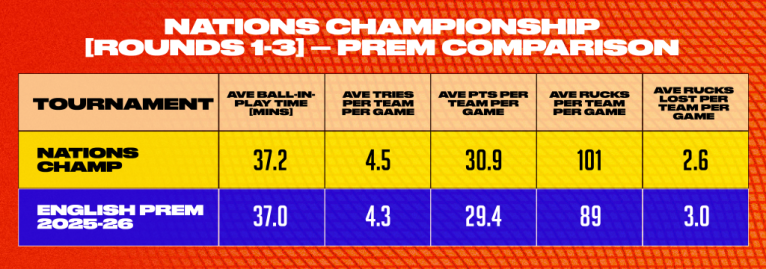
It is the first time in recorded rugby history a tournament has averaged over 200 rucks per game. There have been 15 times more rucks than scrums and eight times more rucks than lineouts. That is what it takes to win a game of international rugby nowadays.
This development is of particular significance to the Greatest Rivalry tour. With new head coach Dave Rennie and Sir Graham Henry masterminding operations, the new All Blacks are surfing an attacking wave and riding the zeitgeist. The offensive stats for the All Blacks are rating higher than average after three rounds of the Nations Championship.
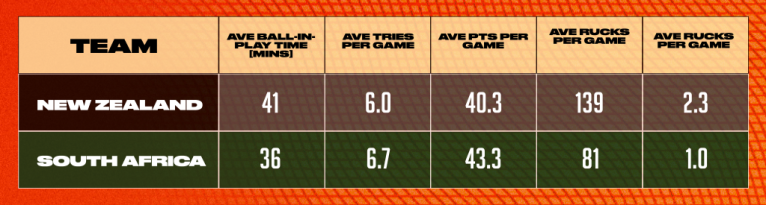
Although the scoring profile of the top two nations in the southern hemisphere is similar, the way they get there is not. Games involving the All Blacks average five more minutes of ball-in-play time and New Zealand build 58 more rucks per game than South Africa. You heard it right – 58 more rucks. The All Blacks set 415 rucks over the Nations Championship, and lost only seven of them to turnover. They will go to Africa and try to starve the hosts of the ball by making the ruck a ‘no-contest’ area, and under current refereeing protocols at least, there may be little the Boks can do about it.
That is probably the veiled reason why Rassie Erasmus has been campaigning so hard for a much greater degree of contest at scrum and maul in recent months. At the beginning of July, he launched a charm offensive around straight scrum feeds at a ‘Shape of the Game’ meeting hosted by World Rugby.
“The scrum feed, we are still trying to get that to be fed straight and everybody hooks and so on,” Erasmus said. “That would be great if we get there one day. It was a great way of communicating, I think, the way World Rugby handled it. They were always fair in every single department.
“For example, the scrum, we were really hoping that [the feed] could be straight, but for various reasons, that could not be. It was raised at the Shape of the Game. [Head of Referees] Joel [Jutge] did give an information page to us, and it was about the referees and the feed. Obviously, the hooker must hook, and obviously the guy can’t stand on that side and put it in like that [very skew].
“If it’s the last minute of the game and they have a scrum on their own goal-line to defend and the guy throws it in this much skew, do you ref it as ‘not straight’ or do you say ‘play on’? I think the problem is just the ones that go like that [very skewed] and the hooker doesn’t hook at all. So, I think they’re trying to get it really right, and I understand why it’s so difficult to referee.
“[But] if it’s this much skew, can we now give them a free kick if the opposition wins the game, or a penalty if it happens twice?”
Erasmus stopped to look at his phone mid-speech, before adding a suitably dramatic flourish: “[Springbok scrum coach] Daan [Human] must be listening to me; he just ‘WhatsApped’ me, saying that the directive is in the scrum [laws]: your left shoulder must be in the centre of the scrum when feeding it.”
The Springbok supremo has likewise been simmering his frogs slowly at the maul. This time last year, inspired by the Paul Roos Gimnasium under 14s side, he debuted South Africa’s controversial ‘midfield maul’ versus Italy as a masked protest against refereeing protocols at the lineout drive.
“It was trying to make a statement in the sense that we can’t maul from lineouts anymore because it’s becoming a dragging competition. So the option was to play it off the top because mauling is dying and the only place you can maul, we felt, was in the midfield, [because] now they can’t plan who swims around on what side.”
Provided defenders maintained their original bind with their inside arm, they were allowed to swim up around the side of a maul, and without demonstrating any particular skill or strength, engulf the ball-carrier from behind and effect a turnover. Wind the clock forward 12 months, and World Rugby directives had changed so that ‘players are asked to recognise that when they get beyond the ball and out of the contest, they [have to] leave the maul’.
Erasmus was pleased with the outcome: “I think there were more maul-drive tries scored in this opening round [of the Nations Championship] than altogether in the 2026 Six Nations, if I have my stats correct. I want to give World Rugby credit there.
“Because you can’t drag in a maul anymore, you have to put more numbers in. The guys who stop the maul now have to get out and defend after that… [They] are tired of stopping mauls. You can’t just put four guys in and drag a maul to the side.”
The battlelines are being drawn and they are crystal clear. Rennie and Henry want to play a fluid game sailing as close to the wind of ‘no-contest’ at the ruck as physically possible. Erasmus wants the game played far closer to the essence of ‘contest’ at set-piece, with lower ball-in-play and more penalties for technical inaccuracies at forward.
The latest iteration of a more recent rivalry between Ireland and New Zealand at Eden Park raised questions around whether more of a contest should be encouraged at the breakdown. With top-flight Australian referee Nic Berry in the box seat, New Zealand were able to build a colossal 149 rucks, losing a paltry three to turnover.
Perennial Ireland breakdown thief Tadhg Beirne had 10 serious attempts at a breakdown pilfer in the game but failed to make off with loot on one single occasion. It is not often that happens, and it was not always clear why.
— William Bishop (@RPvids1994) July 19, 2026
It was clearly part of Ireland’s policy going into the game to add a second man to the defensive breakdown and overload the New Zealand cleanout. In the event Berry called ‘ruck formed’ immediately after the first man had been removed and did not allow the second man to compete. In this clip, Beirne [in the blue hat] is standing directly above the ball unmarked after the initial cleanout removes the tackler, but he reaps no reward for his efforts and the All Blacks score two next phases later.
There were plenty of other examples as the game unwound.
— William Bishop (@RPvids1994) July 19, 2026
— William Bishop (@RPvids1994) July 19, 2026
In the first instance, the first Kiwi cleanout [number five Josh Lord] takes out Tadhg Furlong and Josh van der Flier [in the red hat] has a clear shot at the ball as the second man. But rather mysteriously, he is required to give up the contest and hand the ball obligingly back to the All Blacks. In the second, Ciaran Frawley [in the headband] is standing tall, in glorious isolation as the second man but can do nothing to affect the play, let alone pick up the pill. It all seems counter-intuitive, to say the least.
The home side had their share of head-scratchers too, as the visitors won all but two of the 104 rucks they set.
— William Bishop (@RPvids1994) July 19, 2026
— William Bishop (@RPvids1994) July 19, 2026
— William Bishop (@RPvids1994) July 19, 2026
In both of the first two clips, Jordie Barrett looks dumbfounded when he is pinged after getting a successful lift on the ball after the tackle has been made, while rookie Anton Segner looks to have as much right to play the pill as the Ireland attack when that final ruck forms.
At one point in the second half at the Garden of Eden, the All Blacks ran 31 consecutive phases in and around the Ireland 22m zone. That would have been enough for an entire game in the 1960s and 70s, and it does raise the spectre of whether rugby is becoming too much of a ‘no-contest’ at the tackle area – too much like league, but with unlimited phases.
The Nations Championship has been a roaring success at its inception and it has provided a grand spectacle, but attitudes will harden considerably around a series between New Zealand and South Africa. There will be a philosophical war fought out on the battleground of rugby’s future. The sweet spot in that struggle looks very different depending on whether you wear all black, or don the green and gold.

NEW IN THE APP: Official World Rugby Rankings hub! Compare team rankings side-by-side, with data going back 20 years.
Download the RugbyPass app on the App Store (iOS) and Google Play (Android) now!


The glorious uncertainty of life , war and sport .
Fortunately it’s not done on an IPad or AI .
We get to watch .
No different approachs . Both sides attack when they can .
Neither will play high risk rugby and they will always beat a team that does .
Hi P. I have a sneaky feeling that Mzwandile Stick is going to be a head coach going forward. He has two RWC coaching medals under his belt and he lead the Blitzbokke to their first World Championship title so he has a playing pedigree as well and why he is rated as primarily a backline/attacking coach. Recently however he has been filling the gap that Jacques left as sort of chief assistant to Rassie.
He is genuinely in all of the best possible respects a dark horse for the head coach race.
Either play it through to conlcusion or reset it with the clock off.
NB what you think of this analysis - its a post engaging with Quincy79:
“Hey Q I have tried to put some science around the anaerobic v aerobic point. I think it may be better expressed to say that the Boks are well ahead of the ABs and probably all teams on the efficient use of their mass. Here are some interesting stats based on the Nations Championship. These are averages across the three games:
PCM / Pass - Boks 2.8, ABs 1.5
PCM / Carry - Boks 2.9, ABs 2.2
Points / Pass - Boks .38, ABs .15
Points / Carry - Boks .39, ABs .23
Points / Tackle - Boks .28 ABs .27
As these figures show the Boks appear to be nearly twice as efficient or more on all measures of effort and reward (metres gained or points scored) except points per tackle where they are about even.
I have also examined the mass (average collective weight and height) of the forwards of the latest Bok and AB squads and it may be surprising to note that they are close - less than 1% apart.
So this comes to your point - the Boks are clearly the most efficient at utilising their mass - it appears they usually maximise their key outputs for signficantly less “cost” in terms of effort.
The key will be whether the ABs unlike England and Wales can force the Boks to increase their effort significantly - to take them into difficult “aerobic” territory. In this regard the Scotland game is very interesting. In that game while the PCM/Pass, PCM/Carry, Points / Carry were similar to the average overall, the average points per tackle dropped to .21 or by 30%. In that game the tackle completion was also markedly down from an average of 87% to 81%. If the ABs can bring a similar level of tackle pressure, then it could get interesting come August.”
I think one of your earlier articles made a similar point - but gee the numbers in terms Bok efficiency are scary!
I think it’s fair to say the Boks have been the best and most creative at using the bench for some time now.
Collective mass, utilizing their best set-piece forwards from the pine has been part of that.
They are the most effective in the world when they can play in the rhythm they want. In super-powerful bursts with ‘breathers’ in between. That’s why their ball-in-play time is where it is.
But what Scotland showed, and what the ABs may be able to duplicate, is a sustained high tempo on attack - and overload the Bok forwards with more aerobic work than they can handle comfortably.
The Springbok manifesto for law-making that Quincy presented is also a smokescreen. What he wants is for the laws to favour the Springbok style of play by creating more stoppages via penalty, as supposed ‘rewards for excellence’ at contact situations. Theere was an air of desperation about it.
The direction of he game now and in future will create more ball-in-play time, more fluid situations, with more ‘play through to attacking advantage’ and fewer pens. None of which favours the Boks as they are set up right now. That is what gives the ABs a real shot in this series.
Did you get any response to your excellent post?
It’s been my position from the beginning too, and it’s why I wrote the article.
You could have saved yourself a lot of time and rancour by noticing it at the start, instead of spinning a story that I was ‘donning the all black’. It was obvious to pretty much everyone else.
Good luck on your other threads, I wish you well and hope you take PMcD’s sound advice in future.👍
Cheers P.
According to All Rugby, the last complete season that Snyman started at least half his games overall was 18/19, and even then he was on the bench for the Boks. I don't think he's been trusted as a starter for the Boks all that time and rarely even at club level.
Malcolm played huge minutes in the big tests last year in the absence of Bongi, although Wessells looks impressive and I think he was also injured.
Prop I think remains a real strength but I'm not sure about lock and flank. Good compared to most teams but a step down from the platinums. No obvious Siya level captain, although like McCaw he had to grow into the role.
Exceptional peaks are hard acts to follow. It puts so much more pressure on the incoming players and you need a wise head experienced coach to remove that pressure, keep things moving forward and allow them to rebuild.
The only thing in SA’s favour is they will likely have either Nienabeur or Johan Van Graan and both are no nonsense coaches, who are clear on tactics & philosophy, so should avoid getting lost by changing everything that made them great.
They have some really good coaches to fall back on in the future.
Or Kaino, or Nonu, or Conrad….
Lets face it, replacing GOATs is difficult and both that team and the current Bok team had/has quite a few!
I think it's time to let this one go.
You've spent the better part of this discussion telling me what I "really" believe instead of engaging with what I've actually written. That's why we've gone in circles.
For the last time: I support genuine contests at the scrum, lineout, maul and breakdown. I also believe that when one side genuinely wins those contests through superior skill, technique or power, the reward should reflect that. That's been my position from the beginning.
So please stop following me from thread to thread trying to psychoanalyze me or rewrite my views into something easier to argue against. We've both had our say.
It's getting a little obsessive.
Enjoy the rugby. I'm moving on
I’ve actually found the dying embers of this convo the most useful. Thanks.
I’ve understood you really DON’T want more of a contest at source [scrum or lineout]. You’ve no problem with sides winning their own ball from either at 90% plus.
What you want is for the side who wins the ball to be rewarded for your subjective notion of ‘dominance’ thereafter; to advance risk-averse, and preferably by drawing a penalty.
Quite revealing to see that your argument has such a giant fallacy at its core.
You don’t want to enter any contest you might lose. Shocker.
Good to know when you swing around again in future👍
No—I simply rejected your conclusion.
You spent this debate constructing a version of my argument that was easier to defeat than the one I actually made.
That's not winning the discussion.
It's just arguing with your own echo.
All the best. 🎤⬇️
Still in your own little world of artful misrepresentation I see. You read the third para but redacted the second. Good luck with that 😁
Thanks—that actually makes our disagreement crystal clear.
You see rugby through the lens of administration: fewer penalties, easier decisions, more continuity, simpler officiating.
I see rugby through the lens of competition: if one team is genuinely better in a contest, that superiority should matter.
Neither of us is against more ball in play or clearer laws. Where we part company is that you're prepared to dilute the consequences of excellence to achieve those goals. I'm not.
Rugby has never been compelling because every contest has the same outcome. It's compelling because the biggest contests carry the biggest consequences.
So no, this was never about whether we want contests. We both do.
The difference is that I think contests should mean something.
You think they should be easier to manage.
That's the real debate—and after all these exchanges, I think we've finally found it.
Over and out.
Let me make it real simple for you.
I want a contest for possession, more than occurs right now at scrum and lineout. Put the ball in straight at scrum [with no immediate hook needed], allow defenders to jump across to win ball at lineout, don’t allow attacking mauls to splinter off and roll endlessly downfield with players ahead of the ball.
At the same time I want more ball-in-play time, and more ball-use not less. Refs life to be made as easy as poss, not harder. Target 15 pens per game or less, not 25-30. That’s it.
Over and out.
Hi Nick. I am confused. Elsewhere her you say that two players from each side must be present to constitute a ruck, but the laws of rugby I have say differently.
They say that if one or more players from each side is engaged over the ball on the ground it is a ruck. Are my laws outdated again????
No two players total G, one from each side.
It's interesting that, after all these exchanges, your longest reply is almost entirely about me rather than rugby.
You've repeatedly told me what I "really" think, what I "really" care about, what I supposedly ignore, and even diagnosed my ego. The only problem is that most of it is based on positions I never actually argued.
My position has been consistent from the beginning: simplify the laws if you want, improve refereeing consistency if you want, make the game easier to officiate if you can—but don't solve complexity by weakening genuine contests for possession.
That's a rugby argument.
Your response, meanwhile, is largely a character assessment.
If the strongest rebuttal to an idea is to psychoanalyze the person expressing it, it usually suggests the idea itself is proving much harder to answer than you'd like. That's why this has gradually become less about rugby and more about trying to tell me what I believe. I know what I believe—I don't need you to invent a more convenient version of it.
You do realize how hilarious this is in the context of an article I’ve written suggesting there could be more of a contest at the breakdown, not less?🤣
All I’ve done is give an accurate precis of your own comments. Nothing more, nothing less.
You’ve dismissed ‘use of the ball’ after the contest, and have not spoken once about it.
You’ve derided those who have tried to defend referees like Carlos, who ‘probably blew rugby for a 2nd division club in Uruguay.’
Apparently you don’t seem to feel rugby should bother trying to explain itself, or embrace a wider audience as it has at the Nations Champ.
If you’ve managed to invent a fictional version of yourself in the process, congrats! That’s on you.
I cannot put it better than PMcD did right at the start…
Late to the party and way out my depth, but rassies request are quite ironic. In the 2023 WC final, in the final minute of play the boks had a scrum on their own 22 to close out the game. The ABs got the hit so de klerk didn't feed the scrum. Law 19.15.c “without delay”. Had the laws been reffed as rassie wishes he would’ve conceded a free kick and had to defend in their 22 to hold on.
Yes suspicions remain that Rassie is quite selective about the laws he wants employed, and when ofc….
Or Carter if we are honest . . . . Until possibly now.
Longer term, Love has all the ingredients to be an exceptional player.
Great post JD.
Whilst Snyman is no longer young, he’s missed so many years with key injuries, he hasn’t got the same mileage on him, so it wouldn’t surprise me if he replaced Eben and goes on to +35, which is why I think he and Nortje will be the next pair together as starters for RWC 2031.
Crikey, SA have had such a good run at openside - S Burger, Francois Louw, Siya Kolisi over the last decade - that’s some run of players but they have had some really good baby Boks coming through, so wouldn’t surprise me if you see one come through fairly soon.
If you think it through they have moved on from Bongi, Malherbe & Koch (pretty much) but they will lose PSdT, Siya & Kwagga in quick succession, so whilst Wiese & Hanekom will be around, they need one or two new faces to come through and fill those back row slots.
I actually thought Wiese & DDA were the two players they missed at the start of last season and for me are the two key players they struggle to replace, however, Siya brings culture and captaincy, so you can’t underestimate his impact on that squad. Those 3 players are probably the hardest to replace at this stage but it will have a different feel by RWC 2031 up front.
That's a remarkably long way of saying, "I can't actually refute your argument, so I'll psychoanalyze you instead."
One of us is lowering the bar. It isn't me.
This might be the most revealing comment you've written.
Instead of explaining why rewarding genuine dominance is bad for rugby, you've invented a fictional version of me who supposedly hates spectators, referees, coaches and the future of the game.
That's not debate—it's projection.
The simple reality is this:
You believe rugby should adapt to the referee.
I believe referees should rise to the demands of rugby.
Everything else you've written is just an attempt to avoid that very simple disagreement. And the fact you needed an entire character assassination instead of answering it says more than any statistic ever could.
Top comment Lou, I agree with all that. Tighthead is the least of your worries!
Edit: Absolutely right that we've never replaced McCaw
Snyman is actually 31, so hopefully he is still around for a few more years & has a good run without injuries. Malherbe, if you think about it, has been replaced already as it is almost exactly 2 years since he last wore a Bok jersey.
Eben & PSDT however will leave much bigger holes to fill. We still haven’t seen that next 2m+ lock bruiser with all-round athleticism & brains on the horizon. PSDT & him are generational imo.
I’m interested to see what Rassie does once Siya hangs up his boots, as we all know what he brings as a player & inspirational leader. NZ themselves have struggled since McCaw left & i’m afraid of us going down that same road
Re your first paragraph, I think we're pretty much in agreement. The platinums have lasted so long largely because the younger ones still aren't as good!
Surprised you're considering Snyman next gen, he's well into his 30s and has been in the top 23 since 2018! But I think Eben and Nortje will still be the top starting combination when fit, they were last year. Snyman is prone to lapses.
As I've said, I'm not saying the Boks won't be at the top table for the foreseeable, just that they won't necessarily dominate. There are good young forwards but they haven't been tested en masse in the biggest games. They also won't have the advantage of all playing together from an early age in the biggest games like the platinums did. Finally, the likes of Malherbe, Eben, PSTD and, as a skipper, Kolisi were all around GOAT status and they were so deep throughout - can they all be replaced to quite that level?
Of course they will have more dynamic (but not necessarily as reliable) backs and an established Rassie.
I'm also surprised you don't have NZ with England in the top tranche of teams for 2031. Check out the age of our top level pack - so much growth left for most of them, many still under 26.
Correct. And I enjoy your replies too. I can sometimes loose it because I get too excited to proof a point. It’s best to be humble and not make snark replies. We all can be better.
What are we talking here? Do you want something more than front foot ball?
This is what’s happening in T20.
No that’s what people want to happen when the scrum collapses.
I disagree, T20 is the far more complex sport.