
The Six Nations may be a riveting annual sporting drama with a reassuringly familiar cast of characters, but there is always room for new storylines and fresh plot twists.
The launch of the tournament is traditionally marked by coaches and captains trading platitudes, lavishing praise on forthcoming opponents and being suitably diplomatic about their own team’s chances.
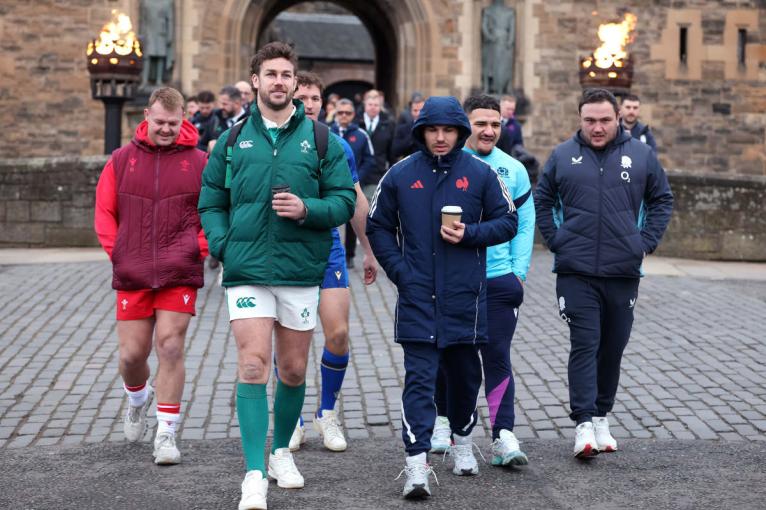
But this year’s event had a hint of The Traitors about it. It may have had something to do with the setting, at the heart of Edinburgh’s Old Town near the top of the Royal Mile, close to the Castle entrance – for those who know their Auld Reekie.
The early-morning photocalls against the backdrop of the castle certainly suggested a nod to the popular reality TV show. The participants may not exactly work together, but the plotting and scheming to make it to the end game is well under way.
All are aware that an opening faux pas could be a fatal blow and lead to early elimination in the contest for the big prize, or at least banishment to the championship’s lower reaches and a desperate scrap to avoid the wooden spoon.
Amid the anticipation of rivalries renewed – “we are six nations that both love and hate each other,” said Scottish Rugby chief Alex Williamson, one of the warm-up acts amid the slightly awkward, Q&A welcome sessions – there was enough edge to proceedings to suggest the championship could deliver on tournament chief executive Tom Harrison’s promise that “every year it delivers jeopardy and unpredictability”.
Italy have traditionally been happy to play the role of grateful guests at the Six Nations banquet, but even their urbane coach Gonzalo Quesada was happy to indulge in a few mind games before their opener against Scotland in Rome.
We know they are going to come super motivated because defeat is forbidden for them. They cannot lose the first game in Rome.
One minute he was love-bombing Gregor Townsend as “one of the best coaches in the world”, Scotland’s style as “absolutely a high level of rugby – it is really amazing what they do in every aspect of the game” and suggesting that some of the criticism that followed the Scots’ failure to beat New Zealand in November and then collapse from 21-0 up to defeat by Argentina was “really unfair on him and the team”.
The next this apparent ‘faithful’ seemed to be trying to deflect some of the pressure away from his own side in front of an expectant home crowd for a pivotal opening contest for both sides on 7 February.
“We know that even though they played some amazing rugby in November, the results were not there and we can feel there is a bit of pressure on Scotland,” Quesada said. “We know they are going to come super motivated because defeat is forbidden for them. They cannot lose the first game in Rome.”
If Quesada was merely reiterating the oft-repeated mantra around the importance of hitting the ground running in the Six Nations, his jibe would still have resonated, with Townsend yet to guide his side to higher than third place or launch a serious title tilt as he embarks on a ninth campaign in charge.
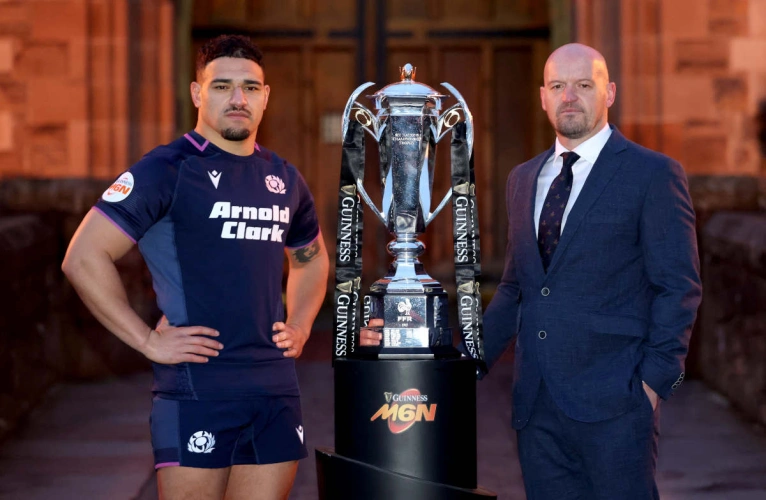
Certainly if Scotland captain Sione Tuipulotu’s optimism is to be realised, Quesada’s words can perhaps be taken at face value.
“I just feel that our only goal coming into this tournament is to touch the trophy,” said the British & Irish Lions centre. “Yes, we want to show progress from the autumn but ultimately it is to win and win now – that is the goal for me and my men.”
Tuipulotu was honest enough to admit that the Six Nations following a Lions tour also has an extra dynamic to it, as traditional rivals who became team-mates in the famous red shirt now revert to enemy status again – at least on the field.
“There is no-one you want to beat more than your friends, and I made a lot of friends over the summer,” he said. “Now you get to play against them, there are a few more things you can say because you know them better off the field. I am really excited for it all to be honest.”
Historically, you might have got a couple of weeks where you could take your foot off the gas, but that is certainly not the case now.
If infectious enthusiasm is par for the course on these occasions, Tuipulotu – who was all set to lead the Scots into last year’s championship before an untimely pec muscle injury forced him to entire to miss the entire shebang – was far from alone.
Jamie George may be 35 and in the twilight of his career, but the Test centurion’s passion for the Six Nations, a championship he has won three times, remains undimmed.
“I love this tournament, I think it’s brilliant, especially recently with the level of competition,” said the England vice-captain, who was filling in for the sadly absent Maro Itoje, who had travelled to Nigeria for his mother’s funeral.
“Historically, you might have got a couple of weeks where you could take your foot off the gas, but that is certainly not the case now.”
Having finished, successively, fourth, third and second under Steve Borthwick over the past three years, England are not shy about their intent to go one better this year, which would end a six-year wait since their last title under Eddie Jones.
They may need to prevail in Paris on the final day to do so, but there are plenty of pundits and bookmakers who make them championship favourites, despite only having two home games. An 11-Test winning run tends to inspire confidence.
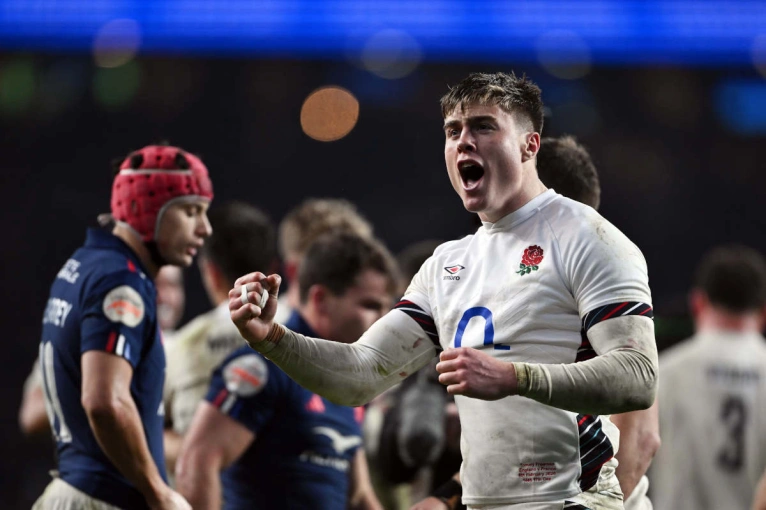
“That is definitely our ambition and there is an expectation on us because we have played well for the last 12 months,” George acknowledged. “We are aware of the external noise, but it doesn’t influence what we are doing day to day, getting aligned on how we want to play. The quicker we do that, we can then start building the extras around the mental and emotional side.”
The intensity of three straight weekends to kick off the tournament – there will be no fallow week after the first two rounds, as in previous years – will certainly test players to the limit, physically and mentally.
Or as France head coach Fabien Galthié put it, enigmatically: “This tournament is very quick but is also very long.”
George, who announced last week that he will retire from club rugby at the end of next season before a possible swansong at the 2027 World Cup, at least has the luxury of having mapped out his own future nearly two years in advance.
There are plenty in Wales, England’s first opponents at the Allianz Stadium on 7 February, for whom the future beyond next season is far from certain, particularly those Ospreys players who appear most threatened by the WRU’s decision to cut the number of regions from four to three.
Having enjoyed only two wins in the last four championships, and been whitewashed for the last two years, more modest targets are now the order of the day in the Principality.
Wales captain Dewi Lake, one of those who has already decided his future lies elsewhere after signing for Gloucester from next season, believes the uncertainty and instability has forged a sense of togetherness in the national squad as they seek to end a run of 11 straight Six Nations defeats going back to 2023.
“It has been tough, there is no hiding from it, but it has only brought us tighter as a group,” Lake said. “It is something everyone has in common off the field and given us something to bond over and become tighter, which can only work in our favour.”
It is only five years since Wales were celebrating their sixth title of the Six Nations era – the same number as Ireland, and only one behind England and France. But having enjoyed only two wins in the four championships since, and been whitewashed for the last two years, more modest targets are now the order of the day in the Principality.
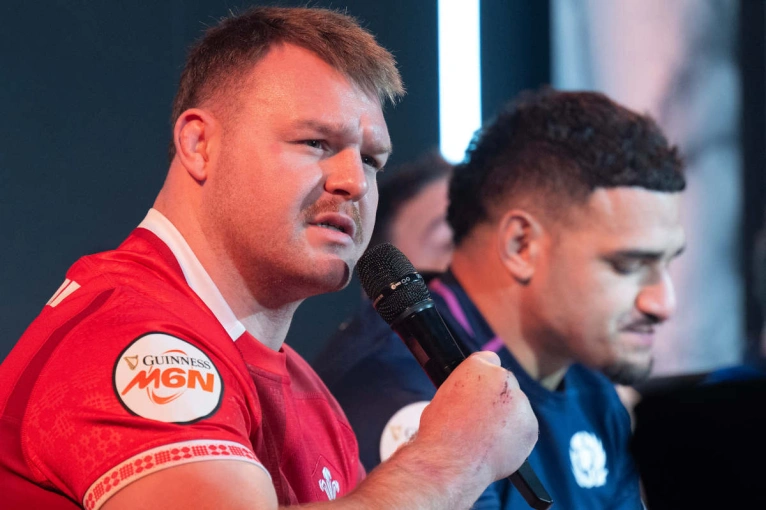
Trips to Twickenham and Dublin are not obvious candidates for away-day frolics, but winning a home game or two – France may be a stretch, but Scotland and Italy offer possibilities – would be deemed progress after an autumn in which they offered glimpses of the team they might become under new head coach Steve Tandy.
“I would love to stand here and say we’ll win five from five and lift the trophy – obviously that is the ultimate aim, we wouldn’t be here if it wasn’t – but we have got to be realistic around what games we can target,” Lake said. “Realistically for us, it is two or three from five – that is where we are heading.”
Expectations have also been dampened in Ireland, after sobering November defeats by New Zealand and South Africa and a mounting casualty list that now includes a trio of frontline loosehead props in Andrew Porter, Paddy McCarthy and Jack Boyle.
There are easier places to start than the Stade de France, but Ireland don’t seem fazed by the challenge. Why would they, having romped to a record 38-17 win in Marseille on opening night two years ago?
Yet Andy Farrell’s side have lost only three Six Nations games in the past four years – two to France, one by a point to England – and if they can somehow eke out a win in either Paris on opening night or Twickenham in round three, three home games suggest the Irish could still be in the title shake-up when Scotland visit Dublin on the final day.
“There is an awareness that we haven’t performed as well as we could have and that has been reflected in some of the results we have had,” said captain Caelan Doris. “But at the core there is still a lot of belief in what we are doing, the coaches we have and the quality of players we have. We haven’t been as good as we think we are capable of, so we are trying to chase down our potential in the coming weeks.”
Evidently, there are easier places to start than the Stade de France, but Ireland don’t seem fazed by the challenge. Why would they, having romped to a record 38-17 win in Marseille on opening night two years ago?
“Traditionally we have done quite well at the start of the tournament,” Doris noted. “It is a big 10 days ahead to prepare properly for what is going to kick off next Thursday.”
The opening match of the tournament has been brought forward to avoid the opening ceremony of the Winter Olympics in Italy on 6 February.
And if France v Ireland – a defining fixture of recent championships – required any further frisson of anticipation, the return of the finest player of his generation should provide it.
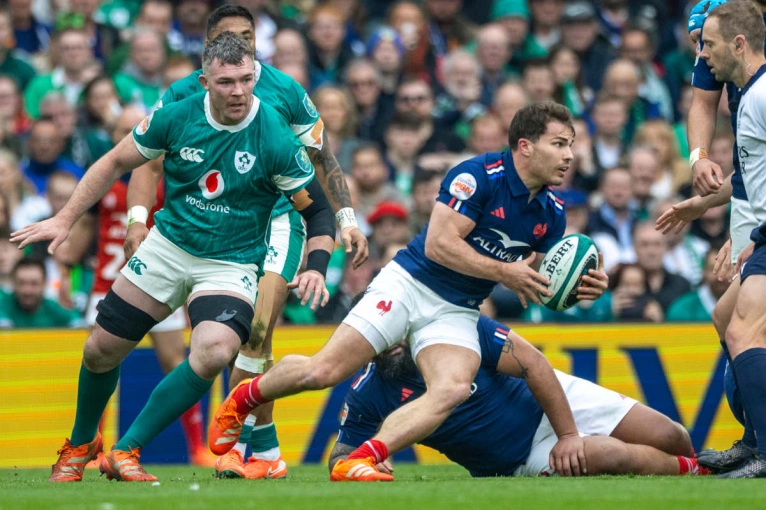
Antoine Dupont was invalided out of Les Bleus’ sensational 42-27 thumping of the Irish in Dublin in round four of last year’s tournament with a torn ACL in his knee, after being cleared out at a ruck by Irish duo Andrew Porter and Tadhg Beirne.
Galthié called the incident “reprehensible” at the time, but Dupont said he bears no anger towards the two Ireland forwards.
“Honestly, no, I think it was just an accident,” said the 29-year-old Toulouse scrum-half. “It happens sometimes on the field, unfortunately. Both of them sent me messages on social media, so no, I don’t think it was intentional.”
Dupont oozed his usual class from the moment he was pitched a question, in French, by the host of Monday’s launch about the extra pressure he might be facing. He replied, nonchalance personified, in English: “I think I am used to this kind of position.”
The good news is that after making his return in late November following eight months out of the game, the great man is back up to speed and ready to beguile us once more.
I think that’s why we all love him – he’s not the biggest player in the world but he shows the brilliant elements of our game.
“The first few weeks were not 100 per cent but now I feel the same as before,” he added. “I feel better than I expected a few months ago, so I am very happy to be back.”
Even his opponents are happy about his return, such is the esteem in which this superstar of the game is held.
“He’s been an exceptional player for a number of years,” said Townsend. “You don’t often get a player who can do everything. He can kick the ball further than any scrum-half, he can break tackles, his passing is outstanding and also he’s one of the best tacklers. I think that’s why we all love him – he’s not the biggest player in the world but he shows the brilliant elements of our game.”
No subtle duplicity or mind games there. Just a faithful observation of a spellbinding talent.
Roll on Paris, then Rome and Twickenham. And on to Dublin, Edinburgh and Cardiff. The joy of Six is here again.

Rugby’s best of the best, ranked by experts. Check out our list of the Top 100 Men's Rugby Players 2025 and let us know what you think!


It’s class that Dupont now speaks English well.
France are the only side with a pack built to front up for five brutal rounds, England have momentum and confidence (sometimes bordering on arrogance), Scotland play running rugby until the pressure bites, and Ireland are still slick and well-drilled — just no longer invincible after being properly exposed up front last year.