
In New Zealand, think Beauden Barrett, Damian McKenzie, and Richie Mo’unga; in South Africa, Handre Pollard, Manie Libbok and Sacha Feinberg-Mngomezulu. Ex-England coach Eddie Jones was victimised by the battle eternal between Marcus Smith and Owen Farrell before the 2023 World Cup, until he felt he had no option but to select both in the same team. It was never going to work and ultimately, it did not save his job.
If there is a position on a rugby field which attracts more controversy than any other, it is 10. It is like the quarterback in American football, the darling of the paparazzi on a dead news week. If there is any lesson to learn from such media imbroglios, it is the value of being decisive. Pin your colours to the mast, and live by your choices.
In New Zealand, Scott Robertson’s travails with New Zealand Rugby began with a public spat surrounding the eligibility of overseas players. In November 2024, Razor was lauding the South African model of open-door selection introduced by Rassie Erasmus. As Robertson explained to the assembled New Zealand media on Zoom: “What’s right for all of our game? We don’t want to be a cycle behind or a couple of years behind [South Africa] … Professional rugby is always evolving. Let’s keep an open mind and see what’s next.
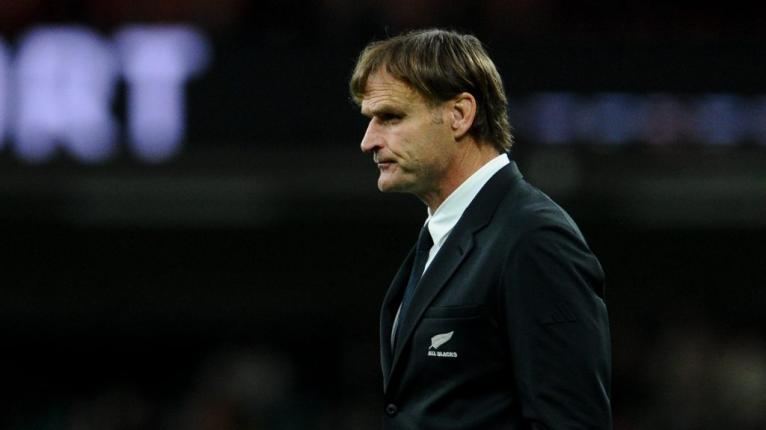
“They get the opportunity to use a lot of experienced [overseas] players who are looked after and managed well into their thirties, so they’ve got a great balance.”
The ultimate aim was to bring Robertson’s first five-eighth with the all-conquering Crusaders, Mo’unga, back into the All Blacks fold – even if he was plying his trade in Japan. Less than six months later Razor was walking back his comments on a Rugby Direct podcast with then-NZR CEO Mark Robinson and reaffirming the value of existing local pathways.
It was an uncomfortable moment in Razor’s relationship with NZR and it meant the argument in one key position was never settled satisfactorily. Robertson never got to pick the man he really wanted as the selection ball bounced between Barrett and McKenzie. The failure to resolve controversy with clarity led in large measure to his downfall.
Even the great man of the current coaching era, Erasmus, was forced to extremes by a similar debate in South Africa. A cataclysmic 22-38 loss at Ellis Park to the Wallabies in the first round of last year’s Rugby Championship persuaded the Springbok Svengali to drop the attacking experiment ascribed to his assistant Tony Brown, with Libbok and Damian Willemse, and return to tried and trusted World Cup-winning methods with Pollard.
Two rounds later, the Springboks were sitting at one win out of three in the tournament, and their chances of retaining the championship were hanging by a thread. It was only then Rassie finally cut the Gordian Knot and committed heart-and-soul to the ‘Tony-ball’ formula with Feinberg-Mngomezulu, Libbok and Willemse running the show.
His Springboks have scarcely paused to look back ever since that stupendous 43-10 win in Wellington on 13 September – but a radical, risk-laden choice was required initially, to kick-start the sputtering V8 back to life, to hear its rhythmic rumble and roar once again.
The same high tidal moment has now arrived in the affairs of England head coach Steve Borthwick and Ireland supremo Andy Farrell. England’s first loss in 13 games in the Calcutta Cup match at Murrayfield is a clear signal for Borthwick to settle the dispute between Sale’s George Ford and Northampton’s Fin Smith once and for all. Ireland’s unconvincing win over Italy means Farrell now has to come down on the side of either Munster’s Jack Crowley or Leinster’s Sam Prendergast to lead Ireland into the next World Cup. A Judgement of Solomon moment has arrived and can no longer be ignored, or postponed.
In a recent piece on Harlequins’ mercurial 10 Smith, I featured the following table highlighting the balance between run, kick and pass in the games of England’s top three outside-halves.
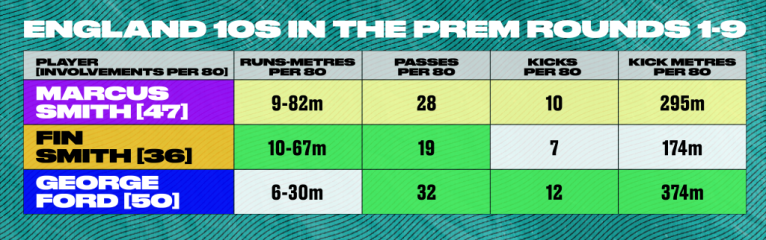
Some 88% of Ford’s involvements come via the pass or the kick, so he is a facilitator, a territory controller. By contrast, 81% of Fin Smith’s actions are ball-in-hand, either run or pass, and the lower number of overall involvements shows he works best in a collective, with others such as George Furbank and Fraser Dingwall.
The underlying problem is distilled by another statistic I omitted from the original article. Within the running games of the trio, the two Smiths have 10 clean breaks between them, compared to none by Ford. That’s right folks – none, nada, nil.
Why does that stat matter? At Murrayfield on Saturday afternoon, Scotland showed they had all the answers to the England kicking game. While an out-of-sorts Tom Roebuck fell asleep at the wheel down the right, Henry Arundell had a full-blown Nightmare on Elm Street on the left, drawing a red card for a clumsy challenge on his opposite number Kyle Steyn towards the end of the first half.
Cumulatively England’s two wingmen only reclaimed two of the 10 contestable kicks launched by the men in white, while Steyn and his sidekick Jamie Dobie won six out of seven for the hosts. Scotland won the kicking battle hands-down, and it meant England had to find a wholly different entry point into the game.
With Ford running the cutter from 10, they did not look likely to find it, and the root cause was the Sale man’s reluctance to take on the line and commit defenders.
— William Bishop (@RPvids1994) February 15, 2026
Ford handles the ball on eight occasions during this long sequence, with seven passes and the fatal drop-kick which handed Scotland a ‘freebie’ seven-pointer right at the end. While Ford can facilitate movement around him with his fine judgement on the pass, the cutting edge must always come from elsewhere – from Guy Pepper straight up the middle at 51:05, from Fraser Dingwall, Freddie Steward and Ben Earl down the left at 51:35 – but never from the man himself.
Ford’s reluctance to run meant Scotland defenders could pass him off to their inside support, and it cost England a potential try early in the sequence.
There is a four-on-three with three other backs – Dingwall, Freeman and Steward – all to the right of the diminutive England 10, and the Scotland backfield is empty if any kind of breach can be made, so ‘line-break’ will probably mean ‘try’. If Ford runs the straight line, he will preserve space for the men beyond him; if he steps out, he will keep the defenders ‘alive’ and drag them towards the ball. Ford chooses the latter, and that is the kiss of death for the overlap.
Smith changed that picture when he entered the game.
— William Bishop (@RPvids1994) February 15, 2026
It is Smith’s ability to force defenders to stop and account for him as a runner which creates the space for Henry Pollock on the right, and his sheer energy to recycle himself from the sideline and into second receiver which oils the wheels on the scoring play.
Bookending Smith with his two club colleagues Alex Mitchell and Dingwall, with the more strategic pairing of Ben Spencer and Ford doing bench duty as ‘finishers’ for the visit of Ireland next Saturday, suddenly makes an awful lot of sense.
Farrell meanwhile, has been torn between Munster’s Crowley and Leinster’s Prendergast for what feels like a media eternity. Before them, Johnny Sexton was the Irish pivot for several normal rugby lifetimes, and as the national team’s newly-minted ‘kicking and mentoring coach’ he has been reluctant to pinpoint the choice Farrell now has to make.
After Ireland’s nailbiter against Italy, the choice should be relatively straightforward. Crowley kicked his goals, Prendergast didn’t. Prendergast could not find a way to stoke Irish backline fires, Crowley prompted Ireland’s best move of the match.
— William Bishop (@RPvids1994) February 15, 2026
— William Bishop (@RPvids1994) February 15, 2026
Crowley is crisper, more compact, and more direct than Prendergast. He drags the likes of James Lowe, Stuart McCloskey and Jamie Osborne that little bit closer to the ad-line and forces them to play the stand-and-deliver offloading game that suits them best.
Where NFL coaches live and die by the success of the quarterbacks, the fortunes of elite rugby coaches are often tied to their number 10s. A hardy, high-level perennial such as Sexton or Ford can be the making of the mentoring man. Knowing when their time is done can be equally problematic.
Suddenly, the third-round game between England and Ireland is alive and well and full of interest. Ever since Sexton’s retirement, all Ireland has been swinging between Prendergast, Crowley and now, Harry Byrne. If Farrell cannot settle on one of the trio and stick with him, it could be his funeral.
Likewise, the moment has arrived for Borthwick to pick between Ford and Smith to lead England into Australia 2027. As his own coaching mentor Jones would no doubt remind him, a feud at number 10 is the last thing he needs in the year before a World Cup is due to be played. ‘QB controversy’ is a coach-killer.

Plot your team's route to the Six Nations title with our Six Nations score predictor game!


Having watched Saturday’s game it did make me wonder why SALE are so strong at home and rarely win AWAY. I do wonder if this is the limitation in George Ford’s attacking game and why SAINTS are so good on the road as they hold possession and build pressure in attack. Interesting times ahead.
Saints are far more flexible than Sale P. As you can see from the stats table, playmaking comes more by committee than sitting in the hands of one guy. Eng can achieve the same effect with the likes of Daly and/or Furbank aded to the mix.
I was waiting for your input. Last week, England was unbeatable, the five/sevens were an amazing innovation. Borthwick was in the Pantheon of greatness (exaggerating a bit). And this week? He can’t make up his mind, he doesn’t have a view of an attacking ten, plus all of Nick’s comments. Maybe both sides a bit exaggerated.
Oh NB - that was painful to watch on Saturday and was a very bad day at the office. 🤣
England were well off it, both up front in defence and we were horribly exposed in the backs. We lost the aerial battle, we lost the breakdown battle and were generally outworked by SCO which was tough to watch.
ENG failed to move the ball away from the SCO forwards and we generally got smothered by the Scottish defence, whilst not going wide-wide until Fin Smith came on and attacking the outside edges.
Great analysis on Ford, he takes to the line and moves, or he kicks but it doesn’t leave the centres very much room and I’m afraid SCO exposed our 10/12/13 combo and outplayed them throughout.
I thought Tuipulotu was outstanding and shows you the value of a true centre carrier who can inject pace into the attack.
I think it will be Fin Smith/Dingwall/Lawrence this week, with Freeman back on the wing, with a greater focus on moving the ball and attacking the outside channels, so will also be Furbank or Daly at 15. Interesting times but confirms we need more pace & movement within out attack.
Ford is a really good player but hasn’t led England to any big away wins and has had plenty of chances. The tactical play and leadership vs Scotland was severely lacking and it wasn’t the first time away from home. To challenge England need to develop an edge to get away wins. Fin Smith has proven he can do it for Northampton and England should pivot to him, and let him run things at fly half and have Marcus Smith on the bench to cover. Ford offers a good squad option but it’s time to move on and look to the future
I don’t mind Ford on the bench to finsh game off Unk, but I feel Smith deserves a shot with Lee Blackett as the attack coach and Saints backs around him. Still not sure where Marcus fits into the picture and he’s now 27 years old after being a child prodigy.
Fascinating article.
So . Ford zero line breaks.
I have repeatedly said he shuffles sideways and passes hospital balls to his inside guy who gets hammered time and again .
Only occasionally does a pump pass work .
The question is.
Borthwick is a stats man apparently.
He will know these stats.
Yet he ignores the more attacking players for a conservative approach.
Will this attitude win anything .
Discuss.
The Ford policy will work well when England are ahead, not so well when they are behind and/or losing the kick-chase battle.
Fin is almost 10 years younger than George, so hwo is the better choice to start in just over 18 months time?
Curious to see what all these coaches do. Galthié as well has a decision to make once Ntamack and Jalibert are both healthy.
They are not often both healthy….
It’s hard to see how Ntamack gets back in that team the way Jalibert is playing. They are looking almost unstoppable in attack and there’s a real confidence building in that squad.
Not sure if Ollivon, Dupont, Jalibert or LBB is the star of the show, as all 4 are on red hot form so far this tournament. Dare I say it, I’m not sure we have seen them hit top gear yet.
Jalibert all day long SB.😁