





1
'After watching the Aussies on the weekend...': Richie Mo'unga's take on Wallabies
3

 Share
Share 
As the Sharks gear up to face the formidable Leinster this Saturday at Kings Park during Round Two of the URC, the spotlight will inevitably shift from the athletes on the pitch to the strategic minds guiding them.
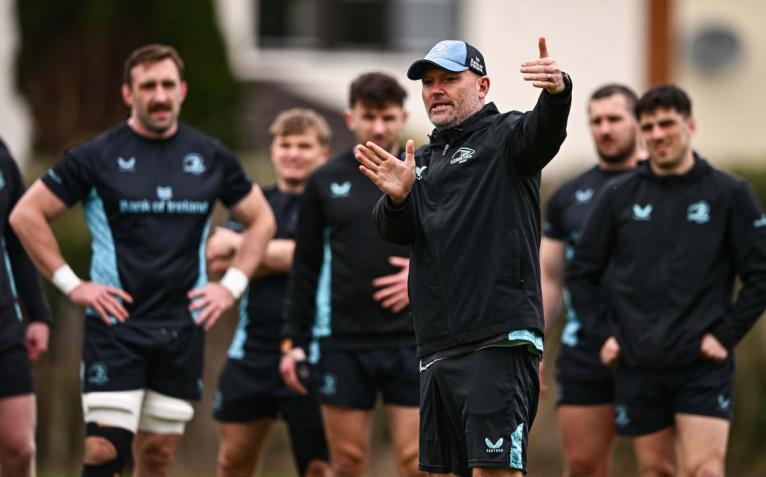
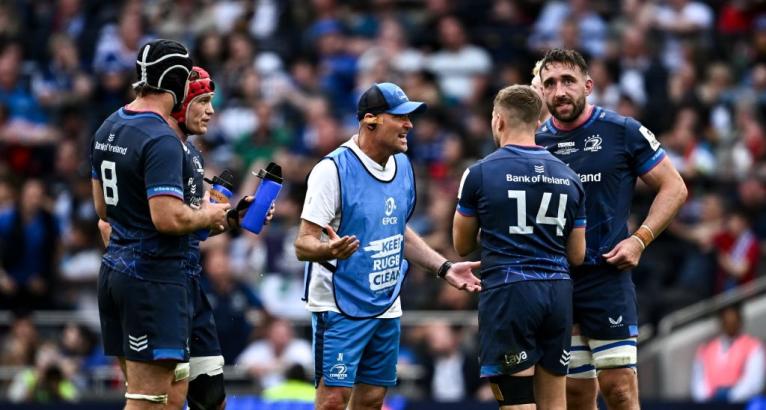
At the forefront is Leinster’s senior coach, Jacques Nienaber, who will find himself under keen scrutiny.
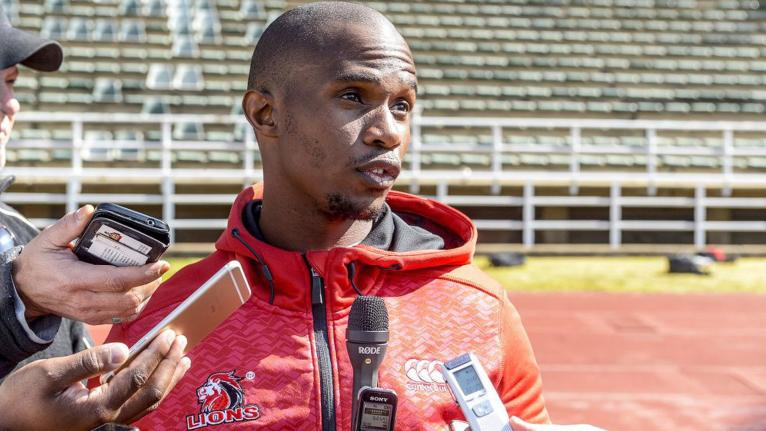
Sharks’ defence coach, Joey Mongalo, has chosen to approach the idea of a personal rivalry with caution, referring to Nienaber as “the godfather of defence.”

This title reflects the deep respect Mongalo holds for Nienaber’s influence on defensive tactics.
In Mongalo’s view, Nienaber stands shoulder to shoulder with defensive trailblazers like John McFarland and Omar Mouneimne.
It’s worth noting that the rush (or blitz) defence system in Rugby Union has its roots in the strategies of cross-code converts from Rugby League.
Notably, figures like John Muggleton, who played a pivotal role in Australia’s 1999 World Cup-winning defensive strategy, and Shaun Edwards brought aggressive line-speed and tackling techniques inspired by American football into the mix.
Gary Gold, a former Springbok assistant coach, was a pioneer in introducing fast-pressing defensive frameworks into South African rugby.
He joined forces with coach Jake White in 2004, acting as a defensive consultant and technical analyst to implement early concepts of this aggressive rush defence system, a method he had refined while coaching London Irish in the English Premiership.
Nienaber’s professional journey is particularly noteworthy.
With no background in elite rugby as a player, he commenced his career as a qualified physiotherapist and strength and conditioning coach before evolving into a master of defensive strategy.
While he is hailed in South Africa as a tactical genius behind two World Cup victories, his tenure in Dublin has often been colored by a different narrative.
There, he has been characterized by the press as a ‘great disruptor,’ unsettling the established order in Dublin.
To truly understand why Mongalo regards facing Nienaber as a lesson in “defensive kung-fu,” one must closely examine the progression of defensive strategies in the game of rugby.
For many years, teams have been honing their drift systems, focusing on maintaining solid defensive numbers while using the touchline as an additional defender.
Nienaber, together with his long-time collaborator Rassie Erasmus, has significantly reshaped the game by prioritizing line speed. His signature approach features a dynamic and assertive ‘blitz’ or ‘umbrella’ defence, which intentionally leaves space in the outer zones.
Reflecting on their shared coaching journeys, Mongalo noted: “I was a youngster at the Lions, starting to coach in 2011, and Jacques was already then coaching the Stormers, I think it was at the time. So I’ve been admiring him.
“It’s not a Joey-Jacques thing. I think it’s more about two similar systems. Because to coach a line-speed defence is quite an art. Jacques has mastered it with Leinster, through the Springboks. He’s won a World Cup. He’s been in a Champions Cup final. He’s won the URC.”
Recognised as a second-generation trailblazer of the modern, aggressive rush defence in South Africa, Mongalo acknowledged the threat Leinster poses, stating they “will punish” the Sharks if they aren’t firing on all cylinders.
“Leinster is a team who are well-oiled. They are the current champions. I mean, if you give them opportunities, they’ll take them,” he continued.
The Sharks conceded four tries against the Ospreys in last weekend’s 41-24 win.
“The [Ospreys] review was that the [defensive] system was in place, we had people in place, and we had four soft moments.”
The Sharks are striving to evolve into a squad that is significantly challenging to score against.
This scenario places rookie Springbok flyhalf Vusi Moyo, just 20 years old, under the spotlight facing the Nienaber system.
Nienaber remains a pivotal figure in the rugby landscape. One with an extraordinary talent for converting a team’s defence into a potent offensive strategy. His approach transcends simple disruption of momentum; it’s about exerting psychological pressure on opponents.
In Nienaber’s defensive framework, opposing flyhalves face not just a defensive line but an imposing wall of athleticism that constricts their decision-making time to a mere heartbeat.
The effectiveness of the Nienaber strategy is evident in the Springboks’ success, is of course, marked by two World Cup victories. When Leinster announced the appointment of Nienaber following the 2023 Rugby World Cup, it felt like the final piece in their puzzle for European success.
However, when he brought the same tactics to Dublin, it rubbed up against the established local traditions. The cultural clash surrounding Leinster Rugby was unmistakable.
Known for their sophisticated, fluid playing style that thrives on multi-phase attacks, Leinster has faced challenges against the brute strength exhibited by La Rochelle in their European Champions Cup encounters.
The intention behind bringing Nienaber on board was to instil a new level of resilience into the skilled Irish side, aping South Africa’s rugby’s ferocity.
However, his arrival sparked a substantial debate within the Irish media landscape. Concerns emerged that Nienaber’s high-press defensive style was draining the players’ energy and, perhaps more importantly, stifling Leinster’s celebrated attacking prowess.
This narrative gained momentum following a disheartening 19-41 defeat to Bordeaux Bégles in the Champions Cup Final, which saw Nienaber shouldering much of the blame.
The 53-year-old found himself accused of crafting a defence that was seen as vulnerable and an attack that had become predictable, with disgruntled fans expressing their frustration on Irish forums, labelling his appointment a failure.
As pressures mounted, Nienaber faced a tense press conference, directly addressing the interplay between media influence and a coach’s job security.
Reacting to being branded as ‘the devil,’ he remarked: “If, as he said, I’m ‘a devil,’ I probably won’t be staying.
“Who fires you? The public, the media, they fire you. Not the CEO. Right now, I’m not quite sure, to be honest. I don’t think people value me here.”
It’s a trend in European rugby journalism.
When a storied and talented squad like Leinster’s struggles on a prominent stage, there seems to be a tendency to pinpoint the foreign defensive coach as the scapegoat, rather than addressing the homegrown issues.
Nienaber is now set to guide Leinster into a challenging encounter in Durban.
After their match in Johannesburg last weekend, where a relatively green Leinster squad narrowly fell to the Lions with a score of 26-27, Nienaber is now ready to bring a team that includes Josh van der Flier and Robbie Henshaw to Durban.
For Mongalo and the Sharks, this upcoming match serves as an essential benchmark for their development.
“If you look at Leinster, the amount of experience and provincial caps that those guys have, I think they played all their babies against the Lions.
“So we’re expecting a full-blown Leinster team, which is pretty much like playing against Ireland. And then they’ve got Jacques Nienaber as the lead coach there, who I admire as one defence coach to another. So that’s an established group of guys who we know what we’re gonna get from them.”
The Durban franchise is currently undergoing a transformation of its own, embracing an aggressive line-speed strategy that is heavily influenced by Nienaber’s coaching approach.
Mongalo is all too aware of the threat Leinster pose. Nienaber’s system thrives on exploiting hesitation and transitional mistakes.
The Sharks are banking on the dynamic energy brought by their younger players, maybe most notably fullback Luan Giliomee, who is set to join URC rivals, the Bulls.
“What a privilege for our youngsters to go up against that [Leinster], to test themselves against the very best… But also the beautiful thing about youth is that they can almost be oblivious or ignorant to what’s coming, you know?
“So they just wanna run out there and test themselves against whatever that is.
“So I think Scott [Mathie] has really prepared them with a clear, simplistic message of what’s required, and hopefully that youthful exuberance just goes out there and surprises all of us. You know, they can even surprise themselves with what they bring on Saturday.”

1 YEAR TO GO
The countdown is on until the biggest Men’s Rugby World Cup ever kicks off in Australia. Go All Out and secure your seats with tickets now available!
With two key Ireland players on the sidelines and all four provinces losing their opening URC games, the league's most dominant country is on the back foot.
Questions have been asked of South Africa's old guard, but the All Blacks may not have developed as much Test-ready talent as desired this World Cup cycle.
South Africa are in that good place again, a potential Wallabies resurgence is on the cards but England's form has been variable.
he meant it as “once upon a time’ but yeah clumsy phrasing
But you’re not not suggesting it 😜
Targeted by Shannon Frizell in the final.
Something happening to Lonergan causes me insomnia


 Clear
Clear 


 Copy link
  Facebook
  X/Twitter
  WhatsApp
  Messenger