
For all the attacking elan and highlight-reel tries, the dark recesses of driving mauls are the talk of the game. The Nations Championship has brought World Rugby’s new law interpretations, where tighter restrictions are placed on players defending the maul, into sharp focus. What was once a powerful weapon in the right hands has now gained even greater potency.
HSBC SVNS returns to Cape Town this December!
Don't miss your chance to see the world’s best rugby teams take centre stage 5-6 December in Cape Town.
Maul tries are being scored by the hatful, at a faster rate than ever before, and yet the Wallabies appear to be tracking against the grain – using this enticing source of pressure and points less and less.
To recap, the guideline from World Rugby was brought in to reinforce the contestability of the maul and designed to ensure “players in a maul should be contesting for possession of the ball, or pushing/driving to gain or defend field position.”
The “pushing/driving” element is the key point. We hosted Australia-based elite referee Angus Gardner on the 8/9 Rugby Podcast as the law took effect in July, and he provided great clarity around what officials would be looking for on the field.
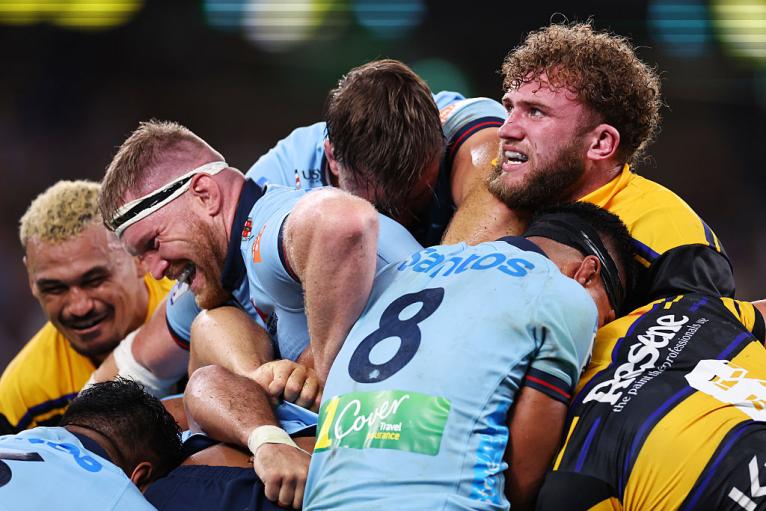
“If you’re defending the maul and the maul spins and you find yourself as a defender spinning up around the side – once you’re no longer in a position to be able to push, you must come out, back round through the gate and onto the front player of the maul,” Gardner said.
“It’s basically trying to stop players swinging around the side of the maul.
“We want the maul to be a genuine pushing contest. So, once you’re not in a genuine pushing contest as a player, you have to bail out, otherwise you’re liable.”
The interpretation is in play throughout the northern hemisphere club competitions now, as well as the international game, and you will regularly hear referees using words to the effect of “you can’t push from there, you’re out”.
From a defender’s point of view, once they’re essentially behind the ball going forward, they can no longer hang on, and must detach, and thus attacking mauls have become so much harder to stop with the defending team not able to maintain their bind for as long as previously.
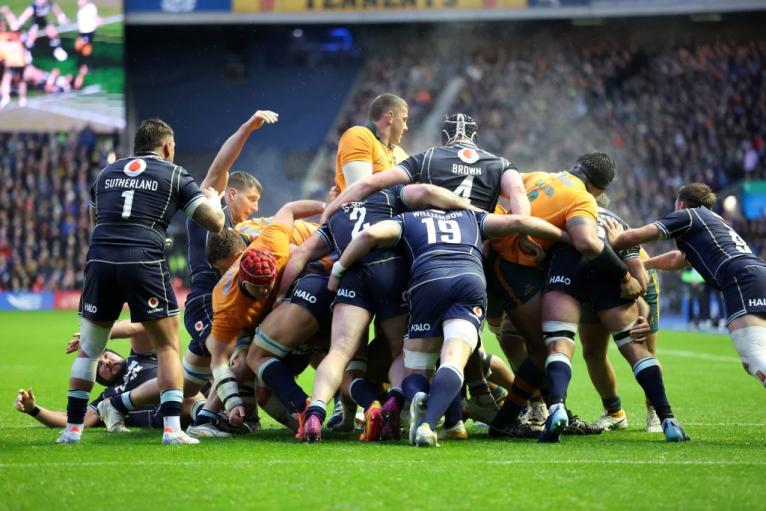
After discovering that 32 tries had been scored directly from lineout drives across the first four rounds of this new URC season – a bit over 13% of the total – the Irish Independent‘s chief rugby correspondent, Rúaidhrí O’Connor, declared last month, “Rugby now has a cheat code in the form of the driving maul.”
He went on: “The maul is an essential part of rugby union, but it currently has an outsized influence on matches and stacks the deck even further in favour of the most powerful teams.
“In theory, the drive should suck in defenders and allow more room for attacking play, but the reality is that sides are refusing to take risks until the opposition infringes and there’s the safety of a penalty advantage to lean on.”
Unsurprisingly, maul tries remain commonplace through the first two Nations Championship rounds in November, with around 10 tries coming from lineout drives in round four last week, and a similar number in this just completed round five.
As an overall percentage, it’s still below that of the 2026 Six Nations tournament, but the number of mauls being set by teams per games will probably end up in similar territory.
Even more curiously, at exactly the same time maul tries are on the increase internationally, they seem to be disappearing from the Wallabies’ game plan completely.
So far in 2026, the Wallabies have scored just four direct maul tries of 55 in total, about 7.3% of all tries.
That’s down from maul tries representing 10.4% of all tries scored in 2025, a further decrease from the 15.4% of total Wallabies tries scored in 2024.
(The Wallabies scored just one maul try from only 23 scored in total in 2023, and that’s yet another reason why we don’t talk about that season.)
With Billy Pollard’s effort disallowed at Murrayfield on Sunday, Josh Nasser’s maul try in the first Bledisloe Test in Auckland remains the Wallabies’ most recent. Before that you have to go back six matches, when Angus Bell and Pollard piloted mauls over the line against Italy, in the first leg of the Nations Championship in Perth.
The trend appears to be heading similarly downward among the Australian teams in Super Rugby too, where proponents of lazy stereotypes will be surprised to learn the Queensland Reds and Western Force have overtaken the ACT Brumbies in their reliance on maul tries.
The Brumbies scored only two of 62 tries from the maul in 2026, with the Reds and Force in the scoring six and eight of their respective totals of 56 and 52. Regardless of who’s leading the way, it’s still not a huge use of the maul, while the rest of the rugby world is catching on to the ‘cheat code’.
This has played out for the Wallabies too, where in their four straight losses – twice to New Zealand, then England and now Scotland – Australia have won the ball back from just 10 mauls in total. Against England that figure was zero, and in the second Bledisloe Test, just one. Half of their total came against Scotland on Sunday.
But they’re actually not setting that many mauls in the first place, at an average of just five per game. That’s way less than other top teams.
Scotland won seven alone on Sunday, and two of hooker Ewan Ashman’s three first-half tries against New Zealand came from successful lineout drives. It was always likely the Wallabies would face the Scottish maul close to their try line, but bizarre they didn’t employ the same tactic to the same degree.
Considering the trouble Australia are having in breaching the gainline and winning fast ruck ball, you’d think the maul might be something they go to more. Surely, it would be one way to nullify general play defence.
But they’re using it less often than maybe any time in recent memory. And like a lot of things going wrong for the Wallabies, it doesn’t seem to make a lot of sense why that’s the case.

NEW IN THE APP: Official World Rugby Rankings hub! Compare team rankings side-by-side, with data going back 20 years.
Download the RugbyPass app on the App Store (iOS) and Google Play (Android) now!


‘So far in 2026, the Wallabies have scored just four direct maul tries of 55 in total, about 7.3% of all tries’ . . . . . This compares to the Nations Championship of 28% of maul’s ending in a try,so they are massively under performing, especially given how good the line out has been all year.
The lineout has been really solid for two years, PM, yet the maul just hasn’t gone with it and it doesn’t make sense why..
How is it that Jeremy Williams is so dumb as to slide in front of one of our locks at an attacking lineout and get penalised ? Is it because he is coached mainly by kiwis ?
Ridiculous comment.
Criticise the techical error all you want, but leave your borish anti-NZ crap out of it, thanks.