
As the famous New York Yankees catcher Yogi Berra once opined, ‘you can observe a lot by watching’. Some observations about the world champion Springboks are becoming too obvious to ignore, and they will make uncomfortable reviewing for head coach Rassie Erasmus after an achingly close two-point loss to France.
HSBC SVNS returns to Cape Town this December!
Don't miss your chance to see the world’s best rugby teams take centre stage 5-6 December in Cape Town.
If you want to beat the Boks, make them use the ball and play some footy, because whenever South Africa dominates the attacking statistics, it is a sure sign they are going to lose the game.
The Stade de France was like a northern hemisphere Bombonera – not trembling but pulsing with the blood of opportunity on Friday night; the game itself, a re-cut version of the Greatest Rivalry opener at Ellis Park on 22nd August. Don’t believe me, take a look at the essential stats:
- In both games, South Africa built more rucks than their opponents and forced them to make more tackles – they set 22 more rucks than New Zealand and 18 more than France. They forced the All Blacks to make 46 more tackles, and Les Bleus 33, than they completed themselves. The myrtle green and gold dominated an identical percentile of territory and possession over the double-header – 56%.
- The Springboks dominated both lineouts, winning all but one of their 30 throws and winning five of their opponent’s 28 feeds. They crucified the two scrums they faced in Joburg and Paris, winning a colossal 13 penalties at the set-piece over the two matches. There was the added bonus in Paris of a yellow card on bench tight-head Régis Montagne.
- South Africa got the high penalty count it wanted to control game tempo in both matches: 25 penalties at the Stade de France compared to 24 at Ellis Park. The Springboks won the lion’s share of them in a very similar ratio – 14-10 and 14-11 respectively.
To quote Yogi once more, it was like deja vu, all over again. A win in any two of the categories described would normally be enough to get you over the finish line with room to spare. To win all three but still end up on the wrong side of the scoreboard reeks of something fishy, if not rotting in the state of Denmark.
As they had done versus the All Blacks, the Boks won most of the physical contests, but Les Bleus had a much better idea of how to use their lesser portion of the ball. The match repeated the same lesson: that simply winning the ball, and winning penalties from your possession, is not enough to win games of elite rugby. You have to be able to use the ball and use all 15 men on the field. The bottom line, nine tries to four over the two games, home and away, does not lie.
Erasmus received every gift at scrum and maul from his Christmas list he could have dreamed of from Italian referee Andrea Piardi, but his Springboks lost ultimately because they have been unable to rediscover the enviable balance they had at the Cake Tin in Wellington, when they drubbed Scott Robertson’s All Blacks 43-10.
They have struggled to rediscover the sweet spot between ball winning and ball using ever since, and the writing was on the wall against Ireland this time last year. Despite winning nine penalties or penalty advantages at scrum time, and drawing two yellow cards on the Irish front row for persistent infringement, the Bokke only chalked up 24 points against opponents who were often reduced to 14, 13 or even 12 men on defence.
The Springbok supremo was in suitably penitent mood after the 21-19 loss, even if he was not quite heaping the ashes on his head. Curious about a repeating pattern, rather than close to solving the conundrum.
“I can’t find a lot of excuses,” Erasmus said. “They were on top of their game and we were a little bit off. It was one point here and there. They took their opportunities and we didn’t. We weren’t just outplayed; we were outsmarted.
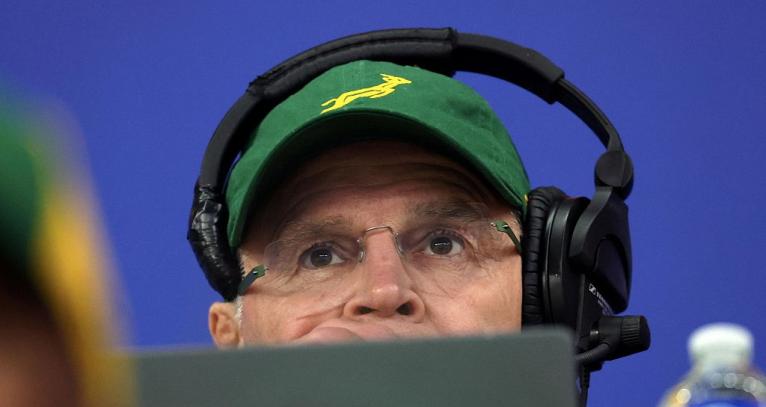
“It’s probably a cliché, but I definitely think we had enough opportunities. There were simple tries we could have scored with one last pass; and perhaps one or two wrong decisions, such as not kicking for the corner, rather [than] expecting the referee to give four penalties in a row.
“But of all of the things that went wrong, you know, we sort of played ourselves into that hole. It wasn’t like they forced us into playing that way. It was like we were a little bit uncharacteristically tentative tonight.
“When something like that happens, it’s probably the coaching staff. I don’t think the players went out there like ‘we’ve got to really tackle our hearts out and be physical’, but then when we get the opportunity, we’re a little bit hesitant. That’s something I have to find out why that happened.”
As his captain Siya Kolisi added, “if you create so many opportunities and don’t take them against a team like this, you’re not going to get the win. We know what we need to fix.”
The crux of the problem orbits around the Springbok half-backs, a natural nine and 10 opposed by France’s stopgap duo of two nines, Antoine Dupont and Maxime Lucu. The French odd couple enjoyed only one training session together, but the shining light of their game management completely overshadowed the pairing opposite them, Morné van den Berg and Sacha Feinberg-Mngomezulu.
The idea of double nines, with Dupont acting as scrum-half and Lucu filling in at first receiver, follows in the footsteps of a proud French tradition of scrum-halves who can function equally well outside the spot – think Jean-Baptiste Élissalde, Dimitri Yachvili, Morgan Parra and Freddie Michalak from previous eras. The Top 14 is based on the organisational skills of the nine rather than the 10, so the fluid movement between the two positions, and transference of game management skills, is only natural.
Look down the list of French national coaches, and you will find four of them have been scrum-halves, but none have been number 10s. There is an unbreakable lineage which can be traced from Jacques Fouroux and Pierre Berbizier in the eighties and nineties, to Bernard Laporte in the noughties and Fabien Galthié in the present day, and that is where the brains of the operation across the English Channel truly lies.
Despite the paucity of their time training and playing together as a combination, the sheer tactical nous of Dupont and Lucu outshone their rivals in the green and gold, and nowhere more than in their use of the kicking game. Feinberg-Mngomezulu may be the brightest talent to have emerged at 10 since Dan Carter, but he had the ball in his hands only eight times in Paris, compared to 10 by ‘Makeshift Max’ Lucu on the other side. He is not trusted to run the game on his own terms.
Outstanding rugby athlete he may be, but as a game manager Feinberg-Mngomezulu has not kicked on, quite literally, since that momentous evening at the Cake Tin last year. He still plays on instinct rather than operating within the needs of a tactical framework.
On a night when the Springboks reclaimed none of Van den Berg’s six contestable kicks, South Africa needed the young Stormer to step up and show more control, but he was still making the same mistakes in the attacking kicking game that had dogged his contribution in RGR One.
https://t.co/Bcjyt7ybbQ
— William Bishop (@RPvids1994) August 24, 2026
https://t.co/UcfRYi2QYd
— William Bishop (@RPvids1994) November 16, 2026
In the second clip, Lucu [at the top of the screen] is reading Feinberg-Mngomezulu all the way, dropping in and out of the line and ensuring he is in perfect position to receive the kick when it is finally delivered.
France kicked 10 more times through their starting combination in the half-backs than the visitors, and they made the most of their possession with Dupont pulling the game management strings like a master puppeteer.
https://t.co/IrZWsgfFNa
— William Bishop (@RPvids1994) November 16, 2026
Feinberg-Mngomezulu kicks high, Florian Verhaeghe reclaims the ball, and the little Toulousain maestro immediately detects the space in behind Kurt-Lee Arendse for a 50/22 turnover, bumped up to penalty when the Springbok wing denies Louis Bielle-Biarrey a quick throw-in by kicking the ball away.
Dupont’s short kicking game was in a different class to that of his opposite number, as Les Bleus used the chip over or kick-pass to exploit the space in behind the rush, or after a line-break had been made.
https://t.co/Is4SF6RxW0
— William Bishop (@RPvids1994) November 16, 2026
https://t.co/D7Bc5dFNLM
— William Bishop (@RPvids1994) November 16, 2026
In the first clip Dupont and Lucu are connecting via the kick, in the second they keep ball in hand to set up a break for centre Kalvin Gourgues, with a pinpoint kick-pass from Dupont to Aaron Grandidier-Nkanang taking play all the way to the South African goal-line.
Nothing described the superior tactical nous of the French combination in the halves better than the build-up to their first score of the game.
https://t.co/1MS3J9X2TM
— William Bishop (@RPvids1994) November 16, 2026
Lucu’s peripheral awareness is constantly scanning the field for opportunity, like a lighthouse looking out to sea – first for the wide phase which stretches the Springboks defence to the right corner, then realigning the short-side attack for Granidier-Nkanang’s try in the same space. Would Feinberg-Mngomezulu be capable of the same action and awareness at this stage of his budding career? Probably not.
If you want to beat the Springboks, give them the ball. That was the message coming out of the pulsing heart of French rugby on Friday night. The Bokke ball-winners may be mighty, but their ball-users are not. Give them enough possession, and chances are they will confound themselves. Ever since the Cake Tin, things have not moved on, especially in the half-backs, the guiding fulcrum of the team. Another Yogi-ism: “If you don’t know where you are going, you’ll end up someplace else.”

NEW IN THE APP: Official World Rugby Rankings hub! Compare team rankings side-by-side, with data going back 20 years.
Download the RugbyPass app on the App Store (iOS) and Google Play (Android) now!


Everyone has a plan until they get moered in the chops! Go on then, give the Boks the ball!
It wasn't the Boks best performance, but to be fair, they usually follow it up with a blinder!
Go on Ireland! Give the Boks the ball. I challenge this muppet Bishop to be here after the test should that be the case!
Intéressante constatation sur le rôle des 9 et 10 en France et l’articulation du jeu autour du 1er !
All I can say is that my national team played smart, but now that they've learned their lessons, its gonna be difficult to win against them, especially if we do actually meet in this final.
Were not there yet, so we'll see what happeneds when it does.
NB, you’re one of the luckiest Welshmen to have actually seen your team beat New Zealand. Squidge must be over the moon too. It’s like being alive to see Halley’s Comet, which only comes around once every 70-odd years. Congratulations enjoy the month-long celebrations!
😶
In other words. Kick the ball away! So to counter this we have to kick even more!
I actually agree with this analysis, it’s been the most maddening aspect of the Springboks performances this year. Ineffective with the ball in hand - and in particular in the opposition 22.
Handling errors. Poor decisions. Turn overs. You name it, we’ve seen it from them in the 22m area. Entries without points. It’s been very frustrating to watch.
I do think we are missing something more at 9 than at 10. But I agree our 9 & 10 partnership isn’t firing. It’s unsettled and I think SFM is overplaying to compensate for a lack of form and maybe even a dip in confidence on attack.
I am not seeing Tony Brown’s influence on our attacking shape as compared to what we saw at Wellington and after, last year. And I am confused by that. Is one foot halfway out the door already?
Anyway, there are many issues that need attention. And rather now than next year. It would be great if SA could be widely written off from all corners, because if there’s one thing I do know, is we don’t wear the favourites tag well at all.
The Springboks will, hopefully, bounce back next week like they often do after a loss like this. Beating Ireland will be motivating enough.
HH - I’m with you, they simply aren’t taking their chances but the only real difference I see if that Reinach/Williams are both good on half breaks, so they keep the defenders honest at the gate, whereas VdB tends to pass, so the linespeed is up on SFM quickly.
The other change is Cheslin K - maybe he brings a bit more variation and excitement to that team, especially on the kick returns and lets the team play off them in broken play.
I don’t think it’s a huge change required, they certainly have the players to do it but Rassie needs to give a bit more freedom to attack and give them a license to thrill. Do that and this team is very difficult to beat.
What can we take from that, well:
1. France used their heads to win, literally!
2. There’s still a case for putting the two best players on the pitch regardless of shirt number
3. Captain hindsight is always the smartest fcuker in the room
4. Yogi was one helluva smart bear…
After the match, i was questioning if Sacha Feinberg-Mngomezulu's best position actually is flyhalf or whether he’s a Damian Willemse type who can play flyhalf but might actually be more suited to playing a position where he can be creative but isn't tasked with being the creative fulcrum.
The intensity of the match in Paris is a reminder to the Gallagher Prem that you don’t need 10+ tries for a match to be eminently watchable.
I can’t believe you’ve buried the lead by not starting the week with an article about that remarkable win by Wales!
Except when the Boks Beat the AB’s by nearly 40 points in Wellington. The Boks has 52% possession.
Thing is, this article is written based on one game, you’ll find if you look at the past 10-15 games (even further back) your premise falls flat on its head, good read, but again, it was one game and theres no pattern you have pointed out. give the boks the ball? umm yea sure, ask all the teams they have come across over the past 5 years if thats the right recipe.