




1
England confirm coaching change after Rugby World Cup 2027
2


 Share
Share 
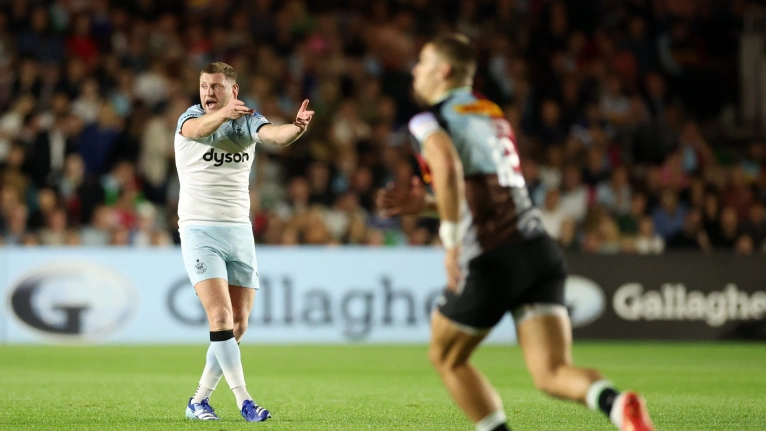
Most coaches would count themselves fortunate to work with a generational talent like Finn Russell once in their career in club rugby, few get the chance to do it twice. No wonder Bath’s new attack coach Mike Prendergast seemed very happy with his lot when chatting enthusiastically to the media on Tuesday for the first time since his move from Munster.
You get the impression that Prendergast would never run out of good things to say about Russell, who he coached previously at Racing 92 and believes has matured into an even more well-rounded player in his three and a bit seasons at Bath, which is a good thing considering a team’s attack coach and 10 need to singing from the same hymn sheet. Apparently, Prendergast can hold a tune as well as Russell can hold a defence.
“With an attack coach, the 10 is always someone you’ll have a close link with. I still keep in contact with number 10s that I coached back in Grenoble 10, 12 years ago. I’m sure most attack coaches will tell you the same, they’re nearly like your little son as such. You always keep those relationships and I’ve a very strong relationship with Finn.,” Prendergast said.
“We are in a stressful, competitive job every day and Finn is an incredible talent, a brilliant player, and a brilliant guy to work with. He is great for your environment, your squad. I couldn’t speak highly enough of Finn.”
Expanding further on his admiration for the 99-cap international, who recently turned 34, Prendergast added: “Go back a couple of years ago, people used to think he is this player who just rocks up. He doesn’t. Finn does his work in the background and I’ll have a lot of mini conversations with him during the week. We’d sit down, we’d look at the opposition, chatting about them, looking at clips. He is so experienced, he has seen those pictures so much; he sees pictures probably quicker than anyone does, and he sees moments and opportunities.
“In soccer you’d say he is incredibly hard to mark, because of his array of skills, his passing skills, his short kicking.
“I think since he’s been here over the last three or four years, the game is maybe a bit different to what it is in France, subtle differences, and you can see he has matured as a player even more so, in terms of understanding the profile of our team and what is in front of him, and his understanding of when we don’t need to overplay and when we need to pull the trigger.
“Finn, or any 10, they are the ones driving the bus. People follow that, his teammates look for him: what he is going to do next.
“He has a great ability to move on to the next job, whether it is good or bad. Most of the time that’s after doing something really good, but he doesn’t pat himself on the back, he is just looking to do something good again, or if something might not work out, whch doesn’t happen too much, he still has the ability to move on.
“He been such an important part of our game, rugby, full stop, over the last 10 years.”
Prendergast’s job is to enable Russell to get even more out of those around him. Two bonus-point wins out of two (34-17 v Harelequins, 40-34 v Exeter) suggest things are on the right track. But Prendergast was keen to stress that the attack, like all parts of Bath game, is still a work in progress, while highlighting the fact that their ability to run the ball so freely is being helped by conditions.
“Johann (van Graan) said, ‘come in, have a look, see what you think we need to make us better’. There was a lot of good here already. There was a lot of good coaching here previously. And I am coming in, picking up the baton and trying to add my experience that I’ve picked up at Munster, Racing, Grenoble etc. You are creating relationships and getting to know new players and seeing what the profile of the team is as well. You can see it start to mould together as a team, in all aspects, not just attack.
“In the first two games we didn’t flow as well as we’d have wanted to, which, in a way, is a positive because we took 10 points, two five-pointers, and fairly decent scorelines in terms of the points for us.”
Prendergast is a big admirer of the way the world champion Springboks can adapt and score different ways if one of their strengths has been nullified. It was a trait of Bath’s under one of his predecessors, Lee Blackett, which got a bit lost last year when picking-and-going became an obsession right to the bitter end, the playoff loss at home to Exeter.
“We have a very good group of forwards, a very good set-piece, but you want that all-round game as well, so that if you aren’t winning those exchanges, which happens some days, you have the ability to play a bit more of an expansive game when the opportunities are there, and that’s probably why I am here, to bring that to Bath Rugby.”
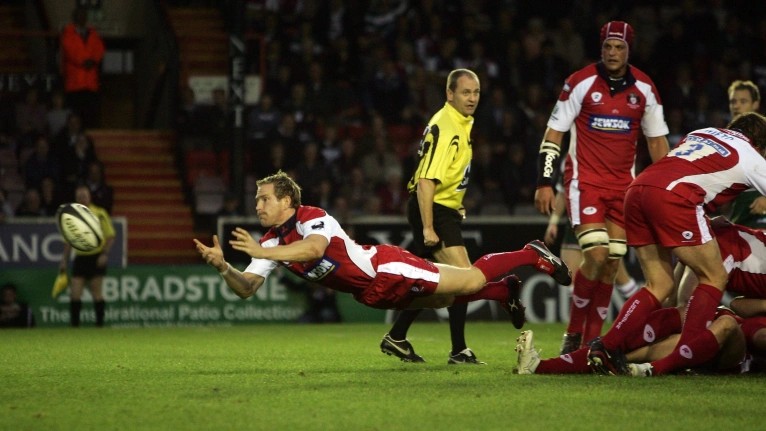
This isn’t Prendergast’s first taste of the Prem; he was Ryan Lamb’s occasional half-back partner at Gloucester in 2007/08, the second year in a row that the Cherry & Whites finished top of the table but ultimately fell short of becoming champions.
With the explosiveness of Lesley Vainikolo on one wing, the elusiveness of James Simpson-Daniel on the other and Lamb and Anthony Allen pulling the strings in midfield, plus a pack that contained the aggression of fan favourite Olivier Azam, gnarly lock Pete Buxton and the scavenging skills of another local, Andy Hazell, Gloucester had a template for success, perhaps just not the mentality to execute it when it counted.
Dean Ryan’s attacking pod system was talked about as being revolutionary back in the day, and Prendergast says that Gloucester, like all the other environments has has experienced in a playing and coaching career largely spent in his native Ireland and France, have helped to shape his philosophy.
“It was quite a similar squad to here; we had a really good group of forwards, but also nice bits of x-factor backs-wise. Lamby was a brilliant talent, a great player to play with, and I am not surprised he has gone into coaching (with Plymouth Albion) because he loved the game and understood it very well. James Simpson-Daniel was another one with x-factor.
“I still talk about the short kicking game as a very good way of attacking as well, and Lamby, a bit like Finn, had that in abundance.
“Another club that I would mention in terms of that philosophy would be Racing. Again, we had a good deep squad, and lost to Exeter in the 2020 Champions Cup final in Covid. Finn was 10 that day.
“Looking back on that squad as well, there was the ability to do both. Sometimes the attack might not have clicked but we had a maul, a scrum that would have got us out of a hole, or, likewise, there might have been times when we were met head on set-piece-wise, but we had the ability in our attack to go to that and score tries and win games. I think the overall balance is really important.
“If you look at South Africa, they have obviously got what they have up front, but what Tony Brown has brought in as balance as well. If they aren’t getting their own way, they have the ability and that running game and x-factor out wide that they can go to in tight games if they are a score or two behind, and sometimes it comes down to that.
“If you look at playoff games: quarter-finals, semi-finals, finals, they are generally tight games and it comes down to moments. But if the game is tight, you can’t just pull a ball out, or expect a bit of shape, it has to be in-grained in you as well. It doesn’t mean you have to go there all the time, but you have to have it in your pocket, and it is how we train as well.
“All the different experiences I’ve had as a player and as a coach, you take bits from it, and also from other coaches as well, that’ll have been a big learning for me.”
Munster have appointed former Hurricanes chief executive Avan Lee as their interim CEO as the province prepares for Ian Flanagan’s departure at the end of October.
Read Now
1 YEAR TO GO
The countdown is on until the biggest Men’s Rugby World Cup ever kicks off in Australia. Go All Out and secure your seats with tickets now available!
Join free and tell us what you really think!
Sign up for freeWith Antoine Dupont no longer an automatic choice at scrum-half, Bordeaux's Maxime Lucu could take centre stage in November.
For so long, a ding-dong rivalry, if the Wallabies renaissance can continue, the Bledisloe Cup has the kudos to rival RGR
The inaugural Nations Championship represents the first major opportunity to embrace private investment, but only if the game is accessible.
Didn’t Ellie Kildunne and Meg Jones ‘flip flip’ to 7s for the Olympic Games in Paris?
I’m pretty sure the Chaban-Delmas accommodates a lot of families P.😉
He left out the worlds best 15 - Warrick Gelant👀
If the Bledisloe doesn't matter, why do the ABs try so hard to hold onto it every year?
So YOU obviously hope. Do you say that with your fingers crossed?
Would love a Bledisloe tour every 4 years
Yeah that needs to change. Im not sure how yellow carding a player helps a scrum get better.


 Clear
Clear 


 Copy link
  Facebook
  X/Twitter
  WhatsApp
  Messenger