
Ten minutes before the end of a coruscating European Champions Cup quarter-final on the Atlantic coast, Romain Ntamack saw his chance. His opposite number Matthieu Jalibert had exposed his ribs as he stretched out for the miracle catch and offload on the run, the décharge sensationnelle. The former French number 10 picked up the hometown hero, ramming him unceremoniously into the billiard-table surface of the Stade Chaban-Delmas.
It was a copybook tackle and it must have hurt, but Jalibert looked up at the man who had done the damage and grinned through the pain. Somehow, that moment epitomized the new ‘greatest rivalry’ in French and European club rugby. There is friction, even enmity, between two clubs contesting the highest honours in the game, and individuals vying for the same spot in the national side. It is a family feud of Shakespearian stature. But there is also mutual respect, and a wider sense that both are playing their parts in an unfolding storyline with many scenes to come.
Even as they were both living in the eye of the storm back in the 1980s, Earvin ‘Magic’ Johnson formed a lasting friendship with his arch rival Larry Bird, in the tiny private spaces between their very public clashes in the NBA. But as a lifelong Laker he still hates the Celtics with a passion. When Boston won an 18th NBA championship in 2024, one more than LA, the 66-year-old posted on ‘X’: ‘I hate that the Celtics officially have more championships than us now’.
That was the predominant feeling of the NBA in the eighties. One of either the Lakers or the Celtics reached the finals in every season, and the Lakers won two of the three series where the two clubs played one another. The marketing men found themselves in seventh heaven with the dynastic contrasts.
The Celtics were blue-collar, with a structured half-court attacking game and a tough, aggressive style that mirrored their support at the Boston Garden. Detroit Piston John Salley viewed them as ‘the [first] real bad boys. The real bad boys were the thugs. The Celtics had guys that would hit you, didn’t even know if they were on the team or not.’
The Lakers were pure Hollywood with their all-court fast-break style on the counter. When the machine purred, it was ‘showtime’ with dunks, jams and three-pointers galore. Dancing Barry and the Laker girls, actors Jack Nicholson and Michael Douglas cheering from the bleachers and the A-listers in the Forum club looking down from on high.
The differences between Bordeaux and Toulouse may not be so unashamedly American in scale but all the stats point towards a classic contrast in styles.
Now the Girondins and the Toulousains are dancing their very own rugby version of the paso doble. There will be beauty and balance in the sequences along the way, but the dance always has to finish with a kill. The spirit of the rivalry was distilled by comments on either side of a 39-33 victory by the rouge-et-noirs in the 2025 Top 14 final, which was only decided in extra time.
From the red-and-black side, full-back Thomas Ramos: “The match was quite incredible, against a confident team. Perhaps, being champions today is more significant than being champions on other occasions. We’re proud to have beaten this team because it’s a title that, for us, comes from a very, very long way back.”
In the claret-and-white corner, scrum-half Maxime Lucu: “A match against Toulouse is never over. Playing matches like that is a treat, it’s a pleasure. The frustration is enormous. They had the frustration of the European Cup. We felt that, and they came to get the French championship title. We tried. We gave it our all. Today, we fell with weapons in hand.”
There is nothing to rival the sensation of the bitter-sweet; the knowledge that, win or lose, you are participating in a game of rugby for the ages, and a battle of dynasties rather than clubs. In some small way, you are fleshing out the shape of history. Maybe that is the feeling Ugo Mola’s charges will have now, after a 30-15 loss in Bordeaux put paid to their European ambitions for the 2025-26 season.
The differences between Bordeaux and Toulouse may not be so unashamedly American in scale but all the stats point towards a classic contrast in styles. Take a look at the following quick comparison table from the performance of the two clubs in the current Top 14:
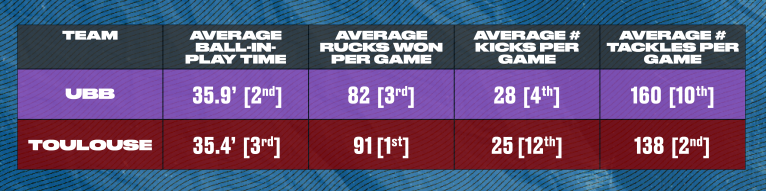
Both teams are able to manage higher ball-in-play times, as you would expect of two such high-quality outfits – only Lyon rank higher in the Top 14 at 36.6’ per game. But Toulouse are much happier to grind away with ball-in-hand and all-world scrum-half Antoine Dupont steering the ship; making fewer tackles per game than any other club bar Ronan O’Gara’s La Rochelle and in the bottom three for kicks launched.
The reverse is true for Yannick Bru’s men. The Bordelais play primarily off their No.10 Matthieu Jalibert and are conditioned to manage long kicking duels and far more protracted periods on defence, with the grand strategic aim of creating as many transitions from defence to attack as possible on their own terms. That sets the basic scene for battle.
Now let’s look at the quarter-final through the lens of the same stats:
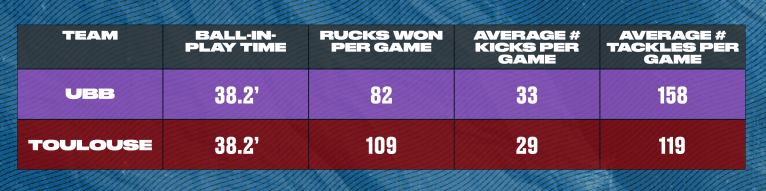
Ball-in-play time was a lot higher than the Top 14 norm, partly due to the presence of a referee from the English Prem, Matt Carley. The tactical envelope was stretched to the limit with the addition of those three extra minutes. Bordeaux launched five more kicks than their normal Top 14 average, and Toulouse set an extra 18 rucks.
It lent the game at the Stade Chaban-Delmas a definitive character, and ultimately it favoured the home side more than it did the visitors. Toulouse kept the ball for long periods, probing patiently for weaknesses. They carried the ball into contact on 34 more occasions than the current champions and forced them to make 39 extra tackles, while making fewer breaks [four to UBB’s 10] and accruing less post-contact metres, averaging 1.01 metre-per-carry compared to UBB’s 1.63m.
The biggest problem of all for the men from the Haute-Garonne was escaping the stranglehold of UBB pressure at the defensive breakdown. By the end of the game, UBB had won 11 turnovers in and around the tackle area, shared among seven different players in the team. A ruck retention rate of 90%, losing one breakdown battle in every 10, will not win you any prizes at this level of the game. There are no medals for trying.
Two long attacking sequences in the first 10 minutes set the pattern for what followed:
— William Bishop (@RPvids1994) April 14, 2026
— William Bishop (@RPvids1994) April 14, 2026
Over the one minute and 23 seconds, and 12 rucks, that these two sequences last in total, there is a serious competition at nine of them. As soon as Toulouse are forced to over-resource the ruck, committing big second-row Manny Meafou as either the third or fourth man at 3:14 in the first clip and at 11:58 in the second, the UBB defence knows it will be short of support on the following couple of phases. That is the trigger for turnover action – a jackal by prop Jefferson Poirot in the first sequence [one of three on the day by the loose-head], and a strip by Jalibert in the second. As soon as they gain precious transition ball, the Bordelais instinct is the same: to shift the ball towards the extreme speed and skill of Louis Bielle-Biarrey on the left edge.
The second major problem for Toulouse was the variety of the Bordeaux competition at the breakdown. UBB won seven turnovers by jackaling on the deck, but they also weaponized the counter-ruck on two other occasions:
— William Bishop (@RPvids1994) April 14, 2026
— William Bishop (@RPvids1994) April 14, 2026
As soon as the Girondins sense weakness – an inside back, Ntmack, against forward Maxime Lamothe in the first instance, and one back [Teddy Thomas] against two or three in the second, the men from Bordeaux do not hesitate to commit to the contest, and it was their fine instinct and situational awareness on breakdown D which won them the game as much as anything.
The third big problem for Toulouse was that the pressure did not slacken in the final quarter, it ramped up further with the arrival of big 150-kilo Ben Tameifuna from the pine. The proud son of Tonga won three more turnovers all by himself:
— William Bishop (@RPvids1994) April 14, 2026
— William Bishop (@RPvids1994) April 14, 2026
The stopping technique linked to successful jackaling makes for compelling viewing in the first clip. The tackle is a low knockdown which allows the ball-carrier to pass over the top of the tackler and temporarily separates him from his support, leaving him exposed to the attentions of Big Ben. As soon as the counter is on, Matthieu Jalibert appears as if from nowhere, and the rabbit is out of the hat.
Stade Toulousain may possess the best single jackaler in the Top 14 – probably in the whole of European competition – in the shape of Jack Willis, but the ex-Wasps and England man was overwhelmed in the aggregate, by the efforts of the UBB defence en masse at the Stade Chaban-Delmas.
The Girondins won turnovers from eight different positions on the field, from forwards and backs, from their starting line-up and the bench alike. It was all too much for the Toulouse possession game by the finish. The war of the two dynasties will surely continue in the future, but as the page turns on the current chapter, Jalibert is still smiling.
NEW IN THE APP: Official World Rugby Rankings hub! Compare team rankings side-by-side, with data going back 20 years.
Download the RugbyPass app on the App Store (iOS) and Google Play (Android) now!


Yes - and most teams are deploying serious mass at 12 and if Super Rugby is anything to go by, 12 will invariably be among the highest tackle counts and carriers. I tried to do a quick comparison to the 6N and its appears unsurprisingly that the loosies and 12 share those stats overall. No surprise then that some of the 12s have loose forward dimensions. It may get to the point that 12 must have the skills needed to pack down. Fainga’anuku at 7 for the Crusaders is ideal preparation for that hybrid role and I would not be surprised if we see Tavatavanawai there for the Highlanders soon.
Every Top 14 side seems to have a massive THP [or two]. Ofc there are inherent risks bulking up with forwards on the bench in terms of positional coverage in the backs… so you may need a proper hybrid to make it work.
That brings to mind the Hurricanes and how they had been able to play this season until they met the Chiefs. I also think it’s really great how these two can play up to 4 games against each other, work out new plans, where the Chiefs and Canes will play twice if lucky (will be guarantied next year with a better format). Does this sort of match create a similar dynamic?
You obviously detailed how UBB could still play to their counter attack style, but about from highlighting a loss of ball for Toulouse, they still had the superior possession count their stats depict as normal. So did either have trouble playing their game?
Also interesting how a greater half of the comp are with 3 kicks average of each other. Would have thought the spread would be similar to the other two stats.
Also very interesting how UBB try to stay on their feet in the ruck, is this a Top 14 rule variation or interpretation, or a ploy only they use to give them better counter ball? I love that it’s successful (though I thought it strange Moefana didn’t ruck the ball back) and which it could be baked in and replace people going off their feet.
Tamiefuna is a true monster and hence my assumption! But if they are usually smaller, then it would be interesting to map their performance over time and their success overall relative to their mass. I have not analysed the 2025 6N, but France winning the 6N is not inconsistent with the basic thesis. I guess the point is that France has been exploring how to utilise its available mass, and based the last 6N tend to win when it can sustain the greater mass of the full 80 minutes.
One of the interesting facts here is that France used the 7-1 split in the 2025 6N but never went further than 6-2 in 2026. How does that affect the net mass theory?
The UBB tight forwards have been generally a little smaller than many other Top 14 units. They do not have a 140 kilos monster like Meafou or Taofifenua or Vander Mescht - who used to play for Stade Francais - in the second row.
I have added the stats from a real professional database on the number of scrum pens - three to one SA, not 13 as you claimed - the total number of kicks by France (30), the number of contestable kicks within it (6), and the number Penaud could contest to his side (3).
Any professional analyst worth his or her salt would tell you that the 3-1 scrum pen advantage would be seen as ‘useful but not decisive’, and that the impact of any new French contestable strategy, and especially those kicks directed to Penaud’s side, was negligible.
If you have any evidence to the contrary I am all ears. But I do mean evidence, hard facts.
No hearsay, no wild assertions, no deflecting towards some other source. Just facts.
I have been following this discussion - it makes very interesting reading. I am following it as an AB supporter trying to work out how to beat both SA and France - so I am definitely neutral on all of this 🤣.
As NB may recall from other posts, I have been analysing the “mass” (collective height and weight) of the forward packs to see whether there is any relationship between mass and success. Unsurprisingly perhaps the Boks and France are winning most contests when playing with the bigger “mass”. In fact the Boks only lost last year when playing with a collective pack mass that was smaller than the opposition. France are the 6N champions having consistently fielded the pack with the biggest collective mass. France lost to the Boks fielding the smaller pack, though not by much. But what the Autumn international and the 6N started to show is that France is still learning how to best assemble that collective mass over 80 minutes and the distribution of that mass between the tight five and the loosies. They got it wrong against the Boks, Scotland and nearly against England. (BTW as NB knows I dont accept his thesis that the Boks won with 7 forwards in the second half. Esterhuizen played in the forwards at key times.)
In any event, what we are seeing though is when they (France) get it right, they are unlocking the most destructive backline in the World at the moment. And this is where the distribution within the forward mass is critically evolving in the French game as they seek to offset the tight five dominance of the Boks with a “back” or “loose” five that is both big and mobile. The effect of this when it works is that they are less reliant on the programmatic rugby (including contestable kicks) strategy that characterises the Bok game - which I don’t think any team can play better than the Boks. They can play what I have always seen as the best French game, based on highly skilled intuitive play - and this is where from my arm chair in NZ, Dupont is key.
Unfortunately I dont have access to the French competition. But just from watching these clips, my guess is that UBB has a big pack that dominates the collisions and the first and second phase engagements much like the Boks. If anything I found the clips frustrating to watch as it is league like in its formula - big collisions until a mistake is made.
Ha, Ha. Throughout this conversation, you seem to have had trouble telling what is relevant and what isn’t as well as trouble with wandering off the point.
Also, while I replied to all your arguments, you’ve repeatedly picked out just one or two of several points made in each of my comments, which in the absence of any evidence to the contrary, I can only assume is because you have no rebuttals of the others, even feeble rebuttals, like the ones you do employ.
The main point of dispute, as you should know well, was whether Dupont lost two matches v SA, including the one last autumn - when he wasn’t in the team - and one of the subthemes was not the number of penalties, a subsidiary detail, but whether the weakness of the French scrum affected the match. I again suggest that you listen to the For the Love of Rugby podcast, with Dan Cole and Ben Young.
We’re not going to agree, and the readers of this thread, if there are any, can make up there own minds, on the basis of what we’ve written.
Serious question - are UBB utilising LBB as much as they should be?
When they move the ball through the backs so LBB faces you (and knows you have to turn), he’s either got the gas to kick over you and win the foot race, or simply do you on the outside as you start to turn.
I’d love to know what percentage of his 1 on 1’s chances end in tries (it’s high) and whilst he almost seems unplayable at times, it begs the question are UBB using him enough?
Should there be more cross field kicks for him to chase, should they be doing more miss passes to get the ball in his hands and maximise the space to give him the outside 15m channel.
It also explains why he has so few hat-trick’s and 4 or 5 try games - he really should do with his advantage, which is why the question sounds nuts but it’s actually a fair one - do UBB utilise LBB enough?
A whole new can of worms P, tho I suspect he already makes many more endurance sprints than most in a game!
Its curious to see but the most successful modern teams dont build the most rucks, make the most passes or maintain heavy possession. They kick more, maintain more territory, are deadly off turnover, turnover the ball at ruck in the tackle a hell of a lot and tackle more in general. Hurricanes in SR right now, UBB in Europe, even Leinster on trend having won the URC last year and have been trending in that direction for a while now. Springboks in international rugby are the same and France are right on that trend too.
Fair comment. Scotland are the big ruck-builders right now, beat France one week with 130 rucks and no turnovers but could not repeat the dose v Ireland…
2 of the top 3 or 4 club teams in the world right now and part of an exclusive club of top tier teams that seemingly can beat anyone. I would think Leinster are firmly in there. Maybe the canes on current form but they cant match these teams for squad depth and form is temporary. Would reckon those 3 set themselves apart from all others just by their sheer success over the past 5 seasons and continuous habit of finding themselves in the top 3 of the champs cup. The depth within their set ups is unrivalled as well. Bath could play themselves into that exclusive club with consistent and sustained success and Northampton are not far behind them. A win against UBB this weekend would put them firmly in the top bracket but with UBB on song its hard to imagine them faltering. Even so Bath and Northampton are definitely knocking on the door.
I suspect UBB adn myabe Toulouse are a cut above, but I would not put Leinster in the same stagory right now for a variety of reason. More similar to Glasgow, Saints and Bath currently, next level.