
The Covid-19 pandemic demanded its pound of flesh all around the globe and showed no mercy. The loss was not only counted in lives and in long-lasting physical and mental health damage to the survivors, but in the economic trickledown effects. For Australian rugby, that meant the termination of its fruitful 30-year association with the Qantas airline at the end of 2020.
When the end came, the tone was bald and devoid of any ‘spin’: “Qantas has had a very long association with the Wallabies, and we’ve stuck with each other during difficult times. Unfortunately, this pandemic has been the undoing. Like all Australians, we’ll continue to cheer them on from the sidelines.” As the airline’s chief customer officer added tersely, “while we’re dealing with this crisis and its aftermath, the cash cost of our sponsorships has to be zero.”
The major sponsor adorning the front of those green-and-gold jerseys may have changed from airline to chocolate manufacturer, but Australian rugby’s love of the airwaves has not. With so many of its contact sport athletes having a background in Aussie Rules, Australian rugby has never been short of big men who can jump to exalted heights, and catch the ball whatever the pressure.
From Brendan Moon and Roger Gould on the ‘Invincibles’ 1984 tour, through Damian Smith and Joe Roff in the 1990s, Chris Latham and Lote Tuqiri in the noughties, Adam Ashley-Cooper and Israel Folau in the last decade and Suliasi Vunivalu, Mark Nawaqanitawase and Joseph-Aukuso Suaalii in the present day, Australian rugby has always produced big, rangy athletes who can make try-scoring in the air looks absurdly easy.
Any Folau aerial highlights package from his time with the Wallabies would be a list unto itself. The man made winning ball in the air look like child’s play, even against international opponents.
You get the picture. Australia has probably the most illustrious lineage of aerial ball-winners on planet rugby, and there is a ready overlap with the background to head coach Joe Schmidt’s success in Ireland. The Kiwi supremo was able to draw on strong Gaelic football roots in the Emerald Isle, in the same way Australia has always derived strength from the ARL to build an outstanding contestable kicking game with the national rugby team.
Back in 1992, Schmidt even played a game of Gaelic footy for Mullingar Shamrocks while coaching the local rugby team in West Meath. Somewhere in among the Keaveneys, Fagans and a trio of Maguires you’ll find a craftily-disguised ‘Joe Smyth’ in the match program, a mysterious Kiwi who helped the club to victory over rivals Milltownpass by “racing up and down the wing in a most impressive manner”. John Fagan, who played senior [Gaelic] football for Mullingar Shamrocks and doubled up as President of Mullingar RFC at the time, was the man who recruited Schmidt to Mullingar rugby and set him on the path to glory with Leinster and Ireland.
The crossover between the sports is too obvious to ignore, and Schmidt will be looking at ways to exploit it with his Wallabies in the last four rounds of the Rugby Championship. The catastrophic third-minute ACL injury suffered by incumbent full-back Tom Wright has only highlighted the need to make the most of Australia’s resources in the back three, on top of prior injuries to Dylan Pietsch [fractured jaw] and Harry Potter [hamstring].
With 6ft 4ins apiece of Nawaqanitawase and Jordie Petaia leaving for the NRL and the NFL respectively before the season ever began, Australia lack the big wingers who have always been such an influential factor in national selection and success. While the acquisition of leaguer Suaalii in the trade with Sydney City Roosters was a huge coup for rugby, Nawaqanitawase’s move in the opposite direction left an even bigger hole.
Marky Mark has arguably progressed quicker in league than Suaalii has in the sister code, to the point where he was mentioned in dispatches as a potential bolter for the New South Wales State of Origin squad. He was moving into world-class when he left and he has continued to develop in a strange new sport.
<blockquote class=”twitter-tweet”><p lang=”en” dir=”ltr”>MARK NAWAQANITAWASE IS OUT OF THIS WORLD! 🤯 <a href=”https://twitter.com/hashtag/NRLBulldogsRoosters?src=hash&ref_src=twsrc%5Etfw”>#NRLBulldogsRoosters</a> <a href=”https://t.co/5J3RZQ98bK”>pic.twitter.com/5J3RZQ98bK</a></p>— NRL (@NRL) <a href=”https://twitter.com/NRL/status/1923344853510844498?ref_src=twsrc%5Etfw”>May 16, 2025</a></blockquote> <script async src=”https://platform.twitter.com/widgets.js” charset=”utf-8″></script>
With a growing raft of injuries in addition to those long-term absentees, Schmidt now has the chance to do a bit of structural re-engineering in his back three, to counter an effective Pumas contestable kicking game. Argentina will be a test of Australian depth and ingenuity.
It is highly unlikely Schmidt will want to go into the third-round game in Townsville with the unit which played most of the match in Cape Town: a short back three containing two sub-six footers on the wings [Corey Toole and Max Jorgensen] with Andrew Kellaway at full-back.
In the wet of the Cape, Schmidt must have been preparing his charges for an aerial barrage, and that is what they got. With Handre Pollard in the Springbok hot-seat at 10, the Bokke kicked twice much as they had up on the Highveld the week before, 35 kicks at sea level compared to a mere 18 in the altitude of Joburg. They squeezed out a big advantage from their contestable kicking game in particular.
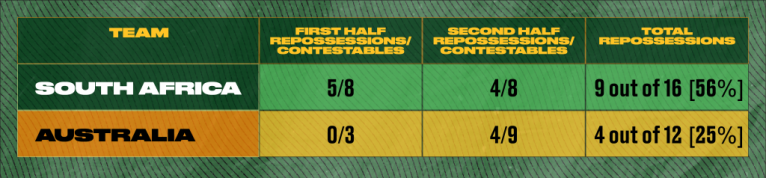
| Team | First half repossessions/contestables | Second half repossessions/contestables | Total repossessions |
| South Africa | 5/8 | 4/8 | 9 out of 16 [56%] |
| Australia | 0/3 | 4/9 | 4 out of 12 [25%] |
The backfield of Kellaway, Toole and Jorgensen lost six defensive balls in the air between them.
On two consecutive plays the real Springbok ‘bomb squad’ set up one-on-one contests between the rival wings, and South Africa come out on top on both occasions, on the first occasion through Cheslin Kolbe on the left and on the second via Canan Moodie on the right.
A lightweight backfield can also create problems with managing the contact situations which arise just after a receipt has been made.
In the first clip Wright makes the catch but Suaalii seals off the ball at the ensuing breakdown, while the ex-leaguer cannot stop RG Snyman winning the ball after Nic White is scragged in the second.
The Wallabies did improve markedly in the second half when chasing their own contestable kicks, and Schmidt will be especially pleased with the box-kicking accuracy of Tate McDermott, who played almost 70 minutes after an early injury to White. Tactical kicking has been one of the weaker areas of the Queenslander’s game hitherto, but in the Cape he was right on the money, twice forcing replacement full-back Sacha Feinberg-Mngomezulu into touch with precise high lobs into the 5m corridor.
There was just a hint of what Toole or Jorgensen might be able to achieve on the counter if Australia can secure the ball in the first place, but the question is whether Schmidt can afford to pick two small wings in the same starting XV.
The obvious solution in terms of back-three balance, and from a historical standpoint would be to move an outstanding big aerial athlete into the back three, and right now there is nobody bigger and better in the air than 6ft 5ins-Suaalii.
He might not like it, but it would do his improvement curve a power of good to spend some time at number 14, and it would help Australia mightily too, given their current raft of injuries. As ex-Wallaby skipper Stirling Mortlock opined recently:
“He’s not going to like this, but when I first came through, I ended up having two full seasons on the wing. I didn’t like it at all. I hated it.
“[But] when you’re on the wing, you learn very quickly what you need from that 13 and that helped my development as a 13 massively.
“You don’t lose much if you put him on the wing and, in particular, what you do get is his aerial skills.
“He’s unbelievable with the high ball and cross kicks.”
Well said. There have been scarcely any glimpses of Suaalii’s aerial skills in either the Lions series or the double-header in South Africa, so why not get them into the game from the wing versus Argentina? Suaalii’s likely opponent would be Mateo Carreras, who at 5ft 8ins is even more diminutive than either Toole or Jorgensen. With his leaping power to add to a nine-inch height advantage, that would add several arrows to Schmidt’s attacking quiver.
Perm one from two with either Toole or Jorgensen on the left wing, stick Kellaway at full-back to provide the communication and organisational skills, and watch the Wallaby back three fly. Qantas may not sponsor the green-and-gold anymore, but a temporary move to the wing could provide a proper lift-off in the union career of Suaalii.


Comments
Join free and tell us what you really think!
Sign up for free