
It is the single most mouth-watering, spine-tingling mystery of the forthcoming July series, before boot has ever been put to ball. What will be the make-up of the All Blacks team which trots out to play England in the first Test, in the glass hothouse of the Forsyth Barr Stadium in Dunedin? How will it play?
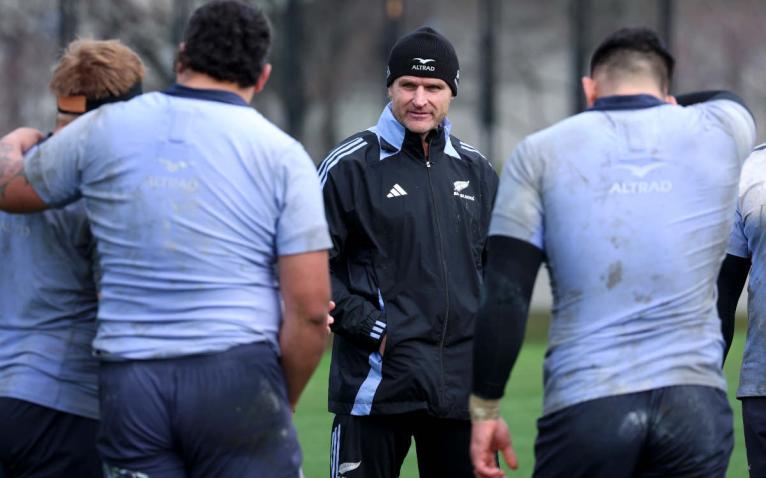
The only common ground with the dynasties of the recent past is the presence of Sir Wayne Smith as ‘performance coach’. Direct answers to the key questions have been few and far between, and Scott Robertson has been giving nothing away since the announcement of the 32-man squad to face the men in white.
The shroud of fog has only thickened with a selection split up by coaching responsibility:
“The way I set up my coaching groups is to ask them to select the area they coach.
Me: loose forwards. Jason Ryan: tight five. Scott Hansen: nine and 10. Jason Holland is midfield and Leon [MacDonald] the outside backs.
“They’ve all played in that area and they’ve all coached in that area, so they’re experts. They have tracked all the players and given them feedback throughout the season.
“In the end, I have the final call, but it makes it robust. There’s ownership and accountability. You have to own those selections and you have to own the players you have selected.”
It doesn’t give much clue, and neither did MacDonald’s following comments about a revolution in playing style:
“We ripped up the [Ian Foster] playbook and started fresh. We looked around at a lot of rugby, we’ve all had projects and come together. And we feel we’ve got a game that suits our players and the way we want to play the game at international level.”
But what is that game going to be, and who are the best players available to oil the cogs in the machine? There were hints in both the inclusions and exclusions from the recently-announced squad, which allow some reading between the lines, and give a strong premonition of the shape of the new All Blacks under ‘Razor’ Robertson.
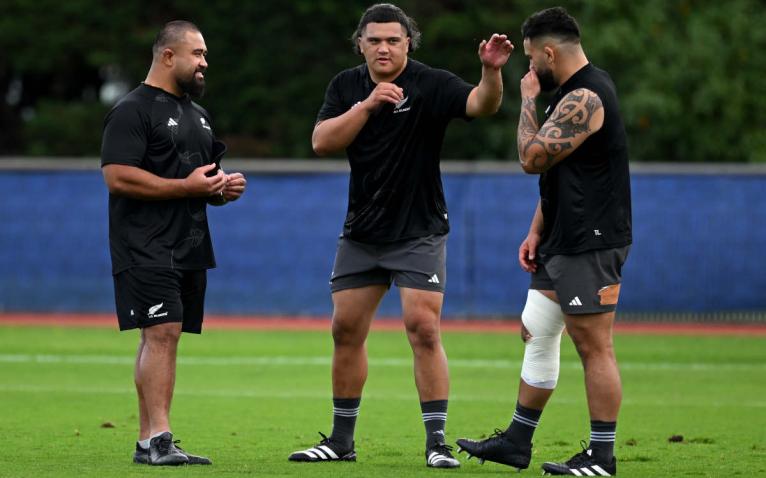
The front row selection contains three very large men at tight-head prop – Tyrel Lomax at 6ft 4ins and 130kg, Tamaiti Williams at 6ft 5ins and 140kg, and bolter Pasilio Tosi, all 6ft 4ins and 145kg of him, who understudies Lomax at the Hurricanes. As Sir John Kirwan commented on Sky Sport’s The Breakdown: “What is the All Blacks’ point of difference? We have these huge young men coming through [at prop] but they are also athletes. Are we looking at really dynamic [forward] ball-carriers, with late feet at the line?”
The other positions in the forward pyramid enjoy a plentiful trickle-down of athleticism and agility: from hooker at the apex, through a couple of second rows who have both spent a considerable amount of time playing six, all the way down to a back-row base which is almost certain to feature Ardie Savea as starting number eight. Here is ex-All Black turned pundit Jeff Wilson on the same show: “The selection of the three hookers [Codie Taylor, Asafo Aumua and George Bell] tells me the kind of athleticism [they want] – guys on the edge, carrying the ball out in the open spaces to play at high speed.”
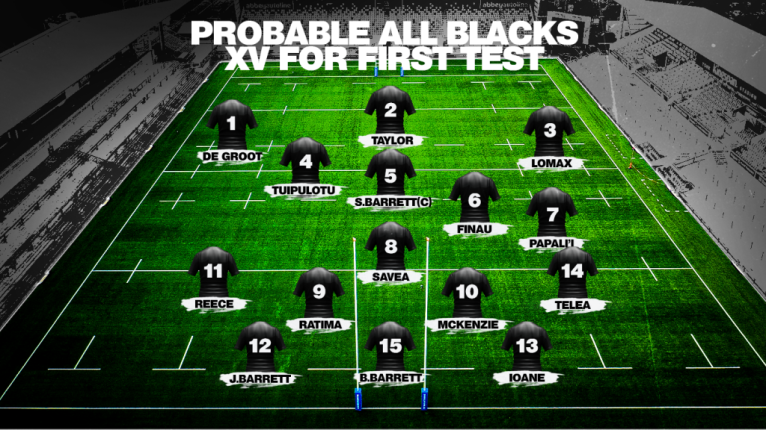
In the backs, nine of the players selected can play either on the wing or at full-back. Beauden Barrett has been picked as one of two fly-halves, but does anyone really doubt he will be shifted to start at full-back this month?
Kirwan: “We have a strong outside backs contingent, we have taken more outside backs than midfielders. I think with a northern hemisphere opposition and South Africa, a specialist full-back is fundamental and we need to be nailing the high ball.”
Wilson: “Barrett has been named as a first five-eighth but I am expecting to see him at full-back. We have taken four specialist wings but with no specialist cover at full-back.”
The selection has the philosophy of the great silent partner, Smith, writ large in the margins. His fingerprints are all over the paper: big men at prop, but athletes rather than pure power-players at all the other six spots in the pack; a heavy weighting to explosive quality in the back three, which even extends to the men likely to be picked as the starters in midfield – the trio of Damian McKenzie, Jordie Barrett and Rieko Ioane have all played international rugby at full-back or on the wing.
These All Blacks will not be espousing the style of the winners of Super Rugby Pacific, Stern Vern Cotter’s Blues, nor will they be perpetuating the ball-control philosophy of Australia-bound Joe Schmidt. They will be built on lines far closer to Smithy’s beloved Chiefs.
In the recently concluded tournament, the Blues ranked top in active time-of-possession [19.4 minutes per game] while the Chiefs rated a lowly fourth of the five New Zealand franchises at two minutes less per game. The Blues scored only 48% of their tries in the first three phases, the Chiefs upped that to 67%.
Cotter’s men averaged 107 rucks per game with 65% lightning-quick ball – the other four provinces averaged out at 85 rucks with 48% of LQB. Scott Robertson will likely opt for the second of the two templates and shun the lessons of that Auckland triumph at Eden Park. That is why there are only three Blues among the 18 squad forwards selected, despite Cotter’s pack carrying all before them at provincial level.
It is also why an eight as good as Hoskins Sotutu was passed over, much to Kirwan’s consternation: “Hoskins has played well all year, so he will be disappointed. I don’t know what more he needs to do.”
The back-row stats make for interesting reading. Here is a table including Razor’s picks, plus a couple of the likely lads who missed out.

- Ethan Blackadder [injury meant less than 400 minutes played] and Ardie Savea [playing in Japan] are excluded from the table.
During SRP, the Blues carried more but passed less than the Chiefs, they generated fewer line-breaks and used the grind of pick and go and one-out run in a ratio of roughly 2:1 compared to their grand final rivals. The stats at number eight say all that needs to be said: Sititi offers a big future: great work rate and more explosiveness on the carry, but Sotutu is the more rounded forward right now, particularly at lineout, in the passing game and at breakdown. There is no place for a ball-carrying number 7 such as Peter Lakai because carrying will not be a primary need in that spot.
The problem for Razor and Smithy is the Chiefs’ fluid counter-attacking model was totally overwhelmed by the Blues’ ball-control game in the final. A comparison of the stats at eight provides a case in point. Sititi’s numbers were impressive in isolation: he posted 20 tackles and 9 carries for 71 metres with six breaks or busts, compared to a mere five stops by Sotutu, who ran 15 for 76m with no breaks at all.
It was the Blues man’s all-round ability which counted for more. Sititi began the game with a bang.
In both clips, there is the requisite late footwork at the line and terrific lower body power to beat the first defender. But the game offered by Sotutu was far more wide-ranging. The Auckland eight topped the lineout charts, winning six of the Blues’ throws and stealing one of the opposition feeds.
On the Blues throw, he was equally comfortable setting ball off-the-top or on the drive.
On this evidence, Sotutu is the best back-row lineout forward in New Zealand, although the Crusaders’ Cullen Grace might argue the point.
He also possesses better balance between run and pass than Sititi, and keeps the option between the two open for longer, particularly in the all-important red zone.
Late hands at the line, or late decision-making at the base, may be just as valuable, if not more so, than ‘late feet’!
There is no doubt Robertson’s All Blacks are following a very different star to Ian Foster’s charges over the last World Cup cycle. With Smith at his shoulder, Razor will take a step backwards, returning to New Zealand’s favoured kick and turnover counter game to move forwards once again. With McKenzie and Barrett likely to be paired together in the Kiwi backfield, it is too good an opportunity to pass up.
The ball-control preference built in by Schmidt over the past two years will be dumped, and the success of Cotter’s Blues ignored. Whatever happens in the upcoming series, these All Blacks are already balanced on a razor’s edge.


Comments
Join free and tell us what you really think!
Sign up for free