
Former England and Australia boss Eddie Jones loves new trends in the game. With the Wallabies at the 2023 World Cup, he picked blindside flanker Josh Kemeny as a ‘utility player’ to cover both the back-row and the centres and wings in an emergency, perhaps in fond memory of the old Queensland wing/number eight Radike Samo.
Jones’ experiments were fine-tuned to the occurrence of World Cups. At the tournament in 2015, he had moved number Japan eight Hendrik Tui to the wing in a warm-up fixture versus Georgia to ‘play him as an extra runner off nine’. In his next incarnation as England head coach, he suggested at the beginning of 2019 Exeter wing Jack Nowell had the potential to become a top-shelf number seven.
In the 2022 Six Nations game against Ireland, England second row Charlie Ewels was sent off in only the second minute, and Jones got his wish, with Courtney Lawes shifting into Ewels’ spot and Nowell promoted to the flank.
The expansion of skill-sets in certain positions has been both noteworthy and ongoing. In my recent interview with new Wallaby assistant coach Geoff Parling, the ex-Leicester, England and Lions lock name-checked a new breed of hooker north of the equator: Dan Sheehan, Theo Dan and Curtis Langdon. While New Zealand has produced a succession of rakes who can play as an extra back in the wide channels on attack, such as Dane Coles and Codie Taylor, the combination of size, athleticism and footwork embodied by Sheehan is a new development again.
Parling went on to pinpoint the importance of a combination of passing skills and decision-making by number sevens at the lineout:
“You look at the quality of [Leinster seven] Josh Van der Flier’s pass from the dummy maul, the width they get off it is unreal. But in general, the quality of passing from the base by open-side flankers in Super Rugby is better.
“You cannot overstate the importance of a good ‘ripper’ [number seven] punching the ball straight through the maul, or passing away from it to hit the nine out wide.
“The slickness of the decision-making there is key. There is also more attacking focus on the extreme edges of the lineout – over the top and straight into midfield, or drop throws down the 5m corridor at the front – because of a greater congestion in the backline.”
One of the most unexpected advantages Ireland enjoyed during their historic 2022 series win in New Zealand was the amount of production they got out of the number seven position. While Sam Cane and Van der Flier sat on roughly equal terms in the traditional openside roles of tackles, breakdown pilfers and first-man ruck attendances, the Irishman carried the ball on twice as many occasions as the Kiwi skipper and delivered a slicker passing service as the ‘+1’ insert, or receiver from lineout.
Cane has announced his retirement from international rugby at the end of the current season, but as former All Black Israel Dagg suggested on SENZ Radio, there is an accompanying feeling the decision may not have been entirely voluntary.
New head coach Scott ‘Razor’ Robertson is looking for both a new skipper, and a wider range of skills from the blue riband position in the All Blacks.
“I get a sense there was a shoulder tap from ‘the one and only’ [Robertson], saying: ‘G’day son, I think the writing is on the wall in terms of where you are seen in New Zealand rugby. Scott Barrett is going to take over the captaincy’. I think this was forced to be completely honest.”
The heir to the throne may well turn out to be Blues skipper Dalton Papali’i, who arguably could have offered a crucial upgrade even earlier, at the 2023 World Cup itself.
The current yardstick for a multi-skilled number seven in Super Rugby Pacific is probably Reds openside Fraser McReight. Here are the raw stats, quantified by averages per game, in a comparison between McReight and three Kiwi ‘likely lads’ [Papali’i, Hurricane Peter Lakai and Crusader Ethan Blackadder] looking to compete for Cane’s spot.
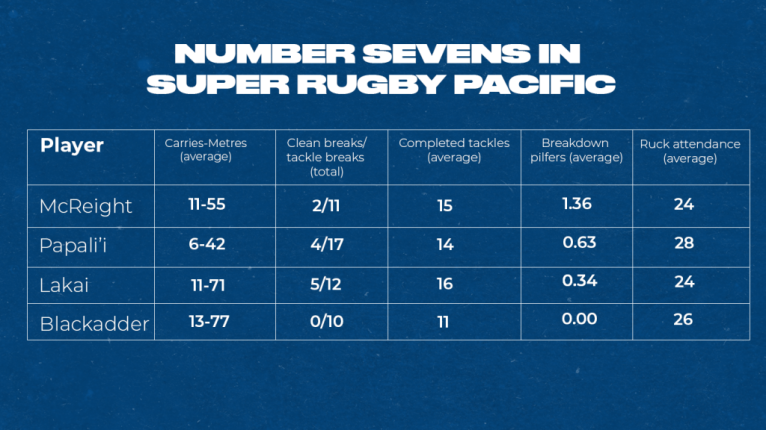
It looks as if Papali’i is asked to play a tighter role than the others at his club, with more ruck attendance and fewer carries; but as the brightly flickering spark of his international career has also already demonstrated, those carries are more likely be dynamic and powerful tackle-breakers. The Blues man shares that ability with Lakai, and all three New Zealanders can be useful auxiliary lineout targets.
McReight comes into his own as a pilferer at breakdown, a support runner on attack, and as a decision-maker from that key role as receiver from lineout – one ability which does not show up on the stats. Number sevens are effectively playing as a scrum-half in that position, and they require a nine’s passing skills or the power of a tight forward, depending on the choice of play.
In their double-header against Parling’s Rebels, the Reds scored seven tries from lineout and accrued no fewer than eight other penalties. That outstanding return came mostly from lineouts when McReight was stationed as the acting nine.
The position is full of decision-making: whether to drive straight on the ‘rip’ by McReight, or the slower poison of a transfer to hooker Matt Faessler.

The screenshot shows the basic formation, with McReight [red and white hat] set as acting scrum-half behind the line of forwards. But the first decision is subtle and linked to the speed at which the drive develops. In the first instance, the ball is transferred all the way back to Faessler and the maul is slower; in the second the pace is faster, with Fraser keeping hold of the pill all the way through to the goal-line and ‘the Fez’ a happy cheerleader.
When the plan is to break away from the base, the seven needs to decide whether he will become a runner or a passer.

In both cases the aim is to test the first defender around the end of the lineout [Rebels hooker Jordan Uelese] by running at a gap on his shoulder – on a keep-and-run by McReight, or with a pass to the flanker’s great brother-in-arms Harry Wilson.
At the same time, the seven needs to be able to multitask, supporting throws over the top, or playing as an extra centre in midfield when he is not impersonating the scrum-half.
In both clips, the Queensland number seven is playing the more traditional role of the first cleanout support on an initial carry from lineout, and in the second example it set the scene for a terrific long-range try by Jock Campbell.
Who is the first man up in support of Campbell? That’s right, it’s the ubiquitous man in the red and white cap wearing another of his metaphorical hats, and never very far from the ball.
If Joe Schmidt’s Wallabies are to compete with the mighty All Blacks this year, the contest at number seven will be a true-blue litmus test. Both sides are likely to be moving on from the previous generation, and the war between Michael Hooper and Sam Cane. Chances are, the green and gold troops will close the symbolic gap, whoever Razor picks.
If McReight succeeds, it will be because he is able to play as an eighth back and in his core role as a forward with equal facility, not least from lineout. Jones may not have gotten too much right in his second coming as Wallaby coach, but his notion of overlapping roles between backs and forwards in the game rang true. As McReight goes, so will Schmidt’s career as coach of Australia.


Comments
Join free and tell us what you really think!
Sign up for free