
It was only a couple of weeks ago ex-Wallaby flanker Jeff Miller branded both Wales and Georgia as sub-par opposition: “Winning three Tests in a row will give the [Australian] men a bit of confidence, but it was really against second-tier teams.” If Joe Schmidt wanted to find out just where his Wallabies stand in the global pecking order, it has become all too painfully apparent after a 30-12 reverse in the second round of the Rugby Championship against South Africa.
They are rubbing shoulders with their July opponents at the bottom of the top 10, and a very long way from seeing eye-to-eye with the top dogs [South Africa, Ireland and New Zealand]. They must even look up to Argentina, Scotland and Italy a few rungs above them.
Australia were fortunate Springbok head coach Rassie Erasmus chose to select 10 players who had played in the one-off Test against European minnows Portugal last month to start the game in Perth.
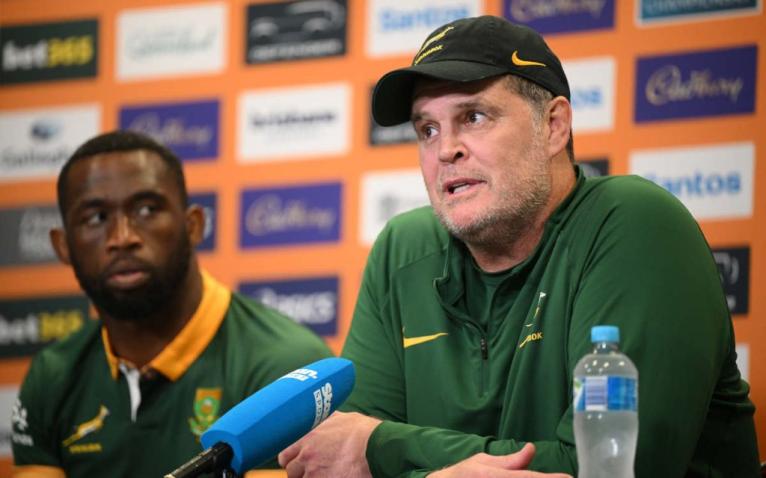
The Bokke mastermind attempted to dance around the issue in his pre-match comments, but without being able to disentangle himself completely from incendiary words like ‘nonchalant’ and ‘disrespect’, and not before taking as his ultimate point of reference the South African outfit which turned out at the Suncorp, rather than the Wallabies themselves.
A soothing silence would have spoken a lot louder than Rassie’s verbal placebo:
“We won the World Cup [in 2023], but it’s probably important to win the Rugby Championship and build into the next World Cup.
“This is not disrespect to Australia and this is not us feeling nonchalant about the game. This is us picking a team we feel is good enough to still get us the win against a tough Wallabies team that wants to bounce back.
“I think if this week’s team played against the Springbok team that beat the Wallabies last week [in Brisbane], they would give them a hell of a go.”
And Rassie was right. Over the past two weeks, the Springboks have beaten the Wallabies away from home, with two very different starting XVs, by a grand total of 63 points to 19, and by nine tries to one.
At the same time, there remains a nagging feeling the purposes of Rugby Australia and Wallabies’ new coach Schmidt have yet to move into a state of clear-cut alignment. Sydney Rooster Joseph Aukuso-Suaali’i is on his way from the NRL, and rumoured to be on the fast-track into the national squad in time for the 2024 end-of-year tour, while teenage sensation Max Jorgensen was rushed into Saturday’s matchday 23.
RA offered Suaali’i a one-year deal worth AUD $1.6m to jump the barricades, then had to shell out another reported AUD $1.6m over three years to keep Jorgensen from moving the other way, to the same club. That is an awful lot of money for an avowedly cash-strapped union to throw at two outside backs who are unproven at any level of the professional game.
It also ignores the two areas which will most concern Schmidt in the aftermath of the double-header against the world champions. The twin super-strengths of any Schmidt-mentored side are a superior kicking game and watertight ball-retention in contact, and at present his Wallabies possess neither.
The Kiwi’s frustration began to show in his post-match comments:
“We couldn’t just have a toe-to-toe battle with them. So, in our effort to do that, we undid ourselves a little bit, maybe over-kicking or trying too hard to get the ball into some space.
“Because not only are they very physical up front, but they are very tough with their speed in space.
“Even trying to combat a Springbok maul with a fully-fit pack is tough enough. With a little bit of half a pack, it became very difficult. And then we ended up [with] Seru Uru getting sin-binned. That is a really big ask.”
Read between the lines and the priorities are crystal clear: kicking game, physicality in contact, driving lineout defence. The Springboks scored three second-half driving lineout tries in the torrential Western Australian rain, and – hard as Lukhan Salakaia-Loto tried – the home side sorely missed the presence of the best individual maul defender on planet rugby.
The Will Skelton ship appears to have sailed, with Top 14 clubs now into the third week of their preparation for the season to come, and the big man’s head well and truly embedded in la mêlée. Ronan O’Gara’s coaching fingers are becoming increasingly sticky as the start of the French domestic season on 7th September approaches.
The kicking game should be seen through the lens of overall backline selection. At 15 Tom Wright is needed to provide playmaking support to Noah Lolesio, but he is a full-back who prefers to run rather than kick, and power-wing Marika Koroibete is cast from the same mould. With Hunter Paisami’s contribution largely confined to shorter attacking kicks, the reasoning behind the selection of 34-year-old veteran Nic White at scrum-half became obvious. There is simply no-one else in Australia with the strategic nous to control a game with the boot like ‘Whitey’.
In Perth, the Wallaby kicking game offered a succession of countering chances to the South African return team in the first quarter.
Wright correctly assesses he can beat the first flying chaser and set up an opportunity for Koroibete down the left, but when the wing chooses to kick ahead rather than keep ball in hand the tables are suddenly turned. Cheslin Kolbe is the last man you want to see returning kicks in a broken field, and only an uncharacteristic handling mistake by Sacha Feinberg-Mngomezulu spoils a straightforward scoring chance. On any other given Sunday, the Stormer catches that pass and walks in.
Almost immediately afterwards, Lolesio gave South Africa’s left wing Makazole Mapimpi another gilt-edged opportunity from a first-phase cross-kick.
Opponents have been trying to exploit the positioning of the man called ‘Mapimps’ ever since Richie Mo’unga tormented him with the kick-pass at the 2019 World Cup five years ago, but the Springboks’ backfield positioning throughout the game suggested the lesson had been well-learned.
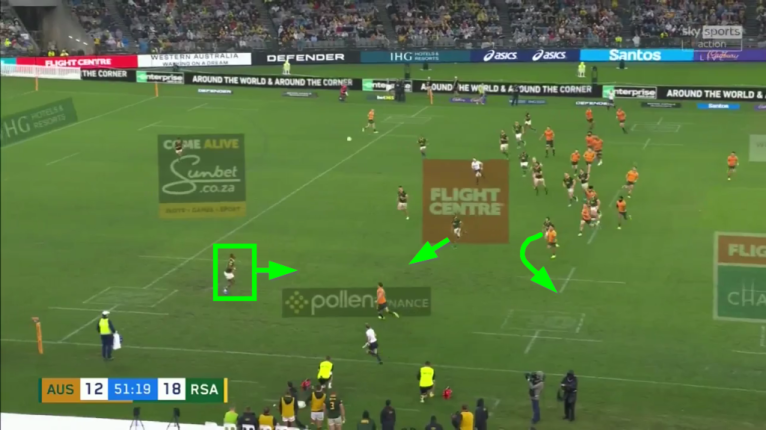
On this occasion Wright’s cross-kick goes to the other side, but the catcher [number 15 Aphelele Fassi] has already dropped off to receive it rather than jamming in as the outside ‘horn’ on the defensive edge. With Kolbe and Lukhanyo Am scrambling back in enthusiastic support, three of South Africa’s most dangerous men are concentrated in a thinly-defended area.
The Australian kicking game presented more of opportunities for the visitors than the home side as the game unwound in the wet.
Len Ikitau’s grubber through goes straight into Kolbe’s catching ‘mitt’, and the Wallabies find themselves tumbling back downfield, with the little magician failing to win 50-22 turnover by a matter of inches.
South Africa were equally well-prepared to punch some meaningful holes in Australia’s ruck retention when they looked to keep the ball.
Lolesio is static when he makes a telegraphed pass to Angus Blyth, and that encourages Feinberg-Mngomezulu to rush up and force the play back inside, where new Springbok rake Johan Grobbelaar [in the white hat] is waiting. The Bulls hooker is one of the most refined connoisseurs of the breakdown pilfer in the URC.
One of the non-negotiables in any ball-control offence is ‘power-and-placement’ from the 12, and an accurate first cleanout from the seven chasing him into the first ruck. In 2021, the Wallabies had Michael Hooper cleaning out over the top of dominant carries by Samu Kerevi, and they beat the Springboks twice in two weeks. Three years later, the work of Hunter Paisami and Carlo Tizzano left more to be desired.
Paisami struggles forward for a few extra post-contact metres but loses the ball in the process, and the Boks are geared to counter with the turnover ball, leading ultimately to a long kick-and-chase try by Fassi down the left.
The carry-and-clean link between Paisami and Tizzano was a problem one week before at Suncorp.
Paisami makes a second move on the ground after first contact, and Tizzano flops straight on top of the ball-carrier in his attempt to save a turnover. Referee Luke Pearce had a choice of two penalties against Australia within the same piece of action.
Over the two games, Tizzano gave up three penalties for the same indiscretion.
The Western Force flanker is clearly nervous about the presence of Grobbelaar nearby and goes straight to ground in his efforts to protect the ball.
There are plenty of issues for Schmidt to resolve before the next pair of matches against the Pumas in La Plata and Santa Fe at the end of the month. It is unlikely Skelton [or any other French-based player] will be available for selection for the remainder of the Rugby Championship, and that weakens his maul defence from lineout. If you can’t defend lineout drives, you cannot stop opponents scoring from entries to your 22m zone.
The Wallaby kicking game is nowhere near the standard Schmidt enjoyed during his time in Ireland. Back then, he had Conor Murray and Johnny Sexton in the halves, and Rob Kearney’s educated left boot at the back. Now his kicking options in all three spots are far less varied, and far less certain in outcome.
Likewise, the art of ball control at the breakdown is something he is having to teach from virtual scratch. It used to be one of Australia’s greatest strongpoints but now it is just another part of the rebuild. The French novelist Albert Camus once wrote: “Men must live and create. Live to the point of tears.” There will be plenty for Schmidt and his staff over the coming months and there is no shame in it. Shed the tears before any more talk of climbing the tiers.


Comments
Join free and tell us what you really think!
Sign up for free