
Who would want to be a defence coach right now? The opening weekend of the Prem delivered a record 52 tries, the chaotic Australia v South Africa classic in Perth nine more.
NEW: Follow Your favourites in the App 📱
You can now follow their favourite teams, tournaments and players in the RugbyPass App!
Rugby union’s ever-evolving balance between attack and defence has never been so strongly weighted in favour of the former.
Whether this is a good thing or not depends on your standpoint.
Professional rugby is in the entertainment business and a try is its crowd-on-feet, adrenaline-spike moment. Plenty of tries equals plenty of excitement.
Northampton, try centurions last season, started this campaign with nine against Newcastle on Friday night including hat-tricks for Tommy Freeman and James Pater. Some of the Saints’ interplay was sublime.
Newcastle’s ambition with the ball was equally clear and they scored four of their own.
Gabriel Hamer-Webb also touched down three times for Leicester in their 40-38 defeat to Saracens.
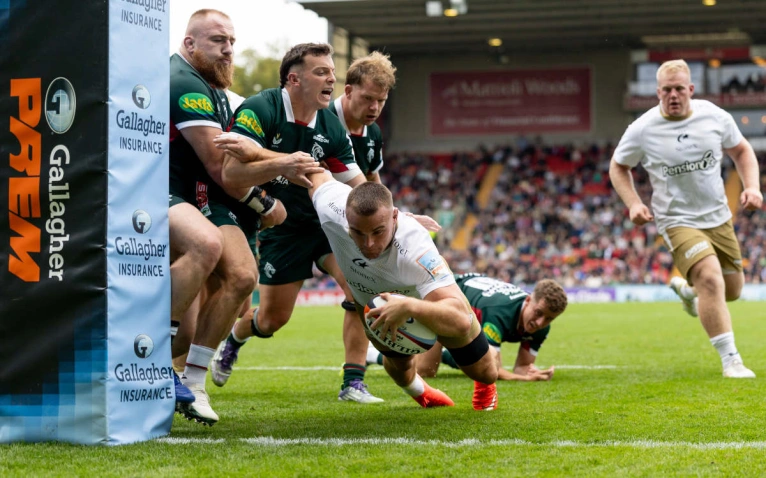
It wasn’t just the number of tries across the weekend but the variety of them too. Santi Carreras’s intercept and breakaway for Bath against Harlequins, engineered with his boot, was a pearl of instinct and innovation.
But in amongst the praise for the avalanche of attacking rugby there is also unease that the pendulum has swung too far; that defence is becoming obsolete.
Former England and Ireland defence coach Mike Ford was at the AJ Bell Stadium watching a game of eight tries between Bristol and Sale.
“You’d have to do a survey of fans whether they prefer 40-38 to a 12-9 or a 21-8 game but to me the balance probably isn’t right. It is frustrating at the moment,” he said.
“At the moment the interpretation of the laws is obviously favouring attack. The rucks are quicker and the guys who try to slow it down and jackal aren’t having much joy.
If I was a defence coach at the moment I’d be mortified by some of the scores. Even internationally. The France-England game last season I just didn’t enjoy. It was a bit basketball-ified.
Mike Ford
“I think that’s what the Prem want but for me, as a coach and as a spectator, I hate those sort of you-score, we-score games because the culture of a club is usually built around what you do defensively. People can see from that whether you are going to work hard for your teammate, get off the ground and go again.
“If I was a defence coach at the moment I’d be mortified by some of the scores.
“Even internationally. The France-England game last season I just didn’t enjoy. It was a bit basketball-ified.”
There are many paths up the mountain when it comes to a good rugby match.
In rugby league, the women’s Super League Grand Final on Sunday finished 8-6 to York against Wigan and featured an entirely scoreless second half. Sounds boring? Far from it. It was gripping fare as an underdog team tackled themselves to a standstill to lift the trophy – led by a teenage rugby union player from Northern, Amelie Lenham, who is surely destined to be a Red Rose one day.
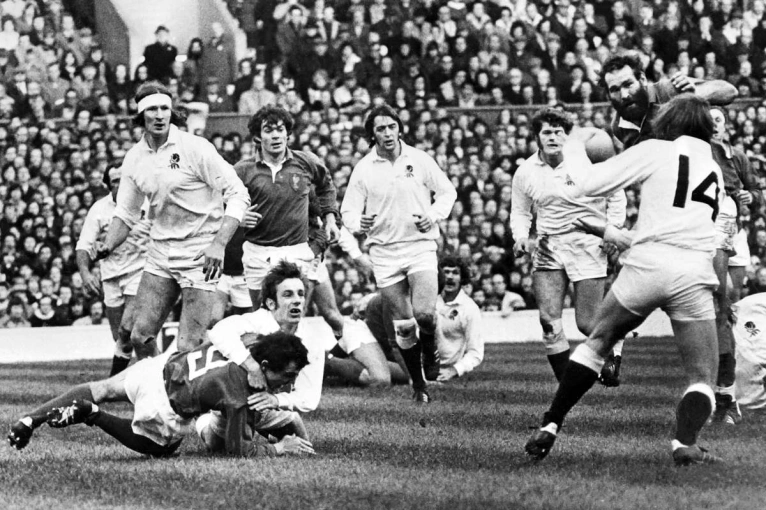
In union too, a low-scoring game – as long as there is jeopardy in the result – can be hypnotic.
At the same time you wouldn’t want to go back to the turgidity of the 1963 Five Nations game between Scotland and Wales when Wales prevailed 6-0 at Murrayfield in a game of 111 lineouts.
There is a balance to be struck.
It should be taken into account that this is September and in Europe the conditions are ripe for moving the ball. Come December and January games could well tighten up.
But from an admittedly small sample size this season promises to be a high-scoring one.
The URC, after one round, averages 6.9 tries per game, the Top 14 in France 7.3 after four with the Prem out in front with an average of 10.4 tries per match after the opening weekend.
The contest for the ball on the ground is more difficult now for defenders because of the adjustment to breakdown interpretations.
The end to blocking around the catcher in the aerial contest has created more broken-field, unstructured opportunities.
This season’s move to tidy up the maul with the enforcement of the law which stops defenders loitering on the wrong side will almost certainly see more catch and drive tries because of it.
They are having some blowout scores in the NRL because of some new rules to speed up the game. The debate there is the same. Have they gone too far in favour of attack? The conclusion in Australia is that it is up to the defence coaches to come up with solutions.
Mike Ford
The tinkerings are all aimed at improving the spectacle but they have left defence coaches with an almighty headache.
Ford, who left his role as Oldham Rugby League director of rugby in February, sees a parallel with the 13-man code.
“They are having some blowout scores in the NRL because of some new rules to speed up the game. The debate there is the same. Have they gone too far in favour of attack?” he said.
“The conclusion in Australia is that it is up to the defence coaches to come up with solutions.
“Maybe it is the same in the Prem. Defence usually finds a way.”
So what can they do to stop the flood of tries? Ford’s advice is for club teams to stop pretending they are the Springboks.

“There’s a lot of people copying South Africa’s defence which is Felix Jones’s up and in, all or nothing, hair on fire, as fast as you can. There is a place for that but it can’t be every time,” he said.
“I see some systems – if you can call them systems – at Prem and international level where the defences are committing suicide and making it easier for a composed attack.
“The underpinning of any good defence is that you stick together. Don’t try to solve the puzzle until you have to. Every now and again you can fly out of the line and go and get them but not every time.
“You have to coach the players to make really good decisions.
“The defence coaches have to come up with solutions to keep the attack guessing. Different line-ups, different personnel in different set-ups – I think potentially that has gone out of the game.”
Maybe some defence coaches aren’t helping themselves, maybe some defenders aren’t doing the jobs they are paid to but taming the attacking forces at play in the game right now is the devil’s own job.

NEW IN THE APP: Official World Rugby Rankings hub! Compare team rankings side-by-side, with data going back 20 years.
Download the RugbyPass app on the App Store (iOS) and Google Play (Android) now!


I and the many others could not disagree more. The score lines are reflective of mainly the ability of the more dominate team, on the day. Forward tries by crash n bash, The illegal mauls, where players are ahead of the ball carrier are an easy score. The one area where the offence team is king though is the Maul !The defensive capabilities to stop a maul are nil, it used to be that all players were not offside as long as they had contact with another player. This was mandatory whether or not you were at the sides or in fact anywhere in the meelay. Now you have to retreat on the refs call to the back, you can’t even tackle the ball carrier, as you then get penalized for collapsing the maul. ALL the advantage is with the offensive side, Mauls are a freeby ! The structure that favors forward participation is predicable and boring. Backs have had to become forwards ! Line speed has totally killed off, running play. To qualify the offside laws have not or seldom been altered since rugby went professional. No compensation has been made for these elite athletes of today, meaning LESS time and SPACE to find a gap. Our game is compressed. We see all games where the pass is made and the receiver getting cleaned out. What does this tell us ? As coaches you have designed a bar the door screen of players, we have pods of forwards, hitting up with intent yet hardly making the gain line, time and time again. with phase play in the thirties. Backs are now used as forwards to hit it up and hopefully retain possession from the tackled ball or ruck. If you diagnosed our game with mathematicians and engineers, they would come up with two causes. Either you have less players, or you enlarge the field of play. Of course this would not be entertained, so the obvious solution is to add a metre to all the current off side laws. WHY to give a little time and space for the offensive team to attack, that’s right the opposite to what we have just read, but for both sides this would allow some freedom for backs to be backs, less kicking, less forward interference, we may even get our game back as it would be more enjoyable to play, to follow, to ref, fans could actually view tactics in motion as against the current predictability. Compression is negative, a little separation freedom.
Agree with a lot of what you said here.So many defenders these days are borderline offside,but rarely get pinged.If you moved the offside line back a bit,it wouldn’t matter if they were marginally offside.
I didn’t see any of the prem games,but in the recent internationals with the Wallabies,Boks and All Blacks,many of the tries come from close range,many phases by forwards.Occasionally you will see an exhilirating try from a back,but they are in the minority.I think it was in one of the Wallabies vs Argentina games,that all the front row,including replacements,scored the tries.As a Wallaby supporter,I was quite happy,but I would still rather see a free flowing backline move.
10 tries per game, absolutely bonkers
Not on topic. However in the prem section you have tigers as 2023/24 winners where as it was saints
Defence is harder to drill than attack so it makes sense that while teams are still blowing off the rust and forming new units, understanding and cohesion that there will be more scoring opportunities. I think in round 1 Saint and Gloucesters attack clicked well off the bat. Credit due to the Chris Boyd effect
I missed the mention of how many tries are being scored by hookers due to the legal obstruction of the rolling maul. Further, the jackal is a farce. Defending players are not on the ball and getting penalties. Further, it is getting nigh impossible not to go high on an attacking player who drops their head into the tackle. That's where your imbalance comes from
As you stated in your opening paragraph rugby is in the entertainment business so attacking rugby is what sells. There are still teams out there that can win with defence and as the season goes on most teams cohesion will get better as will there defence. Test rugby is a different beast where defence can still win you games.as the margins are so much tighter.