
The day of unions fighting their own corners in isolation, and Test-match schedules fracturing into ‘friendlies’ in July and November, is over. Investment in rugby as a global, bi-hemispheric economy is here to stay. The Nations Championship is only going to get bigger and more inclusive after the World Cup in 2027. Get used to the new order.
Save 20% on tickets to the Emirates Dubai 7s with HSBC
We’d like to offer our customers 20% off the first 800 tickets on Friday, Saturday and Sunday. Activate the offer via the Special Offers section of the Emirates Dubai 7s app and complete your purchase with your HSBC Card or debit card.
There will be short-term pain, but more long-term gain as the annual calendar is restructured around the needs of private investment, with packaged media rights, major sponsors and the ultimate aim of bigger, more sustainable financial yields.
It may be a closed shop, for now, but like it or not, this is the new direction of professional rugby as a business, and it filters into all aspects of the product on free-to-air display. Nowhere is this truer than in the officiating of the game, which is designed to generate more content than ever before; more ball-in-play time, at over 37 minutes per game; more points, at 62 points per game; and more tries, with the current average rolling in at nine tries per game.
After four rounds of the competition, there have been 216 tries scored but only 21 penalty goals kicked. To put that figure in perspective, at the record-setting 2026 Six Nations, there were 111 tries scored and 30 penalty goals kicked. 91% of scoring achieved by tries is a ratio which has never been seen on a rugby field in any major tournament before.
Before the resumption of the Nations Championship, new refereeing tweaks were discussed and implemented in the light of the RGR series played out in South Africa in August and September. This recent article with the match officials taking charge of this month’s Tests offered an informative overview of the main topics of interest: the scrum, the lineout and the driving maul.
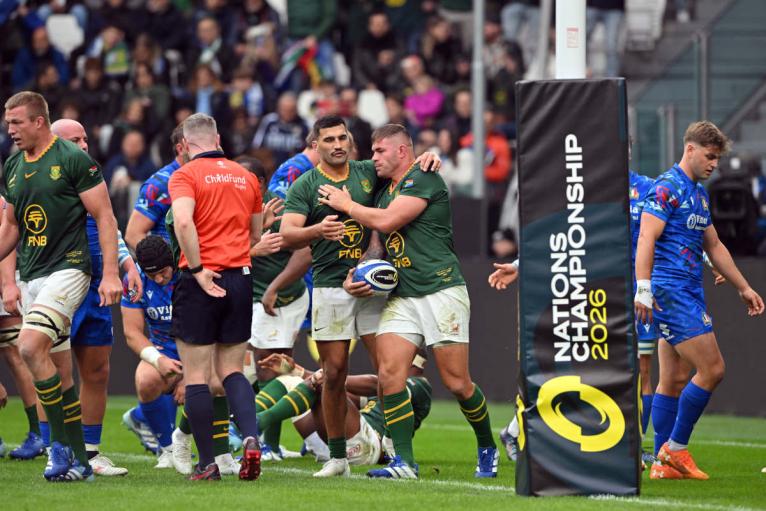
The balance between the amount of usable ball derived from scrums, and the number of penalties awarded at them was a major talking point, given the diametrically-opposed views of the set-piece which emerged from RGR. Where 32 of 34 New Zealand feeds were played out [94%], 12 of 16 Springbok scrum feeds ended in penalties [75%]. Establishing a sensible middle ground was a priority for the referees in November, and the debate was summarized thus in the article:
“Listening to the discussion around scrums for around an hour, the message that came out of it was that while ‘the brake foot’ was all everyone was talking about in those early Greatest Rivalry Series Tests between New Zealand and South Africa – where, as per existing law, the hooker must keep one foot forward flat on the ground in the tunnel during the “crouch” and “bind” phases before withdrawing it on “set” – fixing the loosehead’s shoulder positions is now paramount.
“If it becomes an issue early on in Test matches, officials will soon let players know about it. The only way to really break bad habits.”
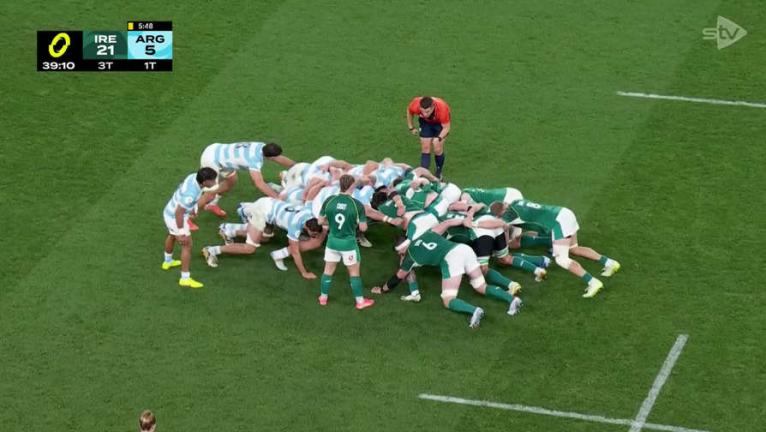
Englishman Luke Pearce set the stage in the Friday evening encounter between Ireland and Argentina, asking for ‘loose-head shoulders out’ at the start of every scrum. Pearce stood close to the set-piece all evening, examining the minutiae of angles at set-up in forensic detail:
The torch was passed to his Prem colleague Karl Dickson in the Saturday night fixture between France and Fiji, via a running dialogue between Dickson and France replacement loosehead Jefferson Poirot. Three times the Englishman prompted the UBB prop to remove his right shoulder from the ‘tucked’ position underneath Peato Mauvaka’s armpit, before finally losing patience and free-kicking him at the fourth time of asking:
https://t.co/FsxnuNeEDk
— William Bishop (@RPvids1994) November 10, 2026
Why? The picture of dominance painted by modern scrums on their own feed – but so rarely confirmed on the opposition ball – begins with the loose-head and hooker crowding the opposing tight-head’s space, then pincering their victim with a ‘double-team’. For the most part, referees chose not to reward this tactic in round four:
https://t.co/Ma5aCgIFMB
— William Bishop (@RPvids1994) November 10, 2026
https://t.co/OJSwkagLby
— William Bishop (@RPvids1994) November 10, 2026
These scrums both represent ‘pictures of dominance’ which were rewarded by penalty in RGR, but in the first instance referee Andrew Brace of Ireland penalises the feeding team in the game between Scotland and New Zealand at Murrayfield, while in the second Paul Williams of New Zealand calls for a reset in the Wales-Japan encounter in Cardiff: “No one’s clearly going forward there. I’m not rewarding that,” he answers crisply, when Welsh flanker Jac Morgan asks the question.
There were also clear signs that referees are seeking more of a contest in the air at lineout. Luke Pearce free-kicked Argentina’s first lineout of the game on Friday evening for ‘not straight’ and the Pumas promptly lost four of their next eight feeds with Ireland in general – and Ryan Baird in particular – offered greater access to the throw.
The elephant in the Nations Championship room is the number of tries being scored from close-range lineout drives. Out of the total of 55 tries scored in round four, 20 were converted directly from lineout drives, and the sheer ease of the scoring under the revised maul rules was a sight to behold. That reinforces a trend in the game as a whole.
A banner headline in The Irish Independent a few weeks ago read ‘32 maul tries in the URC this season already – are you not entertained by rugby’s new cheat code?’ It was written by Irish journalist Rúaidhrí O’Connor, and for those who cannot view the piece behind the site’s paywall, a précis can be found on ‘X’:
‘Twenty-four URC matches so far this season have produced 32 maul tries. Each team is averaging 10 mauls per game, with each maul worth 3.7m per maul. The maul has become rugby’s cheat code, are you not entertained?’
I really think the maul is a strength for all teams now, because it’s a pushing competition and a sync competition and a flying in a V-formation competition… I’m very glad World Rugby did that.
To put the average metres per maul statistic in perspective, in European competition last season, the top stat for metres gained at the maul was 3.6 metres by Champions Cup winners Union Bordeaux-Bègles. The current URC average already exceeds the best figure from the previous season.
As Connacht head coach Stuart Lancaster noted, one of the top mauling sides in the competition, the Stormers from South Africa, were already exploring the option of setting mauls in midfield, well away from lineout: “Teams are going to maul more outfield as the Stormers did, and then obviously that maul outfield leads to a penalty.”
There is a real possibility that the new maul laws may exert undue influence on the outcome of games with the biggest tournament on the calendar looming on the horizon in only 12 months’ time. Needless to say, the coaches of traditionally-strong mauling sides, like the Springboks head coach Rassie Erasmus, are quite happy with the new developments at the set-piece:
“I really think the maul is a strength for all teams now, because it’s a pushing competition and a sync competition and a flying in a V-formation competition, where it was dragging and this technical thing which the referees struggled to sort out. I’m very glad World Rugby did that.”
Before we go any further, let’s offer a refresher on the essence of the new guidelines:
‘Players must join [or rejoin] the maul by binding onto the hindmost player in the maul, not by creating a chain of two or more players and swinging up, or round, the side.
‘Any player bound on the outside of the maul, may contest possession with their other arm, or may continue pushing/driving on the maul, but must not be in a position to pull/drag the maul.
‘Once a player loses dominance and moves to be in a position to drag or pull, they should remove themselves from the contest or will be liable to sanction.’
The essence of the new law is designed to reward players who remain in a pushing position, whether they belong to the attacking or the defensive side, rather than the ‘lazy action’ of those who look to drag or pull opponents away from the ball, or simply block access to it.
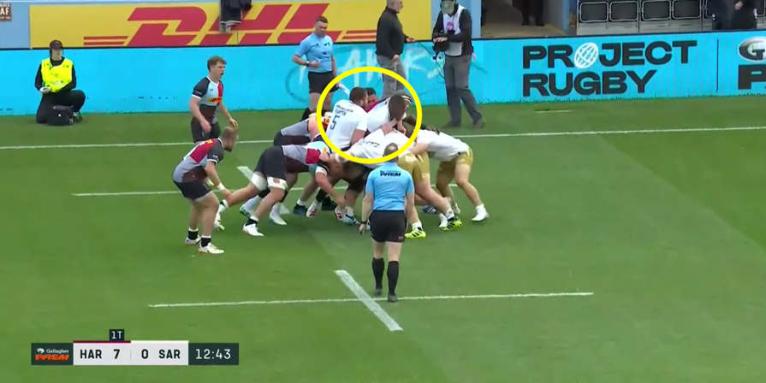
Any lineout coach in the game would recognize this picture as the optimal start position for a successful maul. As the receiver returns to terra firma, one of his lifters moves around to block access to the ball. He is not in a pushing or driving position with his back to the defence, and he frequently gets there ahead of time, but nonetheless the action is penalised all too rarely.
Not only are tries being scored for fun from lineout drives, they are being scored from positions well beyond the 5m line:
https://t.co/8UOxOc8Qti
— William Bishop (@RPvids1994) November 10, 2026
https://t.co/p8ml8kPwCp
— William Bishop (@RPvids1994) November 10, 2026
In both clips there are also players ahead of the ball clearly dragging or pulling the ball-carrier through with their backs to the defence towards the end of the sequence – Scotland’s Sione Tuipulotu and Matt Fagerson in the first instance, England’s Maro Itoje and Alex Coles in the second:
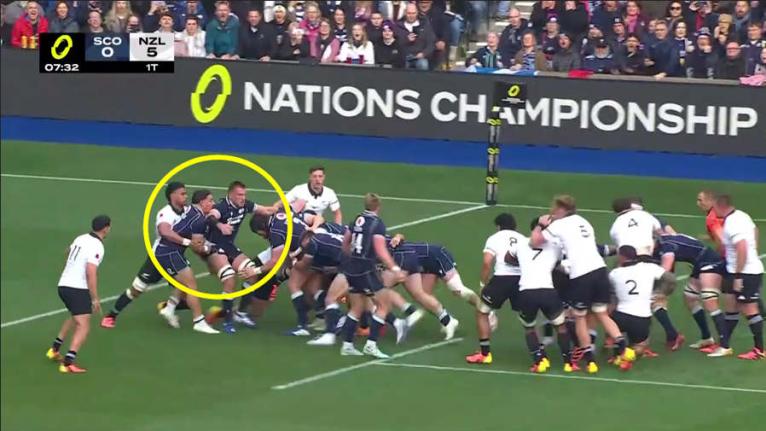
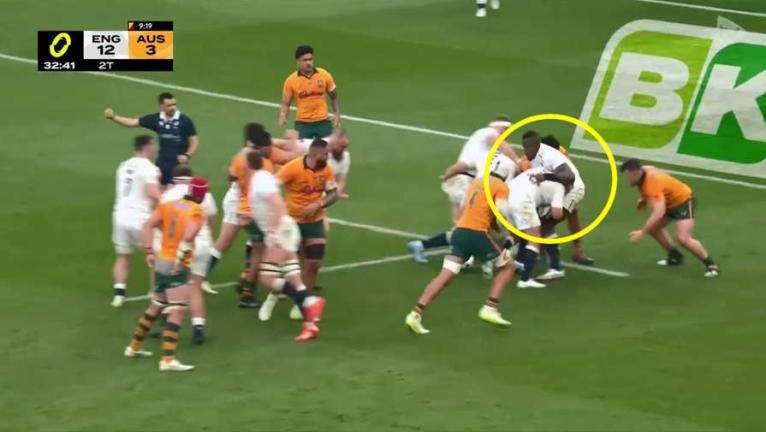
If you are on the offensive side of the ball, pulling or dragging doesn’t attract censure to the degree that it does on defence. Players are allowed to stay in the contest, and block access to the ball to the very end of the play, as rugby’s very own version of a ‘human shield’.
The new direction of rugby in the Nations Championship era is all about entertainment – more points, more tries, more spectacle. This is the game growing into its smartest Savile Row business suit, presenting a natty brand to its public and expecting a return on its investments. Refereeing is being asked to keep pace on and off the field, and nowhere more so than at the set-piece. A slight advantage to the attacking side at every scrum or lineout? For sure, but let’s keep a fair contest, in the truest spirit of the game.

1 YEAR TO GO
The countdown is on until the biggest Men’s Rugby World Cup ever kicks off in Australia. Go All Out and secure your seats with tickets now available!


Comments
Join free and tell us what you really think!
Sign up for free