





1
The 3 winners and 3 losers from the Six Nations, including the Boks
2

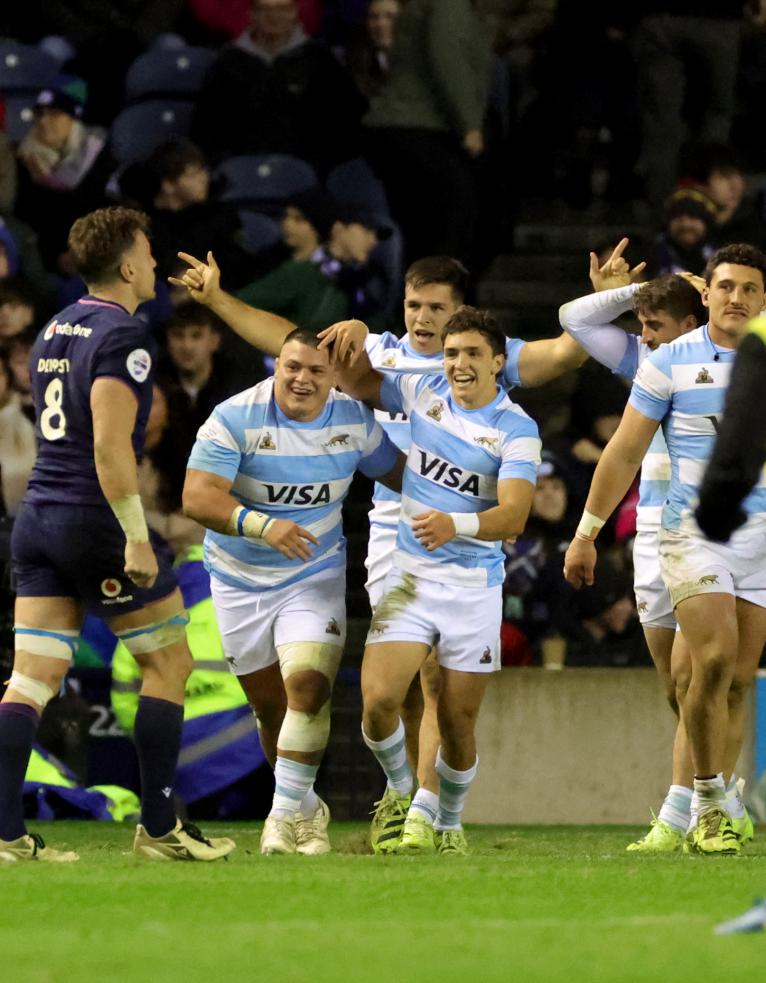
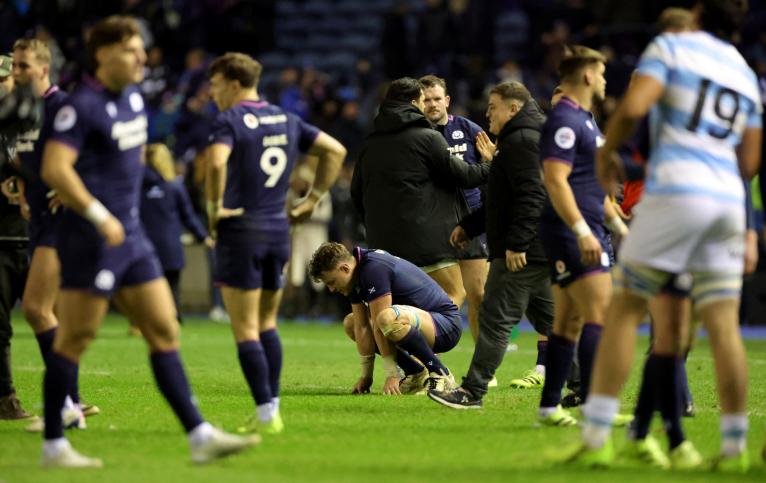
Scotland’s autumn campaign suffered a major setback for the second week running as Argentina came from 21-0 down to stun Gregor Townsend’s team 33-24 at a shell-shocked Murrayfield.
Not only did defeat end any prospect of the Scots snatching a top-six seeding at next month’s draw for the 2027 Rugby World Cup, it also continued a depressing habit of failing to get over the line against higher-ranked teams.
Here are three talking points from a dispiriting day for Scotland’s players, coaches and supporters.
You snooze, you lose, you get boos
Murrayfield has never been regarded as a particularly hostile stadium, and no-one could remember the old place, which is celebrating its 100th anniversary, reverberating to a chorus of boos before. Certainly not directed towards its own team.
But there was a tangible air of fury about the reaction in the stands once Scotland’s self-implosion took root in the final quarter. One gentleman, sat a few rows in front of the media seats, was particularly vociferous in his views, letting everyone in close proximity – including the Scotland coaching box – know exactly what he thought about the tactics as they desperately chased their tails late on. Mr Muted of Morningside he was not.
Some supporters had already seen enough when Pablo Matera scored Argentina’s fourth try, and Carreras converted to put the Pumas in front for the first time at 26-24.
They clearly had little confidence that the final few minutes might produce some sort of stirring rescue act – a winning penalty maybe? – and headed for the exits. Again, not a common sight in these parts. A second successive sell-out it may have been, but there was mutiny in the air.
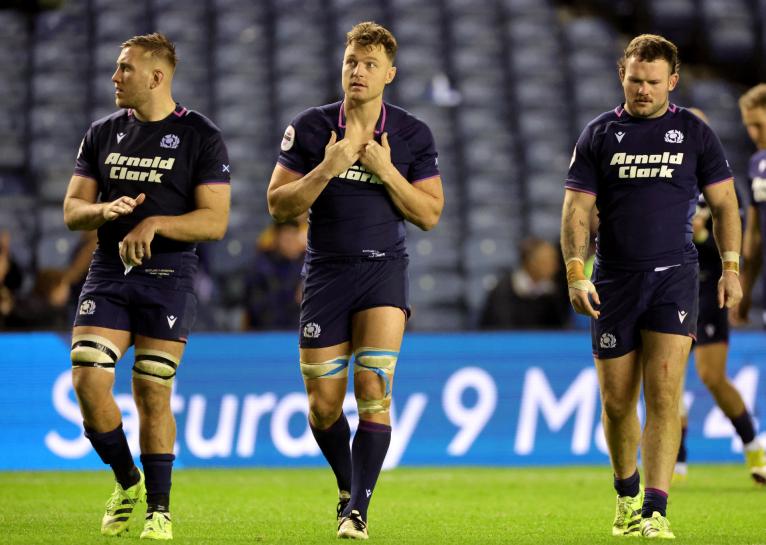
Scotland captain Sione Tuipulotu had no issue with the booing, saying “We deserve to cop it”, in a commendably honest appraisal.
Reaction on websites and social media in the hours after the game was also scathing. Much of it was directed at the lack of on-field leadership when the heat came on. One long-time supporter said folk sat around him were “utterly furious” at what they were watching unfold. Many put the blame for that squarely on Townsend.
There were already dissenting voices when the head coach’s contract was extended until the 2027 World Cup, and even more when news emerged of his part-time consultancy gig with Red Bull. On the back of two displays seen as almost quintessentially Scottish when confronted with the game’s elite – of which Argentina are certainly now a member – those voices are now louder than ever.
Bench strategy a pressing issue
These days, when match-day 23s are announced, there is almost as much discussion about those filling the 16 to 23 shirts as the players starting the game.
With South Africa’s ‘bomb squad’ setting the trend, and England head coach Steve Borthwick bringing six Lions – a so-called ‘Pom squad’ – off the bench for the past two weeks, it seems everyone is prioritizing a strong finish as much as a fast start.
It’s fair to say Scotland don’t appear to have quite settled on the right formula yet.
Last week, against New Zealand, Gregor Townsend opted for a six-two bench split, with the versatile Jamie Dobie and Tom Jordan covering all backline options, Marshall Sykes the second row and an extra back-row forward – Josh Bayliss, in addition to Rory Darge.
Beforehand, Townsend said he had “a really good bench this week” and that “we’ve got to trust our 23”, citing speed, versatility and experience among numbers 16 to 23.
The front-row replacements, plus Dobie at scrum-half, materialised after 54 minutes with Scotland’s comeback already in full swing, levelling the match from 17-0 down on the hour, with Darge, Sykes and Bayliss appearing early in the final quarter. But the home side’s momentum faltered and it was New Zealand who finished the stronger.
For Argentina, Townsend reverted to a five-three split, opting to do without a specialist lock (Sykes) in favour of an extra back (wing Duhan van der Merwe). The plan seemed sound enough in theory, with Gregor Brown, an emerging hybrid forward who has started Tests at lock and blindside, at No.6 and able to move into the second row.
Citing the dry weather forecast as a factor after announcing his team, Townsend said: “We really like the make-up of the bench, with the speed we can bring on at some point in the game.”
Best laid plans and all that. The withdrawal of scrum-half Ben White before the game saw the in-form Dobie promoted to start, with George Horne brought onto the bench. But no loss of speed there.
Brown’s early departure to an HIA, which he failed, brought one back-row replacement, Matt Fagerson, into the fray as early as the eighth minute and the knock-on effect of needing both locks to go deep. Another injury, to tighthead D’arcy Rae, saw prop Elliott Millar Mills sent on after 32 minutes.
The other back-row replacement, Bayliss, a No.6 or No.8 by trade, stayed on the bench until nine minutes from time, when he replaced Grant Gilchrist at lock. Hooker George Turner, praised for his impact against New Zealand, was also only brought on in the 71st minute, even if two-try starter Ewan Ashman admittedly had a fine game.
Van der Merwe, said to be full of motivation after being dropped for the first time in his Test career against New Zealand, was given the final 15 minutes. In that time, he carried the ball twice and made one tackle, according to the match stats.
Jordan was sent on for the final minute, once Argentina had scored their fifth try to confirm victory. Horne, a renowned energy bunny, didn’t make it off the pine. Nor did the aggressive loosehead replacement Nathan McBeth, with Pierre Schoeman going the full 80.
Argentina, by contrast, sent on five replacements – two props, back-row Pablo Matera, plus half-backs Agustín Moyano and Santi Carreras – five minutes into the second half, having fallen 21-0 down.
You could argue Felipe Contepomi had little choice but to shake things up given that scenario, while Townsend was perhaps reticent to make changes earlier as his side negotiated 10 minutes without the sin-binned Blair Kinghorn from the 54th minute.
“We’ll be looking closely at what we can do as coaches – could we have done anything differently, whether it was in the week or changes off the bench?” Townsend pondered afterwards. “Collectively and individually, we have to do better.”
Scotland’s head coach was asked if he might follow Borthwick’s lead in holding back some of his better players specifically for the last half-hour of games.
“It could be an option,” he said. “We are seeing the impact of benches on games. It was the right time for the Argentina guys to come on, when they were trailing, and they threw everything at us – with a man up – and some of those guys off the bench were outstanding. Some of the starters played very well in that final 20 minutes, too.”
Carreras, in particular, after taking over from the less experienced Geronimo Prisciantelli at 10, took the game by the scruff of the neck, orchestrating the Pumas attacks with gusto and kicking four out of five conversions. Matera and replacement centre Justo Piccardo scored their final two tries.
Contepomi played down any tactical masterplan on his behalf, pointing out “it’s very difficult to plan everything. You can have an injury in the first minute and your plan goes to scratch. But we know what we need from everyone.
“Sometimes guys stay on longer, sometimes they come on early. But it’s about feeling the game, and we know who can make an impact. We don’t have it pre-set.”
Scotland, by contrast, looked slow to react to the developing situation, on and off the field. Once the wheels started to come off, they looked clueless and rudderless.
Mental fragility in the face of resistance
This was not the first time Scotland have blown a big lead in recent memory.
In Cardiff at the start of the 2024 Six Nations, they led 27-0 after 43 minutes when Duhan van der Merwe ran in their third try. But Wales threw caution to the wind, scored four tries in a little over 20 minutes, and heading into the final 10 minutes it looked like one of the great comebacks – and even greater capitulations – was on the cards.
Scotland looked utterly bewildered but belatedly found some backbone to sneak home by a point. But a first victory at the Principality Stadium in 22 years felt more like a defeat.
Earlier this year, the Scots again cruised into a 27-point lead against Wales, playing some sumptuous rugby to score five tries and establish a 35-8 advantage after 48 minutes at Murrayfield. It looked for all the world like a record rout was on the cards. But the Welsh scored three unanswered tries in the final quarter to give Scottish supporters more palpitations before Townsend’s men eventually prevailed 35-29.
While they took three try-scoring chances with alacrity and defended superbly to lead 21-0 on Sunday, the scoreline was not an accurate reflection of how play had unfolded, with Argentina enjoying plenty of possession and territory but lacking accuracy with several opportunities in the first half.
But it only took one errant pass from Finn Russell – with Scotland camped in Argentina’s 22 and stretching the Pumas this way and that, there seemed no need for the fly-half to push the envelope at that point – for the momentum to completely switch.
Superb tackles from Kyle Steyn and Darcy Graham almost prevented the Pumas’ counter, but once they advanced deep into the Scottish 22 and Blair Kinghorn was binned, a high-quality team seized the day.
Scotland’s discipline, decision-making and defensive alignment all seemed to unravel spectacularly, with the energy and accuracy of the first half non-existent in the face of waves of Pumas attacks.
When you add in the failure to get over the line on the last two occasions against New Zealand, plus the World Cup mishaps of 2019 and 2023 against Ireland, it is hard not to point the finger at a mental fragility, as much as tactical or technical, in this side.
Jess Thom, a former competitive figure skater who was the British Olympics team’s lead psychologist at the Paris 2024 Games, has been working with Scotland’s players since last year’s autumn Tests.
But there remains little evidence, as yet, that this undoubtedly talented group are minded to shake off their head-wrecking reputation for self-sabotage and snatching demoralising defeat from the jaws of victory.
Do not forget, Argentina is a very good well coached team. They won this game more than Scotland loosing it. So please do not loose your heads. Acknowledge a better team and plan.
When your captain’s response starts with ‘We’ve got to cop it’ then therein lies the beginning of the problem…not clear pathway…players from NZ, Australia and obviously SA and we wonder why they are struggling when they are in a hole with 20 to play ?
Join free and tell us what you really think!
Sign up for freeSo many great tries, matches and individual displays in a championship for the ages, but which were the best?
England have lost four games in the Six Nations for the first time but their brilliant display in Paris provides a route forward
The backrow has come in for heavy criticism for his on-field behaviour but is he showing rugby is far less open-minded than it thinks it is?
Indeed we do, GM ! And a very good one !
Of course you can.
all you need to reverse that is make the game more aerobic again.
...
But he'd have to give his income taxes to a king
He's stays in Dublin and he's the king
...
Long game, Ed.
We own them in the recent fixtures. Give them a wee Dublin win
...


 Clear
Clear 


