
When Rodrigo Fernández made his Chile debut in 2016, the national team trained twice a week in the run-up to international matches, on Mondays and Wednesdays from 7pm. The schedule was no more demanding than that of most amateur club sides, but it was all Chile could manage at a time when professional rugby was as much of a pipe dream as appearing at a Rugby World Cup.
HSBC SVNS returns to Cape Town this December!
Don't miss your chance to see the world’s best rugby teams take centre stage 5-6 December in Cape Town.
A decade later, Fernández is speaking from Lisbon, in the days leading up to Los Cóndores’ Nations Cup meeting with Portugal.
“I think if you’d told someone back in 2016 where we’d be today, they’d have given it a one per cent chance, or less. We’ve now spent five days at a training camp in Lisbon, staying in a really nice hotel with every comfort imaginable, genuinely preparing in the best possible way for this weekend’s match against Portugal. It would have been unthinkable.”
Chilean rugby has undergone a remarkable transformation over the past decade. Spearheaded on the field by the likes of Fernández and captain Martín Sigrén, and guided by long-serving head coach Pablo Lemoine, Los Cóndores have qualified for back-to-back Rugby World Cups. The team was ranked 29th in the world when Fernández made his debut, behind Kenya, South Korea and Germany. They had climbed to 16th by the time they arrived in Lisbon.
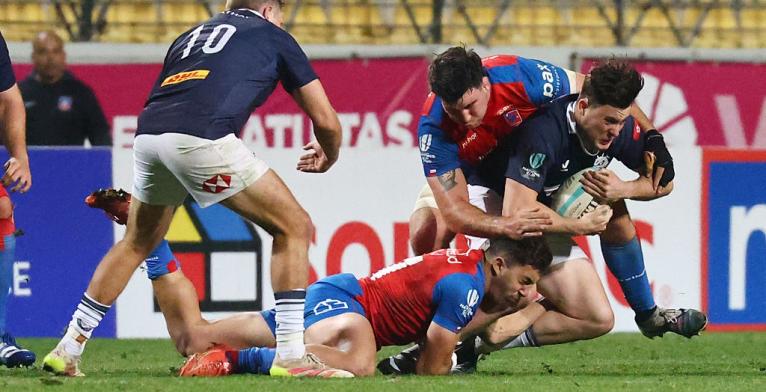
That progress is being put to the test this month, with Chile facing Portugal, Spain and Zimbabwe in the Nations Cup. Speaking before the Portugal game, Fernández explained why the first two fixtures carried particular significance. Despite more than a decade in the international game, the fly-half had never faced either European side, both of whom he regards as kindred spirits.
“I see them as the Chile of Europe, so to speak,” he says. “I feel they’re teams with similar characteristics and similar circumstances. We’re competing on an equal footing. Really, whichever team is more switched on is going to win.”
Portugal got the better of that clash, winning 36-15 in Lisbon. Los Cóndores trailed by just two points at the break, but were unable to keep pace with the reigning Rugby Europe champions in the second half. Fernández and his teammates now turn their attention to Spain, another opponent against whom they will be eager to demonstrate how far Chilean rugby has come.
Having won two of their three Nations Cup fixtures in July, Chile have two more opportunities this month to measure themselves against strong opposition ahead of next year’s World Cup. Los Cóndores are targeting their pool match against Hong Kong China, one of the teams they defeated in July, and will also face hosts Australia and three-time champions New Zealand. Fernández chuckles when asked if he’s thought about potentially swapping jerseys with some of the sport’s biggest stars.
“I’ll have to show [them] a video, because I don’t think [they’ll] know who I am!”
He may have been joking, but Fernández’s highlights are no laughing matter. His stunning solo try against the USA during Chile’s successful qualification campaign for the 2023 World Cup remains one of the defining moments of his career. He beat six defenders on a slaloming run to the try line, a score that was later named the International Rugby Players men’s try of the year. That would be a video worth showing.
An all-time individual try from @chilerugby’s qualification run to #RWC2023
Rodrigo Fernandez 🔥 https://t.co/dFo6kIyKJF
— Rugby World Cup (@rugbyworldcup) September 18, 2022
Even now, Fernández struggles to comprehend what happened in 2022.
“We had so little chance of winning, and nobody expected us to qualify for the World Cup. I think that year was genuinely the most important turning point there’s ever been in Chilean rugby.”
The team overcame World Cup regulars Canada and the USA in two-legged ties to qualify. For a country with so few resources, it was nothing short of a miracle. Fernández would make a little more history at the tournament itself, scoring Chile’s first-ever World Cup try just six minutes into their opening game against Japan.
The momentum has continued since the last World Cup, even if much of their progress has gone unnoticed by the sport’s major powers. Fernández missed out on the team’s first game in Chile’s iconic Estadio Nacional in 2024, where they hosted Scotland in front of a record 25,000 fans. Even in his absence, Fernández was impossible to miss as dozens of supporters wore masks bearing his face.
More recently, Fernández was involved in Chile’s emphatic 31-12 win over Samoa which booked their ticket to Australia. Some 20,000 fans crammed into the Estadio Sausalito for that game, a sign the public are increasingly getting behind Los Cóndores. Fernández has witnessed that shift firsthand.
I think before World Cup qualification, rugby had a stigma which, to me, was completely mistaken – that it was an upper-class sport because it came mainly from the British schools. It’s something we’ve managed to change over time.
“I think before World Cup qualification, rugby had a stigma which, to me, was completely mistaken – that it was an upper-class sport because it came mainly from the British schools. It’s something we’ve managed to change over time. Part of our mission as players was to qualify for the World Cup, but to do so while changing Chilean rugby forever, and changing sport in our country as well.”
For Fernández, the significance of those crowds goes beyond their size. It is the changing relationship between Chileans and rugby that matters most.
“You only had to look at the stadium at Sausalito, when we qualified against Samoa. People were coming to the stadium who didn’t understand rugby, but who identified with what the team represented. Nowadays, I think it’s becoming much more normal for people to get involved, to feel included, and to feel part of what we’re trying to convey.”
That enthusiasm extends beyond Chile’s borders. The country currently ranks ninth for tickets purchased for next year’s World Cup in Australia. Matches such as those against Samoa and Scotland could inspire a new generation of Chilean rugby players, some of whom might otherwise never have discovered the sport. Already, youngsters who watched the last World Cup as fans are pushing for inclusion this time around. Players like Nicolás Saab and Marco Alvano are snapping at the heels of their heroes.
Fernández belongs to a generation who experienced Chilean rugby’s transition to professionalism. Whereas he did not enter a national development programme until he was 19, today’s prospects benefit from structured training from the age of 16.

That investment is already paying dividends. Just weeks before the senior team left for Europe, Chile’s U20 side won the inaugural World Rugby U20 Challenger on home soil, completing an unbeaten campaign with a 30-17 victory over Belgium in the final.
“The difference between their preparation and ours is enormous,” Fernández says. “They’re 10 steps ahead of where we were when we were their age.”
Having fought so hard for opportunities younger players can now take for granted, Fernández and his contemporaries could be forgiven for looking back with a degree of envy. But that is not how he sees it.
“We experienced having nothing, so to speak. Training with nothing but promises ahead of us: that we were going to achieve this, that we were going to reach that, that we were going to pursue professionalism. It’s almost impossible to pass that on in the way we experienced it.”
As he approaches the final years of his career, Fernández has little interest in lecturing youngsters about how hard things were back in his day or worrying about whether Beauden Barrett has seen his highlights. His focus is on what comes next.
“The idea is never to go back to where we were. Quite the opposite: we want them to keep getting better.”
A humble ambition, perhaps, but better has brought Chile this far. Saturday’s meeting with Spain offers another opportunity to be better still. And in a year’s time, there is no telling how far ‘better’ might take Los Cóndores.
NEW IN THE APP: Official World Rugby Rankings hub! Compare team rankings side-by-side, with data going back 20 years.
Download the RugbyPass app on the App Store (iOS) and Google Play (Android) now!


Viva Chile ! From Old Grangeonian that played the game in the 60’s and 70’s