
For all you rugby supporters coming along for this ride, let me first take you on a detour through an amazing Gaelic football feat. It happened just two months ago and could yet inspire Ireland on their road to the 2027 World Cup.
NEW: Follow Your favourites in the App 📱
You can now follow their favourite teams, tournaments and players in the RugbyPass App!
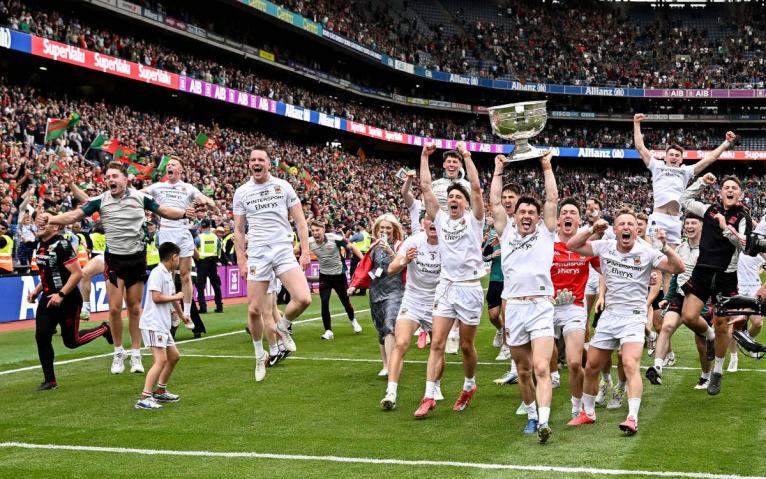
As N17 and Green and Red of Mayo pumped from speakers across Croke Park, long suffering Mayo GAA supporters basked in a triumph that ended 75 years of waiting.
A football-mad county, Mayo had last won the All-Ireland in 1951. They endured such a tough time of it over the ensuing decades – losing 11 finals along the way – that urban myth of ‘The Mayo Curse’, imposed on the team by an irate priest, became a readily-accepted tale within GAA circles. The longer the losing streak, the more crushing the heartbreaks, the stronger the curse grew from playful reminder to crippling spectre.
Tell that to 18-year-old Kobe McDonald or Eoin McGreal and Darragh Beirne, both 19. The young footballers were drafted into Mayo’s senior panel for their latest tilt at All-Ireland glory, this summer. Fresh into the squad, and unburdened by past failures, the trio helped their county to their latest final and played key roles in a victory over reigning champions Kerry that secured the Sam Maguire trophy.
When Beirne, who scored a goal and three points in the final, got a phone-call from manager Andy Moran, inviting him into the senior panel, he was convinced it was a wind-up. Not so. “Andy said, ‘You’re coming into the senior squad, you’re here to play, you’re not here to take part’,” Beirne recalled.
“He gave me that confidence that allowed me to go out and express myself. Told me, ‘Go out and have fun, play with a smile on your face’. That’s exactly what I’ve done.”
McDonald finished secondary school, back in June, after sitting the Leaving Certificate examinations. Asked, amid the celebrations, when his results were due, the teenager replied, “I haven’t a clue, to be honest.”
The last Irish rugby player to dice with Leaving Cert exams while in the thick of a senior squad was Gordon D’Arcy. Back in 1998, Ireland wanted him to tour South Africa, but the then Clongowes full-back opted to stay home and see out that phase of his education. D’Arcy would make his Test debut for Ireland a year later, at the age of 19.
Teenagers breaking through at Test level for Ireland are extremely rare. After D’Arcy, Luke Fitzgerald (2007) and Rhys Ruddock (2010) have been the most recent 19-year-olds to win senior caps for their country. Three in the past 30 years. France, on the other hand, have capped three 19-year-olds in the past two years – Lenni Nouchi, Marko Gazzotti and Théo Attissogbe. England have done so twice in the past four years, with Henry Arundell and Noah Caluori.
Every province has a hierarchy and a long line of experienced professionals, all looking for match minutes and training reps. It takes an exceptional talent to break through before the age of 22.
With only four provinces in the Irish system, younger players must bide their time and first prove themselves in the United Rugby Championship, and either the Challenge or Champions Cup. James Ryan proved an exception to that rule, in 2017, when he made his international debut before he had a chance to line out for Leinster. Every province has a hierarchy and a long line of experienced professionals, all looking for match minutes and training reps. It takes an exceptional talent to break through before the age of 22.
In the past two years, Andy Farrell has started to dig deeper in search of potentials for his World Cup squad. He was significantly aided by Simon Easterby and Paul O’Connell, in their interim head coach stints, in 2025. Since the summer 2024 tour to South Africa, Ireland have handed Test debuts to 23 players. The average age of these debutants is 25 years and eight months. That average is nudged up by Oli Jager (29) and Tom Farrell (32).
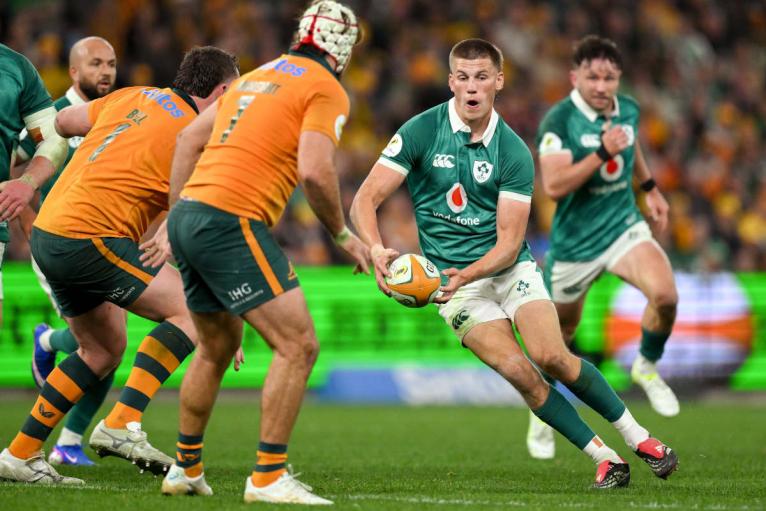
From that list of 23 players, eight were aged 22 or under when running out for their first cap. Bryn Ward, Paddy McCarthy, Jack Boyle and Jamie Osborne were 22, Sam Prendergast, Hugh Gavin and Gus McCarthy were 21. The youngest pup was Billy Bohan. At 20, the Connacht loosehead became the youngest prop to play Test rugby for Ireland this century, when he featured against Japan in the Nations Championship.
“The younger lads are absolutely fearless,” Ireland openside Josh van der Flier tells me. “they bring that bit of optimism and energy. Looking at the likes of Billy and Bryn, they are super, talented lads of great character, who bring a real spark. In every way, I feel, they add to the group. It also kicks lads on, as well, because they’re seeing this young lad who is playing very, very well. They’ll recognise that they need to up their game. It keeps everyone trying to improve, and keeps everyone on their toes.”
Over that same period, England and Wales handed out caps to 18 new players. Italy (15) are the lowest for debuts awarded over the past two years, with Scotland on 21, South Africa 25 and Australia 29. France lead the way on 34, aided no doubt by end-of-season tours to Argentina and New Zealand, in 2024 and 2025, when a raft of major stars were rested or unavailable. Les Bleus have a considerable advantage over most other nations, with 30 professional sides spread across the Top 14 and Pro D2.
Picking two backline players, by way of example, Attissogbe had made 28 senior appearances (26 starts) for Pau by the time he made his France debut, aged 19. Connacht centre Hugh Gavin made 11 appearances (eight starts) when he made his Ireland debut – scoring two tries in the process – against Portugal, aged 21.
• Ireland – 23 Test debuts awarded since July 2024 – Average age: 25 years, 8 months
• France – 34 Test debuts awarded since July 2024 – Average age: 23 years, 8 months
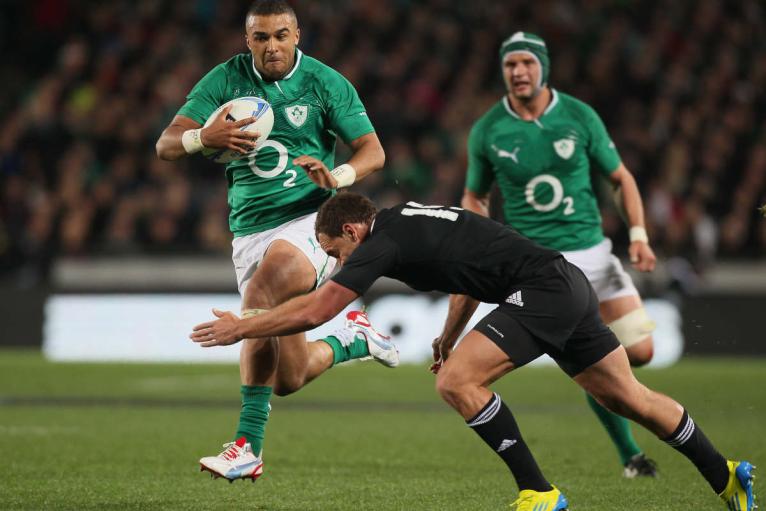
Simon Zebo made his senior Ireland debut against New Zealand, at Eden Park, in 2012. He was 22 and had two seasons with Munster under his belt. Having played in the URC and Top 14, he has a rounded perspective on both nations giving game-time to younger players.
“I thought we used to be like that, you know?” he says, “Giving younger players a go. You look at Luke Fitzgerald, Keith Earls, Conor Murray or myself even, in 2012, there used to be a lot more of it. Maybe the game is changing a bit, I don’t know, or the talent coming through may have dipped.
“We were getting exposure and decent game-time at an early age, but perhaps at a time when there was not so much scrutiny, and pressure on getting results, as there seems to be these days. There are a lot of moving parts to it. What I’ve always liked about France is that it was always a case of, if you’re good enough, you’ll get your chance. It still is like that, very much. In Ireland, it’s a little more bide your time, bide your time, bide your time. For better or for worse, it’s hard to say, but I do enjoy young fellas being given a go. Sink or swim.”
The ‘sink’ part of that outlook is the major downside of pushing a young player too soon. From Ireland’s most recent crop of internationals, Jamie Osborne and Tom Clarkson have been the biggest successes – both making it into the British & Irish Lions squad, as late call-ups, a year after their Ireland debuts. Gus McCarthy got off to an excellent start while Jack Boyle and Paddy McCarthy were both on good track until injuries derailed their early progress.
Sam Prendergast made his Ireland debut in November 2024, at the age of 21, and now has 17 caps to his name. The Leinster flyhalf has, undoubtedly, experienced the highest highs and lowest lows of those 23 debutants. He was named Man of the Match after a Six Nations win over Scotland, in Edinburgh, and was in scintillating form in a home victory over Australia, last November. Prendergast won Ireland’s 10 jersey, then lost it back to Jack Crowley, in the space of 12 months, only to get it back, this summer, when his rival was sidelined. The pressure on Prendergast has been immense, with many of his detractors irked by a perception that he was elevated ahead of a better player on promise alone. It may be tougher on the body in several other positions, but those wishing to wear the 10 jersey, no matter the age, need a stubborn steeliness of mind.
The provincial system, and statistics, show Ireland debuts tend to arrive for players between the ages of 24 and 26. That path of progression – URC, then Champions Cup, Ireland squad inclusion and eventual debut – is well trodden.
Farrell and his assistants are clearly looking for a spark, heading into the World Cup countdown. An ageing squad is being infused with younger blood. The hope will be that a clutch will have the staying power. Looking back on his seven years in charge of Ireland, eight players capped when under 25 have fallen by the wayside – Max Deegan (4 caps), Eric O’Sullivan (1), Gavin Coombes (4), Shane Daly (2), James Hume (3), Paul Boyle (1), Fineen Wycherley (1), Michael Lowry (1). It is too soon to tell for the nine players that were handed Test bows by interim head coach Paul O’Connell, against Georgia and Portugal, last summer.
The provincial system, and statistics, show Ireland debuts tend to arrive for players between the ages of 24 and 26. That path of progression – URC, then Champions Cup, Ireland squad inclusion and eventual debut – is well trodden. In recent years, though, we have seen Farrell getting bolder, and younger, with his selections. It would be worth tracking if any of this year’s Ireland U20s crop can push through, in the coming six to nine months. Josh Neill and Sam Bishti are two to watch closely, at Leinster, while Crowley and Will Harrison being sidelined gives young Munster fly-halves, Tom Wood and Charlie O’Shea opportunities for meaningful minutes in the URC and Champions Cup.
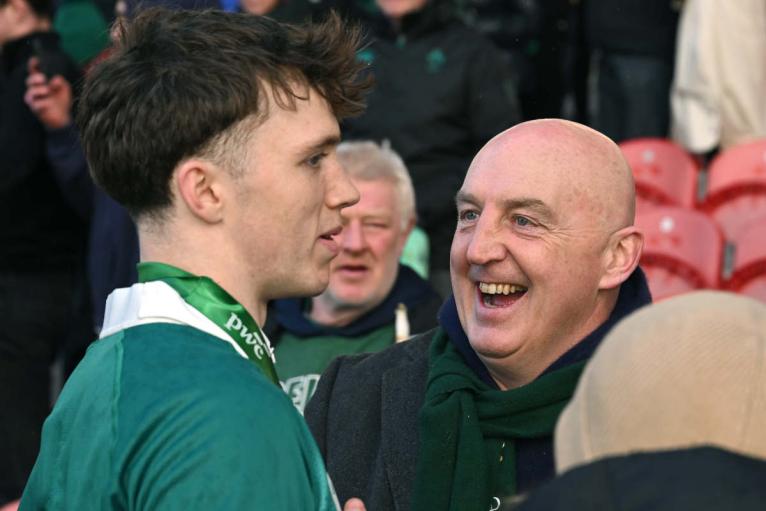
Mayo had long been darkened by the shadows of the past. Every failure branded upon the collective consciousness of a county that, somehow, kept coming back for more. An injection of youth was a key component in them ending that 75-year famine for All-Ireland glory.
“I grew up coming to Croke Park, seeing Mayo coming to finals,” said Beirne, after reaching the pinnacle of his sport at 19. “This wasn’t new to me, I wasn’t nervous at all, coming here. A completely free-shot at it, no-one gave us any chance. We came out fighting it, we’re bringing Sam home back to Mayo.”
“Myself, Eoin and Darragh probably don’t understand the magnitude of what we’ve done,” McDonald would admit. “We’ve never been here before, it’s that unknown. I think one day, hopefully in the future, I will realise what we’ve accomplished.”
Mayo’s story is one, I hope, Farrell was following closely. Ireland have had 10 cracks at the World Cup and have fallen at the quarter final on eight sorry occasions. Why not shake up the staid formula by bringing along a few lads that are too young, feckless and fearless to drag that weight of history with them?
 Register your interest to receive priority updates on RWC27 ticket releases. Don't miss out, stay in the loop!


Not in million years will Farrell follow the mayo recipe and suddenly start blooding youngsters in Test rugby left, right and centre, let alone watch them sink or swim in a World Cup (it would be sink!). Different sports and very different demands.