
The South African segment of the Greatest Rivalry series is over, and the focus now shifts to Baltimore, Maryland for the final game. Bulls skills coach and ex-sevens wizard Kennedy Tsimba believes a shift has occurred across the first three Tests.
NEW: Follow Your favourites in the App 📱
You can now follow their favourite teams, tournaments and players in the RugbyPass App!
The Springboks have not just become better at what they do best – applying set-piece pressure and finishing from within the opposition 22 – but also in their speed of adjustment to those changes of possession which lead to ‘broken-play’ scenarios.
What follows are Tsimba’s observations from the third Test at the Calabash, and a conversation with legendary 101-cap South African full-back Willie le Roux, who was the essential on-field ‘brain’ behind so much of the Springboks’ success at the past two World Cups.
*
How the Boks learned to navigate the shift
KT: The first Test of left us with an interesting question. What happens when the game moves away from the structure we have prepared for?
By the time the third Test was played, another question had emerged:
Had the Springboks simply improved their execution, or had they become better at adapting when the game shifted? That distinction is important.
Because adaptability is often spoken about as an instinct or attribute of great players. But if we can identify it happening in a game, perhaps we should be asking a more uncomfortable coaching question: Can we actually coach it?
In reviewing the third Test specifically through the lens of shift theory, two moments stood out.
24:26 – Recognising the opportunity
— William Bishop (@RPvids1994) September 9, 2026
NB: The All Blacks had won the line-breaking and try-scoring battle over the first two games, scoring nine tries to four and converting 50% of their opportunities from line-breaks compared to 33% by South Africa.
The All Blacks did not have to wait to enter the opposing 22 in order to seize the attacking moment, having converted almost half of their tries from situations outside the opposing 22. How the Springboks reacted to a line-break by the All Blacks was always going to be a key factor in the outcome of the game in Soweto.
KT: New Zealand are deep on attack when they fail to secure the ball, leaving it exposed. What interested me wasn’t simply that Ethan Hooker eventually played the ball. He had to shift almost instantly from defending, to recognizing an attacking opportunity.
The picture had changed. His response involved speed of reaction, perception and decision-making. Rather than waiting for the referee or for the defensive structure to dictate his next action, he quickly asked whether he could play the ball and then acted immediately.
It was a small moment, but it contained many of the elements we associate with adaptability: recognise, interpret, decide and act. There was no time to reset the picture. The player had to interpret the new one.
56:40 – Adapting collectively
— William Bishop (@RPvids1994) September 9, 2026
NB: Kick-offs are key psychological moments in the game and they are often excellent measures of the maturity of a team, of how quickly they can regain focus and reset mentally. The scoring team tends to relax unconsciously and that vulnerability can be exploited.
In this instance, the Springboks go straight for the throat with a short kick-off straight up the middle for 6ft 4in Hooker to contest. Four phases and less than one minute later, they have crossed the line for the go-ahead score.
KT: Hooker wins the contestable restart with a tap-back. At that instant, the original picture changes.
Peter Lakai and Jasper Wiese have to adapt immediately to the new position of the loose ball, and Springbok eight Wiese appears to react faster, recovering the ball and initiating a sequence that ultimately represented the most decisive momentum swing of the game towards South Africa.
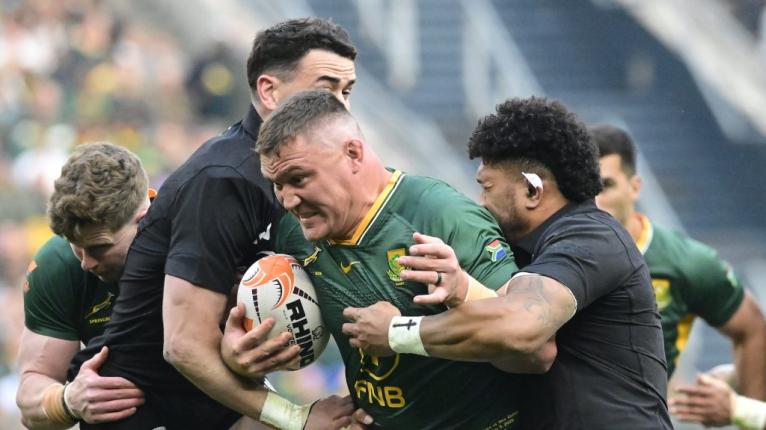
Again, the outcome is not the only interesting part. The important question is: who recognised the shift first? The players couldn’t simply execute their plans at the restart. The loose ball had created a new problem, and the players had to reorganise their behaviour around it.
One moment was an individual player recognising an unexpected opportunity. The other required players to adapt collectively to a changing picture. Both are examples of what I mean by a shift, the moment when the game moves away from what can be controlled, and players have to interpret what is now in front of them.
*
What changed for the Boks?
KT: Looking across the second and third Tests, the evidence suggests the Boks didn’t eliminate uncertainty. They became better at navigating it. They appeared to play more to their strengths: their set piece, their kicking, their ability to compete for scraps and the use of their outside backs in those wide spaces.
Rugby matches are not necessarily decided by who controls every moment. They can be decided by who responds best when the expected picture changes.
Springbok veteran Le Roux is now among Tsimba’s charges at the Bulls, and provides a player’s perspective on these key questions.
When the game suddenly becomes unstructured, what are you looking for?
WLR: First I look at the second-last defender, assessing whether that player is slow or fast. From there, I start looking towards the outside and what space may be available there. The Bok scored two tries in this way, by testing the ability of the penultimate defender in space.
— William Bishop (@RPvids1994) September 6, 2026
— William Bishop (@RPvids1994) September 6, 2026
Do experienced players recognise these moments differently?
WLR: I believe experienced players tend to have more time on the ball because they have a better level of pattern recognition to work from. Younger players, by comparison, will often initially look to make the play themselves.
Can adaptability be developed through training?
WLR: I strongly believe it can be developed by training, and it should be trained much more! The more often players are placed in similar stressful situations, the better their anticipation and reaction will become. The key is creating the right drills that allow players to experience these scenarios more frequently.
Did the Boks adapt differently across the series?
WLR: I felt the Boks adapted better to their strengths in the second and third Tests, particularly through their set-piece, their kicking, in the ‘scraps’ battle and in the way the outside backs used the space. Ultimately, I felt we won the key moments.
KT: Willie’s perspective raised an interesting question about the value of experience.
Perhaps experience doesn’t actually give a player more time. Perhaps it allows them to use the same amount of time differently.
An experienced player may recognise something familiar in what initially looks unpredictable. That recognition can make the next decision faster. And this is where the conversation starts moving beyond tactics, and into cognitive performance.
Can adaptability be coached?
This is becoming a big personal area of study for me. I am looking more deeply into cognitive performance in rugby and the relationship between perception, anticipation, reaction and decision-making when the game becomes unpredictable.
The question is whether adaptability is something we simply hope players acquire through years of playing, or whether we can deliberately develop it. Willie le Roux believes we can. When asked whether adaptability can be developed through training, his answer was unequivocal.
That raises a bigger coaching question. If we want players to become better at adapting, should we simply tell them to adapt, or should we create training environments where they repeatedly experience situations in which the original picture changes and they have to recognise and interpret them, and respond?
Perhaps the answer lies somewhere between experience and deliberate practice. The Boks provide us with a fascinating case study because we can see the improvements in behaviour just in the RGR series.
But seeing adaptability is not the same as understanding how it can be developed. And that is perhaps the next frontier of the shift conversation. Can we deliberately create the experiences that allow adaptability to develop in training?
*
The ongoing conversation raised some fascinating questions ahead of a Rugby World Cup in 12 months. Can a mature team, with a relatively high average age such as South Africa [31 years old], learn quickly enough to stay ahead of their rivals one year down the road? Are the All Blacks, who average roughly three years younger in the current series at 28, in a faster developmental cycle ahead of the showpiece event in Australia? Or for that matter France, who come in one year younger, at 27?
Which competition at the level below equips players to manage the shifts in the game better – Super Rugby Pacific in the south, or the URC and Champions Cup in Europe? In the recent past, when South Africa were still a part of Super Rugby, there would have been only one answer. But the waters may have muddied since then, and the sands in the cross-equator battle are shifting too.

Your home for rugby. Download the RugbyPass app on the App Store (iOS) and Google Play (Android) now!
Follow your favourite teams, tournaments and players, and get personalised news and Match Centre notifications direct to your device.
From live rugby streams and upcoming fixtures to breaking news, in-depth analysis and live scores, RugbyPass has everything you need to stay connected to the game.


Man Kriels try off the kickoff was way too easy.
The All Blacks looked completely switched off and didn’t respond to suddenly defending at all.
I was wondering where the backfield cover was, he ran it in from 40m out.
You can see McKenzie overruns to cover the winger because of the overlap (fair enough, it’s Kolbe but still, hold off and use the sideline )
And then there’s just no-one tracking across in case Carter misses. I wonder who should be doing that in their system. Jacobson looked buggered at around this time, they probably planned to take him off but couldn’t.
Savea’s injury showed there is also a risk in playing 5/3 especially when your game plan revolves around high tempo and high ruck count. You need fresh legs to do that and defend aggressively.
These are critical situations Toko. You don’t want to have worked hard for a score then give one up so easily immediately after!
So close to the line, defences will often use just one defender in the backfield or even an empty backfield in their own 22, so if you stop the vid at 57:04 you see DMac coming up on the edge and nobody else home. That leaves Carter on his lonesome.
Also notice ALB hesistates when he has the oppty to take Libbok man and ball.
Thanks for this series Nic. I’ve really enjoyed it. Thanks for bringing some cutting edge thinking in Rugby to all of us!
No worries JA, I’ve enjoyed doing it.
Had Ellis Park been a springboard for a series win in South Africa or overall series win for the All Blacks, the way Super Rugby Pacific is seen outside Australiasia would have to be revised.
A drawn series over the 4 Tests with the Springboks winning the South African leg won't move the needle.
If the Springboks seal a 3-1 series win with a commanding display where they dominate scrum and maul, the old Super Rugby Pacific stereotypes about it being all style and no substance will remain undimmed.
Yes it will raise a few ghosts that SR had done its best to banish Mitch.
But it has become inarguable that SA leaving Super Rugby was the best move it could have made. It has made the Boks stronger and its traditional rivals in the south weaker.
Yes it's pure recency bias Mitch. The Boks happen to be the best at the moment so everyone says it's the URC. People forget that South Africa became number one when their players were very young and 80% of the starting lineup were in Super Rugby.
To answer your question Nick:
If you want raw reaction speed in wide space then it's SRP.
But if you want players equipped to manage test-match shifts, the URC and Champions Cup take the prize.
In SRP, shifts often lead to s
track meet type rugby.
In the URC, shifts occur under heavy physical fatigue, tactical kicking pressure, and breakdown contestability.
That environment forces players to process scraps with a lower margin for error, which is exactly what test rugby demands when a kick-off tap-back or turnover occurs.
Instead of the Bulls, you can look at the Lions in Johannesburg as the benchmark for how a franchise can explicitly coach this.
The Lions don't just recruit for rigid systems, they select multi-dimensional, high-tempo athletes and coach them to exploit altitude-induced chaos.
Their entire tactical identity is built on attacking before the opposition defense can stabilize after a transition.
They prove that adaptability isn't just an innate Southern Hemisphere trait, it’s an environment you build through selection and training under pressure.
I think we need a bit more refinement in that answer W.
The knockout stages of the Champions Cup have taken over from SRP as the quality of comp nearest to Test level, but URC is not on the same level. The influence of Top 14 rugby cannot be overstated in that respect.
If you look at the club which is best attuned to ‘shifts’ KT describes globally, it would have to be UBB, which is why they have moved ahead of everyone else in Europe.
I had the impression that too many ABs were on the deck for the Kriel try and it looks like it still with a SA jersey being the closest player to him in the backfield. I do wonder if this CPR game is tiring out the ABs.
Yep. I handn’t noted what a terrible line ALB was running before. What was he expecting an inside runner and switchback or something?
That is Rennie’s weakness. His expectations are unrealistic.
I guess we'll find that out in due course OM. Leagues like the Prem are more advanced in terms of multi-phase rugby than SRP, which is saying something😲
NB I liked these articles when they were saying how good the ABs were. Not so much now 🤣. The overwhelming feeling I have from the last test is that SA went up a gear with their go to weapons (scrum and maul) and had complete faith in their systems. The ABs went up a gear too with the direct running and explosive carries - two of the four tries exemplify that -Aumua charging into Cobus and PSdT and Wallace gliding through Nortje with Taukeiaho barrelling over were sweet reminders we have one hell of carry game too. It then came down to some key “small” moments and key players - Vaa’i knocking on an easy receipt, DDA bumping off Carter, Kriel throwing off Carter, Hooker’s kick receipt like every god damn time etc. So I guess what I am saying, is this so much about “shift” as teams and players winning more of the big moments?
Generally speaking the ABs have not been very switched on around kick-offs after scoring themselves CW, and they’ve lost a lot of key moments there over the series. The great side of 2008-18 was always superb at those transitions!