




1
All Blacks injury crisis: Predicted 36-man Nations Championship squad
4


 Share
Share 
The France men’s and Poland women’s teams claimed the Rugby Europe 7s Championship Series 2026 titles, coming out on top after two highly competitive legs hosted by Hamburg and Split.
In the men’s division, France managed to retain their European title once more despite finishing in second place in the opening leg of the series, with Germany taking the gold.
In front of a home crowd, the 7s Schwarze Adler produced one of their finest performances, going unbeaten to celebrate their first leg win in several years.
With Italy seeing off Belgium for the bronze medal, it was all to play for heading into the final stage of the competition, which took place in Split over the weekend of July 25–26.
Unfortunately for Germany, their dreams of capturing the 7s Championship Series title came to an abrupt halt after a shock 21-19 quarter-final loss to Italy.
With France easily overcoming Georgia (47-7) and Spain (22-0), the winner of the second tournament and overall title would come down to the Les Bleus and the Azzurri.
In the final match of the Rugby Europe Sevens season, France emphatically underlined their dominance, crushing Italy 43–0 to claim a fifth championship title.
In the competition’s final standings, Italy and Belgium claimed second and third place, with Germany finishing in fourth, and as a result, the Azzurri and Belgium will compete in SVNS3 for a chance to reach Division 2.
Portugal, Spain, Great Britain, Georgia, Czechia, and Ukraine finished between fifth and 10th in the final standings.
Meanwhile, Poland and Lithuania were relegated to the Trophy division after ending the season in the bottom two positions.
Switzerland and Romania secured promotion and will take their places in the Championship for the 2027 season.
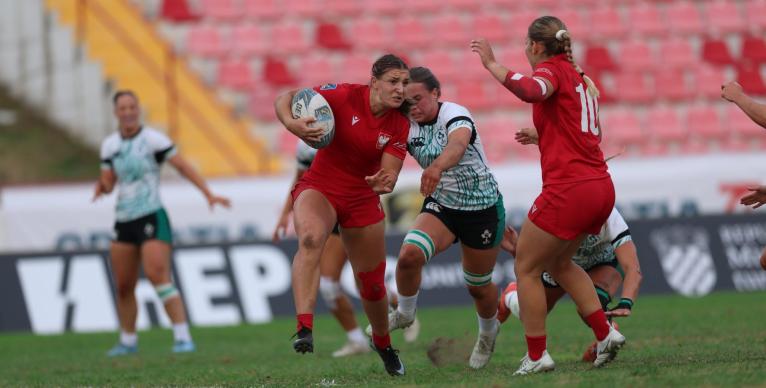
Regarding the women’s division, after three seasons of trying, Poland regained their status as champions even without winning a single leg, thanks to back-to-back silver-medal finishes.
France ended up winning the Hamburg leg after defeating Czechia (29-5) and Belgium (22-12) in the quarter-final and semi-finals, while Poland performed to their best to overcome Portugal (31-0) and Spain (19-7) before conceding a 17-14 loss to Les Bleues.
As with the men’s competition, both the title race and the battle to avoid relegation remained wide open, with Poland, France, Belgium, and Spain all still in contention for the championship.
In the second leg in Split, few could have predicted what would happen after an entertaining pool stage, with France suffering a surprising 22-17 defeat against Germany. This result meant an early end to the Les Bleues’ hopes of achieving a three-peat, as Poland had qualified for the semi-finals after beating Belgium 21-7.
After securing a 31-12 victory over Spain in the semi-final, Poland were able to celebrate the Series title even before the final had been played, having amassed enough points to clinch the championship for the first time since 2022.
Ireland reached the gold medal match with convincing victories over Portugal (27-0) and Germany (22-0), before capping off their campaign with a 26-12 win over Poland to claim 1st place in Split.
In the final Series standings, Poland, France, and Ireland occupied the top three positions.
Spain, Belgium, Germany, Portugal, the Czech Republic, Great Britain, and Denmark finished between fourth and 10th place, while Sweden and Türkiye were relegated after failing to survive the relegation battle.
Ukraine and Italy, meanwhile, secured promotion from the Trophy division and will replace them in next season’s Championship.
Regarding the SVNS spots, Poland and Ireland head on to SVNS3 for the chance to reach the second tier of the 7s World Series.
A reminder that the 10 best-placed teams on each side of the aisle will also be competing in the 2027 European Games, taking place in Istanbul, on June 16-27.
NEW IN THE APP: Official World Rugby Rankings hub! Compare team rankings side-by-side, with data going back 20 years.
Download the RugbyPass app on the App Store (iOS) and Google Play (Android) now!
Join free and tell us what you really think!
Sign up for freeAfter a long injury absence, the Harlequins loosehead has been missed by club and country and is determined to make up for lost time
The Leicester wing endured losing his father at 18 and the death of his brother last year but has found strength in adversity for club and country.
Canada snapped England's incredible winning run and there are signs the all-conquering Red Roses at last have meaningful and regular competition.
No. I'm saying they've no reason to change their priorities with the rules as they are
FIJI !
What a power house . They almost beat Australia at RL at the same time .
...
He looks like a young Judi Dench
With the sweat band. That's his business
...
Hard South African once apon a time 😄


 Clear
Clear 


 Copy link
  Facebook
  X/Twitter
  WhatsApp
  Messenger