




1
Six Nations 2026 Awards - and our Team of the Tournament
9

Substitutions in rugby usually pass by with as much fanfare as the changing of cutlery at a restaurant. Some players leave. Other players enter. If you’re paying attention you might catch the stadium announcer reading out their names.
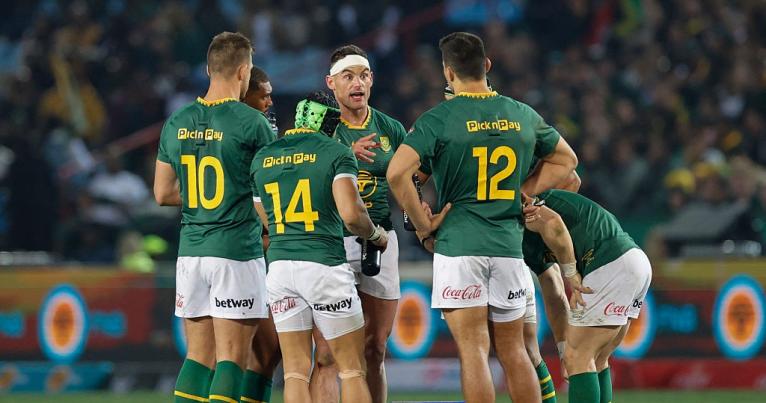
There is, of course, one exception. And on Saturday, seven minutes into the second half of South Africa’s Test against Italy in Pretoria, five replacements were welcomed to the pitch as if they were rockstars. Fireworks exploded around the stadium. Music blared from the speakers. You half expected someone to fling their underwear onto the pitch.
For six years the Springboks’ vaunted Bomb Squad has inspired awe, admiration and antipathy in equal measure. The tactic of unleashing a cohort of indomitable forwards in one go was not invented by Rassie Erasmus and his Boks, but no coach and team has ever marketed the ploy as effectively.

Watch the future stars of our game in action with the World Rugby U20 Championship, available on RugbyPass TV and the RugbyPass App.
Watch the future stars of our game in action with the World Rugby U20 Championship, available on RugbyPass TV and the RugbyPass App.
They arrive with the rumbling force of a herd of Cape buffalo. You know they’re coming but there’s very little you can do to stop them. As RugbyPass regular Jon Cardinelli showed recently, South Africa had scored more second half points than their opponents for 14 consecutive matches as a direct consequence of their arsenal off the bench. Critics might clutch their pearls, deriding the tactic as an affront to rugby’s spirit, but there is no denying its potency.
But something else happened on Saturday that has given South African rugby fans, coaches and players pause for thought. The Bomb Squad failed to detonate. When Erasmus hit the red button and launched his missiles, the Boks held a 28-10 lead. Manuel Zuliani had just scored a converted try but, according to the script everyone had been reading, that should have been the last we’d see of Italy. After all, the Bomb Squad would sort them out. Right?
The Springboks still won the match 42-24 but this was no thanks to the Bomb Squad. In fact, while South Africa’s not-so-secret weapon was on the pitch, the two teams scored 14 points apiece.
This is not the first time the Bomb Squad has spluttered. Against Scotland in Edinburgh last November, six forwards were brought on at 46 minutes but bumbled their way to the finish line. South Africa won a tight game but they dodged a bullet as Scottish profligacy in the red zone proved the difference. Afterwards, Scotland coach Gregor Townsend suggested that the Bomb Squad was less effective than some might think.
Part of the Bomb Squad’s success lies in its novelty. In its early years, through the 2019 World Cup and including the 2021 British & Irish Lions tour, there was an element of the unknown at work. Not necessarily in whether or not opposition coaches anticipated its arrival but in how players responded to the sudden injection of fresh legs. There’s an argument to be made that the Bomb Squad now raises the intensity of the opposition, elevating their output.
We grew used to seeing the Springboks suddenly steamrolling tiring front rows in the scrum and maul. And in the 2023 World Cup warm up match against New Zealand at Twickenham, when seven forwards were brought on at once, the fear factor was ramped up. Even if an All Black forward expected the onslaught there must have been an alarm going off in the back of their mind. In elite sport, where every play and tactic is broken down to its finest detail, something so unexpected can prove destabilising.
Now the opposition are not surprised. Now they are waiting. Every coach who faces the Springboks likely has multiple contingency plans, each with a code name ready to be triggered for the arrival of the Bomb Squad. Italy’s head coach Gonzalo Quesada called his forwards the “grenade squad” in a post-match press conference over the weekend. Perhaps that’s not the first time he’s used that phrase.
Then there’s the personnel issue. The average age of the bench last weekend was 32. Bongi Mbonambi is 34 and starting to show signs of wear and tear. Vincent Kock is 35. Franco Mostert is 34, and both Lood de Jager and Kwagga Smith are 32. At 24, Jan-Hendrik Wessels was the only forward among the substitutes in their 20s.
Turning 30 doesn’t mean that a player is past their best, but when the collective fails to produce its trademark heft it is worth considering if the Bomb Squad relies on younger hands at the wheel, even if logic might suggest that fewer minutes on the park allows older heads to perform at a higher tempo in the second half.
For this weekend the average age of the bench is just short of 27, with Wessels again taking his place alongside Ox Nche (29), Evan Roos (25) and two debutants in Asenathi Ntlabakanye (26) and Cobus Wiese (28).
That’s five forwards, a possible sign that Erasmus is tweaking the formula. This could be a good thing. Because beyond the age profile of Bomb Squad regulars, and putting aside the element of surprise and whether or not opposition teams are now better equipped to handle it, the evolution of the Springboks themselves means that less reliance on a forwards heavy bench could be beneficial.
Even compared to the victorious teams of 2019 and 2023, this group has more attacking potency than any South African outfit that has come before it. Sacha Feinberg-Mngomezulu looks the real deal at fly-half with threats at scrum-half, midfield and on the wing. And with Damien Willemse under pressure from Aphelele Fassi for the number 15 jersey, Erasmus is blessed with hot-steppers and playmakers that were once solely confined to Australia and New Zealand.
On a previous episode of the Boks Office podcast, Schalk Burger quipped that South Africa might one day field an unprecedented 4-4 bench. It sounded ludicrous at the time but now seems viable as the giant centre Andre Esterhuizen has been seen training as a makeshift loose forward and packing down at flank, a symbolic nod to the team’s growing tactical flexibility. Damian de Allende could probably perform a similar role if required.
The Bomb Squad may not be obsolete, but it is no longer the cheat code it once was. As the Springboks enter a new cycle with fresher faces and a more multi-dimensional attack, clinging to old formulas could stifle growth. A more balanced bench, smarter substitutions, and adaptability might be the next evolution in Erasmus’ playbook. The detonation button still works. It might just require a little rewiring.
The British & Irish Lions have provided a positive injury update for full-back Blair Kinghorn, but have called up Ireland's Jamie Osborne as cover.
Read NowJoin free and tell us what you really think!
Sign up for freeThe in-demand coach will be pushed to reject overtures from England and Saracens when his contract is up after the World Cup
After the Super Saturday epic, Fabien Galthie was left with more questions than Steve Borthwick, despite their sides' contrasting Six Nations form.
So many great tries, matches and individual displays in a championship for the ages, but which were the best?
No, just no, as good as Jordan is, a player like Cullen does not have comparisons
You’ll have to give me one of those vivid descriptions of a Queensland sunrise Miz!
Fine article, Nick. Late here as I read, so back in the morning when the old brain is refreshed !


 Clear
Clear 


