
“I’m more interested in beating the three teams from the southern hemisphere than I am in winning the Six Nations. I want to test myself against the likes of South Africa, New Zealand and Australia. Did you know they have won all the World Cups played out so far?
“I want England to become the first northern hemisphere nation to win it, and I want us to do it by playing quality rugby. Not just by kicking the ball down the f**king pitch and running after it.”
Those were the words of Clive Woodward which persuaded Great Britain supremo Phil Larder to hop codes and become the first-ever leaguer to coach the England national team in 1997. Six years later, Larder had built the finest defence in the world and England were winning the World Cup in Australia. To this day, that remains the only occasion when a side from north of the equator has won the Webb Ellis Cup.
Winning the Six Nations is not really the point, not in the year before a World Cup is due to be played. Developing a robust style which can succeed in all conditions, against all opponents is very much the aim. Forget the tribal rivalries, and look at the bigger picture. No more kick and clap.
If Larder has a spiritual successor in the modern game, it is Shaun Edwards, the defensive mastermind of Les Bleus for the past six years. When the ITV Sport cameras panned in on Edwards’ glowering face in the aftermath of France’s trenchant 48-46 victory over England, the fact that his defence had conceded 96 points in the last two games was mentioned in passing. The Wiganer’s face darkened for a moment as he paused to explain the difficulties of defending in the modern game. Then it brightened suddenly with a cheeky parting shot: “That’s seven – seven [Six Nations] titles now.”
Edwards has now won three championships with France to add to his four with Warren Gatland’s Wales between 2008 and 2019. But he has never come close to winning a World Cup with either country, and that is something he will want to change before his glittering international career is over.
For Edwards to affect a volte-face on the same good Australian earth where Woodward turned the odds on the southern hemisphere 24 years before, he will need tight forwards who can tackle, then get off the ground and make another bloody tackle – on hard, unforgiving pitches, and more often than not, in hot or humid conditions. The same applies to an England defence which has conceded an average of over 30 points per game, and gave up over 40 points in two matches against Ireland and France.
For Edwards, the balance of the French tight five must still be in question.
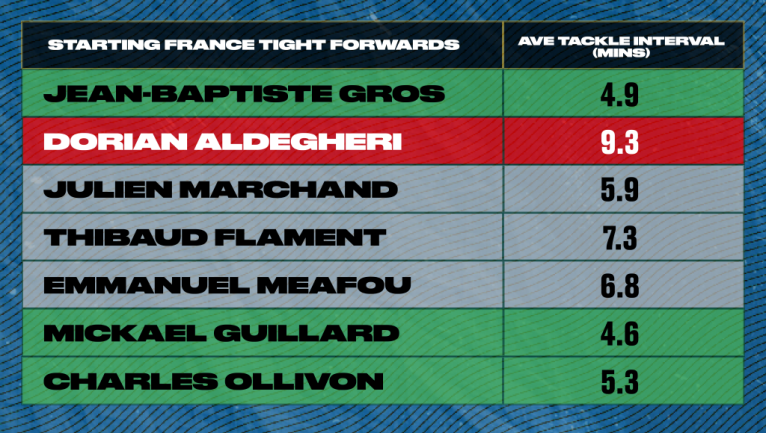
An interval of six to eight minutes between tackles is the mean for an international tight forward. Edwards has three – Gros at loose-head, Guillard and Ollivon in the second row – who are either superior, or elite operators in defence. Three of the four Toulousain tight forwards who started the game against England are fair to middling, while another has been poor in that aspect of play in the course of the Six Nations.
The single biggest problem is at tight-head prop, since the unfortunate retirement of Stade Rochelais colossus Uini Atonio before the Six Nations ever got underway. Aldegheri is below par for tackles made, and he has given up five penalties at scrum time into the bargain. There is little upside for Fabien Galthié, whether the coin falls on heads or tails at number three.
By way of comparison, the two dominant set-piece tight-heads in the championship – England’s Joe Heyes and Italy’s Simone Ferrari – were capable of engineering scrum penalties and contributing positively to the defensive structure. Heyes averaged 6.7 minutes between tackles while playing 65 minutes per game; Ferrari was even better, with a 5.4-minute interval between tackles, while being on the field for an average of 10 minutes less than the Tigers man.
The equivalent stats for the England tight five illustrate just how vast the potential for Red Rose improvement in 2027 really is.
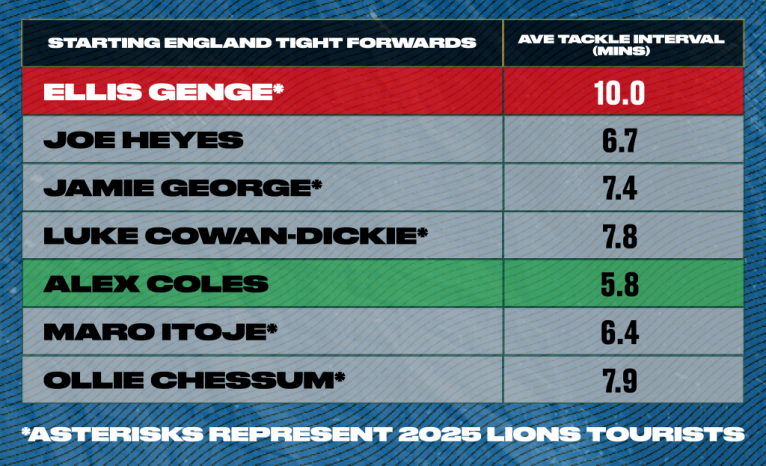
Taken in isolation, Genge’s tackle work-rate is as unimpressive as Aldegheri’s, but there is a great deal of significant ‘mitigation’ to that picture. The Bristolian carried 39 times at the Six Nations, compared to a combined total for both the French starting props of 24. He was also part of one of the two most dominant scrummaging front row units in the championship.
The Lions fatigue factor is likewise, clearly pointed: at the 2025 Six Nations, Genge was averaging 7.5 minutes between tackles, a whole two and half minutes less than his tackle interval one year later. In 2025, George and Cowan-Dickie lopped more than a minute off their own tackle interval in this year’s tournament. There is ample scope for improvement, perhaps more so in old Blighty than across the Channel in La Belle France.
To claim a team which finished with an unprecedented number of Six Nations losses is in as good shape to win the World Cup as the champions of the competition may seem outlandish, but that is how the theory touted by Woodward works. You don’t worry about Lions fatigue or Six Nations success, you keep your eyes on the ultimate prize. And you stop kicking the ball down the pitch and running after it.
That is why veteran England and Lions hooker George took the bullish, four-square stance he did after the game.
“Under Steve [Borthwick] I think we will be right up there with the favourites to win the World Cup. We’re a great team, a great group of players and he’s the perfect person to take us there.
“He has been unbelievable for English rugby. It’s crazy what has been happening over the last few weeks and he is absolutely the right man to lead us forward for a long time.
“That’s because he’s an English coach who cares so much about this game – but he’s also a very, very good coach who has created an excellent programme. When you combine that with a good group of players it’s a recipe for success.
“It hasn’t been where it has needed to be over the last few weeks, but the excellent thing about Steve is that we will have answers.”
Many of those answers were unearthed on Saturday night at Stade de France. For the one and only time in thia Six Nations, the men in white stopped kicking obsessively [only 26 kicks in the game] while bettering the hosts for:
- Total metres gained [419m to 323m]
- Gainline dominance of the carry [64% to France’s 49%]
- Ratio of lightning-quick ball [65% to 52%]
Les Bleus still made more offloads and clean breaks, but England finally revealed how they could evolve profitably towards the World Cup. That should be enough to keep Steve Borthwick in a job at the RFU.
England went off like a firecracker right from the beginning, and showed they had learned their lesson on kick returns from the game in Rome one week previously.
— William Bishop (@RPvids1994) March 15, 2026
On the first phase from the opening kick-off return, full-back Elliot Daly momentarily contemplates the Roman solution with a kick at 0:32 before feeding Cadan Murley instead. When the kick finally comes off Daly’s left boot three phases later, it is infield and creative rather than straight out into touch and programmatic.
That set the tone for subsequent events in the first half.
— William Bishop (@RPvids1994) March 15, 2026
— William Bishop (@RPvids1994) March 15, 2026
In the second of the two clips from the same sequence of play, it nine Ben Spencer, enjoying his finest outing in an England jersey, who finds a creative solution with the boot after the France defenders have been drawn up to the front line in typical Edwards fashion by multiple phases of passing and handling.
The creative use of the kicking game was also key to a try from lineout later in the half.
— William Bishop (@RPvids1994) March 15, 2026
Spencer only chips through when the French backfield defence has been stripped bare by multi-phase attack and the odds have shifted in favour of his side.
Les Bleus deservedly won the Six Nations, but ironically Galthié may still have more questions to answer to become a World-Cup winning head coach than Borthwick. That sounds strange when one side finished at the top of the table with four wins, and the other finished near the bottom with only one. But in reality, there is not so much of a gap, if any, between the two nations with 18 months to go.
The French supremo’s best combination in the tight five forwards looked no clearer after the close shave on Super Saturday, and the cupboard looks especially bare at tight-head prop. Meanwhile the big Cumbrian has probably secured his own position with England’s best performance of the entire campaign, and Genge, George, Cowan-Dickie, Chessum and Itoje can look forward to long-term recovery from Lions fatigue. The welcome return from injury of Fin Baxter and Will Stuart in the front row, and George Martin behind them, will add depth.
If anything is giving Rassie Erasmus sleepless nights, it is probably that prospect. The England tight forwards can match the Springboks. Is Rassie wary of England’s potential to go all the way at the World Cup and scupper a Springbok three-peat? They did it 23 years ago in the same country, maybe they can do it again. As long as they don’t keep kicking the ball down the f**king pitch and running after it.
Watch all the upcoming SVNS action for FREE on RPTV!
*Available live in select territories


Fine article, Nick. Late here as I read, so back in the morning when the old brain is refreshed !
You’ll have to give me one of those vivid descriptions of a Queensland sunrise Miz!
The injuries have set us back a lot. The “Pom” squad in the summer was used very well, as was the English bench against France. Borthwick has seen his mistakes and as he always does fixes them, turns them into strengths.
I think its fair to give him the chance to fix what is broken, and there were already signs of that happening v France…
Who goes to Paris, scores seven tries and still loses??😲
Some really interesting stats about work rate post-Lions. Gives cause for quiet optimism. Spencer's best game for England by far. First time he's actually looked the part. JVP utterly killed all our momentum when he came on which is a role usually saved for Spencer and in days gone by - Wigglesworth.
Only issue - and it's a big one - we've been here a few times before regarding not kicking the ball down the f**king pitch. This isn't the first time after a humiliating defeat Borthwick has “rolled the dice” (been forced out of his comfort zone). Most notably we had a player revolt a couple of years ago following defeat to Scotland, we then turned over Ireland and lost narrowly á Paris. I rubbed my hands together knowing that Borthwick had seen the error of his ways but sure enough come the summer all was forgotten and the box kick re-emerged.
I just don't have any faith he won't revert to type again. The Wigglesworth - Borthwick axis is just too much Sarries 2013 to overcome.
The positive aspect of the SB saga is that he has tried to both change and innovate Tom over time.
He played the five #7’s and dropped an entire Lions front row on to the bench in November…
And if he is indeed listening to what the players want and how they feel most comfortable, that is another tick in his favour.
The thing about player revolts is that they never occur by players going out on the field and simply disregarding the coaches’ instructions. What England did versus France was very obviously practiced all week long.
So there are grounds for hope looking forwards - but no guarantees!