
Even though they were introduced to professional rugby and soccer 15 years apart, the TMO and VAR systems are brothers under the skin. Whether it is the Television Match Official or the Video Assistant Referee, the aim is still the same: the introduction of a remote third party to check, and if necessary, correct the decisions of the officiating crew out on the field.
Since it was first launched in the Premier League back in 2019-20, VAR has been a bone of contention, creating more controversy than it has resolved. One of the more recent high-profile examples occurred in a match between Arsenal and Newcastle United in November 2023. If you can bear to live through it, the process of decision-making around a goal scored by Newcastle’s Anthony Gordon can be viewed here:
Apart from the chaos of a conversation in which the participants are constantly talking over one another, there are any number of subjective assessments involved in a supposedly objective process. There are references to ‘gut instinct’, assumptions about the ‘curvature of the ball’ affecting viewpoint, personal evaluations on whether or not a player was pushed in the back, and even an admission ‘you do not know where the ball is’ in judgement about offside. Coherent and cohesive, it is most definitely not.
In the aftermath of that decision, two demands emerged from the debris. The League Managers Association insisted:
“[1] The managers strongly feel that a VAR specialist should be considered a member of the close team of officials (Referee, fourth Official, Assistant Referees and VAR specialist) that become one unit for every game they are officiating together.
“The use of officiating teams, with referees and assistant referees regularly working together, has already proven beneficial and produced positive results.
“[2] The managers are also calling for a review [and simplification] of the interpretation of the term ‘clear and obvious’ in VAR decision-making, as this is a cause of much confusion at present.”
The Spanish manager of AFC Bournemouth, Andoni Iraola, reinforced another important theme in comparison to practice in La Liga:
“[3] In Spain, probably they call the referee, he goes and analyses the play [on a small TV] and then he takes the decision. I feel like they call the referees less to go to the VAR than in Spain.”
The Everton manager Sean Dyche added, “The sense of sitting in a room [watching a monitor] – it’s different than it is to referee naturally [out on the field].”
The VAR experiment has produced a renewed will in soccer: a desire to trust the man in the middle more rather than less [even if he views the replay on his own private screen]; a demand for crews of officials who work together week-in, week-out and understand each other’s language and viewpoint; last but not least, a limpid clarification of what the phrase ‘clear and obvious’ really means.
Understanding the flow of a sporting contest is a fluid, dynamic process, and it is best understood by the person in the thick of the action. He or she is attuned to the game-in-motion in a way the people in the office are not. As the recently-departed manager of Liverpool FC Jurgen Klopp explained lucidly, “the [only] clear and obvious mistake is showing a frozen picture, and in slow motion.” It is one takeaway rugby can apply immediately from the VAR experience in soccer, without having to endure the universal heartache and growing pains involved in the process.
The first Test between South Africa and Ireland in Pretoria provided an object lesson. The fate of the match was effectively decided by the shifting power dynamic between English referee Luke Pearce and Welsh TMO Ben Whitehouse.
The key moment came in the 58th minute, with the Springboks 13-8 ahead. These are the broad strokes.
How many TMOs would bring the referee back for an offence committed at the ruck, when he is looking directly at the breakdown only two or three metres away? Luke Pearce does not observe any wrongdoing in real time even though he enjoys an eagle’s eye view, but the ‘people in the office’ – Whitehouse – ease him away from his first instinct. ‘The sense of sitting in a room is different from what it is to referee naturally’. Indeed, it is.
It is clear South Africa are on the defensive throughout the ruck, with Bundee Aki first to the ball and full-back Willie Le Roux then attempting to manage a big front row forward [Ireland replacement hooker Ronan Kelleher] in the latter stages.
The current of the conversation between Pearce and Whitehouse ran thus:
“Number 16 [Kelleher] hooks the ball backwards, but he is lying on the grass when he does so…16 counter-rucks, then goes to deck, but then kicks the ball back.” [BW]
“It is hooked backwards – but a player cannot play the ball on the floor. So that’s illegal, it’s not a try.” [LP]
It was a case of the man upstairs setting the agenda remotely, and the man on the field following it. Both missed an essential piece of information in the process.
The only way Le Roux can find to remove a much more powerful man is by means of an illegal neck-roll. The force of the wrench drags Kelleher sideways and his leg knocks the ball backwards, probably by accident. There is no conclusive proof it is a deliberate action and the more flagrant offence which triggers the ‘kick’ is missed.
That incident set the tone for another potential review five minutes later.
Ireland scrum-half Craig Casey is first spoiled at the base by Springbok behemoth RG Snyman, but then has the back of his head smashed into the unforgiving highveld turf by a protracted, four-step drive-tackle from the big man.
As ex-Munster and Ireland flanker Alan Quinlan pointed out in the aptly-named Off the Ball podcast “He [Snyman] follows through with the tackle. You look back at that again and you review it, the argument is, why don’t you stop? You don’t need to keep following through there.”
In the NFL, ‘roughing the passer’ is an analogous offence. Once the ball has been released by the quarterback, the men looking to hunt the passer down can take only one more step towards him before actively looking to avoid further contact. The lawbook in rugby is equally straightforward:
Law 9.11 Players must not do anything reckless or dangerous to others.
Law 9.13 A player must not tackle an opponent early, late, or dangerously.
When Pearce asks a tentative question, “It’s just a collision, isn’t it?” the decision-making power moves away from the man in the thick of the action, to the man sitting in a room.
Only a couple of minutes later, the same player denied a try by TMO interference [James Lowe] was involved in a situation which led directly to a South African score.
If Lowe has a foot in touch before he releases the ball, it is a Springbok lineout rather than a Springbok try. It is a 50/50 guess from the angles available, but without the benefit of a TV screen of his own to watch the replay, Pearce had to rely on his TMO:
“It’s all on you Ben.” [LP]
“I’ve got nothing clear to overturn it [the try].” [BW]
There was one more reviewable event before the final whistle, with Ireland skipper Caelan Doris looking to plant the ball over the line from a close-range drive in the 75th minute.
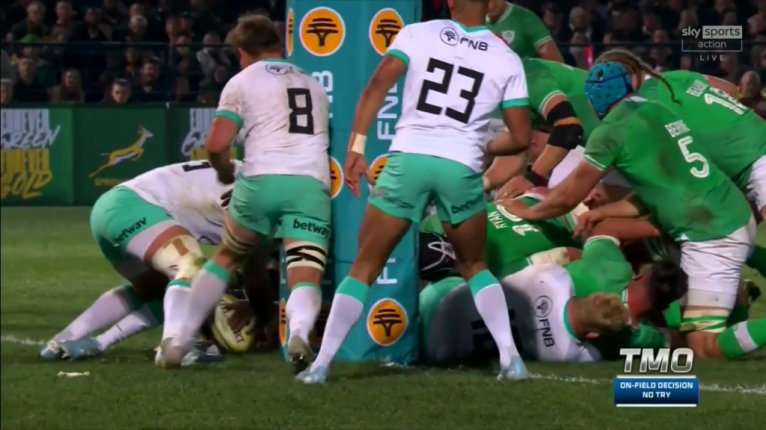
The ball looks as if it may have been grounded on the whitewash but by now the TMO’s word was law: ‘stick with your on-field decision [no try]’. That was game, set and match to the Springboks.
South Africa deserved to win on the quality of their play alone, of that there is little doubt. Their new Kiwi attack coach Tony Brown already looks to have paid his air fare over to the Republic, and much more besides. South Africa is busy bolting on some attacking finesse to its power game at the set-piece and in contact.
The game did not offer a positive model of cooperation between the referee and the TMO. With Pearce unable to access a private screening of his own, decision-making power passed inexorably to Whitehouse, and the man in the back seat began driving the car. Chelsea manager Mauricio Pochettino had hammered a similar nail home in relation to the Premier League: “I trust in VAR. I trust in the car – but not the driver. That is the problem.”
The natural rhythm of the game came to a grinding halt in the process, with numerous stoppages in play, particularly in the second half. Judgements were no more accurate in freeze-frame, or in slow motion than they would have been had the referee remained at the centre of the decision-making process, in real time.
Officials in both sports need to work with established crews, within partnerships they know and understand. They need access to on-field monitors and the decision-making must stay with the person on the field, rather than a person in a room. ‘Clear and obvious’ evidence should be found in real time wherever possible.
Better to learn from the problems which beset VAR, without sharing or re-experiencing them. Let the final word remain with Spurs manager Ange Postecoglou:
“With VAR, the more we use it, the worse it is going to get. Clear and obvious error? It seems like everything is getting scrutinised. It’s not our game.
“We are not rugby, we don’t have those stoppages. What I always loved about our game – especially in England – was the frenetic pace. Why are we trying to take that out?”


Comments
Join free and tell us what you really think!
Sign up for free