
Just when you think the desert storm must have blown itself out, another haboob arises seemingly from nowhere. A downdraft of cold news air hits the ground and the dust devil rises up, and the visibility of the underlying topic is quickly reduced to zero by a gale of voices on social media.
If payments to Rugby Australia and New Zealand Rugby were triggered by the number of reads and comments from their news items, the bank accounts of both would be sitting very comfortably in the black over the past few weeks.
There is no sign of the pace slackening, even with the start of the Six Nations on the horizon. The home unions may want to believe it’s all about the premier international tournament on the global calendar, but much of their media thunder is being stolen by events on the other side of the equator.
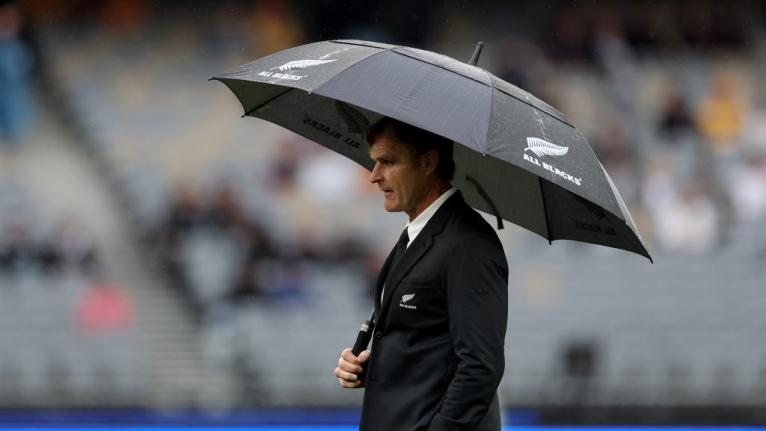
In New Zealand, the ramifications of ‘Razor’ Robertson’s brusque removal are not only still being felt, they are spreading out in huge, billowing clouds of dust. As Bristol Bears head coach Pat Lam pointed out, Sir Wayne Smith – “the icon of coaching, the most revered coach in New Zealand” – was not invited to become a part of the review process that led to Robertson’s resignation.
While NZR could justifiably claim a conflict of interests, with ‘the Professor’ functioning as Razor’s erstwhile high-performance consultant during his time in charge, the opinions of probably the wisest of the three wise men could not, and should not have counted for nothing. Smith made it crystal clear he did not agree with Robertson’s dismissal.
“Unfortunately, Razor hasn’t been given more time, greater opportunity to adapt and overcome many of the challenges new All Blacks’ coaches face,” he said. “I feel sad about that – for Razor and for our game.
“They obviously feel that the win percentage wasn’t going to improve, although that is just guesswork.
“I actually found Razor and his coaches to be extremely competent around their roles.
“It’s a tough old gig when 76% isn’t good enough… Egos abound, 76% [sic] win records are no longer enough.”
Robertson’s record was “only” 74%, not 76% as ‘Smithy’ claims, but his words do raise the shadow of a soccer-style culture where success has to be instant or the sword will fall on the manager’s head. Was the decision to remove Razor bold, or was it impatient, bordering on the reckless?
The news storm gained added impetus when it was revealed that a potential key player in the All Blacks’ reformation, the Springboks skills and attack coach Tony Brown, would not be available to the recruitment of any new coaching panel. The Otago man made it quite clear to Mike Hosking on Newstalk ZB there was no possibility of him joining his long-time coaching “brother” Jamie Joseph. After the last World Cup in 2023, Brown said “it was definitely the Scott Robertson team versus the Jamie Joseph team, that was the process that New Zealand Rugby set up.
“With me being with Jamie, Scott potentially didn’t want to take me as well. He had quality coaches in Jason Holland and Leon MacDonald, Scott Hansen and Jason Ryan, so they had a strong coaching team. Jamie put his team together and I was part of that, and New Zealand Rugby went with Scott.
“So, it was just the way it was, and I was stuck. Then Rassie gave me a call about South Africa. I played under Rassie for the Stormers and knew him as a coach and he’d obviously done some amazing things with South Africa over the last two World Cups, and I just thought, ‘oh well, what an opportunity to go and learn off him’.
“I’ve even talked to Razor a couple of months ago about potentially joining the All Blacks, but it’s like I said to him – my commitment to South Africa was four years, and I’ve always wanted to honour that.
“I said, ‘I’m just so frustrated that no-one talked to me two years ago’. But that’s rugby, and that’s coaching. He had his coaches, and I just had to go and find another job.”
The idea of renewing the Joseph-Brown connection was one of the main attractions of removing Robertson and it has been shown to be pie in the sky. If the new man is stuck with the same coaching group which was largely perceived as a busted flush under Robertson, he will be starting behind the eight-ball.
Meanwhile Australia is rolling the dice on another league crossover, Sydney Roosters forward Angus Crichton, on the runway to their home World Cup in 2027. The 29-year-old’s reported $650K AUD deal does not register on the Joseph-Aukuso Suaalii scale of investment, but it could potentially fill a Wallaby need at second five-eighth.
The NRL season is not due to finish until early October, which means Crichton, like Suaalii, will probably be selected on a Wallaby tour before he has ever played a game of Super Rugby. The underlying question is whether one November tour, one season of Super Rugby Pacific and one Nations Championship will equip a leaguer who played rugby as a schoolboy but has been out of the game for the last 12 years, to compete at the highest level of the game.
The timeframe of 12 months is not a forgiving one, especially as Crichton will probably be required to learn one of the more complex roles in the modern game at 12. He may have enjoyed the spot at Scots College in Sydney, but the professional interpretation of the role is so far removed from schools rugby that it will be, literally and figuratively, a matter of learning a new game.
The combination at 10 and 12 is the glaring hole in the Wallaby backline. During his two full seasons in charge, Wallaby supremo Joe Schmidt tried out six different 10s, four different 12s and 11 – yes, eleven – new combinations at 10 and 12.
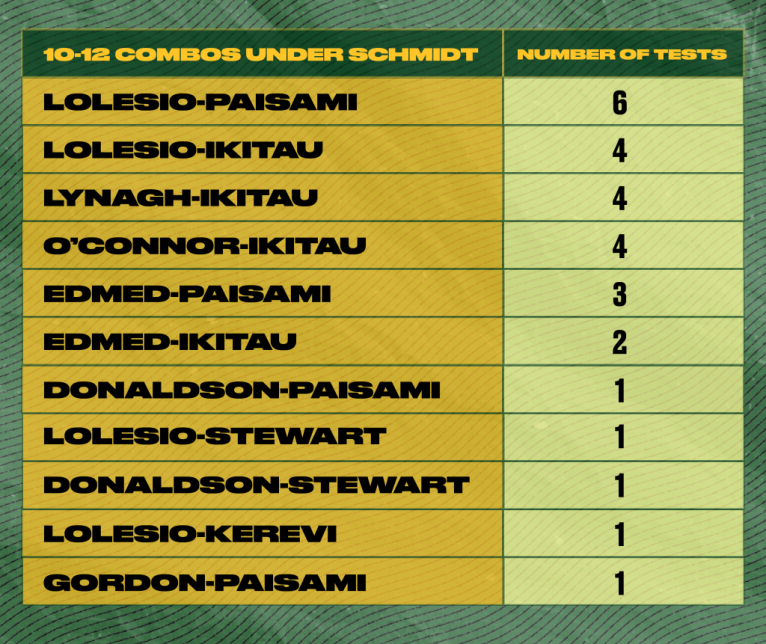
It is the one area where Schmidt’s Wallabies were never settled. The introduction of Suaalii at centre forced Len Ikitau inside, and the Gordian Knot of selection at 10 was never satisfactorily resolved.
At the age of 31 come World Cup time, will Crichton turn out to be more Sonny-Bill Williams than Sam Burgess? The man himself made all the right noises at his unveiling by RA:.
“It’s incredibly exciting to be returning to the sport I played throughout my childhood,” Crichton said.
“Growing up in Young [New South Wales], I have great memories driving up on buses to Canberra with the other farmers and their families for the Tahs-Brumbies game every year.
“To have a chance to play in the same Waratahs jersey as Lote Tuqiri, my favourite rugby player as a kid, is something special. I grew up with a Wallabies jersey and poster on the wall and my dream was to one day represent them.”
In England, Burgess was caught in a deadly merry-go-round, with his club Bath viewing him as a long-term prospect in the back-row and the national side wanting a fix at inside centre in time for the 2015 World Cup. Throughout his six seasons in New Zealand rugby, Williams was a 12 in the national side or with Auckland. There was no confusion about his role, it was black, blue and white.
With Fraser McReight and Carlo Tizzano already holding the fort so strongly at seven and the indefatigable Bobby Valetini at eight, Australia does not need a long-term back-row experiment from the sister code. What it needs is a true second-five eighth who can nudge Ikitau back to his true calling at centre and reposition Suaalii in the back three, where he properly belongs. Sprinkle on some magic dust from ‘Marky’ Mark Nawaqanitawase and Max Jorgensen and that is some three-quarter line.
Crichton knows how to straighten a line as a first-wave ball-carrier and in support.
— William Bishop (@RPvids1994) January 23, 2026
— William Bishop (@RPvids1994) January 23, 2026
He has SBW-like touch on an array of different offloads.
— William Bishop (@RPvids1994) January 23, 2026
— William Bishop (@RPvids1994) January 23, 2026
Stand and deliver? Under-arm hook through the tackle? No problem. He has also developed an understanding with Suaalii during their time together at the Roosters.
— William Bishop (@RPvids1994) January 23, 2026
With Crichton and Ikitau in midfield, there will be ample power and excellence at line-running inside. All Les Kiss will have to do is find the right number 10 to provide the bullets for his outsides to fire.
With an unholy alliance of Suaalii and Nawaqanitawase in the backfield, Australia’s range to field and reclaim high ball moves from local to inter-continental. As ex-Wallaby cap centurion Adam Ashley-Cooper commented on the Kick Offs and Kick Ons podcast, “there’s a lot of growth opportunity for Joseph at the back. It would get his hands on the ball in a lot more space [and] something that we’ve struggled with over the last four or five Tests – the aerial pursuit, defusing the bombs, winning the aerial game.”
“There is no such thing as bad publicity”, as the showman PT Barnum once wryly observed, and the state of New Zealand and Australian rugby is in the news. One country has sacked its head coach in the middle of a World Cup cycle with no obvious replacement in mind. The other has holes to fill in its own coaching panel and is reaching towards league for emergency reinforcements before a home World Cup in 2027. In both cases time is running short. Talk, don’t talk, the time is coming to match words with action.


I love how RA just give away the Wallaby jersey to players who have never done anything to demonstrate they deserve it and the Wallaby jersey is becoming less and less meaningful every time they do it. RA complains that the NRL is pinching their best players and then demonstrate to every schoolboy player out there that the easiest way to become a Wallaby is to actually go to league because coming back you’ll get a free Wallaby jersey without ever having to prove you’re good enough to deserve it. It’s no wonder so many go away overseas when RA show that loyalty and demonstration of rugby skills and knowledge isn’t worth anything to them. Certainly every opposition team will be hoping that it’s Chriton at 12 and JAS at 15 because while both will not doubt be dangerous if given room they will both have far more downside than upside in their game and will provide a pathway for anyone who wants to beat the Wallabies. Really starting to fear that the Wallabies may end up looking back at the last RWC and wishing they did as well because some of the decisions coming out of RA at the moment seem designed to push the Wallabies further down the world rankings.
Great article Nic. Love your video ‘details’ on Critchon.
Great to read a familiar voice. I’ve just left the funeral at the other place, After a bright start to Super from two of the Oz teams it was eerie to find tumbleweeds in those lonely corridors. If success has many fathers I’d love to know who and how that sad result got orphaned.
Pretty ignorant take on ABs coaching. 1 no one was banking on TB he wasn't approached he said so himself it was known he had a committed to SARU. 2 Yes Smitty was compromised. He was in a part time role from Aus where he mostly lives and is known to be a big softie which is why his amazing rugby brain wasn't suited to head coach. 3 you obviously haven't read what the AB Crusaders players said about Razor he was a great people motivator and very upbeat but that went out the window on day 1 at the ABs he was tense didn't communicate a vision and played them motivational videos! Happens sometimes people get to the big stage and freeze.Looks like he didn't want to let on he was struggling and Smithy may not have known. Time is not running out it's a process and I suspect Kirk already knew he had one of his preferred candidates at hand in JJ. Maybe you should do more research and less click baiting.
Yeah the private schools system is the only thing saving the wallabies. The schools produce great players and RA discard them to league
I don't understand how Australian Rugby is failing because I believe their school boys rugby is as good as South Africa, what am i missing here? Please inform me
SA school boy rugby is the best in the world. You would have 20,000 people attending a top school derby. Rugby is massive at the grassroots level. Saffa living in Aus.
Morning Nick. A lot to unpack there!
Those losses to SA and England were just so meek and suckful. I had no faith in Robertson to improve the ABs at all.
I suppose they can be coached like a golf swing, except in my case - after some coaching for an outside-in swing imperfection, the first time after that I tried the new swing, T’ed off and hit a ball onto the club captain’s car - a fair bit off the fairway. Some things should rather stay broken.
I’d guess that the Boks hv a GK coach so you would like to think their tech cd be refined G!
He looked trussed up like a Christmas turkey didn’t he? Never made the job his own.
Spot on re PSdT - at 200cm and 120kg+ his power is key to their scrum success. ABs were looking to respond to this with a three lock second row. It was a work in process that had some partial success in the scrums but needed a heap more work.
The Razor situation appears to be more off-field related than winning percentage.
The Wallabies situation is interesting with the recruit. It is difficult to compare to Sam Burgess in England, as Australia has over 25 years of experience converting players, and within Australia, Rugby and League are closer aligned than outsiders would realise. Time will be a challenge for the player to prove he is actually good enough to become automatic at the little details, but the basics of the game are nearly identical for a 12 and an NRL forward.
JSA moved to the back three will be good for the Wallabies. JS biggest weakness was around team selection, followed by supporting a left-field defensive system which was lightyears away from what our players use at SR level. I have no idea why they did not just move Filipo into the centres with Lenny and put the tall JSA in the back three. Filipo was perfect for the JS attacking style but clearly that Wallabies coaching outfit had stubbornly got something stuck in their heads, and that was the way it was going to be. It will be interesting as you did not mention Tom Wright in the back three….A Marky Mark if form is good, otherwise Dylan Pietsch (oh no, why not Jorgo….Dylan is better with Tom Wright style player and provides a lot more support to our 10s), JSA with Tom Wright at 15 is our most dangerous combination with and without the ball.
Tom Wright will be there or thereabouts, but it is a stron foursome to pick from - TW plus Marky Mark, JAS and Jorgenson, with huiys like Dylan Pietsch also in the mix. I think Jorgo needs to be put under pressure to justify that big contract, so far he’s been good… in patches!
It was wrong from the day he traded the tracksuit for the shirt & tie.
The pressure & environment changed him from who he was and I doubt they ever saw the Crusaders Razor after that.
They are big jobs but you can’t allow them to change the way you are and act.
That is the general feeling this side from guys who generally have a good ear to the ground.
Highly unlikely to attain and maintain his percentages. What is remarkable is the similarity in the “swing” by Polly and Morne and how they differ from Sasha and Manie. I might be deluding myself here but without the benefit of slo mo it seems to me the first two are classically in a straight arc at 90% both the other two “swing” slightly outside in.
Probably one of the poorest attempts at trolling I’ve seen on here…
So what we gather from the latest dump of Duckledigook is 1. It was a brilliant boardly move by NZR, 2. It was a process that mere mortals cannot hope to understand, and 3. The decision is very probably wrong anyway!
Oh my aching sides!…. don’t ever stop posting Ed. Comedy gold🤣🥰🤣
Ahh I see, makes much more sense with forwards, PSDT too looks like he pumps power into that scrum compared to our shorter flanks.
Holland is a god send for the All Blacks in that he’s an answer to Snyman.