
Just over a year ago, in August 2024, Swys de Bruin was enjoying a meal with his family when his phone rang. It was Dave Wessels, SA Rugby’s high-performance manager, calling about a job opportunity. It wasn’t high profile or strenuous, just a mentor role for coaches across South Africa’s pipeline, offering some expertise from the grassroots all the way up.
De Bruin was on board. His last coaching gig had been in 2019 as Rassie Erasmus’ attack specialist, but stress and burnout forced an unexpected departure from the Springboks on the eve of the World Cup. For five years De Bruin freelanced as a pundit for SuperSport, sharing his insight for public consumption. The break had done him good, and he was ready to dip his toe back in.
A week after accepting the role, Wessels called again. He hadn’t been entirely honest.
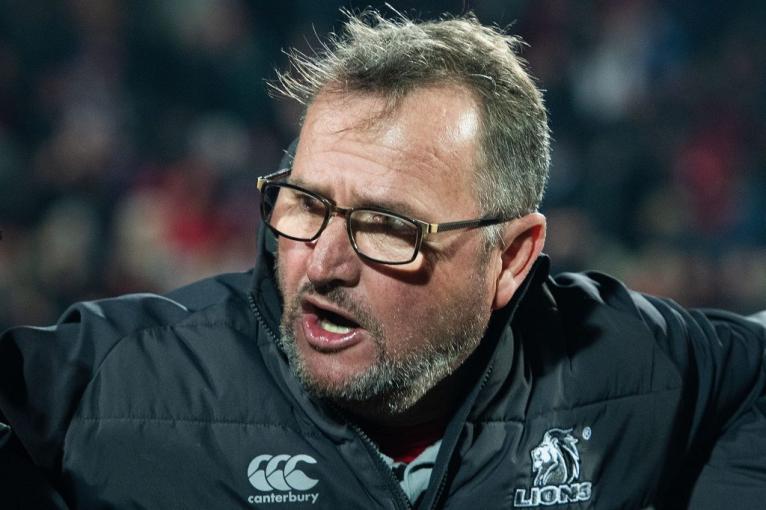
“He asked if I was interested in coaching the Springbok Women,” De Bruin tells RugbyPass ahead of the team’s World Cup quarter-final against New Zealand’s Black Ferns. “They wanted me to take the team to the World Cup but I only had 12 months to get things done. I thought, ‘This is a different kettle of fish than what I’m used to’.
“I didn’t know much about the team but I knew they took some big losses in the World Cup in 2022 and in 2017 they weren’t good enough to even go to the World Cup. It wasn’t a good picture. I knew this would be a big job.
“After praying with my family and getting the OK from my wife, I said I’d do it. But I’d have to start from the ground up. I love challenges, I always have done throughout my career. The rest, I suppose, is history.”
De Bruin first cut his teeth as a coach at Hoërskool Durban-Noord, an Afrikaans school in Durban’s leafy northern suburbs. His player pool was shallow and filled with undersized athletes. Still, he managed to bloody the noses of some of the top teams in the region including Glenwood and Northwood, which combined has produced 11 Springboks.
“We couldn’t host games because he didn’t have the facilities,” he recounts. “So we’d have to go to these big schools and beat them on their own patch with players who probably wouldn’t make their first XV. I’ve loved coaching underdogs. It can be freeing when no one gives you a chance.”
The job was impacting my health, it was impacting my life at home. It really wasn’t good for me.
His reputation of turning lumps of coal into diamonds earned him a job with the Sharks academy where he was responsible for the development of promising youngsters in the region. From there, he spent several seasons in charge of the under-resourced Griquas in the Currie Cup, followed by a short stint with the SA U21s. In 2013, when Johan Ackermann was tasked with rebuilding the Lions after their relegation from Super Rugby, De Bruin joined as attack coach.
The Ackermann-De Bruin axis transformed the Johannesburg franchise. From perennial wooden-spooners, the Lions became the leading team in South Africa. In their first two seasons they reached the finals of the Currie Cup before sweeping to victory across an unbeaten campaign in 2015. That year they achieved their first top-half finish in Super Rugby since 2001 before making two consecutive finals. When Ackermann left in 2017, De Bruin took charge and yet again qualified the showpiece game of Super Rugby.
Though the Lions were beaten in three finals in a row, they dazzled with an entertaining brand of rugby. Faf de Klerk and Elton Jantjies pulled the strings. Franco Mostert and Malcolm Marx owned the tight exchanges. A devastating backline and a rangy back row marshalled by skipper Warren Whiteley morphed the once unfancied Lions into the darlings of the southern hemisphere.
“I think coaches can become fixated on structure,” De Bruin explains when trying to sum up his coaching philosophy. “I’m not big on structure. I believe every coach needs to find out what each individual is best at and get that player to excel in that. If they’re attacking they just attack. If they carry hard then they need to carry as hard as they can with every carry. I believe the art of coaching is not to over coach.”
Around this time the Springboks were a force in decline. They’d slid down to fifth in the world after humiliating losses to New Zealand (57-0), Argentina (32-19) and Italy (20-18). Erasmus was brought in to steady a teetering ship and he naturally wanted a deputy with a reputation for doing just that.
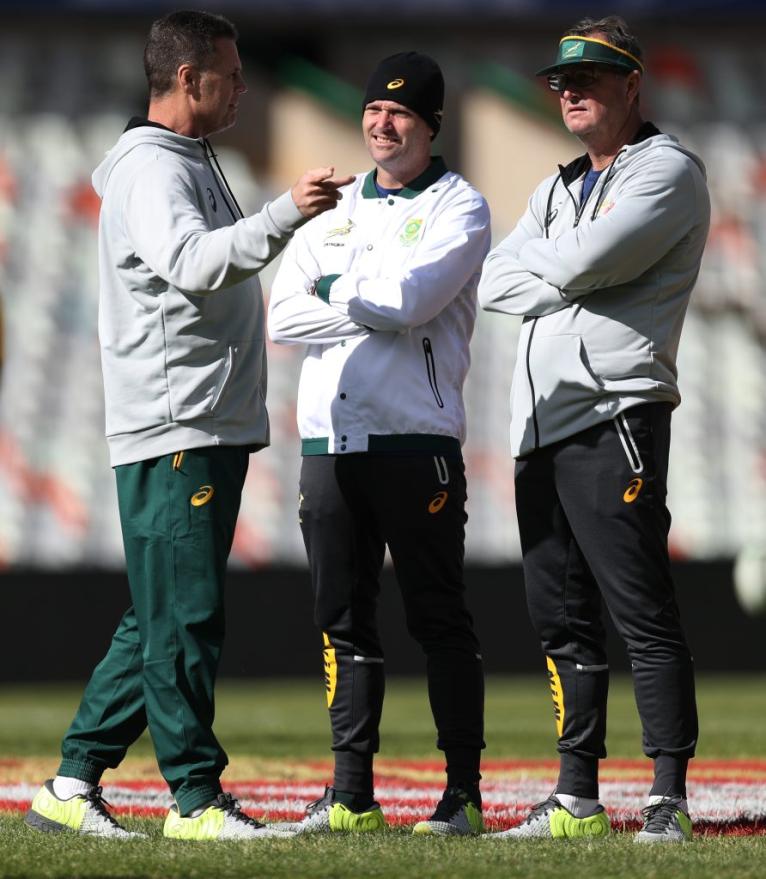
But the burden of expectation proved too much for De Bruin. “I was burned out in no time,” he says. “The job was impacting my health, it was impacting my life at home. It really wasn’t good for me. It was so hard stepping away from the Springboks but I knew I had to do it. And rather do it before the World Cup.”
Time away rekindled his love of rugby. He became a fan favourite on TV, concise and accessible. Then came the call while eating a hamburger with his family and a week later, without interviewing for the role, he was head coach of the Springbok Women.
The scale of the task at hand became apparent during his first training camp. “We had to start from scratch,” he explains. “I first had to learn what made them tick. I couldn’t go in there and treat this like a men’s team. Of course the fundamentals of rugby are the same, but these are different athletes, different people. I had to educate myself.
“When I took the job I had a lot of people tell me I was mad. I have people close to me that questioned my decision. People would tell me these stupid things, that women’s rugby wasn’t real rugby, that I was wasting my time. You still get arseholes who say that a woman’s role is in the kitchen. That almost made me want to do it more. I wanted to shut them up.”
I have mates my age [65] who couldn’t believe I got involved in women’s rugby who are now the team’s biggest supporters.
His first focus was to improve the team’s conditioning. “We couldn’t play for more than 30 minutes when I started and we couldn’t move the ball for more than five phases,” De Bruin explains. “So we drilled the players. I was worried that we were pushing them too hard but I tell you what, these women are tough. You tell them to do something and they’ll keep going. They will give you everything.”
De Bruin credits this resilience in the team to the challenges they’ve faced as individuals. Fly-half Mary Zulu was abandoned as a baby. Prop Babalwa Latsha grew up in poverty. Scrum-half Nadine Roos was deserted by her mother when she was three. There are dozens more that, according to De Bruin, “would make you fall off your chair”.
Gumption alone won’t transform a team. On the field, De Bruin demands direct, hard running that tests defences, sharp ball movement around the fringes, and a punch over the gainline that keeps momentum with South Africa. It’s a style that rewards courage, precision, and decisiveness and it fits his players to a tee.
“I often reference the old cowboy movie The Magnificent Seven, where every member of the gang had a special attribute,” De Bruin says. “Every player has a special strength. A coach has to work with what he has, not try to force things.”
What De Bruin has is a group which is physically confrontational, enjoys each other’s company and fully recognises their role in changing perceptions around the women’s game. “They see themselves as ambassadors,” he says. “Our job is to help them achieve their goals.
“I have mates my age [65] who couldn’t believe I got involved in women’s rugby who are now the team’s biggest supporters. Sponsors are on board. We have media interest. It’s incredible what we’ve achieved in just a year. I’m telling you, if we continue like this, by the next World Cup [in 2029] we will be a top four team. You can hold me to that.”
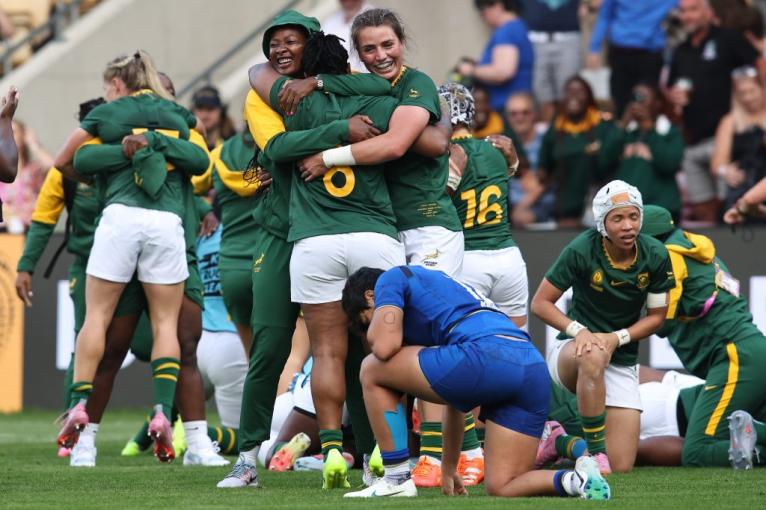
The gap between South Africa and the world’s elite is still significant. Anything other than a romp for New Zealand this weekend would constitute an upset. De Bruin says without regular fixtures against the premier opposition – either as part of the Six Nations or in a competition with Australia and New Zealand – change will be glacial. He’s also adamant more professional sides back home are imperative for the Springboks’ growth. He is confident, though, these changes will come.
“We’ve made sure we are a team to be taken seriously,” he adds. “We’ve done our part. The players have done their part. We’ve shown that women’s rugby is more than surviving in South Africa. It’s thriving. I feel so blessed to have played a role in this story. Coaching this team has been an absolute joy.”


Comments
Join free and tell us what you really think!
Sign up for free