
While some events leave the soul untouched, others leave a permanent mark – maybe even a little scar tissue. We never know when the turning points will arrive in advance, but only get to know them afterwards.
NEW: Follow Your favourites in the App 📱
You can now follow their favourite teams, tournaments and players in the RugbyPass App!
Three months after the tournament finished with a remarkable 13-try extravaganza, a last-gasp 48-46 victory by France over England, the reverberations of the 2026 Six Nations are still being felt as the inaugural Nations Championship looms large. It is one of those landmark events which will leave a permanent stamp on the game.
It may even have defined the moment when rugby in the northern hemisphere finally caught up with the south. Whether the players are as good as those being produced in New Zealand, Australia and Argentina remains to be seen, but the systems finally seem to be doing their job around them.
The attitude towards long periods of ball-in-play, and positive attacking rugby has improved out of sight and all of the six nations buy into it. The presence of the four South African franchises in domestic European competitions has undoubtedly helped create an atmosphere where northern hemisphere rugby can compete at the highest level, whatever the pressure.
World Rugby consultant and ex-international referee Corris Thomas completed a review of the competition, and like all quality analysis it helps the spectator understand why they were watching an important moment in the game’s evolution. The following statistical content derives from his report on the tournament.
The shape of the game
The shape of the game, it is a changin’. A whopping 111 tries set a new tournament record, but also changed the balance of scoring between tries and penalty goals. There were only 33 penalty kicks at goal over the 15 matches, and that means you can only expect a maximum of six points per game off the tee, compared to a possible 52 points from scoring tries and making the conversions.
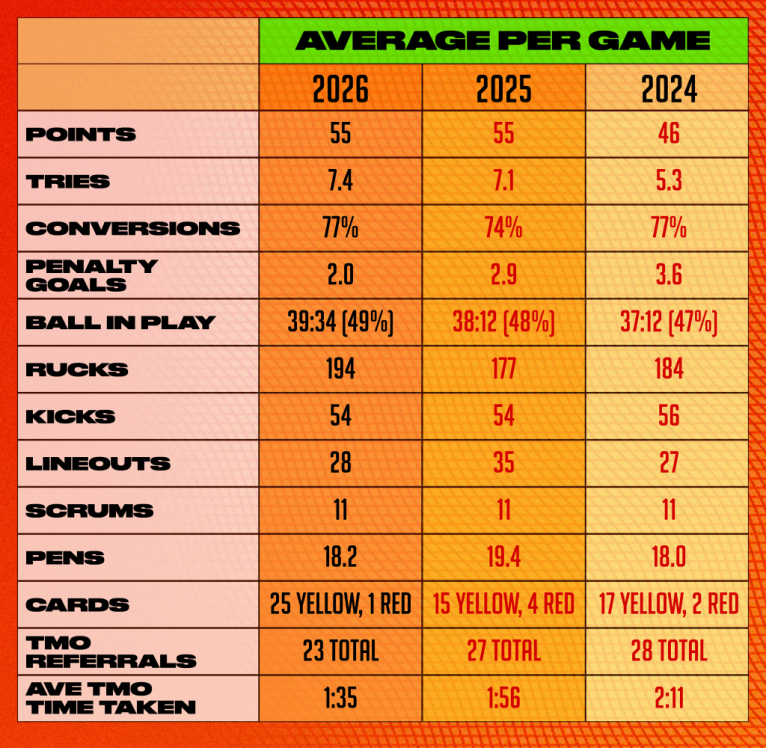
Ball-in-play time at the Six Nations is rising steadily, by over one minute per season, and there is less time taken up by TMO referrals. There is less tolerance for negative or cynical play, as evidenced by the increase in yellow cards at the 2026 tournament. The game has more content, and it is getting faster all the time.
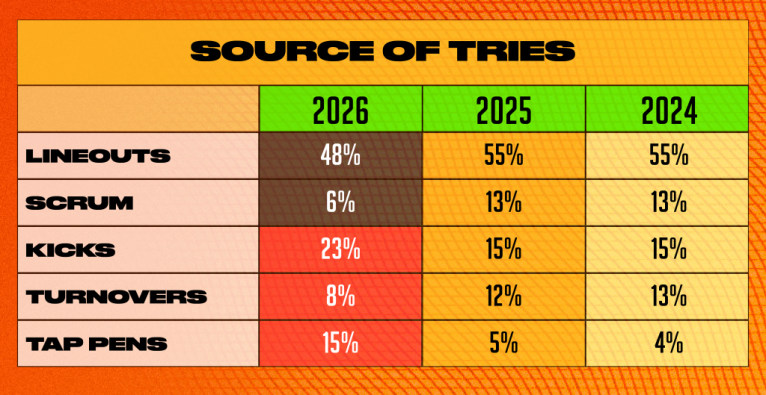
Another table illustrates less reliance on scoring off set-piece than ever before, with 55% of set-piece tries in 2026 compared to 68% over the two prior seasons. That represents far less reliance on stop-start rugby and more focus on fluid transitions in play.
The importance of the contestable kicking game
I will leave the summary of an upsurge in the contestable kicking game to Thomas:
“A noticeable feature of this year’s Six Nations was the increase in the number of punts that were contested. In 2025, only 39% of kicks were contestable, this year it was 50%. and it was clear teams had targeted this area as a positive source of possession.
“France won over 50% of their contestable kicks, Scotland won 38%, both above the tournament average, but the other four teams averaged 25% success.”
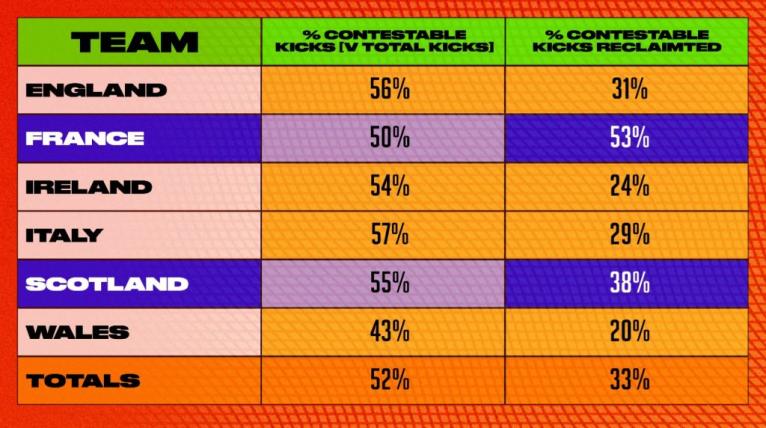
Predictably, France and Scotland were also the two best sides at defending contestable kicks.
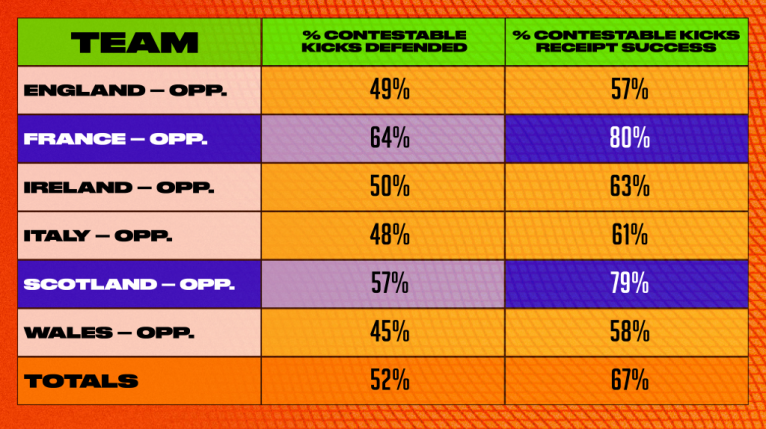
“France and Scotland also scored 16 tries from kick possession,” notes Thomas. “The other four teams scored a total of nine.”
As a footnote, let’s add Les Bleus were also the most ambitious side in the competition on attack, scoring 14 tries from inside their own half compared to 15 by the other five nations put together.
Do scrum penalties automatically lead to advantage?
The fate of the November tour game between Ireland and South Africa was determined almost entirely by the number of scrum penalties, and scrum pen advantages, awarded to the Springboks.
Any straightforward correlation between winning scrum pens and winning matches was disputed by the 2026 Six Nations. The three lower teams were awarded over twice as many penalties as the top three teams and the table was an ‘upside-down’ representation of the tournament outcome!
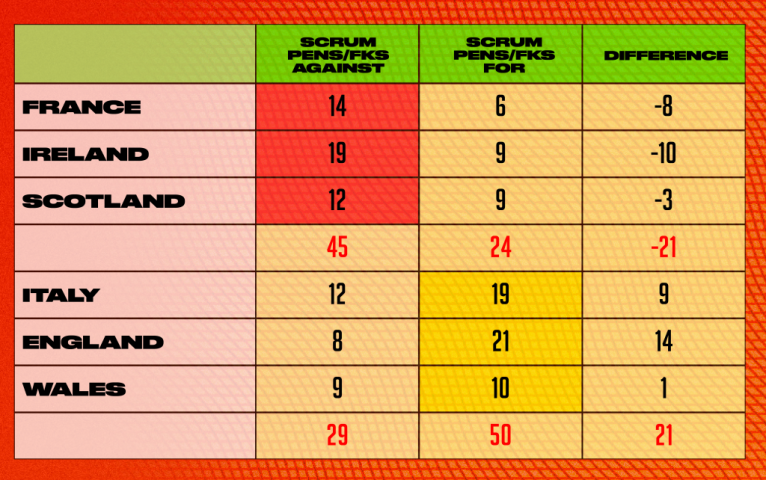
Maybe the scrum is just not as important as it used to be? Is it becoming redundant in the modern game?
There were fewer than 12 scrums on average per game, and 43% of those ended with a sanction, either via penalty or free-kick.
When you consider only 3% of lineouts end in a sanction, it is no wonder coaches view it as a far more reliable platform for attack. The status of the scrum in rugby is still in question when you see stats like that.
The financial consequences of failure or success
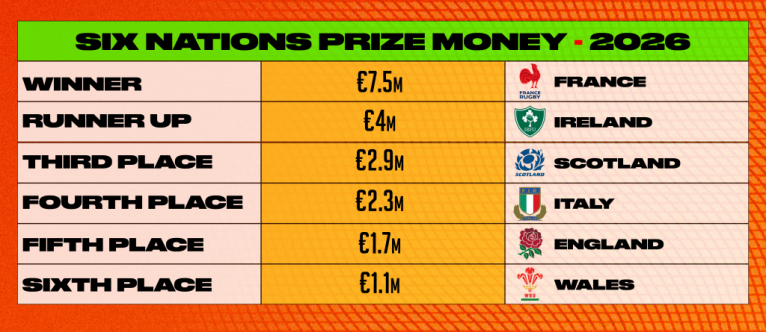
One of the most interesting aspects of the Six Nations, but which rarely attracts column inches, is the vast difference in financial reward between top and bottom. The difference between financial Olympus and Hades is a massive €6.4m. Those fortunate enough to win a Grand Slam can count on a cool extra €1.2m landing their bank account too.
Take the case of Ireland after their first round, blowout 36-14 loss to France in Paris. Nothing looked less likely after that defeat than Ireland winning their next four games on the bounce, but it was also vital to the Irish rugby economy to finish with €4m in the bank.
In its latest annual report, the IRFU explained its income generation is significantly reliant on the performance and popularity of the men’s national rugby team.
“A substantial proportion of total income is derived from a limited number of high-profile international fixtures, including home test matches and tournament participation.
“Accordingly, fluctuations in team performance, scheduling, or external factors affecting match attendance may materially impact income levels.
“The sustainability of this income stream is therefore closely linked to the continued success and marketability of the men’s national team.”
The IRFU made an operating deficit of €4.2m in 2024/25, down from €18.4m in 2023/24, and the company is budgeting for a deficit during the current season despite playing an additional November international. Winning the Six Nations, rather than finishing in fourth place would cover that deficit and bring the IRFU back into the black. The difference is tangible.
The issue of national eligibility
This Six Nations also generated an interesting ‘league table’ based on the success or failure of nations who adopt a strict ‘no overseas players’ policy in selection. France and Ireland operate within their own ecosystems, with a high percentage of home-grown players, all of whom ply their trade in either the URC or Top 14.
The teams which finished third, fourth and sixth [Scotland, Italy and Wales] all picked from a selection base with one-third of the players deriving from other domestic leagues, and slightly lower ratios of home-grown ‘produce’.
As in the final table per se, the great outlier and the most inexplicable anomaly was England. Head coach Steve Borthwick fielded a higher proportion of the home-grown, playing in the Prem, than either France or Ireland but the team still finished fifth in the table.
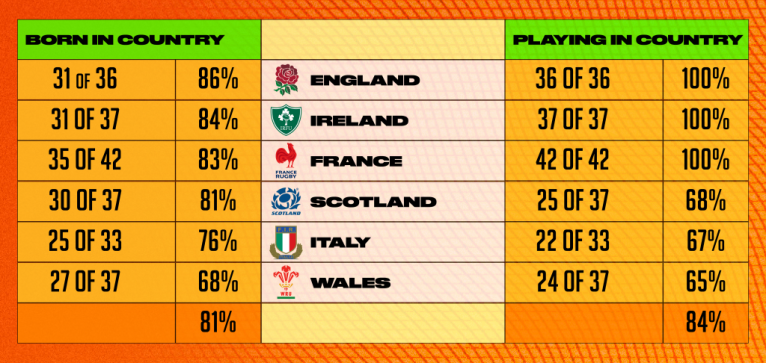
Given an extensive injury list from the November tranche of tour matches the inclusion of Jack Willis, Kyle Sinckler and Dave Ribbans, who all ply their trade in France, would probably have improved England’s overall win ratio. But it would also disincentivise the optimal selection policy, where England [like France and Ireland] reward the production of young players grown by Prem club academies. As with the scrum penalty matrix, it was another example of England doing the right thing but getting the wrong result.
Summary
With the benefit of a few months’ hindsight, there can be little doubt the 2026 Six Nations marked a turning point in northern hemisphere rugby – it was a true tipping point. The impression the tournament was content to play by its old, slow, penalty and kick-dominated rules no longer applies.
There were fewer tries scored from set-piece, and the teams which scrummed for penalties finished in the bottom three in the competition. There was more infield, contestable kicking designed to create new attacking platforms than ever before and ball-in-time has risen with every successive season.
The teams at the top are emphasising home-grown products rather than overseas players naturalised by either residency or grand-parentage. The outlook for the health of the game in the north has never looked healthier, or more vigorous.

Your home for rugby. Download the RugbyPass app on the App Store (iOS) and Google Play (Android) now!
Follow your favourite teams, tournaments and players, and get personalised news and Match Centre notifications direct to your device.
From live rugby streams and upcoming fixtures to breaking news, in-depth analysis and live scores, RugbyPass has everything you need to stay connected to the game.


And the RESULTS show the North are still a few steps behind.
The only stat that counts……. Games won vs games lost. At the end of the Nations Championship, we’ll see how much the north has caught up.