
Even as Amanaki Mafi got around Jesse Kriel with a stiff hand-off and a quick step, the result felt impossible. Even as the ball floated through the air and arced towards Karne Hesketh, no-one really thought this was actually going to happen. And even as the Japanese winger skipped past JP Pietersen and found the try line in the 82nd minute, it was scarcely comprehensible.
Japan’s 34-32 victory over South Africa in the 2015 World Cup, dubbed the Miracle of Brighton, remains, by some distance, the most staggering upset in rugby’s history. The Springboks were stacked with previous and future World Cup winners. Victor Matfield was running the line-out. Jean de Villiers was captaining from midfield. Schalk Burger was in the loose alongside Pieter-Steph du Toit. Bryan Habana was prowling the wing.
While a @JRFURugby masterclass at #RWC2015 ended with Karne Hesketh’s match-winning try against South Africa pic.twitter.com/xjPxZ7lznc
— Rugby World Cup (@rugbyworldcup) August 14, 2024
And yet they were undone by a team ranked outside the top 10 on World Rugby’s charts. Japan’s players lived up to their moniker of Brave Blossoms as they came from behind on six occasions to forever change the sport’s landscape.
“I still can’t fully comprehend how it happened,” says De Villiers, 10 years later. “I can look back now and recognise it was good for the game and this was an unbelievable thing. I can also see the funny side now and take the lessons that it taught me.
“But in the moment and the week that followed it really hurt. I’d wake up in the middle of night sometimes thinking it was just a terrible dream. There’s a part of me that will never really get over it and I have to live with it. It will probably hurt until the end of time.”
They toyed with us and used our size. They were so clever. It was a great game plan.
The Springboks came into the tournament having finished last in a truncated Rugby Championship, losing all three of their matches to New Zealand, Australia and Argentina. Still, they were the third-best ranked team at the World Cup and were placed in the weakest group alongside Scotland, Samoa, the United States and Japan.
“We never expected to lose a group game,” says Schalk Brits, the hooker who, at 34, was playing in his first World Cup. “We weren’t arrogant. We were just confident. We never imagined that any of the teams would be good enough to beat us.”
It’s tempting to say every Test match matters equally, but even those of us far from the elite level know that isn’t quite true. Pulling on the national jersey is always an honour, yet some fixtures pulse with a deeper energy. Others, like an apparent gimme against a so-called Tier Two nation, don’t quite get the juices flowing like an encounter with the All Blacks.
“It’s human and completely normal to have different energy levels depending on the game,” De Villiers explains. “Don’t get me wrong, every time you pull on a Springboks jersey is a special moment. You’re representing so many people and what you do has a lot of meaning.
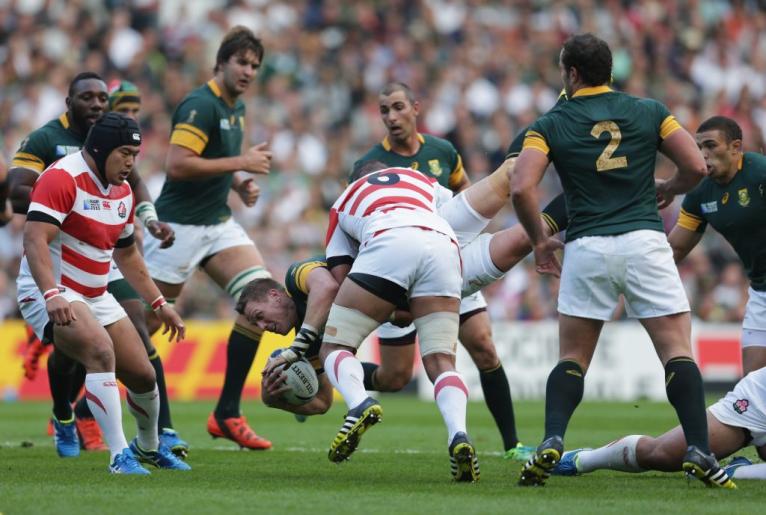
“We just weren’t close to our best that day. It’s not that we didn’t prepare well. We did our homework and we were confident. But for whatever reason we just didn’t deliver. You have to give credit to the Japanese players and their coaches. They deserved it.”
If South Africa were undercooked, Japan were razor sharp. Their coach, Eddie Jones, had spent years studying how to take size out of the equation, how to turn his relatively diminutive team into a weapon capable of taking on the heft of the Boks.
From the opening exchanges the plan was clear as men in red and white stooped low in every tackle to chop down hulking ball carriers as if they were cedar trees. At scrum time, Japan ensured that the ball stayed inside the set-piece for no longer than a blink of an eye. South Africa came into the match hoping for a bar-room brawl. What they got was a lesson in the art of judo.
“Our guys just couldn’t get a hold of them,” says Brits, who was not part of the matchday 23 so had an elevated view from the stands. “They toyed with us and used our size. They were so clever. It was a great game plan.”
On the ball Japan were just as slick. Their match-winning try demonstrated superb handling skills under pressure and another score on 69 minutes was just as incisive, involving a delicious pop-pass back against the grain by fly-half Kosei Ono to set up Ayumu Goromaru down the right. But their opener on 30 minutes showed they had the grunt to stand up to the South Africans.
The WiFi password in the hotel was changed to ‘Brighton 1’ which I thought was hilarious.
With Steve Borthwick as forwards coach, Japan backed their line-out. Though they shipped two maul tries they scored one of their own through skipper Michael Leitch. Beyond the result, the sight of Japan bullying the Boks at their own game was proof something deeper was happening. A team long dismissed as lightweight had refused to play the role assigned to them. In that moment, Japan didn’t just compete with South Africa, they dismantled a hierarchy that had felt immovable.
“They were brilliant,” De Villiers says of his opponents. “Every time we took the lead, it was like, ‘okay, let’s get this done now’. But they refused to go away. They’d come back and they kept us working. I never once felt that the game was safe even though I never felt like we’d actually lose it.”
Even when Japan won a penalty on the floor in the final minute of the game and South Africa’s prop Coenie Oosthuizen was sin-binned, De Villiers never contemplated defeat. Especially when Japan turned down a kickable three points to square the game and instead chose to scrum five metres out. “Madness,” is how de Villiers recounts that sliding doors moment. “I was actually grateful because a draw felt like the worst thing I could imagine.”
South Africa brought on Tendai Mtawarira and Jannie du Plessis to prop the front row, but with only seven men in the scrum Japan forced another penalty. They went to the scrum again. “It was deafening,” Brits recalls. “There was an old Japanese man next to me in tears.”
Another scrum was needed before the ball was finally released out the back. Japan’s forwards kept it tight before they probed the right edge. Leitch carried close to the corner, sucking in multiple South African defenders. With space now opening up on the left, scrum-half Atushi Hiwasa fired a pass to Harumichi Tatekawa who spiralled it on for Mafi. A hand-off, a step and another pass later, Hesketh was sliding over to secure the most implausible of victories.
“I was stunned,” De Villiers remembers. “It was utter shock. But I must thank my parents for the way they raised me. I never threw my toys or blamed anyone. I’m proud that I praised the way Japan played. It wasn’t conscious. I was on autopilot.”
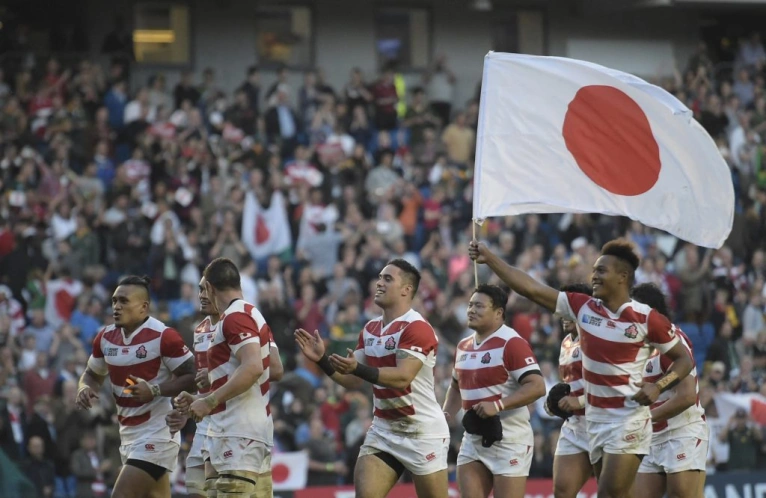
That was the last time De Villiers was on a rugby pitch for the final whistle. A week later, during South Africa’s restorative 46-6 win over Samoa, he broke his jaw and retired before the team’s next game against Scotland.
“Whether I like it or not, that Japan game is a big part of my story,” De Villiers continues. “I played [109] times for my country and was lucky to captain the Springboks, but that’s the beauty of sport. No-one has a perfect record.
“It used to bother me but I’m comfortable with it now. Time heals and honestly, it’s given me perspective. It’s just rugby. Losing to Japan won’t be the worst thing that will happen in my life.”
Even so, the result proved seismic for the game. What began as a miracle soon became a movement. Participation numbers in Japan skyrocketed after the 2015 World Cup with TV audiences for rugby increasing by 59 million from the 2011 edition.
“We helped put Japanese rugby on the map,” Brits says with a wry smile. “It was just the most amazing day for our sport. When we went to Japan in 2019 for the World Cup they treated us as their second favourite team. Everyone showed us so much love. Well, until we played them in the quarter-finals. All of a sudden our meals were late, the bus wouldn’t show up, we’d not have proper gear for training.
“The WiFi password in the hotel was changed to ‘Brighton 1’ which I thought was hilarious. Some of the guys got pissed off about that but I thought it was brilliant. It showed that beating us all those years ago still meant a lot to Japan. How can you not love that?”
A decade on, the Miracle of Brighton endures not because Japan beat South Africa, but because it proved the game could still surprise itself. It was a reminder rugby’s great divide between Tier One and Tier Two, between might and movement, is only ever temporary. Every so often, belief and preparation align, and the sport remembers why it calls itself a world game.


I was at the game with some friends who were all supporting the underdogs. We got dressed up in specially made t shirts and headbands, and loved the game and the result. Catching the train to Brighton from Clapham Junction, we travelled with a lot of Springbok fans who were treating it is a fun day out and picnic. On the train back, the mood amongst the RSA fans was like thunder. One of group spent the journey back asking each Springbok fans, how they felt. The answers were not very personable, I can tell you!
It was great for the game of rugby. I couldn’t believe the handling of Japan
As it happened I went to the NZ v Argentina at Wembley the next day among 92,000 others. Not long before the game started a Japanese couple in full traditional costume arrived in the seating area. Thousands stood and cheered their arrival and they graciously bowed towards the cheering audience.
So much for a ‘good big ‘un will always beat a good little ‘un’!