
A few weeks back the rugby world went gaga at the sight of Antoine Dupont throwing into a line-out at the Olympics. Fair enough. After all, this was a man who had trained his entire life to deliver a ball at the base of a ruck or scrum in the manner of a No 9. Now he was not merely cosplaying as a hooker but executing the role to perfection. In a sport such as rugby, where every position is highly specialised and is the grand sum of unique variables working together, this was uncharted territory. Fans of the oval ball understandably lost their collective minds at the audacity shown by the diminutive Frenchman.
Then again, perhaps this is the new normal. Perhaps numbers on the backs of jerseys are as meaningless as the numerical values on the shirts of footballers. After all, Dupont has at times over the past four years demonstrated the passion range of a fly-half, the strength of a loose forward, the running abilities of an inside centre and the spatial awareness of a fullback. And if you thought that his versatility is the exception that continues to prove the rule, you only need to look back at Cheslin Kolbe’s contribution against the Wallabies last week.

Is Kolbe, and not Dupont, the true all-round generalissimo of our sport? The very fact that we’re asking this question will be damned as sacrilege by zealous French fans, but let’s allow the evidence provided by Kolbe’s display speak for itself.
At the very first scrum, mere minutes into the contest, Kolbe was feeding the set-piece. That he was doing so when Cobus Reinach, the designated scrum-half, was on the pitch seemed to shock even Rassie Erasmus, who wore the same face a groom might make if a stranger in a white dress started walking down the aisle at his wedding. But there Kolbe was, with 14 on his back, rolling the ball into the morass of 16 large men.
Siya Kolisi once said that the Springboks winger with a scrum-cap on his head and nitroglycerin in his boots was his “favourite player” and the one man he wished he could emulate on the pitch.
A little while later Kolbe was first receiver, spiralling passes after a flourish of twitching limbs. Then he was at second receiver, looping in from his standard position on the wing to inject spark down the line. Then he was defending the outside-centre channel, a role we are told by defence coaches is among the most challenging jobs on the pitch. Then he nailed Allan Alaalatoa in the tackle, shoving back a man who outweighs him by 50 kgs. To top it all off, and possibly influenced by Dupont, Kolbe threw to the line-out when Malcolm Marx was sin-binned. Of course Kolbe found his jumper. One assumes he left Suncorp Stadium and cleared a snooker table with a score of 147 before rolling a perfect 300 at a ten-pin bowling lane.
Siya Kolisi once said that the Springboks winger with a scrum-cap on his head and nitroglycerin in his boots was his “favourite player” and the one man he wished he could emulate on the pitch. “For me what he does on the field, honestly I think he’s one of the best ever to do it,” Kolisi said. “I’ve been inspired. I am always happy that I play with not against him.”
Just the Springboks using the smallest player on the pitch as a crash ball runner. 😂
What didn’t Cheslin Kolbe do against the Wallabies? 🤣 pic.twitter.com/E1lRTy7I0Y
— Jared Wright (@jaredwright17) August 11, 2024
So, is Kolbe the GOAT of versatility or is Dupont the undisputed alpha? That’s one better left for punters on their second double brandy and coke or third glass of Cabernet Sauvignon. What’s more interesting is how this amalgamation of roles might shape the Springboks’ strategy over the next three years and whether or not these all-rounders are irrevocably changing the game as we know it.
Erasmus has been given a lot of credit for a number of things. He’s shifted the culture of the national rugby side, better linking it with the nation as a whole while reaching fans who once felt alienated by a symbol of apartheid. He’s advanced racial transformation without sacrificing on quality while also backing players who might previously have been dismissed as too small. On the field he has recalibrated the way substitutes are used around the world and has cultivated an immensely powerful sense of brotherhood.
The hot new topic, the strobing flashing light that should turn out heads and compel us to pay attention is the flexibility that is now a trademark of this cohort.
But one adjustment deserves more attention than it’s received. More than any Springboks coach – and arguably more than any other Test coach around – he has redefined the set functions of each position. When a hooker got injured during the World Cup last year he called up a fly-half and backed a loose forward to occupy the middle of the front row. Before Erasmus took control of the Springboks in June 2018, Pieter-Steph du Toit had played 66% of his Tests at lock. A year later he was the world’s best flank. He helped morph a speedy but comparatively small sevens player into a Test No 8 and selected four scrum-halves for a World Cup that saw two play on the wing and one step in at fly-half.
This is what we should talk about when we talk about the Springboks. Yes they’re big and brutal, yes they’re direct and in your face, yes a large portion of their fans take this game far too seriously and yes their coaches provide half-time team talks as if they were staff sergeants in the trenches at the Somme. But that is just part of the narrative. The hot new topic, the strobing flashing light that should turn out heads and compel us to pay attention is the flexibility that is now a trademark of this cohort.
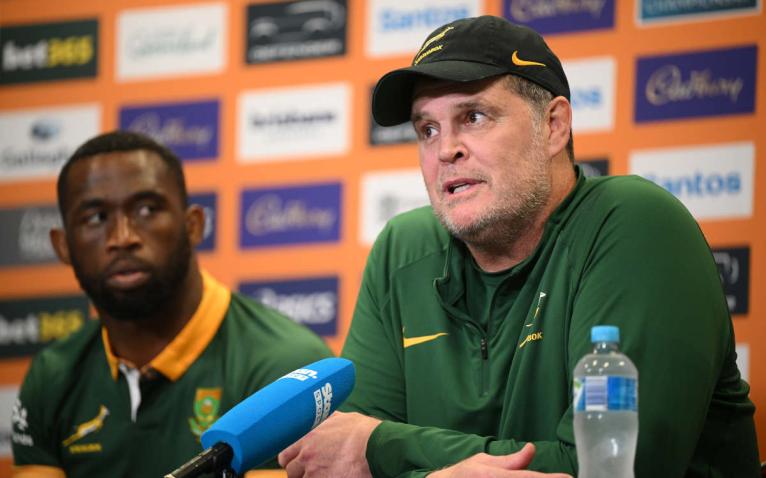
For the second Test against Australia this weekend in Perth, Erasmus has made 10 changes to the side that demolished the Wallabies in Brisbane. Kolbe keeps his place at number 14, but frankly who knows what he’s been asked to do. Du Toit moves back to the back row though that hardly matters as he played like a flank last week despite technically operating at lock. Lukhanyo Am returns to the side at inside centre, one step closer to the action from his usual position, and two fly-halves in Manie Libbok and Handre Pollard have been picked to start on the bench.
This was a team that was once considered utterly one dimensional. An outfit that couldn’t conceive of an alternative approach to navigating a brick wall other than running straight through it. Now it can scale any height, circumnavigate any obstacle and bust through it if all else fails.
Will Libbok replace Aphelele Fassi at fullback? Will he slot into the fly-half position and nudge Sacha Feinberg-Mngomezulu into the back field? Will Pollard continue to find a new home at inside centre, offering a combination of grunt and guile in a position that has solely been in the possession of battering rams? Will Marx offer an option in the back row? Will Grant Williams prowl on the wing?
The point is we don’t know. This was a team that was once considered utterly one dimensional. An outfit that couldn’t conceive of an alternative approach to navigating a brick wall other than running straight through it. Now it can scale any height, circumnavigate any obstacle and bust through it if all else fails. The first Rugby Championship match was a roaring success. The challenge is to keep the wheels turning and the on-field job descriptions in a constant state of flux.


Comments
Join free and tell us what you really think!
Sign up for free