
There is the truth of the rugby world, and then there is the truth of South Africa. While the rest of the rugby world is dancing to the compulsive disco-beat under a glitterball of relentless attack, the world champions are waiting for the next World Cup and keeping their counsel; ready to pull the unwary back into the dark alleys outside and brawl with them in the gutter.
HSBC SVNS returns to Cape Town this December!
Don't miss your chance to see the world’s best rugby teams take centre stage 5-6 December in Cape Town.
The 2026 Six Nations set a new record of 111 tries scored, and Les Bleus hardly noticed that they conceded the most tries [19] and points [130] of any winning campaign in the tournament’s history. The newly-minted Nations Championship in July promptly upped the ante, with an average of one extra converted try scored across the first three rounds.
Attacking records have been tumbling all around the rugby globe quicker than new heights set by pole-vaulter ‘Mondo’ Duplantis. Last weekend, the best two teams in the English Prem, Bath and Northampton, combined for a total of 18 tries and 119 points between them, with telly pundit Austin Healey comparing the game to one of the scoring extravaganzas in the NBA. Yes, the same Austin Healey who once memorably described the essence of the modern scrum as ‘16 guys who like food. They push. Sometimes they go up, sometimes they go down. The referee has a guess. Penalty. Lineout.’
The Greatest Rivalry series between New Zealand and the reigning double world champions temporarily dragged the dance choreography of all-out attack kicking and screaming back into the gutters. It was the most gripping event in the annual calendar thus far, a clash of two rugby worlds, and depictions of both beauty and beast alike were hung together along its storied walls.
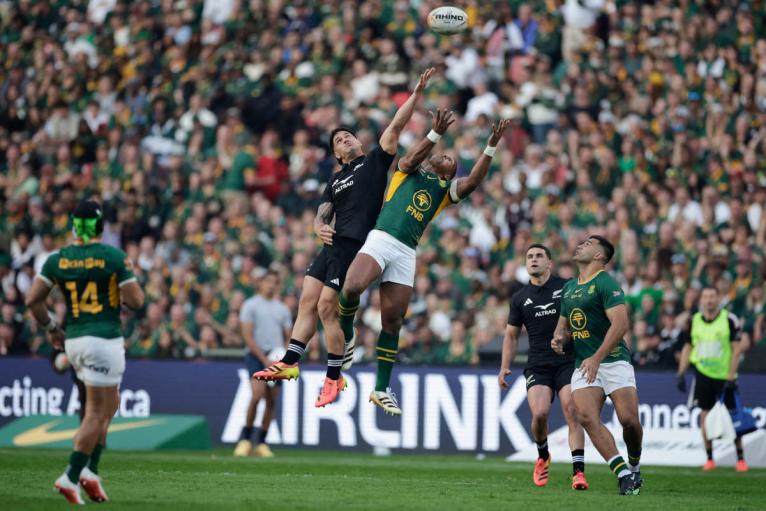
It was like the Bayeux Tapestry of modern rugby, great forward warhorses flying into defensive shield-walls, the dead brutally stripped and dismembered at scrum and breakdown; finally, a green-and-gold arrow piercing the eye of the silver fern.
It will not be repeated. The temporary suspension of the Rugby Championship has illustrated a great divide in the game, and the two divergent forks in the road are growing too far apart, too quickly. South Africa has flirted with the dance floor via ‘Tony-ball’, but when pushover comes to shove, it believes in the gutters far more. Rassie Erasmus set the scene for the RGR series thus:
“You can see on social media, [the All Blacks] are advocating this high-intensity running, multi-phase, and ‘nobody can keep up with us’. [But] there are always three truths: New Zealand’s truth, the world’s truth, and then what we believe. There’s the waarheid – the Afrikaans word for truth.
“We think there’s a certain way to win World Cups, and we think that’s a grind. We think when you’re under pressure on your attack, it’s very tough to keep cohesion. If the pressure is very big, you start fumbling a few balls, and then you are stuck.
The first Bledisloe Cup game between Australia and New Zealand at the Garden of Eden Park provided further evidence that for better or worse, planet rugby is moving away from South Africa’s sphere of influence.
“When games are really, really ‘clutch-and-crunch’, you have a system that you can fall back on, which protects the players sometimes from not always having the confidence to do things.
“Since [Kiwi attack coach] Tony [Brown] has been with us, we feel we were attacking alright. We feel we’re doing not too badly, but we always want to keep the thing that we can fall back on when the pressure is really tough.”
Before the RGR series kicked off, the rest of the rugby world had aligned with New Zealand more than South Africa and it was flocking towards the bright lights, the dance-floor and avoiding the dark alleys of the game. When those traditional forward-biased heavyweights, France and England, have worked the new direction of the game out for themselves without any help from the shaky isles, you know you are well and truly on your own.
The first Bledisloe Cup game between Australia and New Zealand at the Garden of Eden Park provided further evidence that for better or worse, planet rugby is moving away from South Africa’s sphere of influence. Take a look at the following table, illustrating the progression of the All Blacks in some key areas from Nations Championship through RGR to the first Bledisloe Cup match:
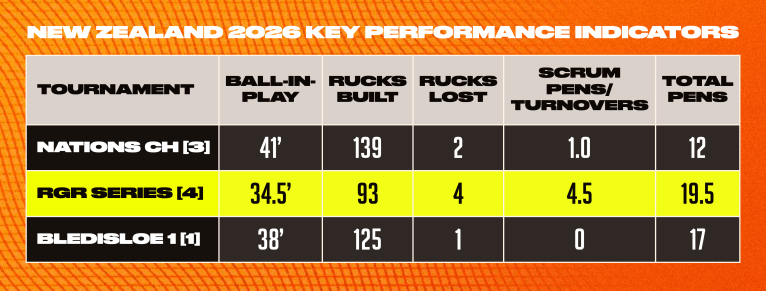
As soon as New Zealand left South African shores, it is as if the pennies have dropped from the eyes and they are able to revert to ‘Nations Championship normal’. They comfortably hit their target of 100+ rucks set per game while losing less than one per cent to turnover, ball-in-play time rose effortlessly by over three minutes, and the total number of penalties dropped. Suddenly the scrum was no longer an issue and Irish referee Andrew Brace was able to navigate the entire game untroubled at set-piece.
What will All Blacks’ head coach Dave Rennie have learned from the 50-19 victory in Auckland, having been so mercifully released from the South African pressure-cooker? The four areas of weakness highlighted by the RGR series were the two set-pieces, the contestable aerial game, and discipline:
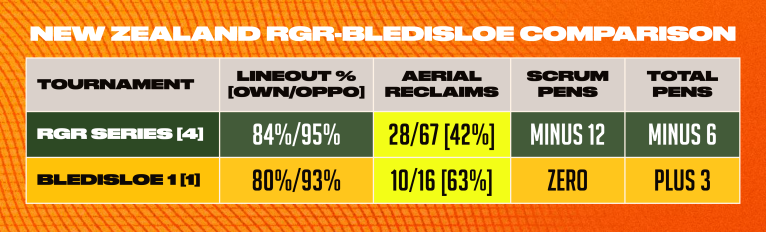
- Sub-par lineout. The lineout did not improve despite the continued selection of a natural lock [Tupou Vaa’i] at No.6. The set-piece is still fumbling its way forward at a sub-par average of 83% for the season.
- Sidelined scrum. With both sides intent on playing the ball, rather than looking to draw penalties from the well of perceived dominance, we do not know what the Kiwi scrum looks like under pressure.
- Improvement in discipline. The balance of penalties improved because of better ball-retention at the ruck and the marginalizing of the scrum as a penalty-winning machine.
- Big gain in the aerial game! The biggest advance made by the All Blacks was in the contestable kicking game, against the same Wallaby backfield which had been so dominant versus the Springboks.
The biggest step forward, by far, was made in the contestable kicking game. Rennie was fulsome in his praise of the gains accrued:
“I thought [scrum-half] Cam [Roigard’s] kicking was excellent and allowed us to put a lot of pressure on. We kicked a bit more off nine than we have been [doing].
“I think, as you guys know, receiving those kicks is difficult. I think receiving teams are catching one out of four. That’s the nature of the game at the moment.
“Our guys did an excellent job at either winning it in the air or picking up scraps, so that was a good shift.”
Rennie’s remarks were echoed by his back three superstar Will Jordan in the aftermath of the match:
“We’ve felt pretty good all year about contesting when we’re going forward, and I thought tonight, Cam did a great job with his kicking game – to pull it back five or so metres just to allow us to get up in the air; the likes of myself, Jordie [Barrett] and Leroy [Carter].
“It’s always going to be a point of emphasis for us. So, it’s a good win for us tonight, but it’s going to be important moving forward.”
One of the main ideas was to ‘bracket’ or double-team the Wallaby receiver under the high ball with two aerial athletes, and give a wider target for the reclaim:
https://t.co/NCflFdBi4U
— William Bishop (@RPvids1994) October 11, 2026
https://t.co/grsFCcA2Ot
— William Bishop (@RPvids1994) October 11, 2026
https://t.co/T7mmCQsiIK
— William Bishop (@RPvids1994) October 11, 2026
It could be Jordie Barrett and Jordan, both aligned to the same side of the field and giving the chase an ‘inside’ and an ‘outside’ option as it closes on the receiver, and overwhelming Joseph-Aukuso Sua’ali’i at the point of receipt. Or it might be a kick dropping further infield, with a double-team formed out of the wing to that side [Leroy Carter] and a big forward athlete [Vaa’i] to secure the regather.
Jordie Barrett was in his most ruthless and unforgiving defensive mood throughout the course of the 80 minutes, and even when a Wallaby was able to make the catch successfully, Jordie ensured he paid the appropriate price at the first tackle:
https://t.co/zBsgu31nt8
— William Bishop (@RPvids1994) October 11, 2026
In this case, the ‘inside/outside’ chase works as a tackle/jackal rather than a double competition in the air, with Barrett flattening Wallaby No.10 Ben Donaldson and Carter finishing the job by pilfering the ball on the deck.
When the boot was on the other foot and the All Blacks were receiving kicks, they benefited from the presence of three men with extensive full-back experience on the field at one time, with regular RGR full-back Damian McKenzie at 10, Beauden Barrett at 15 and Will Jordan on the right wing:
https://t.co/LVL3R5nks8
— William Bishop (@RPvids1994) October 11, 2026
Rennie’s All Blacks were probably glad to be back home, and playing in front of their own people on Saturday evening at fortress Eden Park. The test they got from the Wallabies was the same as those they experienced in the first three rounds of the Nations Championship. It was a test of movement on the dance floor, without too much attempt being made to drag them off-stage, let alone into the gutters.
Their ruck-and-pass game built more and more momentum as the game wore on and they dominated the airwaves in a way they never had in the Republic. But the sub-par lineout trod water and the South African scrum test was signally absent, so it would be unwise to draw too many positive conclusions. The high-and-mighty in the All Blacks’ hierarchy will still be wary that waarheid has enough breath left in its body to dominate one more World Cup, before the dance of progress in the professional game finally leaves it behind.
 Register your interest to receive priority updates on RWC27 ticket releases. Don't miss out, stay in the loop!


This game just reinforced that you need forwards to go forward. This made the cleanout easier, and allowed the backs more space and freedom.
Against SA everything was hurried so hence the flaw in Rennies tactics.
No problem moving the ball as that is what rugby is about, but against SA ABs vacated the forward contest basically. Even if you get beaten up front you still need to try and engage.
So the jury is still out on ABs especially TV at 6. Dmac at 10 and BB at Fback.
Saying that the ABs loosies looked better balanced with out AS.
AS problem is he is really a 7 but doesn't have the gas for that now.
Sititi looks better at 8
And no one in there right minds would pick Jacobson over Lakai at 7
Just need a 6, maybe TV but I doubt it as it doesn't come naturally for him
Come on Nick, I’m dying to hear your numerous excuses for Scott Macleod’s Wallaby defensive system. Shaun Edwards would have had a heart attack watching the Wallabies.
Imagine what kiwis would say if they had three Australian coaches in their coaching team and they were getting thrashed 50-19 by Australia.
They would go apoplectically feral.
Not sure, Nick. (Howzit!) Always enjoy reading your essays but my view of the Boks’ season thus far is more along these lines. Attack promising and exciting. Defence a bit worrying. Why do I think Tony is going fine? The Boks scored 80 against the Barbarians, 45 versus England, 42 on Scotland, 43 against Wales, 17 in Argentina, 16 in Round 1 of the RGR, then 33, 29 and 43 in remaining rounds, followed by 38 in Perth. Casting out the 80, that’s an average score of 34 for, despite using 67 distinct players (with five debutants) and fielding A/C or A/B experimental sides, including a 13-player switched team for Perth. The Boks have been scoring tries: 7 on England (using 7 line breaks and 101 rucks), 6 versus Scotland (76 rucks), 7 on Wales (7 line breaks, 77 rucks), 2 in Argentina (121 rucks), just one in RGR One (but 4-1 in line breaks over the All Blacks), followed by 3 (82 rucks), 4 (67 rucks), and 6 (112 rucks) to win the series. The makeshift Boks in Perth scored 5 tries (using 72 rucks). That’s 4.55 tries scored per Test; 3.5 per RGR Test (in which the backs scored 8 of the 14 tries). But Flannery’s scheme has failed to contain the edge v Scotland, NZ, and OZ.
Rassie hasn’t defaulted to Tony-ball to win any matches wince Welly 2025 Harry….. And Jerry Flannery is coaching the Bok D in name only - haven’t you heard?😁
Just because you want it to be true doesn’t it mean it is Nick.
Next year’s rugby world cup is wide open, there are several great contenders. For either the Boks or the All Blacks, winning 3 knock-outs in a row is statistically unlikely even if they are favorites in these games. Even if you would typically expect to win 8/10 games against your opponents (which for the likes of the Boks, NZ, France, Ireland, England, Aus, is very unlikely), winning 3 such games in a row is only a 50% proposition. Just to say the world cup won’t be much proof of anything.
But watch the URC and the Champions Cup this year, South African sides will be more competitive overall, not less. Previously they were only competitive in the URC. The budgets have slightly increased (while still running behind those paying in Euros), allowing a few of the heavyweight Boks to come back, and some more young talent is kept.
South Africa are also u20 world champions in 2025 and 2026. While forward power was as always key, there was significant skills and flair on display also. The reasons are probably that the gap that previously existed between the insanely strong school rugby system in South Africa and the professional rugby scene is closed, there is better retention and nurturing of talent. This is also related to the increased URC budgets, the SA sides are investing into their future. Dobson the Stormers coach was somewhat mocked for his “2029” plan relevations, but it just shows that foundations and roots are being thought about at all levels now.
And why would the changing laws hurt the Boks worse than other nations? They will adapt. If defense becomes harder, that will mean the Bok attack will also become more potent. Maybe you will need less 20 phase build-ups if you can do it in 5 or 6.
Under Rassie the Boks leave their egos at the door and they approach their weaknesses and shortcomings straight on. So they will not be bothered by these discussions of who is playing the "beautiful" or "future proof" rugby too much (except to use it as motivation). And with the conveyer belt of talent that seems to be welling up, they have the tools to problem solve. So you and other scribes might wish them away, but I don't think the Boks will be left behind in any way.
Doesn't mean they will stay number 1, these teams on top are too close to make any predictions on that. But irrelevant, outdated? I think not.
I think they [prob the Stormers] are a good shot to win the URC, but I cannot see them cutting much ice in the Champions Cup.
All good teams ‘leave their egos at the door’ and know how to be honest with themselves so it’s not an exclusively South African preserve.
Nonetheless, all the major comps in the world tend to have a diff profile to current URC or last RGR, so it will be interesting to see whether Rassie really is future-proofing the Boks, or not.
Nick I'm so disappointed in my beloved team as we had so much information available from the the RGR tour on the AB. Surely you had enough time to put a plan together with some surprising elements in it. I'm not convinced by L Kiss
Yes WB prob benefited from more relevant info than NZ in their prep. But hey really did not put many dents in the Kiwis apart from lineout.
Hi Nick, well mate it should come as no surprise that we get hammered by the all Blacks. I have noticed now under Harry W leadership this Wallabies team falls completely apart especially against the top current rank teams. The game plan by Less Kiss was obvious and nullified especially the aerial game. The shooting out of the defense line is still a work on. It has costs us tries. Less K will always choose Harry W over T hooper even if the evidence shows otherwise. We should have had Carlo T on the bench.
“The pennies dropped from their eyes” Eish! How about mixing your metaphors, Nick. Oh, and we DO know what the Kiwi scrum looks like under pressure….the Boks showed us.
Pennies on the eyes. It’s a Greek thing😉