
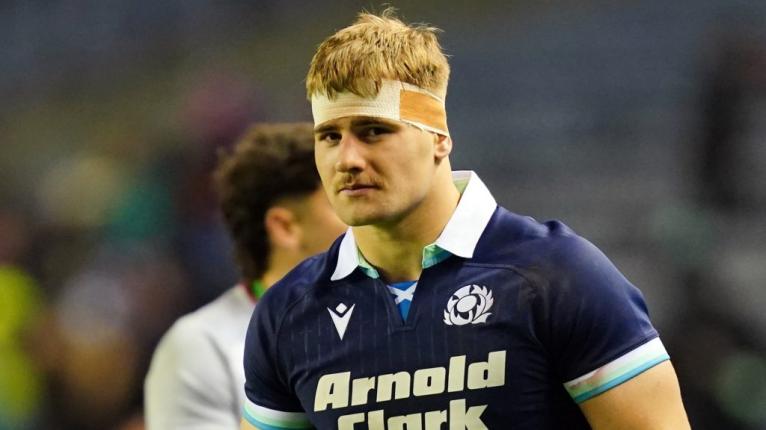
Freddy Douglas shares two stories which tell you everything about the tyro flanker’s mindset, the kind of iron will and cussedness that have turned so many heads and made him Scotland’s youngest debutant in over six decades.
The first, in that fateful November of 2024, when Douglas won his first cap before playing a single professional match for Edinburgh. He was just 19 years old. Gregor Townsend pulled him aside at the end of an academy session to tell him he’d be in with the big boys and Douglas gawped at his coach like a landed fish. When the time came to train, Douglas wasn’t gawping anymore.
“I remember there was this one day everyone – I say everyone, might just have been me – was really up for it,” Douglas remembers. “I was on the non-23 side. We weren’t doing full shoulder-on hits. I saw Finn [Russell] winding up a miss-pass to Matt Fagerson and I shotted Matt to the deck and he did get quite fuming at me. The next play was a lineout and he went straight at me, full boom.
“In the scrums afterwards I went up the side a bit and I just remember feeling these two arms go up my belly. It was Schoey [hulking prop Pierre Schoeman] and he just flipped me over the top of him. I’m not sure what enraged him, I just remember being flipped on my back.”
Welcome to Test rugby, son. Suplexed by ‘Schoey’. That’s one insight into the Douglas psyche. The snarl and the force and the sheer disregard for status. Here’s the second. The other side. A quiet diligence; the stuff people don’t see.
“I did yoga when I was much younger just before bed. It was mainly for rugby in general and then as I got older it was my hamstrings and hips for jackaling. I always enjoyed doing it before bed because it relaxed me a lot. I didn’t tell anyone that because it’s a bit embarrassing when you’re, like, 13 doing yoga, but I did do it to get more mobile.”
Too sheepish to tell his friends, Douglas was laying the foundations which have already established him as an extraordinary breakdown predator. The penny dropped – literally, in a sense – when Douglas was in his early teens, a player fell at his feet and he leapt on the ball. He liked that feeling. He wanted more.
As a schoolboy he could chase that sugar rush too keenly. He was too trigger-happy, too much of a penalty machine hunting lost causes and unwinnable rucks. He’s found his rhythm now. Across Edinburgh’s four Champions Cup matches, he averaged a turnover every 16 minutes. Some stats providers have him winning the most steals per match of any player in any league during 2025, close to three a game.
It all happens so quickly, it’s got to be an instinctive thing. You can’t notice one thing and think ‘oh that’s my opportunity’. You’ve got to see it and go instantly.
And it’s not just his eye-watering flexibility, the ruthless speed and the jackal execution itself. It’s Douglas’ maturity in choosing when to sit off and when to wedge his hands in the biscuit tin.
“There are a few cues,” he says. “Almost counterintuitively, when the opposition make quite a good carry and get in behind you. If you are quick enough, quicker than their supporters, you’ve actually got quite a big window to get on ball. That’s quite easy to spot.
“More subtly, when someone tips the ball and one of our defenders tackles the player who passed it, that’ll be one less guy cleaning the ruck. Or even more subtly, just someone getting in the way a wee bit of a supporting player, it just gives you that half-second more to get on ball.
“It all happens so quickly, it’s got to be an instinctive thing. You can’t notice one thing and think ‘oh that’s my opportunity’. You’ve got to see it and go instantly. Little things. Once you’ve done it a few times, you spot things much more easily than when you are starting out.”
Douglas is very conscious not to be typecast as a single-skilled player. He was a relative flyweight at the start of his U20s career, a mere 85kg. No matter how effective a jackaler, that would never cut it in the Test arena. He’s a little over 100kg now, and more destructive on the gainline for it. He ran over four Frenchmen en route to an outstanding try in last year’s U20 Six Nations and his tackle impacts are trending upwards.
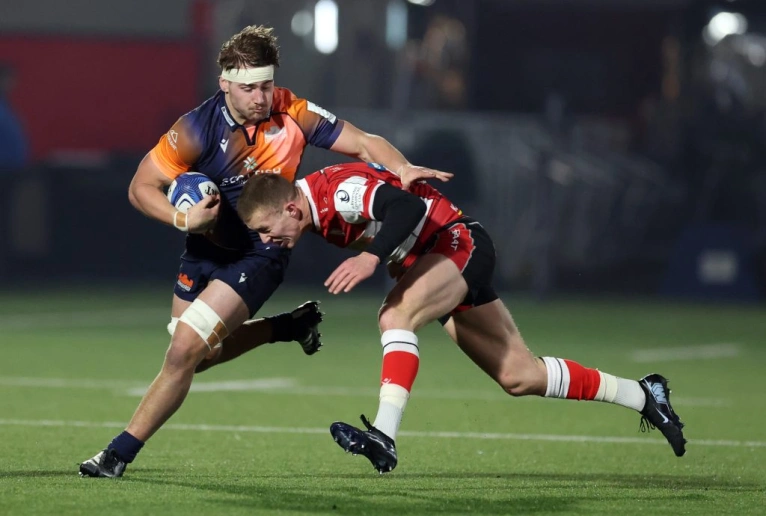
“At the start of the season, we had forms to give in and I said in mine I didn’t want to be a one-trick pony – I didn’t just want to be jackaling,” Douglas says.
“I have worked on my carrying, that’s been one of the big things because I am not the biggest guy. I’d wanted to put on a wee bit of weight. Because I am a bit shorter I can get quite low which is good for me, and then it’s working on the feet before contact and the leg drive when I’m there.
“At the end of last season, I really worked on my dominant shots. In the U20s World Championship in the summer my dominant shots were the highest they’d ever been. That needs to keep getting better. It’s all good being able to jackal but if someone is running at me, I have to be able to put them on their arse.”
There are some fine players plopping off Scotland’s much-maligned conveyor. Liam McConnell followed Douglas onto the international stage in November and has played almost every game for Edinburgh this season. There’s huge excitement around McConnell. So too Ollie Blyth-Lafferty, an enormous specimen in the problem position of tighthead prop, and Douglas’ flatmate and full-back Jack Brown. Fin Thomson, the dynamic centre, has won player of the match awards at URC level.
Along the M8, Gregor Brown is a Lion at 24. Max Williamson and Alex Samuel are massive men and full caps. Gregor Hiddleston and Seb Stephen will not be far behind them.
Opportunities are probably quite a bit rarer coming through [in Scotland] and you probably have to wait much longer than anywhere else.
Scotland’s U20s are routinely bashed by their counterparts and its development pathway gets hammered as a result. The players themselves are emerging; the problem is finding meaningful rugby for them in a two-team system. Rugby which gives them the best shot at competing with their age-grade rivals and compelling professional coaches to pick them.
“If you’re a spectator and all you see is a team losing, I think it’s fair enough to think that [the pathway is poor],” Douglas says. “If you look a bit closer, it gives young players like myself an opportunity to play against really class teams.
“We do produce quite a few really good rugby players. Maybe not to the extent of bigger countries with more resources but we do produce a lot. Maybe because there are only two teams here it is harder to break through than down in England where it may not be easier, but there is a clearer path to a professional team.
“If you are a young player coming through you have not been seen at a high level so it is really hard to justify being picked over someone more senior. Then it’s so much harder to get minutes. A-games are a good connector, they allow coaches to see how you perform in a proper match. It’s just opportunities are probably quite a bit rarer coming through and you probably have to wait much longer than anywhere else. They do come, it’s just frustrating that it might not be as soon as you want them to be.”
The future is here. 🏴
Huge to see Liam McConnell and Freddy Douglas earn their spots in the Scotland #GuinnessM6N squad. pic.twitter.com/b6m22UlsJR
— Edinburgh Rugby (@EdinburghRugby) January 20, 2026
This is the lot of the young player in Scotland. Coaches must balance the need to win rugby matches and compete for honours with the responsibility to blood Scottish talent. David Nucifora is reshaping the internal structures and limiting overseas recruitment but it’s far too early to pass judgement on the Australian’s change.
Douglas is a prime example of this maddening dynamic. After his Scotland breakthrough, he played just 106 minutes for Edinburgh before the season ended. He was hobbled by an ankle injury then competing with Jamie Ritchie, Hamish Watson, Luke Crosbie and Connor Boyle for the seven shirt. Three are internationals, one a Lion, and the other five years his senior. He captained Scotland U20s rather than tour with the national squad in July. He got scant game time at the start of this season because Sean Everitt wanted him to attack other parts of his game while Dylan Richardson, a seasoned URC player and Scotland cap in two positions, impressed on the openside flank.
“Nothing is ever guaranteed,” Douglas reflects. “You cannot take the highs for granted. You have to love them as much as you can. But when I didn’t get as much game time at the start of this season it was really frustrating, but it also built in me a lot of hunger, especially seeing young guys like Liam, Harri Morris, TC [Tom Currie] all get opportunities.
“I got hungrier and trained that bit harder. I should take that as, that’s how I should always train – that bit hungrier – I shouldn’t need that frustration. Now I’ve gotten a few opportunities I am very grateful and want to get as many as I can and keep that hunger going.”
My dream would be to open up a wee café somewhere and just run that. Or a pub. Something like that.
To escape this all-consuming rugby bubble, Douglas might be found tending to the rhododendrons in his mother’s back garden. He games, like most men his age, and plays poker with the Edinburgh boys. There was a brief flirtation with university but the ‘uni’ life wasn’t for him.
“My mum is a landscape designer so I’ve always grown up around gardens and helping my mum with that. I’ve always enjoyed it. It’s quite therapeutic, I think. Mum has quite a big back garden so going around there and helping her with that is something I enjoy.
“My dream would be to open up a wee café somewhere and just run that. Or a pub. Something like that. I’ve always wanted to do that after rugby. ‘OBL’ [Blyth-Lafferty] said he wanted to do that as well. So we might have a partnership and open up our place when we’re done. I don’t know what we’d call it, it’d have to be something to do with rugby.”
However brightly Douglas has shone these past few months, there was significant conjecture about his Six Nations prospects. The competition is ferocious. Andy Onyeama-Christie is the highest-profile back-row casualty. Glasgow’s Euan Ferrie hasn’t made it either. Crosbie is still injured but has much to offer. Douglas is in. Frankly, he’s been too brilliant to leave out. He’s ambitious enough to shoot for the stars but sanguine, too, in his outlook about the next two months.
“The dream is starting for Scotland but that’s quite a big mountain to climb, especially with the competition in the back row. That’s something I’m aiming for as soon as I can but you’ve got to have the perspective that it’s probably not going to happen as soon as I want it to.
“It is hard because it is out of your control, but it builds a bit of hunger. You want to keep going and going and hope the opportunity comes.”
Nobody stumbles into an international jersey but with Douglas there’s that added edge. He’s been striving for this for as long as he can remember; not in some abstract vision but in a striking, tangible way. The bite and the drive, the breakdown belligerence and the twilight yoga. He is young, sure, but be in no doubt: Freddy is ready.


Comments
Join free and tell us what you really think!
Sign up for free