
A withering ‘sledge’ is never far from Aussie lips, particularly when the coaching of Australian rugby players by New Zealanders is the topic at hand. Typically, it does not represent the majority view of the Australian sporting public and only rarely does it rise above a low background murmur.
When it breaks the surface in plain sight it can be savage. Robbie Deans was subjected to a barrage of criticism and resigned midway through a World Cup cycle in 2013. Dave Rennie was sacked and replaced by an Australian only a few months out from the 2023 World Cup.
As then-chairman of Rugby Australia Hamish McLennan told SEN 1170 Mornings at the time: “[Eddie Jones] is the best coach in the world. He is an Aussie, he’s a classic Sydney-sider and he understands rugby and our competitive dynamic.”
It was followed by the inevitable sledge from the slip cordon: “I would rather we have somebody who’s really tough and we win World Cups, than we have a Kumbaya session, everyone holds hands and we fail.”
The same happened when Joe Schmidt was appointed after Jones’ spectacular crash-and-burn at the World Cup in France. Ex-Wallaby full-back Greg Martin wasted no time going on the offensive on Triple M Breakfast with Marton, Margaux & Dan:
“Robbie Deans was appointed Wallaby coach about 10 years ago, then Dave Rennie only about five years ago and was sacked for Eddie Jones. So, we have had two Kiwis, and both times it’s ended in tears – and we’re about to go down the same track.”
Given that chequered history, Australia’s third coaching supremo from across the Tasman Sea might be forgiven for feeling he is burning on a shorter fuse than normal. He needs results and he needs them quickly, especially after the unexpected departure of administrative maestro David Nucifora to Scotland. If Schmidt was hired to engineer a revival of national fortunes on the field, ‘Nussi’ was enlisted to resurrect the infrastructure of the game off it.
Beyond the universal language of results, Schmidt will be measured by one simple yardstick: his ability to create an attacking style which pulls in the crowds and persuades the sporting audience in Australia rugby is a viable alternative watch to league or the AFL. He needs to create his own dialect, a new version of ‘The Australian Way’ with ball in hand, a lingua franca home supporters will understand and embrace.
The start of the Rugby Championship has not augured well, with Australia only chalking up three tries compared to six by Argentina, 12 by South Africa and 13 by New Zealand halfway through the competition. The problem is thrown into sharper relief by a scoring efficiency table showing the number of rucks needed before a try is scored or a clean break made.
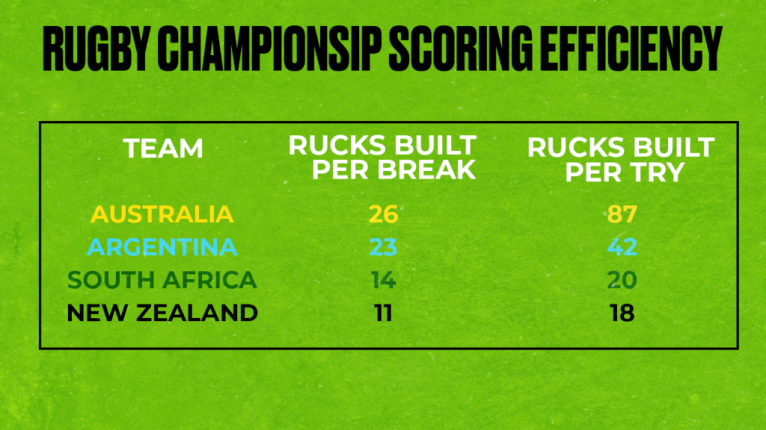
Twenty rucks per try is above average, drop that figure to 15 and you are an elite attacking team.
Despite building at least five rucks per game more than any of the other three nations, the Wallabies require twice the number to manufacture a clean break, and over four times the number to score a try compared to the top two sides in the tournament.
The basic theme of any Schmidt-mentored attack is breakdown control. Control activity in contact, exhaust the inside defenders and split the defence in two at the ruck. Progress is made down a vertical axis.
This was Schmidt’s first attempt at beating the All Blacks with Ireland back in 2013, a near miss featuring a try from lineout where play was orchestrated between midfield and the right 10m line, all the way to the try-line.
The problem for a New Zealander coaching this programme in an Australian rugby environment was admirably articulated by Queensland scrum-half Tate McDermott ahead of the game in Argentina.
“It’s obviously different, the way we [the Wallabies] want to attack. It’s also very different to the way that I am used to at the Reds.
“We play a very expansive game and Joe’s plan for us is pretty narrow [in focus].
“When we are narrow, that’s the width we want to attack, so it [takes] a very direct and a skilful game-plan at the [gain-]line [to find the space].
“Our adjustment period is probably not quite where we need it to be in regards to how we play as Super Rugby teams and how we want to play here – because it’s [so] very different to how every Super Rugby team plays.
“There’s a definite plan in place and the boys are trying really hard to nail that plan. But we have got a little bit of work to do, on how it looks and how we can make it look in a game.
“I think a lot of our energy is being zapped out of our attack. We are struggling to hold the ball [in] multi-phase and cut teams apart with our attack.”
Ex-Wallaby centre turned pundit Morgan Turinui added, in his Sydney Morning Herald column: “There is a huge amount of detail and accountability in things like how [the Wallabies] are carrying, who they’re carrying with, how they work at the breakdown…. and that has not been a huge part of the Australian game.”
Schmidt’s attacking philosophy is not represented by the Australian sides in Super Rugby, and there will be teething problems while his ideas bed in.
The Wallabies built over 100 rucks in La Plata, despite foul weather conditions, and without allowing a single pilfer. They went over 10+ phases four times in the match too. So far, so good. On the negative side of the slate, it took them an average of 34 phases to create a break and 61 phases to score a try. That is far too long to wait.
The Wallabies began with a three-minute, 27-phase statement of intent in only the fifth minute. There were 21 phases run off the first pass and six second-man plays.
The very first ruck announced some typical Schmidt motifs.
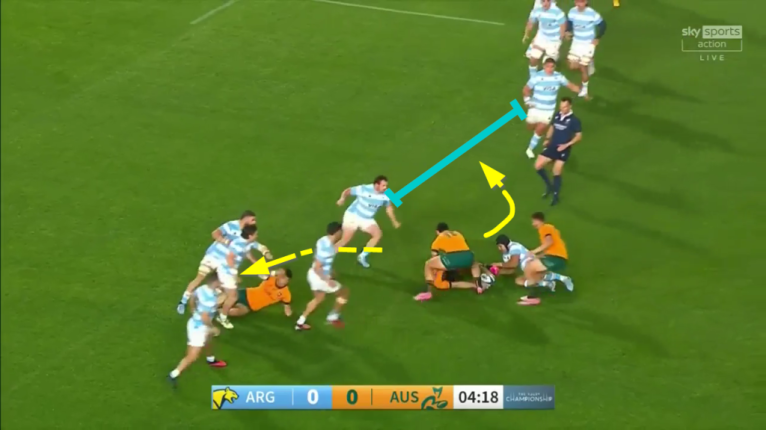
Noah Lolesio doesn’t just want to just stand above the ball-carrier as the first cleanout support, he wants to chase his man out of the play entirely to prepare the next phase, which will attack a hole going in the opposite direction – just like that try in the Ireland-New Zealand encounter way, way back in 2013. He wants to function as a ‘ruck-opener’, forcing a disconnect in the defence around the breakdown.
No Schmidt team will risk going wide until the ‘tin’ has been prised open around the ruck, and that is why long phase-strings can often end in deadlock, with one-out carries, good ball-retention but no hint of penetration.
No big cleanout advantage, no dice further out. Keep zigzagging in midfield. As the sequence unwound, the Pumas were able to tee off on predictable one-out forward carries by big forwards such as Lukhan Salakaia-Loto and Angus Bell.
The hit on the hulking Waratah means a slow second-man play with no chance of achieving width, and the Wallabies zigzagging back to Bell, still standing on the 15m line on the next phase.
Four Wallabies are forced to commit to ruck over Bell on the wide left with only one Argentine defender absorbed, so the defence will always be overlapping the attack on the following play, not the other way around.
The good news is the Wallabies did dig out some ‘ruck-openers’ as the game unfolded.
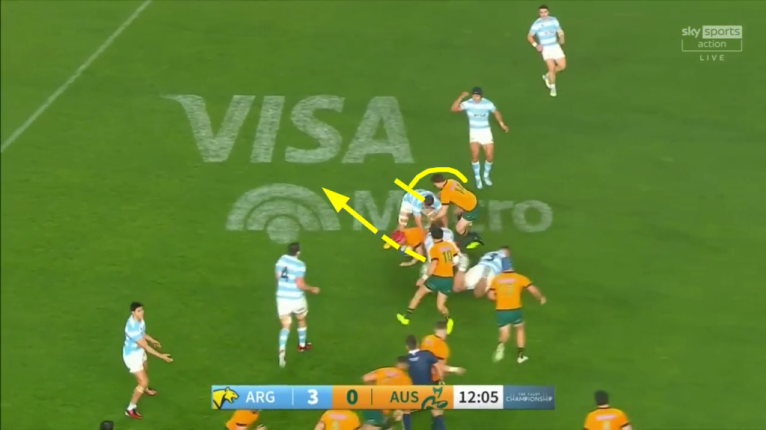
Andrew Kellaway very nearly gets the ideal blocking angle at the ruck to spring Lolesio straight up the middle. Fifteen minutes later, ‘maybe’ became ‘definitely’.
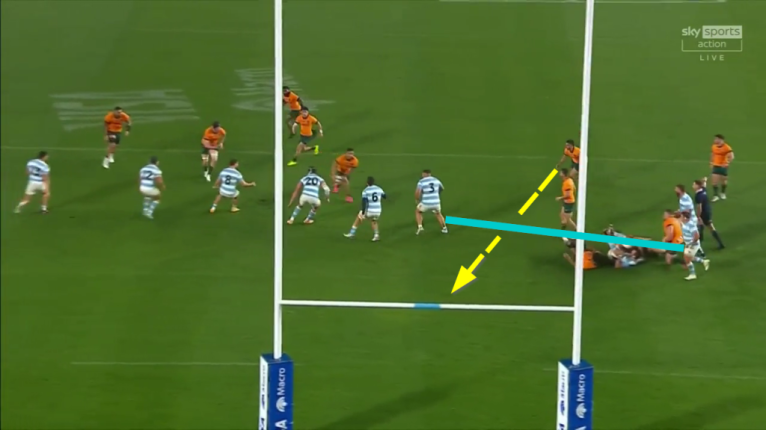
Bobby Valetini scores a big angled knockout at the breakdown creating a split down the middle of the ruck, Jake Gordon signals for the in-pass and follows Tom Wright through the gap to score under the posts. Joe Schmidt rugby at its most ruthless and efficient.
As fatigue began to take its toll on the Argentine inside defence after half-time, defenders began to take longer to get off the ground and get back into line, and tacklers started to slip off their assignments.
Valetini converted the bust by Len Ikitau into a try shortly afterwards. It was only Australia’s third try at the Rugby Championship but it was worth its weight in green and gold.
Turinui may have been overstating the case a little in his comments for Stan Sport after the game:
“What was great in the second half was I could see the next stage of Schmidt’s plan, I could see Noah’s place in it. I loved him have a crack from his own 22, when the game was on the line, really positive stuff in the second half that hopefully they can spring-board off.”
It was probably an expression of pure relief as much anything else. The Wallabies had at least scored two tries to beat the Pumas away from home, and two tries is not only better than one – it is twice the total they managed in 160 minutes of footy against the world champions.
Improvements are slow and steady, with the emphasis on slow. Questions remain about the speed at which Schmidt’s blueprint is being assimilated both on and off the field within Australia, especially in the absence of Nucifora, his chief provincial architect in Ireland.
A successful future will show the Australian sporting public the Wallabies can attack, and attract support in the process. As the WWI French Field Marshal Foch once said, “My centre is giving way, my right is in retreat. Situation excellent. I shall attack.”


Comments
Join free and tell us what you really think!
Sign up for free