
Rivalry, heart-break and clutch, match-winning moments are ingrained in the Six Nations. Every match-up immediately summons memories of legendary teams and individual heroics. In the lead-up to Ireland’s Triple Crown decider with Scotland on Saturday, I had the fortune of chatting with Ollie Campbell and Ian Madigan.
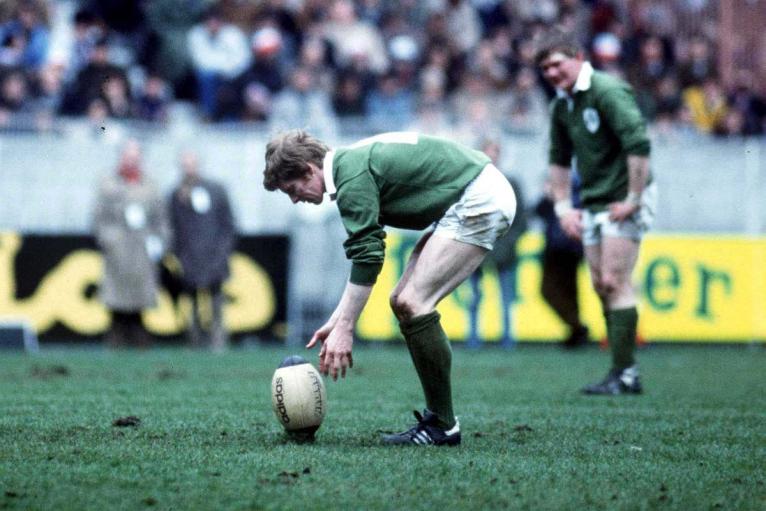
Back in 1982, Campbell kicked a then-record 21 points for Ireland, including a lovely drop- goal, to secure Ireland’s first Triple Crown in 33 years. Ireland also won the Five Nations title that day, at Lansdowne Road. “The pecking order has changed somewhat now,” Campbell noted. “It would be Grand Slam number one, championship number two and a Triple Crown in third place. Back then, a Triple Crown was very much the Holy Grail.”
Madigan took home his second Six Nations winners’ medal in 2015, but a defeat to Wales in the penultimate round ended Ireland’s Grand Slam and Triple Crown hopes. He played the final stages of the final-round win over Scotland, adding an important conversion to Sean O’Brien’s second try. Those seven points and a late, try-saving tackle from Jamie Heaslip on Stuart Hogg proved crucial, later that day. Title-chasing England came up just short in a madcap 55-35 win over France and Ireland won the Six Nations with a points difference just six points better than England.
This weekend sees three teams go into their final matches with a chance of winning the championship. Scotland and France sit on 16 points, with Ireland on 14. The Scots propelled themselves into the title mix by defeating France 50-40 at Murrayfield. They were guilty of giving up a 46-point swing (from a 33-point lead at 47-14 to just 10 by the end) however in the final 14 minutes, when Les Bleus ran in four late tries. What made that French flurry all the more unpalatable is the fact Oscar Jégou should have been sent off for making contact with the eyes of Scottish hooker Ewan Ashman in the 58th minute.
Crowley was otherwise excellent in his replacement role against Italy and performed well in the 10 jersey during wins over England and Wales… but a worrying flaw reared its head last time out.
That feeling of every point, and bonus point, being crucial is certainly true with Ireland’s current campaign. Their championship hopes looked over when they copped a 36-14 hiding from France on the opening night in Paris. A stunning, 21-point win over England in Twickenham revived their hopes. In between, they just about held off Italy to win 20-13 in Dublin. Andy Farrell’s men could have grabbed a bonus point with the last surge of the game, not long after a great intercept and break from James Lowe, but Jack Crowley kicked a late penalty, meant for touch, straight out of play, and dead. Game over and only four points picked up. “I’m actually gutted for him,” Farrell would ruefully reflect, “because he wouldn’t normally do that… it was a bit of a shank.”
Crowley was otherwise excellent in his replacement role against Italy, and performed well in the 10 jersey during wins over England and Wales. He has regained that starting berth, with Sam Prendergast dropped from match-day squads, but a worrying flaw reared its head last time out.

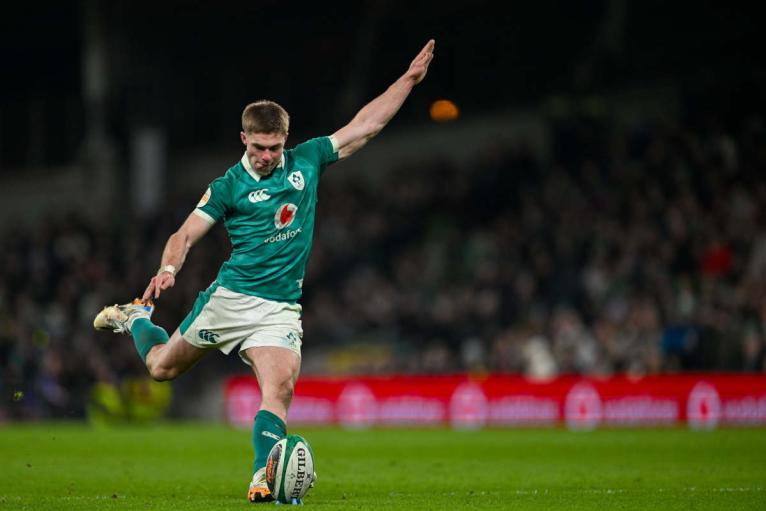
The Munster out-half contributed 12 points in Ireland’s 27-17 victory over Wales to move to seventh in his country’s all-time scorers list, overtaking Campbell (217 points) in the process. He was guilty of two poor conversion misses though, prompting his idol, Ronan O’Gara, to write a newspaper column claiming he would love one hour with Crowley, in Cork, to work on his kicking technique.
Crowley’s first conversion miss was hooked wide, left of the posts, not long after he had crossed over for his fourth Test try. That put Ireland 12-3 ahead, but their lead was reduced to two points at the break when Rhys Carré bullocked in for a glorious try from 25 metres out.
When Jamie Osborne dived over for Ireland’s bonus-point try, after 68 minutes, there was a collective sigh of relief from home fans. The hosts were 24-17 ahead and Crowley had a chance to make it a two-score game. He missed to the right of the posts and that sense of nervousness took hold again. Wales could still level the game, and practically end Ireland’s title hopes, with a converted try.
Ireland weathered that storm and were awarded a penalty inside the Wales 22, with three minutes to play. They wisely opted to kick for points, rather than go for the corner. Had Crowley got his earlier conversion, they could have pushed for a late try; a potential seven-pointer. Again, in some championship years, every point counts.
You may not be sure exactly why a miss has happened. It’s a very lonely feeling, because you’re stepping into the next kick going, ‘Well, I don’t really know what is going to happen here’.
Madigan played 30 Tests for Ireland and is well aware of how highly discussed, and debated, No.10s are. He joked about how, in his playing days, the milkman, butcher and family friends would all weigh in with opinions on his game. Crowley, he feels, needs only to take on board the comments and advice from his coaches and team-mates. The rest is just noise.
“I’ve been reading and listening to some stuff about Jack’s kicking,” Madigan said. “Andy Dunne was talking about Jack’s time-management of kicks, which I thought was a great point. That 60 seconds for a conversion (time limit) is quite restrictive, especially if you’ve had a significant involvement in a try being scored. It can often be 20-plus phases and you’ve been involved in a good chunk of them. Even the one Crowley scored, he’s potentially getting winded there and then the clock is ticking, as soon as he grounds the ball. It is definitely an added pressure that I didn’t have to deal with – clock pressure – barring penalties.
“With someone like ROG, there’s no better man to look at his technique. He’s got the experience, he’s worked with Jack. ROG had very much cracked the code on goal-kicking, to the extent that towards the end of his career, he probably didn’t have to practice a whole lot because it was just metronomic for him. What I’d say about Sam and Jack, at the moment, is that it’s not metronomic. We are seeing inconsistencies.
“Those big misses irk you – the big snap-hooks or big blocks – and if you are not comfortable in your technique, you may not be sure exactly why a miss has happened. It’s a very lonely feeling, because you’re stepping into the next kick going, ‘Well, I don’t really know what is going to happen here’. And if you are kicking with hope, the target becomes very narrow.”
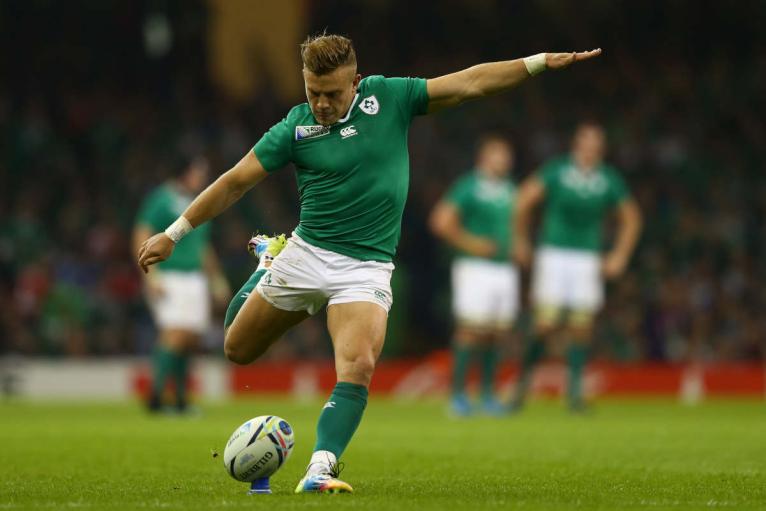
Madigan continues: “When I was kicking, if I missed it to the left, I knew exactly why. I was going to be able to correct it. The way I set the ball up, it was nearly impossible for me to miss to the right. I was diving into the essence of that and, for me, it made it feel like the posts were wider for me than they were for every other kicker. If you are a kicker that is aiming down the middle, and you miss left or right by three metres, your kick misses. Whereas, if I’ve set the ball up one metre inside the right post, if I miss to the left by 4.9 metres, my kick still goes over. It can’t miss to the right, because of the way I’ve set up. There is a mental element to it. There is also a technique element.
I would be in favour of him trialling the telescopic tee. What that gives you is that it takes away the big miss.
“I’ve also seen people talking about Jack’s (Rhino) kicking tee. I’ve been talking about this kicking tee for two years. I think he’s a brilliant kicker, out of hand. He strikes the ball really well. When you have someone who is a good kicker out of hand, there’s no reason that shouldn’t transfer to goal-kicking. There are easier and harder ways to goal-kick and that specific tee, in my view, is more difficult to find the sweet spot on.
“At this mid-point of his career, similar to Ronan, I would be in favour of him trialling the telescopic tee. What that gives you is that it takes away the big miss. The ball turns over through the air and wind much slower, so the wind doesn’t affect it anyway near as much. The sweet spot is way bigger. As regards to a technique point – it is much more of a sweeping motion, through the ball, as opposed to the ball being low to the ground and you trying to kick at it more. I wouldn’t be saying I’d be knocking on Jack’s door, but I have an idea of what I’d love to tweak with it.”
JACK CROWLEY GOAL-KICKING STATS
- 2026 Six Nations: 75%
- 2025 Six Nations: 50%
- 2024 Six Nations: 74%
SAM PRENDERGAST GOAL-KICKING STATS
- 2026 Six Nations: 50%
- 2025 Six Nations: 70%
Johnny Sexton, who had a Test match goal-kicking percentage in the late 80s, is tasked with getting the best out of Ireland’s kickers. Both Crowley and Prendergast have altered their goal-kicking techniques in the past 18 months. Dave Aldred, who worked with both Sexton and Jonny Wilkinson on their kicking, has also been drafted in to help.
Madigan, who is boldly putting himself forward for a comedy ‘Sunday Roast’ at Café en Seine in Dublin, on 22 March, was one of the best players to engage with his followers on social media. He speaks highly of how Crowley, last summer, gave fans an insight into work he was doing to improve his game.
“You look back to the last 12 months and ask what are the positives that people in sport have put out there,” he commented. “I’d think of someone like Jack, who had a tough season last year. He documented all the training he was doing in his off-season. Not his pre-season, his off-season. I thought that was fantastic. I was looking at him working on his stuff that I, as a pundit, thought he had as areas of improvement.
“There were other elements that he was doubling down on, certainly around stuff he was already good at. He’s fit, strong, athletic, good speed off the mark. I thought that was just brilliant. He was saying, comfortably, ‘yeah, look, that season was what it was, but I’m going away and working as hard as I can, hiring my own coach, and seeing where it takes me’. Then, no surprise, he hit the ground running at the start of this season and he’s had a great season off the back of it.”
Crowley has shown remarkable fight and perseverance to reclaim Ireland’s 10 jersey. The impact he and Jamison Gibson-Park had against Italy and England cannot be understated. Against Wales, the Cork native stepped up as more of a ball-carrying option and contributed a fine try when Ireland were struggling to breach a dogged, hard-hitting defence.
The criticism over his goal-kicking, with some pundits and writers also asking for more from his kicking for touch, may seem harsh, but rugby is a game of fine margins. Wringing every single bit out of yourself is a requirement these players have all happily signed up for.
 Don't miss the 2026 Rugby Europe Championship Final as Georgia and Portugal face off live and free on RugbyPass TV this weekend!
*Not available in the following territories: Germany, USA, Canada, Mexico, Guam, Puerto Rico, US Virgin Islands, Georgia and Portugal.


Comments
Join free and tell us what you really think!
Sign up for free