
It is one of rugby’s more intriguing statistics. In the professional era there have been eight Lions tours, from the 1997 trip to South Africa to last year’s series in Australia.
If France win the Grand Slam this season it will be the sixth time that they have achieved a Six Nations clean sweep immediately following a Lions tour. They won Slams in 1998, 2002, 2006, 2010 and 2022. They missed out in 2014 and 2018 but that was France’s ‘lost decade’ when muddled thinking, poor coaching and a weak generation of players condemned them to a period of rank mediocrity.
Is it a coincidence or does a Lions tour work in France’s favour the following season?
There is no doubt that a Lions tour is a huge honour but one that brings with it unique pressures. In his introduction to Clem Thomas’s definitive history of the Lions, Willie John McBride called a Lions tour “the supreme prize…the ultimate challenge”.
In McBride’s day a Lions tour was an epic adventure; the 1971 tourists to New Zealand, for example, played the first of their 26 matches (four of which were Tests) on May 12 and their last on August 14.
The Lions who toured South Africa in 1997 played 13 matches (three Tests) between May 24 and July 5; the 2025 Lions played their first match on June 28 in Dublin, against Argentina, and their last and tenth against Australia on August 2.
Thirty players were selected for the 1971 Lions tour, five fewer than the 1997 tour and eight short of the number picked by Andy Farrell last year. In addition Farrell called up a further five players as ‘additional cover’.
In short, modern Lions tours aren’t what they were. More tourists and fewer matches. Alex Mitchell, the England scrum-half, played 211 minutes of rugby in Australia, and Marcus Smith 225 minutes. That’s not even three full matches.
One Lion who did see a lot of action was Ireland tighthead prop Tadhg Furlong. He appeared in seven matches overall, including the three Tests against the Wallabies.
On the eve of the Six Nations match against England, Furlong gave short shrift to the idea that the Lions tour was to blame for Ireland’s stuttering start to the championship. “I don’t think it’s much of an excuse to be honest with you,” said Furlong. Sure, he said, it was a ‘strain’ physically, but the Irishman suggested the legacy of a Lions tour was more psychological. “Everything maybe seems insignificant the year after,” he said. “Maybe they [the players] think they’re better than they are.”
No one in Ireland has mentioned the Lions tour since they hammered England at Twickenham.
No one in Ireland has mentioned the Lions tour since they hammered England at Twickenham.
It’s not as if France and Italy spent the summer on the beach sipping pina coladas. The French played three Tests in New Zealand (plus one against England at Twickenham) and Italy toured southern Africa, playing a Test against Namibia and two against the Springboks. Although some Italians were rested, most of the Six Nations squad toured including stars such as Niccolò Cannone,
Tommaso Menoncello and Manuel Zuliani.
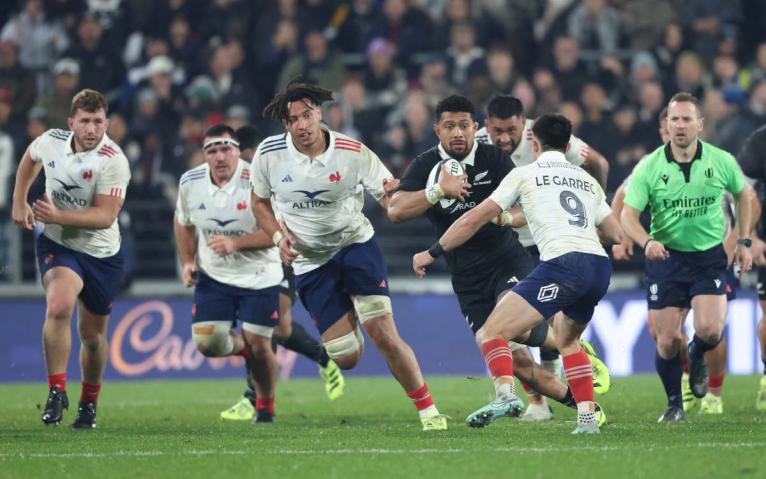
Ten of France’s Six Nations squad toured New Zealand and several played in all three Tests. One, full-back/wing Théo Attissogbe, also played against England: that’s four Test matches in five weeks.
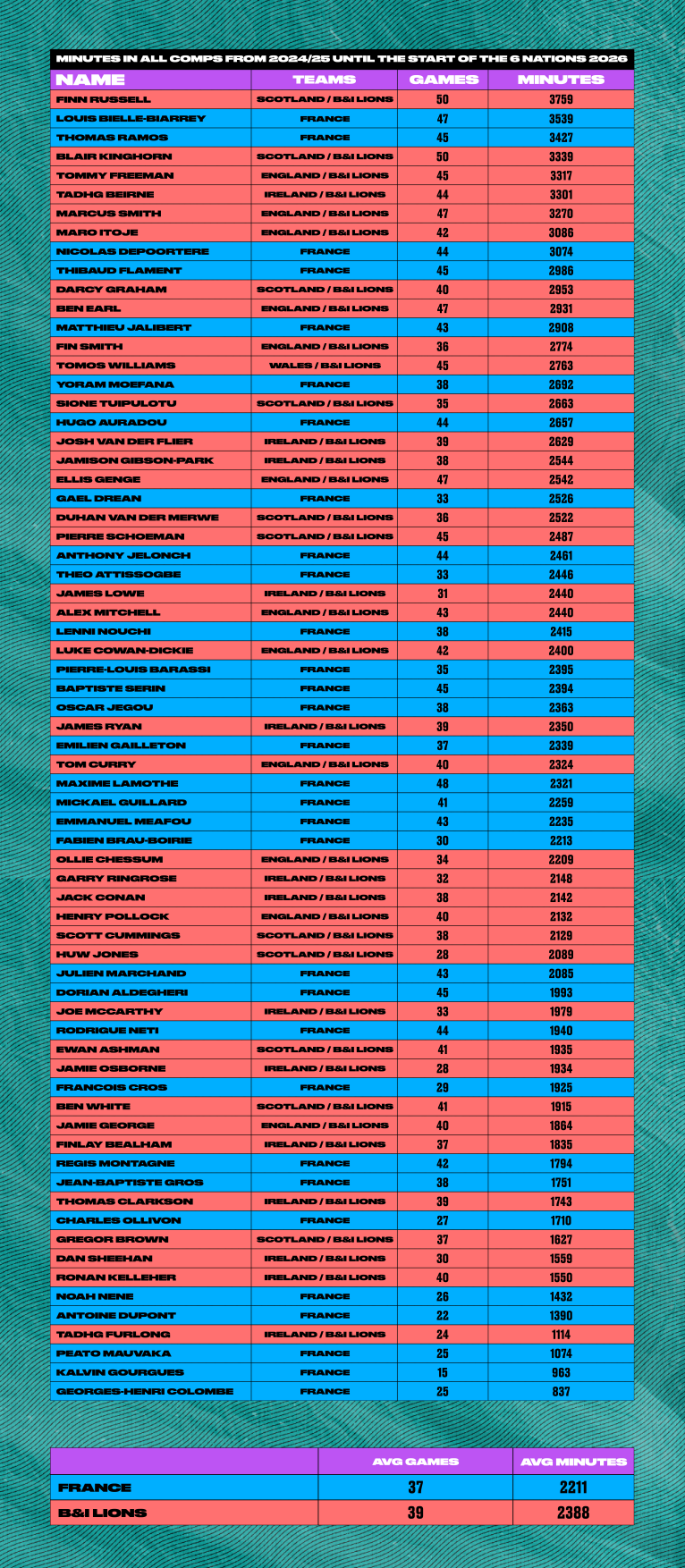
Attissogbe is one of the players who features in some fascinating stats compiled by Opta on behalf of RugbyPass. Their boffins totted up the total minutes played by French and Home Nations players since the start of the 2024-25 season. Of the top 40, nineteen are French, nine are English, six are Scottish, five are Irish and Tomos Williams is the solitary Welshman. The player who has played the most minutes in the last eighteen months is Scotland and Bath fly-half Finn Russell (3,759), followed by the French pair Louis Bielle-Biarrey (3,539) and Thomas Ramos (3,427). The forward with the most minutes under his belt is Ireland’s Tadhg Beirne with 3,301, placing him sixth in the list.
Italy aren’t included in the list but last season Niccolò Cannone and Menoncello both played 26 games last season while Zuliani made 29 appearances.
At the start of this season World Rugby introduced new welfare guidelines that limit players to a maximum of 30 full games in a season. They are just recommendations but they should be followed, for the sake of the players. Freeman spoke last week about what 34 games in a season does to a player.
“Without realising it, I think I was tired,” he said. “My body felt like I was OK to go and I was saying to coaches: ‘Yeah I’m fine, I’m fine.’ I just think mentally it was a bit more of a struggle.”
Freeman had five weeks rest and recuperation after the Lions tour, as did most of the British and Irish players involved in summer tours whether with the Lions or their countries.
The URC and Premiership seasons began on the weekend of September 25/26, three weeks after the Top 14.
Furlong is right: Lions tours shouldn’t be used by the Home Nations as an excuse for a poor Six Nations. They weren’t in 2014 when Ireland won the championship or in 2018 when they achieved the Grand Slam.
French players who toured New Zealand weren’t so fortunate. Take the Toulouse centre, Pierre-Louis Barassi, who played in the final of the Top 14 against Bordeaux on June 28. The next day he jumped on a plane to New Zealand and lined up against the All Blacks on July 12.
He had a couple of weeks off in August but was selected for Toulouse’s first game of the 2025/26 Top 14 on September 7. By the time the Celts and English started their seasons he already had 240 minutes of rugby under his belt.
Barassi played continuously until he was concussed in the November Test against Fiji, an injury that sidelined him for ten weeks. Some French players are flogged until they drop.
Furlong is right: Lions tours shouldn’t be used by the Home Nations as an excuse for a poor Six Nations. They weren’t in 2014 when Ireland won the championship or in 2018 when they achieved the Grand Slam.

Plot your team's route to the Six Nations title with our Six Nations score predictor game!


This is a great in depth analysis and really makes you appreciate the workload of all of these players. It would be very interesting to see this comparison with the Springbok players in Japan and the URC or Super Rugby players for the All Blacks, who are managed much better from a physical point of view so that they can focus predominantly on their test seasons.
Brilliant read!
I think France are just better, top to bottom at the moment. Players, coaching, domestic league and age grade.
Their slam stats are very interesting after Lions tours. It seems that winning or losing a Lions series has no real difference and takes an equal amount out of some players. Or it’s maybe just a statistical quirk? A clean sweep does generally require you to have some key matches played at home with home advantage.
There is a counter trend though against France winning titles immediately following RWCs - tournaments in the professional era were they have always been expected to deliver
(‘99) 2000 - England
(‘03) 2004 - France *the outlier but the 2003 RWC was won by NH team
(‘07) 2008 - Wales
(‘11) 2012 - Wales
(‘15) 2016 - England
(‘19) 2020 - England
(‘23) 2024 - Ireland
I do think their World Cup hangovers are a real thing
Their 2024 6N campaign started as a disaster and seriously could’ve (should’ve maybe) been 3 losses in a row. They pulled it back by beating Wales and England but with Dupont preparing for the Olympics along with the shock of what happened at the World Cup, I believe it was a big eye opener about the team moving towards 2027.
Using the lions tour as an excuse is poor form. France have as many minutes as the BAIL players, and are at their peak right now