




1
Six Nations 2026 Awards - and our Team of the Tournament
9

Felipe Contepomi has an unusual rugby mind. Where most elite coaches enter the labyrinths of their chosen job with torch in hand, ready to chase its flickering shadows to the point of obsession, Contepomi has a life outside rugby. He is a qualified doctor who graduated from the Royal College of Surgeons [RCSI] in Dublin 18 years ago, while still playing in the mid-blue and gold of Leinster.
Contepomi has always been able to juggle two balls at once and somehow, find the point of balance where one informs and ameliorates the other. After completing his internship at the Beaumont Hospital in the Irish capital he returned home to Buenos Aires to work alongside his father in the family practice.
As he revealed in a 2018 interview with The Sports Chronicle, it was then he began walking the tightrope between sport and medicine after his playing career had finished.
“Coaching has to be all-consuming,” he said. “The preparation can never stop; revising the previous game to avoid the same mistakes, preparing for future opponents, and working to make individuals better in specific areas.
“Rugby remains my passion [but] I joined the practice. Not many people are so lucky when the game ends [as a player].
“I worked for a while alongside my dad, but at 80 years old he needed to retire. I was interested in coaching so accepted a role with the Jaguares for one season, just to see if it could become a passion – like medicine and playing the game had been.”
Jaguar or Puma, it does not matter. The distinction was blurred, and the rump of the players who represented the Jaguares in Super Rugby went into the national side en masse as Pumas. The sports medicine high-wire act was inherited from his father Dr Carlos Contepomi, who had been selected to play rugby for Argentina as an outside-half in 1964. As Felipe recalls, “they weren’t called the Pumas until the ’65 tour of South Africa when a journalist’s nickname for them was lost in translation – so the jaguar on our badge became a ‘puma’! Dad was selected for that tour but instead he took up a two-year [medical] fellowship in London instead.”
While Contepomi was with the Jaguares, he realised the length of the road to be travelled for professional rugby in Argentina. The Pumas had only been a part of the Rugby Championship since 2012, and they were catching up with the speed of the game in the southern hemisphere, literally and figuratively. Argentina won seven games in their first 10 seasons and only avoided the wooden spoon once in that time.
It was Contempomi’s facility at juggling which proved key. After spending a couple of seasons working alongside Mario Ledesma at the Jaguares, he swapped hemispheres again to plunge into the deep pool of ideas and innovations at the best educational rugby laboratory in town.
“I was influenced by Irish people from a very early age,” he said. “Educated by the Christian Brothers in Colegio Cardenal Newman, I’ve memories of the Brothers playing hurling and wondering what the hell they were doing! I played all sports growing up, but we spoke the language of rugby in our house.
“I told [my wife] Sofia, ‘To improve as a coach we will need to leave Argentina as I need to be surrounded by cutting edge ideas from other parts of the world.’
“An agent put coaching options in front of me. Leinster was in the pile. ‘This is my priority,’ I told him. ‘This is where I want to coach’.
“Leo Cullen and Stuart Lancaster made it happen. There’s no hiding [the fact] that I got one of the best opportunities in my life to come to the best team in the world in Leinster.”
The Anglo-Irish influence at Leinster was crucial in developing Contepomi’s tactical acumen in the direction it naturally wanted to go. You find the opportunities you really need, whether you recognise it or not at the time they arise. As Lancaster explained to RugbyPass: “Felipe really developed during his time working at Leinster. In truth, he always had it in him. He joined with the title of ‘backs coach’ but it was clear his remit would expand pretty quickly!
“He had that innate rugby intelligence inside him, so it was just a matter of finding the right channels to let it out.
“We spent four years together and worked on developing our attack – and that is the area in which the Leinster teams at that time developed the fastest.
“The popular perception is most games are won by the teams which win the collision zone, but it’s not so easy to win them by power alone anymore. All professional teams are big and physical nowadays. You cannot take a punt on being bigger and more powerful than the other guy at this level, because they are all big and powerful.
“So, you begin to think of options, passing, footwork and running lines that challenged defences, and a better connection between forwards and backs. We found we could replace winning collisions ‘in the aggregate’.
“In other words, if we won super-quick ball through the efficiency of our running lines, our cleanout and precise ball placement, we could achieve the same impact on the defence as a tackle break.
“They would not be able to either regroup or compete in time if we were accurate at even a short machine-gun sequence of lightning-quick rucks, especially with our nine and 10 playing flat on top of them.
“The other main idea was to have our outside backs in constant motion from one side of the ruck to the other, so we would always have three-ply depth in our attacking formation. With that depth we could hit short or fan out wide depending on the attitude of the D.
“That’s exactly what you see now with Felipe’s Pumas. If the D plays soft and becomes too reactive, they will find themselves in a whole world of trouble. You saw it when the Pumas thrashed the Wallabies by 40 points in 2024 [67-27 at the magnificently-named Estadio Brigadier General Estanislao Lôpez in Santa Fe in round four].
“It was a just natural progression when Felipe left Leinster in 2022 to join Michael Cheika’s Argentina coaching staff as the attack coach, and there was never much doubt he was going to replace ‘Chek’ as head coach when he left. He was a head coach in waiting.
“Now Argentina is a serious force to be reckoned with, and an even chance to win the current Rugby Championship. They’ve done it by developing their backs and loose forwards in attack, and developing away from their traditional strengths at scrum and maul. They are true all-rounders now.”
One of the key mindset changes Contepomi took with him from Dublin to Buenos Aires was a healthier respect for process over outcome. The transformation Lancaster describes above takes time, and the results do not appear immediately, so there needs to be respect for growth occurring beneath the surface, often invisibly. As Contepomi himself observes: “Our mentality [with Argentina] has changed. We focus more on process than the result. Obviously, it is nicer to win, but in last season’s win against the Springboks they had the chance to win the Test with a late penalty kick. My impression of the game would not have changed, regardless of the result. The performance speaks to our processes and what we are trying to achieve.”
The work is continuous and the consistency of application is often elusive, but it is in that space the happy balance of sport and medicine is felt.
“The discipline of medicine and rugby complement each other,” Contepomi said in a piece with the RCSI. “You are continuously working in a team, and whether you learn it in sport or in medicine it is no different. It is not something you only learn from playing at a professional level: any team you are involved in where you strive to be the best you can be, but at the same time understanding you are doing something for the good of many other people, teaches you the same thing.”
When you look at the new Argentina fashioned by Contepomi and co, the fearsome beasts who once roamed the Pumas scrum pampas are absent. There is no ‘Topo’ Rodriguez, or Patricio Noriega, no Marcos Ayerza or Diego Cash to be found in the current group. The Pumas were -11 in the scrum penalty count at the 2024 Rugby Championship and they are -2 in the current tournament, so they are not dominating.
That has not stopped Contepomi’s charges from attacking the game or attacking from scrum, and after four rounds they lead the way in key categories such as breakdown retention, speed of delivery from the ruck and most carries per game. That is the Leinster legacy in blue and white.
Argentina can field arguably the best back-row unit in the world and they have backs in Tómas Albornoz, Santiago Chocobares and Juan Cruz Mallía who would all be in the top three in their positions, and therefore by Bob Dwyer’s definition ‘world-class’.
Even when their scrum is under pressure, the Pumas can now use it as a platform for attack.
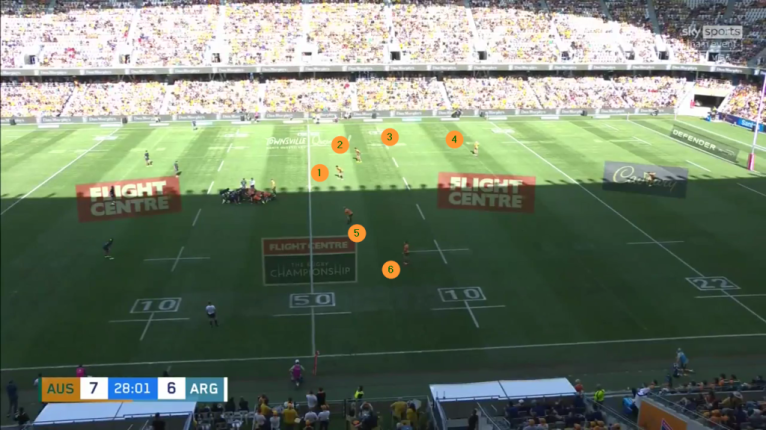
Australia opt for a 4/2 split on defence at a midfield scrum, and that means a number eight pick-up will always create a potential advantage in numbers on the shorter of the two sides, especially when the “2” features a weaker set of defenders [Tom Lynagh and Corey Toole]. Even though the Argentine scrum is under severe pressure, it does not impede swift ‘channel one’ ball, and a great running line from Chocobares takes him inside Lynagh and allows the Toulousain man to set up Mallía and Bautista Delguy on the outside for the try.
Five minutes later the Pumas took it to the other side of the scrum, with Max Jorgensen sitting off the play and too far away to help with front line defence.
Mallía swings around from the back of the set-piece to make the extra man, then Lucio Cinti and Santi Carreras are able to manipulate a back-pedalling ‘Jorgo’ to taste as the long break develops down the left.
A scrum in retreat was never a problem for the Pumas against the All Blacks either.
First the ball is spun out slickly to the left, then there is seamless interplay and exchange of roles between backs and forwards coming back the other way, with six Juan Martin González offloading like a centre and scrum-half Gonzalo Garcia cleaning out like a loose forward. This is the modern blue-and-white way, even if it is a far cry from history.
The working lifetime of Contepomi is a lesson in the rough for the All Blacks. The ex-Leinsterman has moved from sports to medicine and back again, and between Argentina, Ireland and England in the course of his dual career, and it has given him that ‘pearl of great price’ which New Zealand signally lack.
The result is Argentina has been able to modernise its rugby at the highest level, even without a professional home-based team after the demise of Super Rugby’s Jaguares in 2020. Whether Pumas or Jaguares, La Albiceleste is finding success ‘en unión y libertad’, in a unity derived from the freedom of movement of its coaches and players. The ‘hand of God’ is finding a new way to bless its rugby team.
Join free and tell us what you really think!
Sign up for freeThe in-demand coach will be pushed to reject overtures from England and Saracens when his contract is up after the World Cup
After the Super Saturday epic, Fabien Galthie was left with more questions than Steve Borthwick, despite their sides' contrasting Six Nations form.
So many great tries, matches and individual displays in a championship for the ages, but which were the best?
Cian was a 7. Great lineout option and a lot of hard work around the park.
The Prendergast brothers with the lowest ratings.


 Clear
Clear 


