
As players emerge from the tunnel at Loftus Versfeld, there is a sign waiting for them overhead: “Altitude. 1350m. It matters.” For decades, the Highveld has been treated as rugby’s invisible extra man, a place where visiting sides leave talking about burning lungs, heavy legs and games that slipped away once oxygen debt caught up with them.
Visa Priority RWC2027 Ticket Sale: 28 - 30 Sept 2026
Register your ticketing account now for Visa Priority Sale access. Visa sale: 28 - 30 September, 2026
Recently, though, that mythology has taken a few blows. Glasgow Warriors won the 2024 URC final at Loftus with a second-half resurgence. A year later, Northampton Saints became the first away side to win at the ground in the Champions Cup. In Johannesburg, the Wallabies overturned a 22-point deficit to stun the Springboks. These results have complicated the old certainty that a trip to Pretoria or Johannesburg is decided as much by geography as rugby.
Ross Tucker, the South African sports scientist, thinks the answer sits somewhere between hyperbolic folklore and simple dismissal. “It’s definitely a factor,” he says. “No-one wants to go to altitude. It is harder to play at altitude.
“But eight substitutes, the way the game is played now, and the fact that it’s less common to find teams that are purely altitude-based has diminished the size of that advantage compared with 15 years ago.”
The reason the conversation refuses to go away is there has always been evidence behind it. During the Super Rugby era, Tucker analysed home-and-away performance across South African franchises and found altitude teams consistently enjoyed larger home advantages than those at sea level. Playing at Loftus was worth roughly eight points to the Bulls. For the Cheetahs, it was closer to 13. For the Lions, around 14. Sea-level teams typically sat between five and seven.
That did not mean altitude won matches on its own. The Cheetahs and Lions still lost plenty of games on their own patch. What it suggested was altitude added something measurable to the standard home-ground effect. Tucker’s line is a useful frame for the whole subject: “If everything was equal, altitude would be decisive. But everything is not equal.”
Jamie Bhatti knows 👀#Rugby #GlasgowWarriors #URC #Bulls pic.twitter.com/TzHonmAqpp
— RugbyPass (@RugbyPass) June 23, 2024
Nick Hart is a lead performance specialist at The Altitude Centre in London, where elite athletes and teams – including England ahead of their Test in Johannesburg – use simulated altitude to prepare for competition. His explanation starts with basic physics.
“When you go to altitude, the pressure in the air drops,” he says. “Oxygen is more spread out, so with every breath you take, you get less oxygen into the body. What that means is there’s less oxygen delivered to the muscles.”
Less oxygen means less aerobic capacity. Recovery between efforts becomes harder, repeated sprint ability declines and fatigue arrives earlier. Tucker points to research suggesting that at Johannesburg’s elevation – 1,753 metres above sea level – athletes can experience roughly a nine per cent reduction in VO2 max. In a continuous endurance sport, that effect is obvious. Rugby is more complicated because players are not free to pace themselves in the same way a runner or cyclist would.
“When athletes run at altitude, from the very first moments of exercise they slow down because their brains pick up that there’s less oxygen,” Tucker explains. “The problem in rugby is that you can’t really pace yourself because the ball dictates the load.”
A player does not suddenly stop functioning. A wing who normally covers 30m in four seconds may take 4.2. A defender may take a second longer to get off the floor and back into the defensive line. At the elite level, those fractions matter.
That may be the most useful explanation of altitude in rugby. If there is a cross-kick, the winger cannot jog. If there is a line break, the cover defender cannot decide to conserve energy. As Tucker puts it: “Rugby is maximal efforts until fatigue compromises the ceiling.”
The effect, then, is not always dramatic. A player does not suddenly stop functioning. A wing who normally covers 30m in four seconds may take 4.2. A defender may take a second longer to get off the floor and back into the defensive line. At the elite level, those fractions matter.
“That 0.2 seconds over 30m is the difference between the cover tackle being made or not being made,” Tucker says.
The cost of altitude is measurable across almost every metric. The surprise is not that they appear in the numbers, but where they appear.
The data does not support the traditional image of visiting teams collapsing in the final quarter. Instead, some of the clearest signs of altitude stress emerge between minutes 20 and 40.
At Ellis Park, visiting teams record their lowest tackle success rate in the second quarter, dropping to 81.5%, compared with 84.0% in the opening quarter and 84.5% in the third. At Loftus, the strongest home points differential also comes in the second quarter, with home sides averaging +4.62 between minutes 21 and 40, compared with +3.96 in the opening quarter and +2.21 in the final quarter.

The ruck speed data points in the same direction. At Loftus, teams complete 62.1% of rucks in under three seconds in the first quarter. In the second quarter, that drops sharply to 56.4%. Across all other venues, the equivalent drop is smaller, from 60.1% to 58.4%. That does not prove altitude alone caused the slowdown, but it supports Tucker’s broader point the first signs of strain may arrive much earlier than popular language around the subject implies.
“There’s a misperception that at altitude it’s going to hit you at 60 minutes,” Tucker says. “I think it’s hitting you from the start.” Hart makes a similar point from a physiological perspective: “As soon as the aerobic system becomes the main factor, you’ll see a difference in a matter of minutes.”
That helps explain why the fourth quarter is not always the smoking gun people expect. If altitude were simply a cumulative fatigue effect, the data should deteriorate quarter by quarter. Instead, some metrics recover after half-time. Tucker believes the modern bench is central to that.
“The second quarter has the most total fatigue on the field because every player has the same number of minutes in their legs,” he says. Later in the game, substitutions begin changing the equation. The 23-man game does not remove altitude, but it blunts some of the late-game damage. Bench splits that tilt towards mobile forwards have an even greater impact.
The broader results still show altitude venues remain difficult places to win. Since September 2021, European clubs and Six Nations sides have won just 10.6% of matches at Loftus Versfeld and 20.5% at Ellis Park. Across all other venues, that figure rises to 33.7% for visiting teams.
Hart explains that air at sea level contains about 20.9% oxygen, while The Altitude Centre’s systems reduce that percentage to create a controlled training stimulus designed to familiarise players with reduced oxygen availability before arriving on the Highveld.
Touring European sides also show a small second-half drop-off in defensive efficiency at the two Highveld venues: at Loftus, tackle success slips from 84.4% in the first half to 82.8% in the second; at Ellis Park, from 82.7% to 81.5%. These are not catastrophic collapses, but they are consistent with altitude acting as a marginal tax on performance.
That is not the same as a silver bullet. A better team can still win. A better-prepared team can still cope. Glasgow, Northampton and Australia did not make altitude disappear. What they did was manage enough of its effects while executing the rugby required to win.
That is the space The Altitude Centre operates in. Hart says the aim is not to turn players into altitude specialists but to limit the damage.
“The key phrase we always use is: reduce the negative impact that altitude has on performance,” he says. “We want to remove altitude as a criterion for performance, or minimise it and mitigate it as much as possible.”
England and the British and Irish Lions have used intermittent hypoxic training, exposing players to air with reduced oxygen content before returning to normal training and daily life. Hart explains that air at sea level contains about 20.9% oxygen, while The Altitude Centre’s systems reduce that percentage to create a controlled training stimulus designed to familiarise players with reduced oxygen availability before arriving on the Highveld.
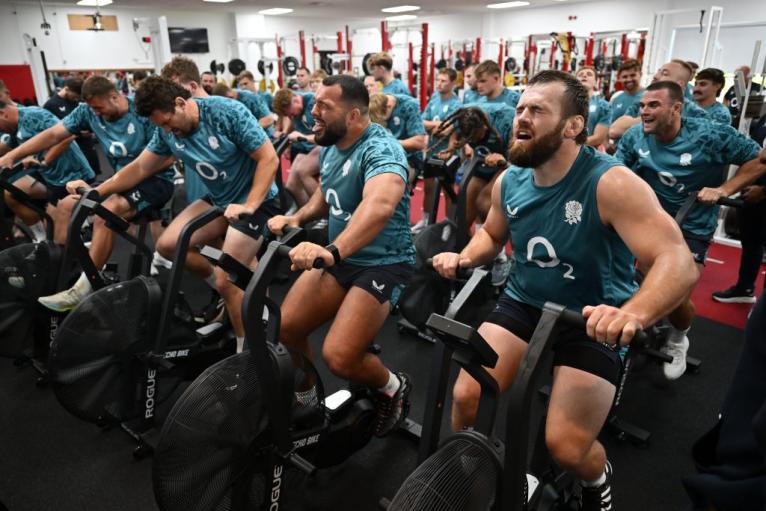
Tucker is careful about the limits. Simulated altitude can mimic reduced oxygen availability, but it cannot fully replicate changes in air pressure. The only people with a genuine altitude advantage are those who live there, and that matters for how the old South African advantage has changed. The Bulls, Lions and Cheetahs of the Super Rugby era were built around squads based year-round on the Highveld. Modern Springbok sides are scattered across Japan, England, France and South Africa.
The advantage may still exist in the club game, where the Bulls and Lions train at altitude and opponents fly in, but at Test level the picture is less clear. “You can’t say Pieter-Steph du Toit is going to be naturally comfortable at altitude,” Tucker says. “He’s in the same boat as Ardie Savea.”
There is also a psychological layer. Hart believes players who have experienced simulated altitude may be less surprised by how much it affects them.
“Psychology in elite sport plays a massive part,” he says. “If players turn up feeling ready for it and are used to the feeling of altitude, that may be advantageous.”
The sign at Loftus is still right. The evidence from Super Rugby suggested it years ago. Modern URC and European data still show Loftus and Ellis Park as unusually difficult venues for tourists. The physiology explains why: less oxygen, slower recovery, reduced repeat-effort capacity and greater cognitive strain under fatigue.
But the old story needs updating. Altitude does not simply arrive in the final quarter and decide matches. It begins working from the start, often showing itself in the second quarter, before substitutions and tactical adjustments alter the pattern.
Altitude is not an excuse, a guarantee or a myth. It is a measurable constraint. It changes the cost of effort, narrows margins and punishes teams that fail to manage tempo, recovery and decision-making. It may no longer be the trump card it once was, but at 1,350 metres, rugby still gets harder. And for that reason, it still matters.

Your home for rugby. Download the RugbyPass app on the App Store (iOS) and Google Play (Android) now!
Follow your favourite teams, tournaments and players, and get personalised news and Match Centre notifications direct to your device.
From live rugby streams and upcoming fixtures to breaking news, in-depth analysis and live scores, RugbyPass has everything you need to stay connected to the game.


When RSA came back into the rugby fold it seemed everyone in NZ was stressed about playing them at altitude. Not just the effects on the body but the effects on the ball and how it changed how the game was played.
I reckon for the first couple of years there was a chunky dose self psyching involved on our part, when in a normal game you'd start to feel fatigued at 60 it was just standard but when you started to feel fatigued at altitude after 60 you convinced yourself that it was the sign of you hitting the wall and that played games with you.
Once we'd been playing there for a few years it seems that kind of thinking went away, possibly because the internal data didn't support the hypothesis. But NZ teams generally don't have any fear of altitude as an opponent, I don't think it every receives a mention in the build up to games these days and hasn't for the last 20 years or so, except for the effect that altitude has that can't be denied: the ball travels further when kicked; more penalties are now within reach of the posts, and kicks will go further (for better and for worse) and you have to adapt to that. But we've also all seen sea-level kickers who suddenly believe they've got 60m boots now that they're on the Veldt…
Remember, in 2009, Ian McGeechan flew his Lions players from Cape Town to Pretoria (and back) in a single day. Yes, they lost that test -I was there!- but the altitude didn’t affect them one percent. I expect ‘Borthos’ to remember that approach.
Doesn’t guarantee anything on the results page, but your lads will be competitive for the 80mins…
There is no mention of kicking in this article
I feel it should get a mention, if u can maximise any advantage from the extra distance or not?
Would the heat also be a factor? Since the advent of the URC, overseas teams are playing rugby in our Summer. So in addition to altitude, sapping temperatures often in the 30’s can’t be helping matters either.
What the author has completely ignored is the effects of the bus ride into Ellis Park on game day.
It is well documented how daunting it is for visiting teams as they approach the stadium.
Over and above the methane fumes, and the running of the gauntlet that is avoiding car guards and knock-off springbok merch salesmen, the jarring ride over potholes has left quite a few players nervous systems shot before kick-off. It matters.
England fans shouldn’t be worried about the altitude.
They should be worried that I have put a grand on England to win by 5 points.
Call me superstitious if you will. But if the science is still out on whether altitude matters or not - I have established a near perfect correlation between who I bet on to win and who wins.
Apart from soaring ticket prices to attend games - a bok season can cost me anything between 11 and 13 grand per annum.
Last year was the worst. I only won 2 bets. But that Aussie test sure made up some.
I hope the bok’s win ratio worsens this year. I’m not sure I can sustain these losses for much longer.
I believe they’ll be reducing the altitude for this game.
Or was it the the amplitude of the DJs decks?
I can’t remember.
What the author hasn’t touched on, in my opinion, is the effect of an empty stadium.
The Lions frequently play in front of their WAGS, their mums, the press, Lions support staff, Supersport staff and security personnel. In a stadium equipped to seat 62,000.
As of last week only a third of available tickets for the Springbok/England clash had been sold.
To be fair, some of us had to make a choice between getting Limp Bizkit tickets or test tickets for this game. It matters.
It doesn’t matter to me, because I’m rich and I can go to both. But my point is - when there are fewer spectators in the stands, there’s more available oxygen in the stadium.
So that should balance out the advantage to the home team.
So England should be fine.
Altitude doesn’t matter. URC teams regularly win at Loftus and the Boks lost a couple of tests at altitude last year. I keep saying it on other blogs, It it is time to retire that sign. Modern players are supremely conditioned.
See my above comment. It matters. But it also doesn't matter. Which matters.
As I show with the stats - it matters, just not as much as before. But URC and Test teams see greaters drops in performance at altitude than at sea level.
Last I checked the Boks lost to NZ and to Aus at EP last year?
NZ won at Ellis Park the year before - but yes you are correct. the ABs have seemed to figure out how to win at EP.
Mostly, they avoid the chicken à la King. Seems to be the trick.
Yes but Eden Park is not at altitude which is why it’s not relevant to this story.
Nice piece, detailed and insightful. Just not very fair for SA to have even more advantages than they already have though.,,😂
We could consider moving the games to below sea level? Down one of our legendary mineshafts on the Witwatersrand.
But then we’ll hear moaning and complaining that black lung affects athletic performance. “It matters”.
You just can’t win…