
The Wallabies’ 28-24 win over Argentina in Townsville on Saturday produced a myriad of emotions for this fan, and I’m sure I wasn’t alone in this experience.
It was strange one; I never really thought they’d lose the game, yet had to acknowledge how difficult they’d made it at 21-7 down at half-time. Even at 24-21 down with all the possession in the world, I still thought they could win yet wasn’t sure how they were going to break the line.
So in summary, we had concern, growing confidence, rapid mathematics while reconciling what a draw or loss would mean for both tournament prospects and world ranking points, more concern, then finally, sweet relief. Watching the Wallabies is hard work, but anyone who has done it for any length of time already knows that.
But another win – no matter how stressful – does quickly erase all that. The Wallabies of 2025 seem to have found a way forward the works for them, even if it does involve coming back from scores that are either uncomfortable, nigh-on impossible, or – just for fun – both.
Coach Joe Schmidt said post-match that he’d prefer his team didn’t allow opposition to get that far ahead in the first place, and believe us Joe, we’re right behind you on that front. But they have certainly found a way.
And it’s hard not to enjoy all the good bits that come with that.
Harry Wilson wanted the win more than anyone
The Wallabies skipper was very diplomatic, democratic even, when he explained post-match that the decisions to not kick for goal and take the draw was made by the senior leaders and the game-drivers in the team. Sure, they probably were involved, but the vision tells a very clear picture.

There are deliberations going on, certainly, and James O’Connor probably is even looking toward the posts, but Wilson suddenly turns to referee Paul Williams and points very animatedly to the corner. He then turns back to the team-mates he was debating with and, with my best lip-reading, makes it very clear – in a way I can’t really paraphrase for a family-friendly audience – Australia should try to win this game. He used more words than that, but the message was clear.
“He made the right call, he backed his boys and that’s what he does,” two-try centre Joseph-Aukuso Suaalii said later.
“He puts belief in his team-mates and for myself, he’s someone that I look to and I want to play for him. He has a special ability to not say too much but lead by his actions and today was a special case of his leadership.”
Wilson has grown into the role with every match. It’s bringing out his best stuff as a No.8 as well
Make no mistake, Wilson deserves all the plaudits he’s enjoyed this week. He is a lead-from-the-front captain and loves nothing more than a Wallabies win. Players clearly do want to play for him.
He was probably only seen as a short-term option when Schmidt first asked him to captain Australia. But he has grown into the role with every match. It’s bringing out his best stuff as a No.8 as well, and he’s making himself a very important part of this team.
I don’t think we could definitely say that 12 months ago. Maybe that’s why the players were so ecstatic when Angus Bell crashed over for the winning try.
Len Ikitau’s influence is terribly under-rated
Late in the second half, Stan Sport in Australia flashed up a graphic that highlighted that at the time the Wallabies had made 101 post-contact metres from something like only 110 carries. Essentially, they were making an extra metre past the gain line every time they carried. It was super impressive.
And through much of that, it was the same group of players making the ground: Bell, Tom Hooper, Rob Valetini, and… Len Ikitau.
Officially, Ikitau’s stats sheet reported 16 carries, 65 metres made, four tackle breaks, 16 passes and one magic offload, which I’ll come to shortly.
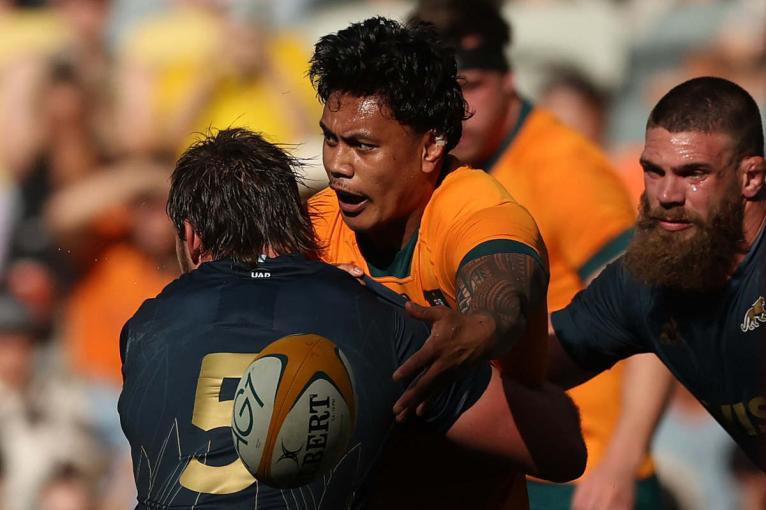
Curiously, the first trans-Tasman authored match ratings I saw lent on the few errors he made and pegged him to about 7.5/10 on average. I couldn’t help but wonder, what more does he need to do to earn an 8/10 rating?
Fortunately, a few other overseas ratings bumped that average up, with 8s and 8.5 more prominent. And accurate, I’d argue. If there was a better Australian player on the field in Townsville, I’m happy to hear it.
There is an argument right now that Ikitau is the most influential player on the field for the Wallabies. He’s not getting the headlines, he’s not getting the highlight reels, but he is responsible for plenty of them.
Watch Suaalii’s first try. Under a second penalty advantage, Ikitau trails Nic White to the back of a ruck and slaps him on the back to draw the veteran scrum-half’s attention to something. White picks up and takes one step forward to engage the first defender and immediately offloads to Ikitau.
At the very least, he’s had a hand in three of the four Wallabies tries and had a stormer of a game overall.
The No.12 puts the shimmy on in the face of Los Pumas No.8 Pablo Matera, but also does enough to engage lock Pedro Rubiolo, and then gets the aforementioned magic offload away around the back for Suaalii to barge over from close range. This was the first sign the Wallabies could claw their way back into the game.
For Suaalii’s second try, Ikitau jumped into first receiver for consecutive phases, and the act of the square-facing stutter step into traffic engaged the direct defender in front and caught the attention of the next man out, allowing Ikitau to swing a pass to Suaalii in plenty of space and set up his fellow centre to beat Santiago Carreras in a straight one-on-one.
For Bell’s match-winner, Ikitau was already in the previous pick-and-drive ruck and emerges around the same time as the ball. But he does peer to his left and see Bell, and just the single stutter-step is again enough to engage the two defenders in front, and their movement leaves the third defender hanging out.
This is enough for Ikitau to recognise the space. He gets the perfect ball for a charging Bell to barge over, from which celebratory chaos erupts. It was a ballsy call from Wilson to start with, but the vision and determination from Ikitau to get into the thick of it and influence the result was just incredible.
I’m still trying to work out if we can count Ikitau standing in behind the ruck as White dived over for the first try as a try assist, but at the very least, he’s had a hand in three of the four Wallabies tries and had a stormer of a game overall.
Joseph-Aukuso Suaalii is finding his feet
During the Lions series, the shift in attack to get the ball to Suaalii earlier and before the gain line was giving him the time he needed to beat players with his physique.
His second try outlined above was a perfect example of this, and performances like Saturday makes it easy to understand why Rugby Australia were so keen to lure him back from the 13-man game.
I’d go as far as to say this was Suaalii’s most impressive outing since his now-famous Twickenham debut.

His stats sheet read no less impressively than Ikitau’s: eight carries for 59 metres, four tackle busts, an offload and of course, two very good tries that tripled his career tally in one fell swoop.
In getting the ball well before the line, Suaalii is beginning to let his instincts and athleticism work for him. He can still beat an opponent with physicality, but he doesn’t need to and the Wallabies shouldn’t use him as a crash-ball runner.
Give him space, give him time, and let him do his thing. His combination with Ikitau is growing as well, and if he can keep this up, then discussion about moving Suaalii away from outside centre will quietly disappear.
Tom Lynagh situation underlines repeated fly-half concern
I find myself coming back to the worrying state of Australian fly-half stocks. First it was Noah Lolesio suffering a nasty neck injury, then Tom Lynagh’s nasty concussion through the Lions series. Then Ben Donaldson went down in South Africa, and the James O’Connor redemption story had another chapter added to it.
Lynagh came off with hamstring tightness in Townsville but was then requested to do an HIA post-match, and though the initial test returned outside his baseline, he was back in the normal range on the follow-up tests and cleared of concussion concerns. Hamstring tightness pending, he could still play this weekend in Sydney.
Whether he should or not is another story, and Schmidt, to his credit, has long favoured conservatism when it comes to head injuries. Lynagh didn’t go to South Africa for this reason.
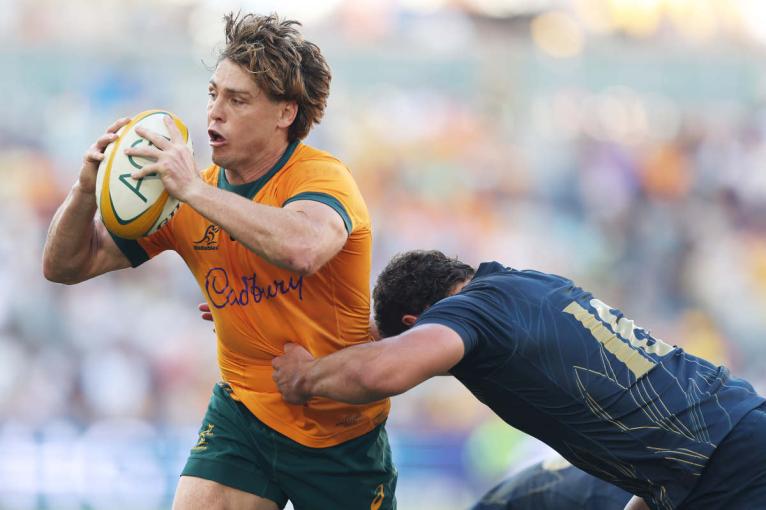
But with Donaldson currently not in the Wallabies squad, and O’Connor’s need to report for duty at Leicester rapidly approaching, those afore-mentioned worrying stocks are looking thinner again.
And this kind of brings me back to Lolesio. His season-ending neck injury aside, it remains a curious recollection of events that his decision to depart for Japan later this year wasn’t met with more resistance. I’ll stand corrected, but I certainly don’t recall too many headlines expressing confidence that Rugby Australia had talked him into staying. It was mooted early on that he was considering overseas options, and he just… did.
Obviously, I don’t know what went on in the background, though I do know the Brumbies very much wanted Lolesio to stay in Canberra.
A winger or a back-rower – both of which seem to grow on trees in Australia – you can understand, but a 30-Test player in an already thinly-stocked position? I’m not sure that’s particularly smart.
But it does make me wonder how hard RA fought to keep him. Lynagh and Donaldson have had injury concerns in the past, Tane Edmed behind them remains unknown and largely untested at international level, and O’Connor was always turning 35 this year.
Hindsight never fails, of course, but it just feels like there wasn’t enough consideration given to the potential loss of personnel, and it’s come back to bite. Right now, Schmidt only has two fit No.10s at his disposal.
A winger or a back-rower – both of which seem to grow on trees in Australia – you can understand, but a 30-Test player in an already thinly-stocked position? I’m not sure that’s particularly smart.


Comments
Join free and tell us what you really think!
Sign up for free