
Australian rugby is on the move, literally and figuratively, as it embraces rugby economics, and ergonomics, which are truly global in character.
A recent RugbyPass article highlighted the increase in the number of Australians now plying their trade in the NPC in New Zealand. After three rounds of action, there were no fewer than 27 Australian Super Rugby squad members playing in New Zealand’s premier inter-provincial competition, up from the previous high of 19 in 2017 and 2024.
🇦🇺 Number of Australian born players in the @HiluxNPC 🇦🇺
2026 – 27 (After 3 rounds)
2025 – 15
2024 – 19
2023 – 13
2022 – 14
2021 – 8
2020 – 10
2019 – 18
2018 – 13
2017 – 19
2016 – 18
2015 – 14 pic.twitter.com/LHeBJ7KkYc— Rugby Database Stats & Info (@nzrugbydatabase) August 17, 2026
Four of those temporary emigrés [Lachlan Hooper, Hudson Creighton, Dan Botha and James Ramm] represent Northland, who recently won their first Ranfurly Shield for 50 years. One of them [Ramm] was a back-three star and starter during his time at Prem champion club Northampton Saints in England, and he is one of 10 players who have been participating in the Hilux NPC within a targeted placement program.
James Ramm represents an important acquisition, for his ability to play any spot in the back three and provide high value at all, and the IP he will bring back from the best attacking side in the UK. As Rugby Australia’s director of high performance, Peter Horne, recently acknowledged: “One of rugby’s great strengths is its global appeal and the platform it provides [for] players to experience different cultures, environments and playing philosophies.
“At the same time, we are pleased with the development of the Super Rugby AUS competition as it enters its second season, and the opportunity it provides for players to test themselves against quality opposition and press for higher honours.”
RA has likewise realised the value of keeping some kind of contractual grip on players who redirect towards established centres of Australian excellence in Europe, such as Rob Baxter’s Exeter. Top centre Len Ikitau signed on the dotted line with the West Countrymen, but only for a nine-month sabbatical. Ikitau is already back home with the Brumbies, while Tom Hooper juxtaposed his one-year contract extension in Devon with a commitment to return to the Queensland Reds in mid-2028.
That means both men remain eligible for Les Kiss’ Wallabies, and the ‘boomerang’ effect for players of national interest is cemented in place. They fly away but they eventually return home. As Reds general manager, high performance Sam Cordingley observed: “While it will be a few years before we see [Tom] in a Reds jersey, he’s another world-class player we can build our squad around. In planning for the future, we’re confident Tom’s decision to join the Reds will be a catalyst for retaining and recruiting players over the next few years.”
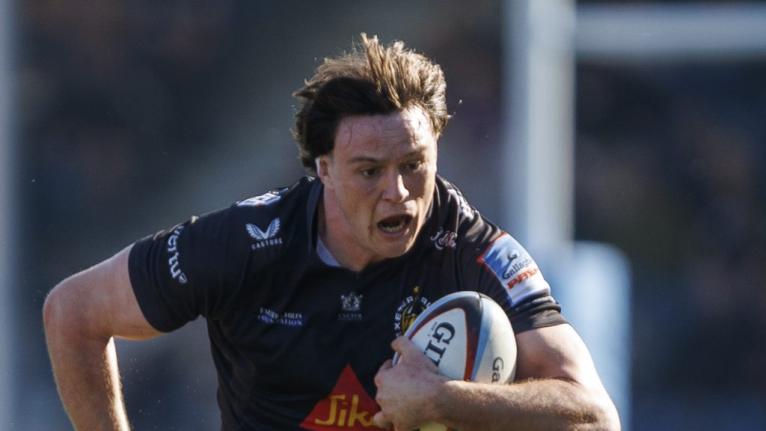
The one word which always accompanies Hooper’s comments on his time in Devon, directly or indirectly, is “growth”. Back in March, he reviewed his reasons for leaving Australia for the UK.
“I’m loving my rugby here,” he said. “I didn’t just come over here for one reason, I came over here because a few of the stars really aligned for me.
“It was that time I’d kind of hit my ceiling in Australia, I needed a new challenge.
“But if I’m over here and I still feel like I’m being challenged as an athlete, and as a person and I’m still growing in those areas, then this is the best place for me.
“So, if I see this environment is indicative of that then I’ll definitely be staying in Devon because that’s what’s best for me.
“When I came over here, I knew full well there was a possibility I wasn’t going to be playing for the Wallabies anymore.
“I had a phone call with [then-Wallaby head coach] Joe Schmidt and he said, ‘I’m going to favour picking guys from home soil, but if you’re the clear standout then I’ll pick you’.
“I just said: ‘Alright, well, it’s a pretty clear objective for me, I’m just going to make sure that I make you pick me’.”
A few months later, after Exeter’s nail-biting 27-26 comeback win over champions Bath in the Prem semi-final, he was repeating the same mantra.
“It’s challenged me to grow, certainly. Not only on the field, [but] off the field as well.
“I realised if I’m going to put my body through 40-plus games a season, including internationals, I’m going to have to change a few habits. I’m going to make sure I really nail down my recovery processes.
“I’ve had to change a lot of things off-field, I’ve really tried to develop into a leadership role and just try and make all the people around me better as well.”
That growth is measurable in statistical terms. By the end of the Prem season, Hooper finished top of the entire league in defensive ruck arrivals with 144, and seventh in effective cleanouts with 336. He won the most turnovers at defensive breakdown at the club [nine] and most important of all, he rolled in second behind England number eight hopeful Greg Fisilau for the number of carries by a forward, with 147. Hooper has added mass, up from 118kg in Australia to 124kg in England, and that has helped him repair the one deficit in his game back home, building a body to sustain a higher number of ball-carries over 80 minutes.
At his new weight he can ‘hybridise’ more effectively as a second row and he has become “more of an athlete… I went over there a little bit on the pudgy side and had to get in the gym and work hard.” Not for nothing was Hooper named in the Prem 2025-26 team of the season; he has become the natural heir to the flinty, ready-for-anything, dig-in-the-dark-places role on the blindside flank – the one previously played by Scott Fardy, Rocky Elsom and Owen Finegan in times past.
In other words, Hooper has turned into precisely the monster the Wallabies needed to complement their dynamic ball-runner at eight [Bobby Valetini], and the athletic high-skill link man at seven [Fraser McReight]. With Hooper at six, you can double up on the power at tight-head lock with either Will Skelton or Lukhan Salakaia-Loto in harness, or you can afford the more the luxury of a more athletic partnership [Jeremy Williams and Josh Canham] which featured in the first Test win over Argentina at San Jujuy last weekend.
The attacking stats of the starting Wallaby back-row against the Pumas were especially impressive all-round.
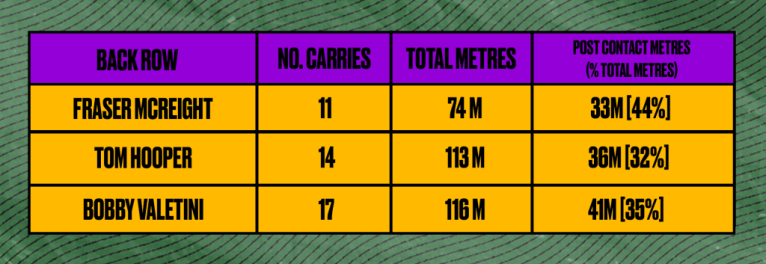
Add in six tackle busts and four pilfers between the trio at defensive breakdowns and it is an admirable combination of high impact and high work rate, the perfect balance. The back five forwards gelled exceptionally well as a unit on attack.
— William Bishop (@RPvids1994) August 31, 2026
Five phases in just over 30 seconds, with Valetini carrying hard into the teeth of the midfield defence on first and third phases, Canham contributing another carry and a silky reverse pass, McReight an all-in-one transfer and Williams two crucial assists – the first for the clean break down the left, the second a scoring offload to hooker Brandon Paenga-Amosa. The scoring phase is made by the interplay between four forwards all on one side of the field, while Hooper is alone on the far sideline.
The Chief was far more involved in a long scoring sequence in the second half.
— William Bishop (@RPvids1994) August 31, 2026
— William Bishop (@RPvids1994) August 31, 2026
Over the 12 phases the sequence lasts, there are seven carries, two meaningful offloads and one try scored by the starting back row trio, and the move is started and finished by Hooper. With the Exeter man’s new-found thirst for the carry allied to an ever-more imposing physique, Australia have found the back-row they need for the World Cup in 2027, and the number six they have craved ever since the halcyon days of Fardy, Elsom and Finegan.
Hooper’s individual improvements in the UK mimic Australian rugby’s willingness to embrace influence from overseas. For the first time in its professional lifespan, Australian rugby is beginning to gain as much as it loses in the gyroscopic procession; from the exchanges and the constant toing and froing across the rugby equator.

NEW IN THE APP: Official World Rugby Rankings hub! Compare team rankings side-by-side, with data going back 20 years.
Download the RugbyPass app on the App Store (iOS) and Google Play (Android) now!


I like Wilson at 8 and the combination in attack he has with McReight. While Hooper, Valetini and McReight are probably the best three individuals in their positions I like a Wilson in there as I think the whole of that 3 is better than the sum of the parts. There is something about Wilson in attack, I just think he sees things that others don’t, he supports really well, he has good offload and passing skills and just a good footy brain, he even kicks well (just as long as he doesn’t overdo it).
I think lock is becoming a really interesting question for AUS.
Frost & Williams have become good options but you then have the ultimate power combo of Skelton & LSL. I don’t think you could play the last two together, so it’s a combination of who to start and who to finish but they look like they have some solid options and should be a great 80 min performance once they decide the final starting/bench combo.
Yes and they have a wide variety of second rows to pick from than ever before. Skelton, Amatosero and LSL fall into roughly the same box as do Canham, Shaw and Frost. Then you have Williams and Hooper who can play 4 or 6.
That’s a lot of quality.
It feels like AUS are on an upward curve under Les Kiss - but the real conundrum is where they actually sit in the new world order at present.
They peaked under Schmidt for the Lions but looked like one game too many from the 2nd ARG game in TRC last year and they were physically shot by The Autumn. They have just beaten a good ARG side, who were on a par with ENG, so suggests they are probably 6th or 7th at the moment behind SA, NZ, FRA, ENG, IRE and then up there with ARG & SCO.
I don’t think we have seen strongest AUS match day 23 yet and there are still some players to return - Skelton, Ikitau, Marky-Mark etc, who all add to the match day 23. We should have a better idea at the end of this year but they do feel like they are making progress and could throw a surprise by the end of the year and are looking on track to be “competitive” by RWC 2027.
Interesting 12 months ahead.
Yes P, this Argy side is short of its European based players so it is still hard to evaluate how much progress Aussie is making…
They will have two key games v Scotland and England in the second phase of the Nations Champ which will give us a much better idea.
Matt Cockbain, Mark Connors, were also great Australian 6/lock hybrids of the professional era.
Yes they were excellent footballing types. The reason I named Elsom, Fardy and Finegan is they had that extra bit of ‘dog’ which Aussies love to see in their sixes. It adds an extra dimension in the forwards.
Agree, Hooper has improved immensely over the last couple of years & good to see him go overseas for more experience.
However, he does have some flaws. He sometimes makes poor decisions & switches off now & then. For example, in the last game when WB's were winding the clock down, he lost control of ball in the breakdown & coughed up position giving the Argies a chance to snatch the game.
He does a lot more good than bad over the 80 mins (he usually plays) but I think he tries even harder as the team starts to tire and that’s where you see the mistakes coming in and fatigue takes its toll on him - he needs to know when to compete and that for me is about bench strategy and getting the best out of him for 60 mins (which you do most games) and having someone else come on for those final 20 mins.
Hooper is ony 25 tho he seems to have been around for longer… So let’s forgive him the odd blunder compare to the huge amount of value he brings!
And Wilson has definitely never done anything like that before. Oh wait…