
Of all the major rugby-playing nations, the professional game has changed more in England than anywhere else since outbreak of Covid-19 in 2020.
HSBC SVNS returns to Cape Town this December!
Don't miss your chance to see the world’s best rugby teams take centre stage 5-6 December in Cape Town.
England lost three Prem clubs because of a shortfall in RFU subsidies during the pandemic. Last year it was revealed club owners were not only plotting radical change, but talking up a post-Covid revolution in the domestic game. The keynotes were conversion of the league into a franchise system, similar to cricket’s Indian Premier League or the NFL in America. That would help centralise commercial operations and distribute revenue equally between the clubs. Financial stakeholders in the game would be buffered from sudden revenue drops with relegation abolished, and promotion would be governed by strict criteria such as the presence of a unique regional footprint, proven financial stability and strong links to the women’s game. An expansion to anywhere between 12 and 14 clubs was envisaged by the start of the 2029-2030 season, with the intriguing possibility two Welsh regions could yet become part of the format.
The radical restructuring of the professional game in England has already been mirrored by a change of culture on the field. The vast majority of teams in the Prem prioritise attack over defence, and that explains the explosion in scoring over the past few seasons, while refereeing has been transformed in the same breath. One of the more extraordinary comparisons in the current season illustrates how the Prem has polarised with Super Rugby at one end of the game, with the URC and Top 14 at the other pole.
The first table shows the clear differences in the basic philosophy of the game between the rival competitions.
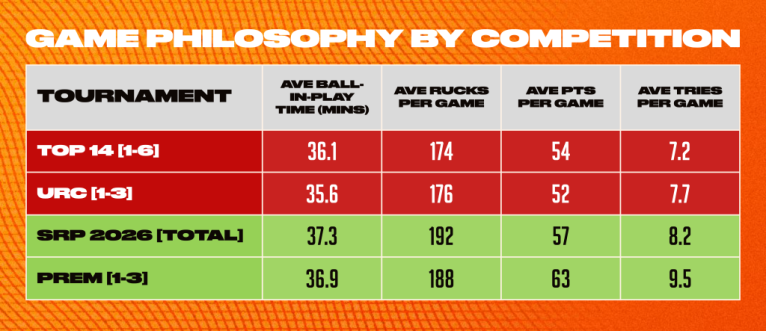
The Top 14, with its historical preference for huge tight forwards and a strong set-piece, tends to pair with the URC, and the presence of its four South African franchises. The Prem and Super Rugby are the two leagues with the highest ball-in-play time, the most rucks built and the highest number of tries and points scored.
Another table showing the refereeing tendencies in some key areas of the game reinforces the same differences.
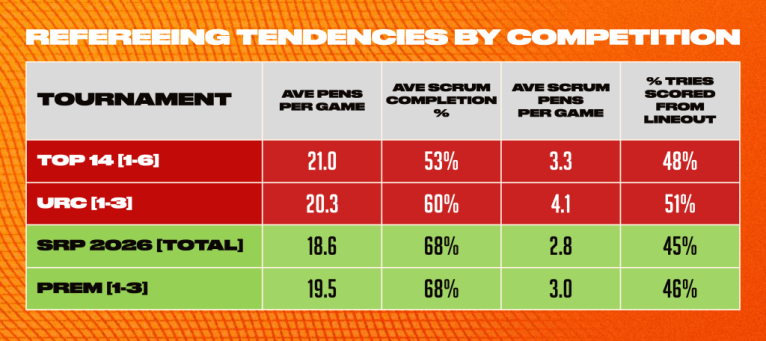
Average penalties awarded in the Prem and Super Rugby Pacific fall under 20 per game, while the set-piece is viewed more as a restart rather than a penalty-winning machine. There is also an early-season hint use of the lineout drive under the new maul laws may be catching on quicker in the URC and France than it is in England.
It is the tendencies underpinning these stats which persuaded England head coach Steve Borthwick to arrange a meeting with Prem directors of rugby in the off-season, with the RFU’s refereeing team also involved in discussions over how the game should be officiated. The England supremo was looking for a game refereed closer to the demands of international rugby, with a particular emphasis on the scrum and implementation of the brake-foot law, more contestability at the breakdown, and stricter policing of offsides.
As the two tables demonstrate, it will be tough for Borthwick to get the game he truly wants from a league fighting for its financial life. The Prem is the most liberal and progressive domestic competition in the world while the URC has probably become the most conservative, and nowhere was the clash of philosophies more pointed than in the two highlight fixtures of the round – between the Stormers and Sharks in Cape Town and the two best clubs in the Prem, Bath and Northampton, at Franklin’s Gardens.
The first match finished 39-22 to the Stormers, with six of the nine tries scored originating directly from close-range lineout mauls, and a seventh from a five-metre scrum pushover. The Gardens meanwhile witnessed a riotous 71-48 score-fest, with only three of the 18 tries starting from a lineout drive.

The officiating and playing philosophies at scrum were diametrically opposed. In Cape Town, eight of the 12 scrums finished with a penalty award, while only three of the dozen set in the East Midlands ended in a similar sanction. The referee in Northampton was none other than Matthew Carley, who had also managed the first Test of the Greatest Rivalry series in Jo’burg. Carley was able to trim the scrum penalty count to half the number he awarded at Ellis Park.
The difficulties of managing the modern scrum were amply reinforced by events in Cape Town. The Stormers fielded three props who have enjoyed Springbok recognition, among whom 144kg Wilco Louw started all four Tests against the All Blacks. The Sharks were able to counter with the selection of Thomas du Toit and Ox Nche, with evergreen Vincent Koch coming off the pine.
Despite starting two acknowledged strongmen of the Springbok front row in ‘the Ox’ and ‘the Tank’, the Sharks were already losing the penalty count 3-1 when that indomitable pair endured the ultimate indignity of giving up a pushover try in the 47th minute. Despite producing a convincing snapshot of ‘dominance’ in the 19th minute, the Tank found himself on the wrong end of the referee’s whistle at two of the visitors’ feeds for alleged collapses.
https://t.co/adiUA1nVfi
— William Bishop (@RPvids1994) October 12, 2026
https://t.co/ZUwisajJZu
— William Bishop (@RPvids1994) October 12, 2026
That second scrum would be considered a textbook exhibition of tight-head scrumming technique. Du Toit is comfortable, and when his opponent Ntuthuko Mchunu tries to exert some pressure from a poor biomechanical position, he gently takes him to turf with the Stormer’s elbow clearly hitting the deck first. The mixture of dismay and anger on the Tank’s face was plain for all to see.
Worse was to come. In the 47th minute Du Toit was made to look like a novice by the step-and-drive manoeuvre all South African teams have now perfected.
https://t.co/KecvSyPp3A
— William Bishop (@RPvids1994) October 12, 2026
Mchunu may be no slouch at scrum time, but it is the first step left by the loosehead and the lock behind him, supported by Louw’s inward angle on the far side of the front row which leaves Du Toit looking clueless and Mchunu like a world-beater. Ask yourself the key question: how can the two best scrummaging props in the current World Cup cycle be so easily dismantled? Or is it an illusion created by the collective scrummaging technique on the other side of the feed? To rephrase Austin Healey, “sometimes they go down, sometimes they go around, the ref has a guess. Penalty – or penalty try.”
The scrums in the game at Franklin’s Gardens were notable for their relative lack of movement – up, down or side to side. They tended to stay where they were set, and they became a more than useful platform for the revival of 8-9 moves off the back of the set-piece.
https://t.co/Tk6P9dcCsf
— William Bishop (@RPvids1994) October 12, 2026
https://t.co/ddcmYCdjM5
— William Bishop (@RPvids1994) October 12, 2026
In the first clip, Henry Pollock plucks the ball off the base and Saints second row Alex Coles makes a bust two phases later. In the second Alex Mitchell exploits an overread by his opposite number to score a spectacular chip-and-chase try.
The primary investors and stakeholders in the English club game are stirring into life – a new, revolutionary life. They are following their own rules to make rugby a better game and a better business proposition – and they have become the unlikely allies of Super Rugby Pacific in the process.
The game is being grown on both sides of the equator, and its pathway to progress is very different in tenor and shape to that envisaged in the URC in particular. Borthwick may not like it too much, but the new Prem is here to stay.

NEW IN THE APP: Official World Rugby Rankings hub! Compare team rankings side-by-side, with data going back 20 years.
Download the RugbyPass app on the App Store (iOS) and Google Play (Android) now!


this article makes it seem as all the prem commentators think, that the prem is the best league in the world when in reality all but one team from England won over the weekend in the Champions Cup! All the prem has is shoddy defence!
Penalties, as their name indicates, are punitive in nature. They are awarded AGAINST an offending team. They are not reward based.
In other words, teams are not rewarded for dominant scrums, teams are penalised for illegal actions when they attempt to avoid being dominated.
This is a very important distinction.
You said, “They are not a team who is going to overwhlem you up front”
I merely pointed out some examples that they do in fact pursue forward dominance. I did not attribute their succes to it.
Similar question on the wings.
Borthers options have been Freeman & Feyi Waboso (best wingers) with Daly providing cover.
Caluori, Arundell & Hendy are the next cabs down but given our issues at fullback, should Hendy not be played to provide cover.
This is where I struggle with Borthwrs options. Murley and M Smith are not the right options.
I think that’s fair but Kepu is on an upward curve, it just depends how far he improves over this season (and he needs to avoid injury which is key).