
When the All Blacks left the field after 40 minutes at Twickenham 12-11 ahead, there would have been plenty among the 82,000 there who were of the view that the visitors were well placed to take control of the game after the break.
This is the way things have played out for as long as anyone can remember. In these frantic, high-energy November Tests, New Zealand punch, absorb and dance about, ducking and diving, but they usually always find a way to pull off a few killer plays and come away victorious.
They have long been the masters of finding a way to win in hostile Northern environments, as evidenced by the fact they only lost three November Tests between 2004 and 2020.
But what’s clear to those who have scrutinised the All Blacks in the last five years is that they have lost, or are certainly losing, that fabled ability of theirs to squeeze teams in the second half by using their inherent rugby smarts to come up with the right play at the right time.
That’s borne out in the overall numbers which show that since 2021, New Zealand have played 14 November Tests and lost four, drawn one. A win ratio of 93 per cent over 16 years has dropped to 68 per cent in the last four.
There is a much more pertinent and specific sub-set of numbers produced in the last two years, however, that provide a deeper insight into why the All Blacks have developed a previously unimaginable vulnerability.
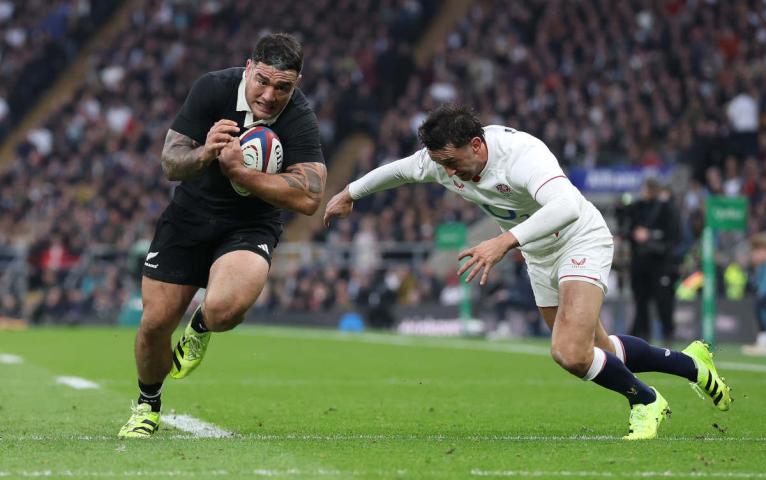
They have become prone to suffering from extreme mental paralysis in the 20 minutes after half-time and losing their way entirely in the third quarter.
It’s a real thing and a real problem because so many times in the last two years they have effectively lost Tests in that period by conceding points, momentum and every conceivable psychological advantage.
Twickenham was yet another example of the All Blacks hitting this mental black spot between minutes 40 and 60.
The numbers tell a damning story that the third quarter has been a black-spot for the All Blacks this year, and the stage of almost every Test at which they have lost their way.
The meltdown started with a yellow card to Codie Taylor when he was deemed to have cynically played the ball on the ground, and from there New Zealand lost their attacking shape. Their strategic blueprint was virtually thrown away and their error count climbed.
A 12-11 lead became a 25-12 deficit by the end of that quarter, after first Sam Underhill and then Fraser Dingwall scored tries, in a period in which England enjoyed so much territory and possession that they built the confidence and near certainty that they were going to win.
The numbers tell a damning story that the third quarter has been a black-spot for the All Blacks this year, and the stage of almost every Test at which they have lost their way.
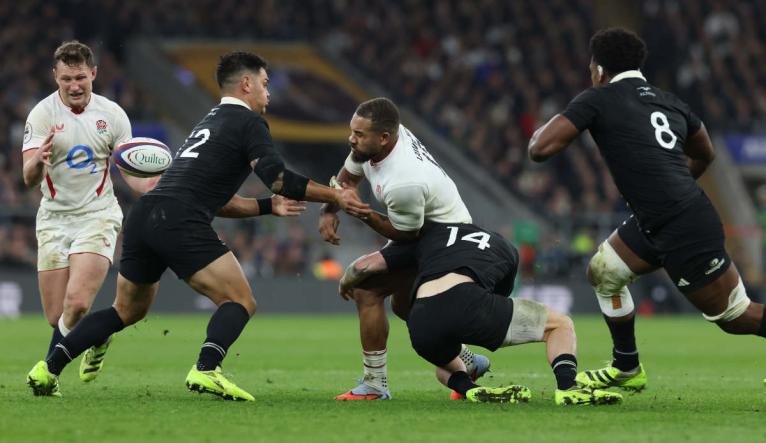
New Zealand lost the slight edge they have been building in the scrums, they opted to tap penalties, their game management was ragged and their defence lost its line-speed.
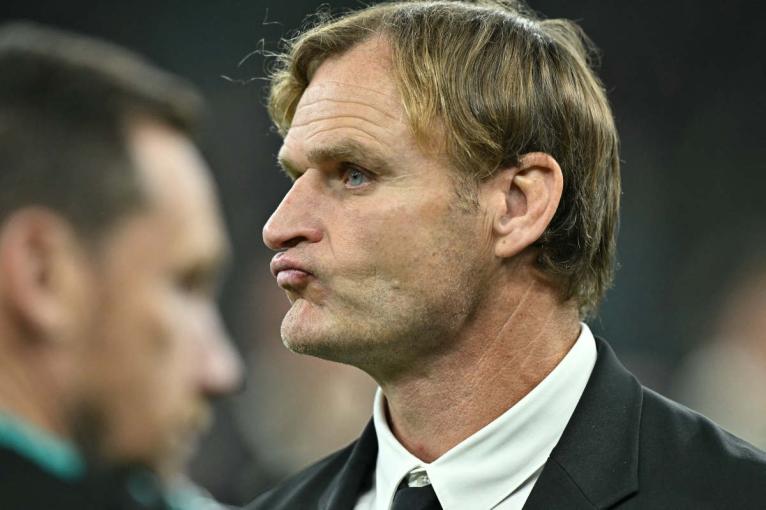
“Your gameplan should be one that adjusts,” says assistant coach Scott Hansen. “We must have a gameplan that allows them to adjust and see what is in front and play the obvious. We talked about composure at half-time, starting well. The first set was about a lack of self-control and a hand in a ruck, going somewhere we didn’t need to.
“Where was our adjustment? You saw us not going for a lineout because we felt in that moment we didn’t need to bring a hooker on, but what was our adjustment there because we ended up kicking anyway.
“The key thing for us is when we are in control, what does it look like and how do you get it back because they got a bit of momentum and we weren’t able to stay in front.”
The All Blacks were able to mount a mini comeback that created a try for Will Jordan, but the damage was too much to repair.
There was a lot of effort in there but not the execution that was required. That hurts.
The frustrating aspect for New Zealanders about the way things played out is that it was nearly a carbon copy of what happened the previous week at Murrayfield.
New Zealand had a 17-0 lead at the break against Scotland, only for the scores to be tied at 17-all 20 minutes later. The build-up to the game at Twickenham was dominated by analysts predicting that if the All Blacks suffered a similar mental void in London, England would be good enough to punish them in the harshest possible way.
And so it proved, with England’s 14 points worsening the All Blacks’ points differential in the third quarter to minus-64 in 2025.
They have scored 28 points in total between minutes 41 to 60 but conceded 92 – figures that make it apparent how vulnerable the All Blacks have become once the game restarts after half-time.
Only twice this year – against France in Hamilton and Australia at Eden Park – have they scored more points in those 20 minutes than they have conceded.
In Edinburgh they conceded 17, scored zero; against South Africa in Wellington they conceded 10, scored zero; and in their two Tests against Argentina, they conceded seven and scored none in the first Test (which they won), and conceded 10, scored zero in the second (which they lost).
Against England it was scored zero, conceded 14, and these numbers look precisely like the rogue trend they are when they are given a comparative value. The All Blacks’ points differential is positive in the other three quarters – plus 32 in the first, plus 60 in the second and plus 27 in the fourth.
“It’s the consistency in games and the ability to manage the game,” head coach Robertson said when he was asked after the 33-19 loss to England what was behind yet another insipid third quarter by New Zealand.
The All Blacks have identified they have a problem, but they can’t seem to find a workable solution.
“We played some good rugby but we probably didn’t manage the game with our kicking enough. We had a great first half, they came out and put pressure on us, and we couldn’t turn that around and put it back on them. There was a lot of effort in there but not the execution that was required. That hurts.”
What deepens the concern is that these numbers in 2025 are a continuation of what happened last year – where the All Blacks’ points differential was plus 49 in the first quarter, plus 89 in the second, plus 27 in the fourth, and minus four in the third.
They have tacitly acknowledged the issue on their Northern tour as they have exited the changing rooms a couple of minutes early after half-time, where tackle bags have been set up and the players go through a few high-energy contact drills.
But it hasn’t helped much, because the problem continues. Pressed to give an answer to what he thinks is causing the issue, Robertson says it’s typically been a case of one early error compounding into a whole series.
In Edinburgh, Peter Lakai dropped the second-half kick-off and from there, the All Blacks committed several basic execution errors and lost their discipline. Both Ardie Savea and Wallace Sititi were yellow-carded.
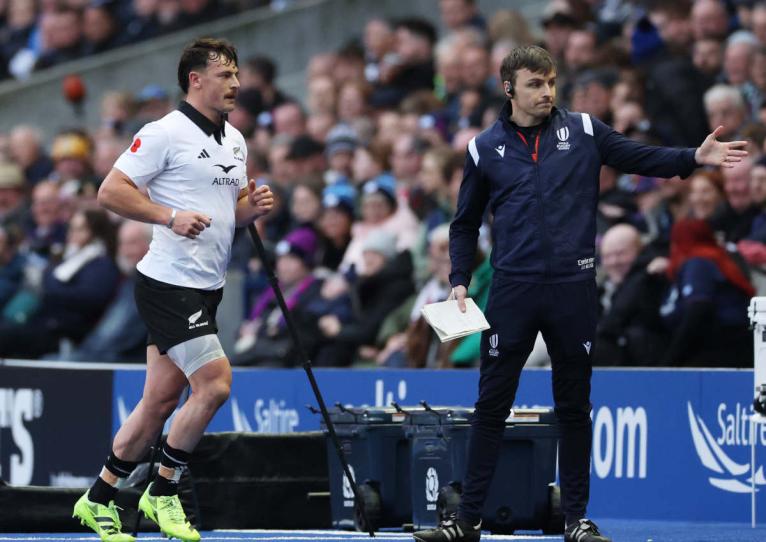
In London, it was Taylor’s yellow card that was the catalyst for the meltdown, with Robertson suggesting it was poor game management rather than individual errors that most hurt the All Blacks against England.
He didn’t think that the playmakers struck the right balance between pass, run and kick, and were guilty of over-playing in the wrong areas of the field.
“The game is faster and there’s more ball-in-play so there’s more fatigue,” he said. “When you get on top of teams, hold the ball and go forward, you get some good outcomes.
“Games can swing really quickly. It can be a case of making an error, conceding a penalty, or two or three at the same time. And we know how much pressure a yellow card can bring. Defending for long periods of time, and not giving a penalty away, is tough.”
The All Blacks have identified they have a problem, but they can’t seem to find a workable solution.


The workable solution is simple, rotation, better player selection, stopping the death of our dynamic players by making them all go to the gym instead of dunes over the summer etc etc.
England went with 6 7s and what no one seems to be talking about (other than Razor in these qoutes) is that England ran NZ off the ground producing twice as much quick ball as they normally would, but most important, also allowing NZ to have half again the amount of quick ball they would expect to have (and have developed strategies around). The wanted NZ to tire themselves out, and they dangled it infront of them like candy.
There has never been a game like it, both sides produced a walloping %90 quick ball each. England abandoned their long held inclination to dither with the ball and blitzed New Zealand as a result.
Like your analysis JW. My only additional thought is that we lacked a genuine general who could control the pace and shape of the game. In fairness too, as I note above, the ABs lost three of their key playmakers at about the same time and just when England were truly firing up. That had a major impact on shape.
Its clear Razor needs a rethink about how he sets his teams up after half time and how they respond with their bench. The All Blacks are just way too reactive. While other coaches get a tune out of their players at half time Razor cant seem to find a way to get his team up for the second half.
Actually I just read another article where this sort of outlook was exactly what a former aussie test player was describing.
I don’t know that the context was around those comments, but this was my attitude at halftime as well.
I must have still been waking up. Because by the end of the game, and after reading a few reviews (but probably after I had of tweeted a bunch if I did that sort of thing) etc, I feel it was fairly apparent that what caused some of those errors in the first half, were actually critical to the second. Injuries to BB and Roigard followed in the second half of course, and the ill discipline.
Is this going full circle now I wonder? Are people ignoring those factors because previous All Blacks teams would overcome them? Is that what Drew was talking about?
Look hate to be the odd one out (having picked that a Wellington type hit was coming) but there is a bit of hysteria here. First as predicted Englands intensity overwhelmed a poorly selected AB team that for what ever reason refuses to go 6-2 even though they have moved to a power game. But second, this game is markedly different from the others. In this game the ABs lost three of their key “spine” playmakers - Taylor, Barrett and Roigard. Whatever our view of them individually losing all three was a disaster. A team cannot function with this type of brain loss. And it showed especially as neither McKennzie nor Ratima has had enough time to slot in and play those roles. Third the stats show a broadly even game except in penalties conceded and line breaks - but query when they occurred - was it when our spine was off the field?
Please see my post below with the key stats, NZ probably had the better of the attack stats but look at the difference in tackles and how much harder ENG worked in defence. That’s probably the difference between the teams and the scoreboard difference is really the 2x drop goals and the Codie Taylor yellow card period.
ABs still in a good place regarding forwards, rotation of players to and from bench to keep it fresh, Tupou V Holland Paddy Barrett and now Lord to an extent ( he has been great ) of those top 4 who cares who starts who finishes
Same for props really with maybe 3rd LH still up for grabs but all the others who cares ?
Loosies are much the same but reckon add Dalton to the mix who cares who starts finishes?
Cody clearly number 1 but if Aumua can find same form he was showing should get some starts as Samisoni should have already more
Keeping your bench stacked in the pack goes a long way to keeping momentum and wrestling it back
The backs are more difficult Razor&co dug themselves into corner with squad moreso than forwards so finding that team looks more challenging with big questions right across backline and a back up to Roigard is of the highest priority followed by the 10 question but with I believe better squad selections our midfield and outside back options can be far more effective and dangerous easy and again we can then make sure with rotation our bench can always be stacked too
Whilst I was delighted by our rare victory over the AB’s, I thought ENG were the better team watching the game live (especially in the 2nd half), so the stats took me by a bit of a surprise when I looked on Sunday.
ENG (1st) vs NZ (2nd) stats from the weekend;
Possession 45% vs 55%
Territory 47% vs 53%
Carries 103 vs 130 NZ
Passes 113 vs 170
Defs Beaten 17 vs 24
Rucks 76 vs 111
Then the big number, which changed everything;
Tackles 191 (ENG) vs 120 (NZ) which also ties in with the ruck numbers.
Whilst the drop goals and the try scored with Codie Taylor in the bin were probably the main difference on the scoreboard, this actually made me realise this game was won by the ENG defence, which constrained a busier and more active attacking side from scoring points.
This pretty much confirms what most AB fans have been saying, the AB’s appear to have lost all the attacking structure and intent since Razor took over and by playing the Razor 5|3 bench strategy, the stats are telling you they need 6|2 and likely a change of attack coach is also required.
I then looked at the same game last Autumn and those stats were even more telling. Over 200 passes last year, with much better attack stats, confirmed how the attack has gone backwards during 2025 and confirms the gut feel intuition of the AB fans.
Whilst I will universally accept the AB’s beat us 3-0 last year and were by far the better team, what this weekends result (and stats) tell you is that other teams are progressing at a quicker rate than Razor and he needs to think about things differently if he wants to overturn these results.
Interesting decisions ahead.
You really need more data to be able to develop any sort of robust idea from stats PMcD.
Those stats are no different to the game last year or that great game against Aussie.
The ones that I’d suggest are worth highlighting are offloads being in favour of England 7 to 3 this year, as opposed to favouring New Zealand 14 to 4 last year, and linebreaks going from 8 to 5 for NZ, to 9-6 for England.
These are stats that England did not win against Fiji, and were areas England struggled in heavily during the 6N. One area it would appear they have achieved this is kicking less. Something happened in this game, maybe it was the introduction of Marcus Smith? But England were on the same path until about 30 min into the test and they stopped kicking. The still kicked more than NZ (a factor Razor says England were on the right side of) but far less than the 6N games.
I will say though, after looking at Englands 6N stats, your defence was pretty bad. I had kinda expected it to be as good as it was in 2024. So I can see where you’re coming from now. The other tactical highlight was the speed at which Steve Borthwick had the side playing. New Zealand weathered the storm and prospered early when there was as stoppage, than plan that worked was giving New Zealand %90 of their possession as lightening quick ball, it helped accentuate their 3rd quarter blues. The mobility he played with/selected and their own speed was also no doubt key in putting NZ under pressure, matching really what SA delivered in Wellington.
Overall giving the problems NZ are having at the moment, the improving in your props and the absence of quite a few key All Blacks (I think they told Razor like a dozen changes from last year, though a couple would have been Jordan and Roigard), the bounce of the ball and luck with the referee, all in all not a bad result.
The one thing I didn’t like was that they couldn’t get their backline structure working, no tried going direct, to draw the scores up at the end there.
I said it somewhere else. If a player is not top fit the rest period is a death knell. The body goes into recovery mode and it takes some time for the body and brain to understand that it’s in active mode again. Athletic coaches talk about the primary and secondary energy tanks. The secondary tank is the reserve which fit athletes have and which comes into play in the “second wind”. The fitter you are the quicker the secondary energy tank kicks in till it’s almost seamless as in top middle distance runners. (Even they have a very slight drop in energy at about the half of say a mile then they basically pick up again.) Trained athletes force their minds to overcome the drop (I used to sing to myself at a familiar tempo to keep from dropping my momentum after two laps). “If you can force your heart and nerve and sinue to serve the turn long after they are gone and so hold on when there is nothing in you except the will which says to then hold on.”
Agree with everything you said except that. If England had won one or even all three of those games, no one who watched the game would’ve been surprised. They were very close.
Last year it was the last 20 minutes that were an issue. The fact remains they do not have an identity and after 26 tests in charge for Scott Robertson, this is incredible. Throughout his tenure, brilliant individuals pieces of play have ensured he has a better record than perhaps what his coaching has deserved. Whether it’s Beauden Barrett at Eden Park last year. Mark Tele’a at Twickenham last year. Damian McKenzie at Murrayfield.
When things get tough, it looks as if the players are not confident of exactly what they should do or what they are being asked to do and this only comes from a lack of clarity. Top teams do not wait once they feel they feel vulnerability in their opposition, hence why they are prone to getting batter in the latter stages of the game.
In fairness SB, this is basically what NB said in his article the other day.
Whilst the AB’s have been poor in Q4 points difference since 2024, with a specific example of TRC 24 being -43, TRC 25 being -17, they have swapped the Q4 slump for Q3 (as they have got bigger), so the same H2 points difference went from TRC 24 -27 to TRC 25 being -38, so they are now losing Q3 & Q4 (hardly what you would call progress)
The more you put this under a microscope, the more you have to question if the AB’s getting physically bigger is helping (data suggests not), if it’s the S&C Q3 or if it’s the bench Q4, or a combination of both.
What I actually found interesting from these comments is the admission from the coaches the players are making decisions with no guidance from the coaching team.
Whilst the players will usually have a discussion, if there is hesitation, they usually look at the bench/coaches and there are some form of instructions offered. For the AB’s to admit the players didn’t know what decisions to make and for the coaches to not have already prepared a player, or sent instructions for what to do feels a bit poor.
For what it’s worth, this suggests you have a coaching team who are not engaged enough, players that seem confused on the pitch (the tap penalty is the best example I have seen of this) and a coaching team that struggle with taking ownership and admitting they got it wrong.
I have never know a successful sports franchise to succeed when these things are evident and until the coaches start taking responsibility, it’s hard to see how this will improve.
Kieran Read said there was no leadership vs SA. Maybe he didn’t mean the players. What’s clear is something is badly wrong with this AB coaching set up and the alarm bells are ringing ever louder by the day.