
A fisherman always spots another fisherman from afar. Giants in any field of human endeavour usually share the same competitive instincts and goals, but they rarely occupy the same space. There may be an unspoken recognition of the same traits and ambitions, an imperceptible tip of the hat from one bank to the other, but the river moves on swiftly and the focus returns, inevitably, to the float bobbing on the water. The next catch.
The two biggest pescadores of either era in rugby, amateur or professional, have been locked in silent combat for 105 years, with the just the occasional silent nod to the accomplishments of the other punctuating the torrential surge of the greatest rivalry. There have been seven prize World Cup catches between the two, with the last tussle between the twin titans decided by one single point in Paris.
The constant jostling for position explodes when the two are pulled together in the same room. After the second Test in Cape Town, which the Springboks won by 33-26 to level up the series at one match apiece, the topic of conversation between Dave Rennie and Rassie Erasmus turned to the vexed question of scrum perception.
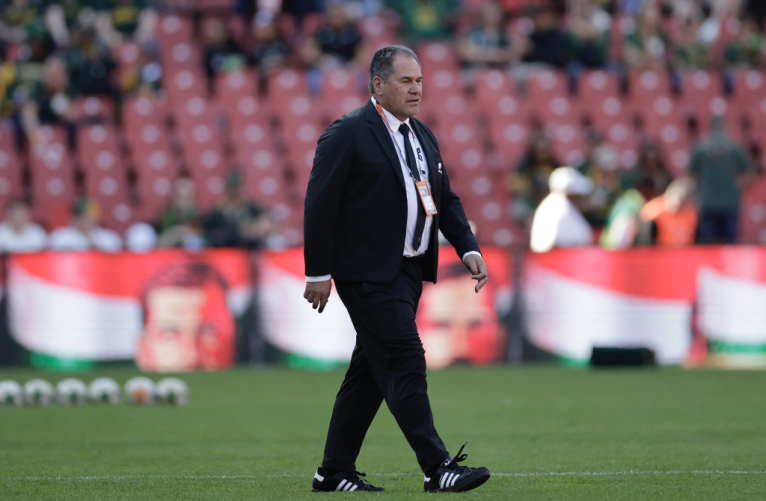
The man christened ‘Dingo Dave’ during his time with the Wallabies began by picking at the sore spot of the set-piece at the post-match press conference.
“The scrums were better tonight,” Rennie said. “I think [referee] Angus [Gardner] was pretty strong around setting a mark and trying to keep the hookers in the same spacing.
“If the Springboks moved across further left, then he stopped them. We’ll give them a bit of feedback around that.
“It’s still a bit of an issue for us because they’re able to walk around and go straight through our tight-head. So, there’ll be a couple of little technical things that we’ll share again.
“But I thought in the end, both teams were able to play off the scrums so I think Angus did a reasonable job there.”
It was not the first time such observations have been made on tour, and Rennie must have known he was invading the Springboks’ primary ‘honey hole’ at the scrum. He duly received a reprimand from Erasmus.
“It’s the first time in history people are talking about us walking around. Why would we all of a sudden walk around?
“Don’t come with that nonsense, and say we’re walking around and try and put those things out in the media.
“If the referees get caught up by that, then it obviously was a plan to get that message out, and we don’t want to stay quiet and just say ‘oh yeah, you’re right, we’re walking around’. We’re not f***ing walking around. We’re scrumming through.”
The scrum had obviously been targeted, and Gardner paid particularly forensic attention to the placement of the hooker’s ‘brake foot’ in the course of it. A climax of tedium arrived in the 45th minute, when a Springbok scrum was reset on no fewer than four occasions. “No more games with the feet!” exclaimed the Aussie official before awarding the All Blacks a free-kick after two whole minutes of dead time. Even the scrum aficionados in the Cape Town crowd were bored silly by the end, and the only surprise was they did not break into an impromptu chorus of ‘Sweet Caroline’ to entertain themselves.
A cruel and unusual balance has been established between the two greatest rivals halfway through the series. The Springboks have confirmed their superiority at the set-piece and in the aerial battle.

The Springbok lineout enjoys a clear 15% advantage in own-throw efficiency, and Eben Etzebeth won two crucial steals deep in the South African red zone with the All Blacks hot on attack.
South Africa has been able to rely on the maul as a weapon in attack where New Zealand have not. The Boks improved their red zone conversion rate from 0.9 points per entry in Joburg to 4.8 points per entry in Cape Town, and they have more attacking strings to their bow when play enters the opposition 22.
Big Ethan Hooker augmented a small but clear superiority in the contestable kicking game, with the hosts picking up 58% of the ball up for grabs in the air.
The South African scrum has been superior when the battle is Ox Nche, Malcolm Marx and Wilco Louw versus Ethan de Groot or George Bower, Codie Taylor and Tyrel Lomax, but the complexion at set-piece turns on a dime when the benches empty from 50 minutes onwards. The two All Black front rows in the last half hour have been very steady, edging the penalty count 1-0 and winning a stream of usable ball in that period. Hard as they hammered, even the heavy brigade of Nche, Marx and Louw made no dent in Asafo Aumua and friends at the DHL Stadium.
As long South Africa can keep the ball close to the set-pieces of scrum, lineout, maul and contestable kicks, they are in control and win the bulk of penalties awarded. A wholly different set of stats illustrate the areas of New Zealand superiority.

The All Blacks have won the line-breaking and try-scoring battle in both games so far, scoring nine tries to four and converting 50% of their opportunities from line-breaks compared to 33% by South Africa.
New Zealand do not have to wait to enter the opposing 22 in order to seize the attacking moment, having converted almost half of their tries from situations outside the opposing 22. Despite some sporadic stirrings and signs of life in Cape Town, a regrip of ‘the Cake Tin template’ is still proving problematic for Erasmus’ charges.
The All Blacks enjoy a clear superiority in the last 20-30 minutes as the benches empty. ‘The Bomb Squad’ has been defused thus far and the late swapping of front rows in Cape Town did not improve the situation. The Bokke have also conceded three yellow cards in the final quarter.
The Springbok tackle completion rate has fallen by 6% from their Nations Championship performance level. The critical contest between Kiwi post-break efficiency and Bok scramble defence in the second and third tier of defence may well decide the fate of the series as a whole.
The fundamental clash between a fluid offloading, defender-duping All Black attack and a bruising, blitzing Springbok defence represents the Gordian knot of the series. Ever since the first whistle, the shadow of current Leinster head coach Jacques Nienaber’s defensive style has bestrode the stage like Banquo’s ghost. The Springboks have jumped back in time to Nienaber’s full metal jacket blitz, and abandoned Munsterman Jerry Flannery’s more selective, watchful structure in the process.
Nothing describes the exquisite equilibrium of the series better than the contest between New Zealand’s new ‘Irish’ attack and South Africa’s ‘Leinster’ styled defence! In Cape Town, the All Blacks tended to convert heavily in phases one-four, while the balance tilted towards South African turnover after phase number five.
Two early sequences established the Kiwi threat to the Bokke scramble defence after the initial rush had been broken.
— William Bishop (@RPvids1994) August 30, 2026
— William Bishop (@RPvids1994) August 30, 2026
The first idea is to pull South Africa number 13 Jesse Kriel upfield on the blitz, and the pass from Jordie Barrett beats the man in both cases. But that is only half of the story. The other half is the All Blacks’ ability to beat the scramble after Kriel has been hooked.
In the first clip Damian McKenzie is able to check back inside into huge gap developing between two loose forwards [Pieter-Steph du Toit and Siya Kolisi] and the tight five inside them; in the second Will Jordan outpaces Kriel and his centre partner Damian de Allende in cover down the right.
The pièce de résistance occurred 15 minutes from the final whistle.
— William Bishop (@RPvids1994) August 30, 2026
It is the short pass in midfield to lock Fabian Holland which drags Kriel towards the ball and leaves him a couple of steps short of lassoing Chiefs wing Leroy Carter down the left sideline.
Th attack-defence balance shifted when the All Blacks passed beyond the five-phase attacking threshold, with the odds shifting in favour of the home defence.
— William Bishop (@RPvids1994) August 30, 2026
— William Bishop (@RPvids1994) August 30, 2026
Although Kriel is beaten by Barrett’s bridge-pass in the first clip, he swiftly gets back on terms, and as the phases mount. the Springboks get ever closer to turnover on the deck. In the second example, Barrett’s pass again bests the Kriel blitz, but scramble help is at hand in the shape of André Esterhuizen, Erasmus’ hybrid back-row/centre who is one of the best jackals in the game. Esterhuizen duly wins the turnover and South Africa win all the marbles.
Let the fisherman who invades another man’s lunker hole beware. Rassie has his signs posted all around the media: ‘the scrum is ours, the lineout is ours, the maul is ours. This is our house’. But as they always tend to do on their tours of the Republic, the All Blacks are asking all the questions that matter. ‘Can you go try for try with us? Can you beat us in the transitions of play, or in the final quarter of the game?’ The contest is achingly close halfway through the series, and New Zealand are in with a shot. The contemporary ‘Cod-father’ of international rugby is under pressure, and he has two games to close the reel deal!

NEW IN THE APP: Official World Rugby Rankings hub! Compare team rankings side-by-side, with data going back 20 years.
Download the RugbyPass app on the App Store (iOS) and Google Play (Android) now!


So after all Nick Bishop crap rugby is all about the set piece. Go Bokke!
Bok power won today - the scrum set piece just too good. But the attacking potency is huge. Need huge work on the front row but I am optimistic.
It’s only going to get better over the next 12 months.
They will add to the playing squad, experiment with the bench and I think they will be even stronger by RWC 2027, so there are a lot of reasons to be optimistic for AB fans - they are certainly heading with the right “trajectory” again.
Todays game could easily go either way. A really big risk to go with more speed and mobility at the expense of power. But either way he has definitely charted a new course based around NZs core DNA and this tour has confirmed the ABs have genuine depth and breadth in its player base.
Thanks👍
It’s just such a waste of time G. 20 posts later you are still in the same place, however much evidence you add!
True - I and well done Lone Ranger 😊 I really don’t care for the thought process of some posters here and I have blocked many - both Kiwis and South Africans and the occasional Irishman. Just can’t waste time scrolling past them.
Simple and accurate Nick. Great explanation.
Whilst everyone knew “Father time” would eventually catch up with Codie Taylor at some point, there was hardly any debate about his inclusion in the matchday 23’s and it was mostly about who should sit on the pine between Aumua or Taukei'aho . . . But over the last two tests Aumua has proven his value and has gone from an either, or bench role to potential starter.
I think the starting front row is potentially emerging as De Groot, Aumua, Lomax and you potentially have the bench front row from Bower, Talyor, Newell and both Taukei'aho & Williams to push their way into the reckoning when they get game time (it will come).
From an area of perceived weakness last season, the future is becoming a lot clearer for the AB’s.
I also think Taylor, Williams, (Brodie or Tuipulotu) & Sititi start to bring quite a bit of experience off the pine, which also has some value during RWC campaigns.
The picture has started to look much clearer for the AB’s over the last 5 tests and there is a lot of light emerging at the other end of the tunnel.
Great read. Do you start Numia and Amua?
Kriel seems a yard slow, lots of effortful chasing and diving on the grass. Harsh maybe.
I think you keep that Numia-Aumua-Newll trio together, whether to start [prob] or finish [poss].
Other one could be EDG-Samisoni-Lomax.
Kriel wasn’t slow last Autumn but the entire team are playing a bit below where they all were last Autumn, so is hard to tell if its just rust, or time catching up with them.
I did think Moodie added a bit more speed to close down the 13 channel last TRC, his tackling isn’t as strong as Kriel but it was harder to move the ball to the outside edges than we have seen with him at 13 last season.
If I am honest, I am surprised Rassie is playing about with his front row - you had the best starters and bench and mixing them all up hasn’t really helped, I am surprised he hasn’t gone back to what they know works really well and played Ox, Marx, Du Toit, with Steenkamp, (possibly Wessells) and Louw coming off the bench - it still feels their best 80 min option. . . . . But there is always a reason with Rassie, so it’s just taking a bit of time to understand what he’s thinking.
Ah Portuguese! Love it in our Algarve village, our ‘second home’.
Found a good point of comparison for the scrums here…
"https://x.com/RPvids1994/status/1992505389108346972?ref_src=twsrc%5Etfw"
This the first scrum of the Ireland game last November which I described thus in my article on the game:
You can see from this description that not much has changed in the space of about 10 months!
Against Ireland, the Boks are clearly scrumming from right to left as DR has said, but they are also ‘scrumming through’ because their THP is moving forwards. So it’s a legit pen to SA.
If you compare that to the the first Test scrum, it is Aumua’s power in the middle which makes all the difference. Because Aumua can resist Wilco Louw in the gap, Louw starts crabbing sideways and SA have to swing the scrum around the side rather than driving it forwards. So it’s a legit pen to NZ.
That is why NZ have not conceded one pen at the scrum while Aumua has been on the field in this series. Simple.
I have never laargered in my life - of Portuguese and Scottish (Catholic Scot) extract (eleven generations in Africa though). Always danced on Sundays 😆
See the world through a very different lens to those with a heavy Calvinistic and paternalistic background.
Hopefully I have a world view that is very similar to yours 😊
I wonder if they try and get Scott Sio from Cardiff on loan as a gap fill but I agree, we are suddenly looking a bit underpowered and there aren’t that many alternative options that come to mind.
I fully agree!
I don’t think these comments have been a good image for the game but appears to becoming more and more part of the landscape that we are seeing more frequently.
Given the focus and profile of these games, I don’t think the game is doing itself any favours to win new fans with some of this stuff dominating the coverage. It’s not exactly a PR masterclass to win new fans to the game.
I think Rassie would make sure you were surrounded before he made his move.
Isn’t that how you learned to laager the wagons in the first place?😉