
In the heat of the moment, Sky Sports commentator Tony Johnson called it “the best individual performance in 30 years of Super Rugby”. One final turnover on his own goalline in the dying embers of the game, to add to three others before it, had just enabled Ardie Savea to bring home the bacon for Moana Pasifika against the Blues last weekend, a scoreline of 27-21.
Though Savea endured a far less influential outing in Moana’s 85-7 thrashing by the Chiefs a week later, his performance against Vern Cotter’s men was monumental. The media debate it ignited afterwards was, in its own way, every bit as significant. The topic under discussion was where does Savea belong in the All Blacks. Should he move to seven in the New Zealand national team, or stay at eight? In the red corner, ex-All Blacks scrum-half turned pundit Justin Marshall on SportNation radio:
“I don’t want to be a smart-ass, but I can’t help myself. I’ve been saying for three years now that Ardie Savea is an open-side flanker. Nobody seemed to want to listen. Particularly All Blacks coaches.
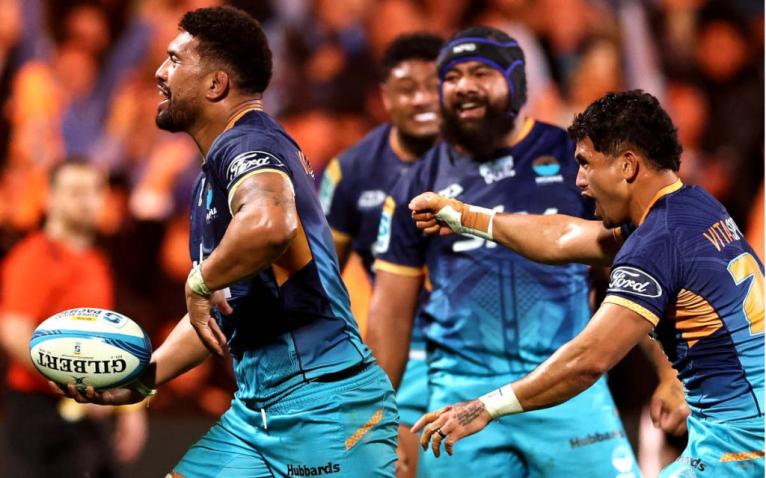
“The more I see him on the side of the scrum, and the way that the rest of the loose forward trio balances out, and the player that he is in that jersey, the more it is glaringly obvious to me that Scott Robertson needs to pick him in that shirt.
“Open-side flankers gravitate to the ball. They want to be first, second arriving player the majority of the time. If Ardie’s going to that zone, he’s picking and going and carrying with his leg-drive and pump, that’s where he’s devastating. He’s hard to get to ground.
“If he’s there as a defender, how good is he over the ball? And how hard is he to move? We saw that last night. For the majority of the game, that’s where he’s at, which suits the jersey number.
“Then he has the ability, when he sees others going to that zone, and he’s outside of that pattern, then he’s got that ability to play second, third receiver and do things that he’s been doing for Moana Pasifika.
“His ability to be able to do that and balance his game out is perfectly suited to that shirt.”
The obvious question orbits around the shirt Savea should be wearing for the All Blacks, and that is how Marshy’s diatribe starts. By the finish, the outspoken one is asking what the role a New Zealand number seven should be. Should it be confined to the traditional, or has it expanded?
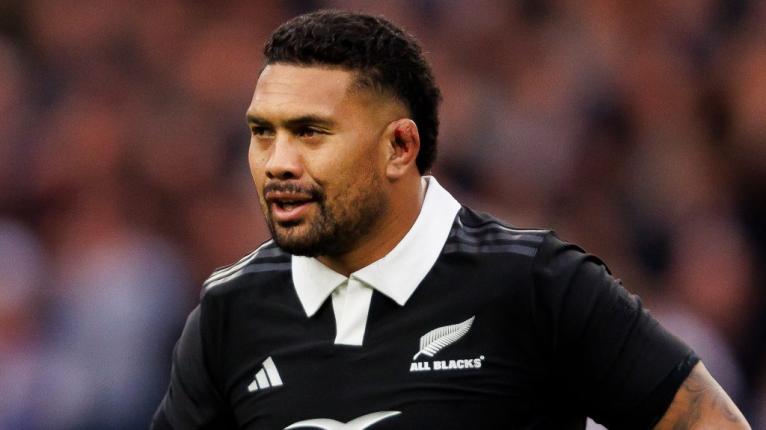
Over in the blue corner, current Wallabies supremo Joe Schmidt supported a sense of the new back-row interchangeability. On Sky Sports’ ‘The Breakdown’, he was asked about the different characteristics of the players in the eight and seven jerseys in the modern game.
“It doesn’t matter who you’re looking at,” Schmidt said. “When you’re making your back row and putting them together, you’re just trying to get some balance, and because Ardie is so dynamic off the back of the scrum [as an eight], that’s great. He’s also so destructive as a defender when he’s coming off at seven.
“And people probably underestimate how good he is in the lineout. He’s actually so quick, so explosive, he’s a very good lineout option. There’s not a heck of a lot he can’t do.”
In Schmidt’s world, you want multi-purpose back-rowers, then you create a balanced unit from the material available. Savea has the capacity to win you two or three balls from the front of the lineout per game, he can carry off the back of the scrum explosively, and he is an 80-minute workhorse with ball in hand, a yards-after-contact brutalist. Just like your traditional number eight forward.
At the same time, he is hard to shift in defensive breakdown situations and always around the ball as the first or second arriving player – in the classic mould of a great number seven. As Marshall implies and Schmidt declares openly, there is a sense that the philosophy behind the blue riband position of New Zealand rugby is under pressure to expand.
The debate has been current ever since Sam Cane replaced Dalton Papali’i in time for the 2023 World Cup in France. At the time, Papali’i was the coming man, having proved his worth on the 2022 November tour of the northern hemisphere. Dalton-plus-Ardie was not an orthodox arrangement as both could play across all three spots in the back row – but it worked, and Papalii added that a bit of extra je ne sais quoi.
Slammin’ Sam returned as skipper for the World Cup in France and the balance changed again. Cane added leadership to the playing group but he did not develop the seven shirt: he was always around the ball, a dominant tackler on defence, an indefatigable cleanout technician and support player in attack – but the expansive element was missing.
The writing was on the wall when Cane came off second-best in his individual duel with Josh van der Flier on Ireland’s triumphant tour of New Zealand in July 2022. The Leinsterman was one of the new breed of sevens, a ball player and a ball carrier, and he was one of the prototypes who helped enlarge the expectation of what the open-side’s role could be.
The debate within New Zealand can be illustrated, ironically enough, by a comparison between Savea, playing as a seven for Moana Pasifika in the current Super Rugby Pacific season, and Papali’i, who has found his role much more restricted under Cotter at the Blues.
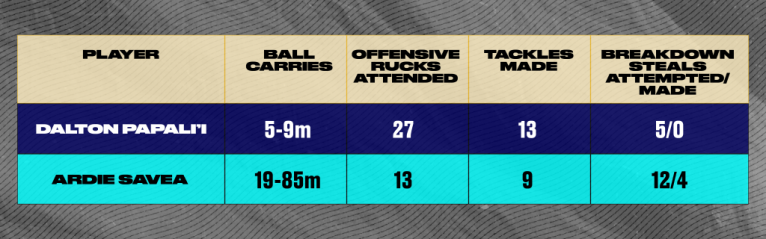
The Aucklander is largely confined to doing the essential chores, but the interpretation of the spot when Savea plays it is far more multi-faceted. Here are some key seasonal figures up to round 14, with Papali’i having played marginally more minutes than Savea [799 to 744].
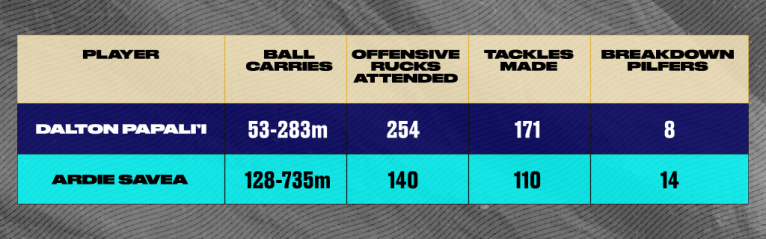
Papali’i cleans out roughly five times more than he carries, but for Savea carry and clean are equally balanced. On defence, Papali’i leads the line and makes the tackles, where Savea sags off and waits for his opportunity to pounce after the tackle has been made by someone else. In the modern game, you can rarely manage both.
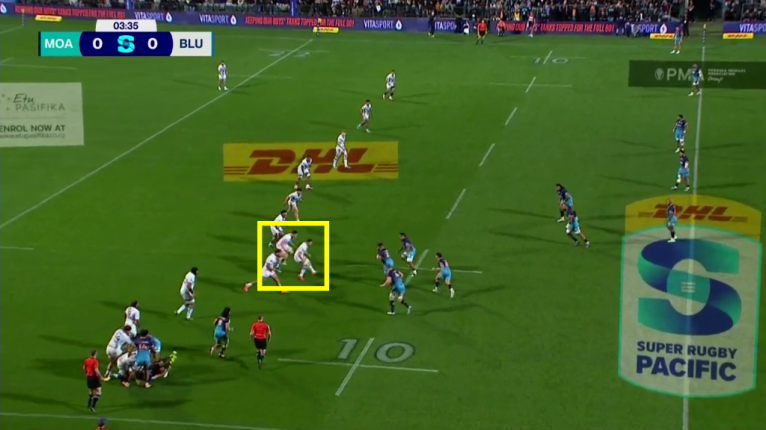
The Blues want Papali’i at the tip of the tackling triangle, making the initial hit. Moana want Ardie contesting the ball on the deck after the tackle has been completed, in the two clips winning turnover twice in the space of half a minute, then having the vision to see the space wide at the base of the ruck.
The seasonal figures of the two men were reflected in the game itself.
At times, there were clear signs Papali’i was becoming frustrated by the limitations of the role he had to play.
In the first clip, he makes the tackle but the attempted counter-ruck afterwards attracts a penalty, in the second you might reasonably expect the pass from Beauden Barrett to find Papali’i [or that matter Hoskins Sotutu alongside him] in midfield, but instead it hits a much less threatening runner in the form of second row Josh Beehre, with Dalton confined to cleanout duty. Yes, Dalton can do it, but he is capable of so very much more.
On the other side of the field, the Blues seven must have been casting envious eyes at the amount of latitude given to his opponent. Savea handled the ball eight times at first receiver or ‘acting 10’ – passing three times, carrying on four occasions and even kicking once – and seven more as ‘acting nine’ at the base:
Firstly, Savea is positioned at first receiver and calling the switch pass to the short side, then he is picking up at the base and generating even more go-forward. Papali’i could only dream about the playmaking freedoms on offer to the Moana skipper.
Moana are effectively using Savea as a short-side decision-maker, putting team-mates into holes in the first clip, or tucking and carrying the ball up in the second. Heck, he could even play left wing if he wanted, just like his brother.
It may have been the greatest individual performance in 30 years of Super Rugby, it may not. The deeper questions raised by Savea’s colossal display orbit around his best position in the All Blacks, and how far New Zealand rugby is prepared to expand to role of the man in the seven shirt.
Was Richie McCaw a typical open-side flanker? No. At 6ft 2ins he was tall for the spot and played across all three back row positions in his stellar career with the Crusaders. Multi-dimensional back rowers of the calibre of Papali’i and Lakai likewise need to be encouraged to make the jersey fit around their unique talents, rather than being forced into a tactical straitjacket.
Whether or not Savea moves to seven with Wallace Sititi at eight is in one sense, a moot point. The real conundrum lies in finding the right complement to those two certainties in the back row unit as a whole. New Zealand rugby cannot afford the unique talents of a Papali’i, a Lakai and an Ethan Blackadder to go to waste for a lack of tactical imagination. Like it or not, multi-tasking is the way forward to the All Blacks future.


Comments
Join free and tell us what you really think!
Sign up for free