
One thing you can be sure of: new innovations in any area of work will always bring misunderstandings along with them. Not just misunderstandings, but more than likely, vehement objections. There will always be those who stand in the way of progress, idealising the past while neglecting the future.
Ex-New South Wales and Scotland coach turned Irish telly pundit Matt Williams has a bee in his bonnet about Rassie Erasmus’ creative use of the bench, and he has had it for some time. His criticism of the Springbok supremo’s use of six or seven forwards on the pine dates all the way back to the World Cup warm-up between South Africa and New Zealand at Twickenham in August 2023. Erasmus deployed the 7-1 split for the first time at the old cabbage patch and hey presto, the Springboks won decisively 35-7.
Ten months later the rhetoric had ramped up a notch or two in intensity. After South Africa won the first game of their two-Test series against Ireland in July 2024, all his comments on the Virgin Media Sport podcast deserved an exclamation mark for pure shock value.
“At the 49-minute mark, six South African forwards walked onto the field. Is that what the replacement laws for safety were designed for?
“That is not any criticism of South Africa, it’s not a criticism of Rassie, it’s a criticism of World Rugby that allows that to happen. That is not what our game is designed for.
“The South Africans took full advantage of a loophole in the system, and that is where the penalty try [for a scrum penalty try with all the new forwards on the field] came from.
“It discriminates against backs; our game is for all shapes and sizes, so in that game, you had 14 forwards.
“That is not what our game was designed for, that’s not what the ancients designed for it. It’s not what we did in the 80s, 90s and 2000s.
“It is not a game for 14 forwards and nine backs. It should be a relatively even [split]…They need a serious review because this is abusing what our game is meant to be.
“It’s abusing our ethos, it’s abusing our traditions, it’s abusing our safety rules and it has to change.”
Put aside the ethical rights and wrongs of the argument, just for one moment. One of the real-world spin-offs of Rassie’s selection policy was glossed over in the statement ‘it discriminates against backs; our game is for all shapes and sizes’. The truth is exactly the opposite.
Why? There is a clue the following table, showing the average weights of the six teams contending at the recent Six Nations.
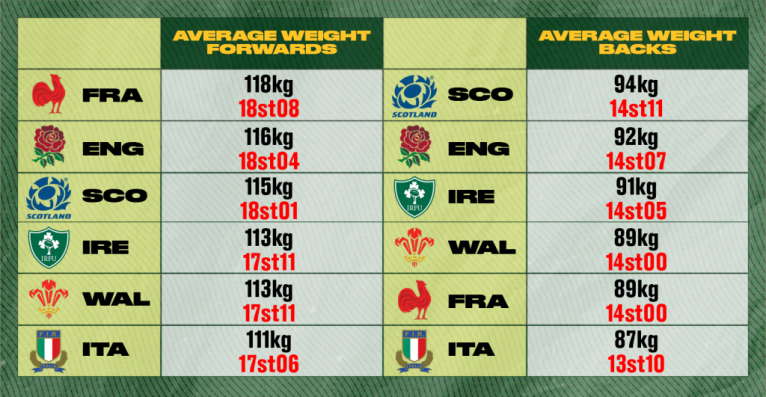
The biggest differential between the size of the forwards and the size of the backs is France at +29kg per man in favour of the forwards. The lightest back, flying Union Bordeaux-Bègles wing Louis Bielle-Biarrey at a mere 79kg, is currently acknowledged to be one of the most lethal, if not the most lethal, finishers in world rugby.
France also used a mix of the 6/2 and 7/1 benches in the Six Nations, just like the Springboks. But the difference in shapes and sizes, and hence the nod to the game’s amateur tradition, is arguably greater in France than it is in nations such as Ireland and Scotland, where the size, mobility and skill-set in the forwards/backs equation has a more uniform, rugby league-like appearance.
South Africa are not only very much on the same page as Les Bleus, in fact the Bokke put pen to paper before anyone else. A typical Springbok team under the auspices of Rassie would have an even greater weight differential between backs and forwards.

The variety of shapes and sizes in a team designed around the 6/2 or 7/1 bench increases in practice, rather than diminishing as Williams suggested. Around the turn of the millennium, New Zealand and Australia were the first to innovate by producing multiple generations of outside backs who could have played comfortably as forwards in the amateur era – huge athletes such as Lote Tuqiri, Wendell Sailor, Norm Berryman and of course, Jonah Lomu. That nudged the game closer to its sister code, where forwards and backs are similar in size and often exchange positions. Andy Farrell, for example, played in every spot in forwards, but also appeared in the Wigan number six jersey in the halves.
South Africa are stripping the game back to its union root by picking much smaller, fast-twitch athletes in the back three. In American football they are known as ‘scat-backs’, players with the quickness and manoeuvrability of waterbugs on the surface of a pond. They can ‘beat defenders in a phonebooth’ and ‘change direction on a dime’ – but let’s leave the clichés there.
The scatbacks with the highest profile are Cheslin Kolbe and Kurt-Lee Arendse, but there are others who have also been tested at the highest level in recent times: Quan Horn, Edwill van der Merwe and Rosko Specman. You can find one or two, and sometimes more, in every one of the four South African franchises in the United Rugby Championship. Rugby’s diminutive Kruger-rand has found its value increasing sharply, in France in the shape of Bielle-Biarrey, and in Scotland via Darcy Graham.
We can only speculate on how Erasmus discovered the value of the quick but undersized outside back. Did it begin with Kolbe, or does it date back even further, to Rassie’s first glimpse of Shane Williams for Wales in 2008, one year after he was appointed to his first national role as technical advisor? He would have had to be impressed by what he saw of ‘Sugar Shane’ on that tour.
What qualities made the likes of Williams such a valuable commodity? The two clips illustrate the obvious: a small man with exceptional agility and quickness can defeat modern power-based athletes who lack the same range of movement in open space.
With the latest rules denying the receiver of a high kick his customary protective pocket, there is more loose ball, more scraps to be pillaged and the quick small man is the one best able to exploit them.
That is Arendse, running away from the defence to score a crucial try in the 2023 World Cup quarter-final win over France. Arendse is not looking to contest the ball directly in the air, that task is reserved for giant lock Eben Etzebeth. Arendse is waiting to pick up the crumbs that fall from the big man’s table, and he is duly rewarded. The scraps make up a seven-point feast.
Small men are also among the most effective kick returners in the game. Here is another South African export, Thaakir Abrahams, returning a kick against La Rochelle in the Investec Champions Cup last 16.
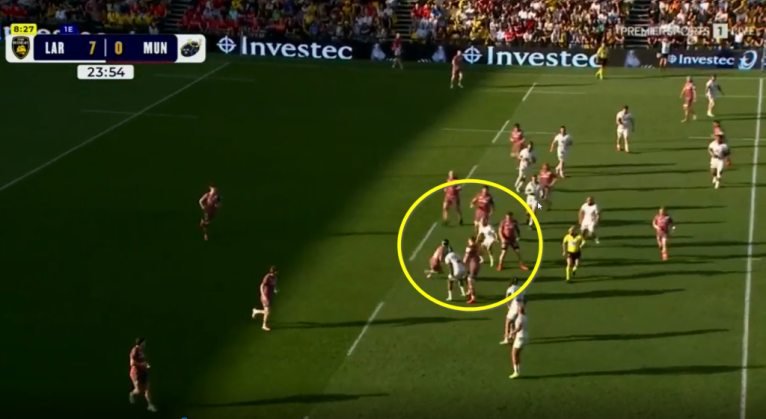
A pair of Munster back-rowers stand judiciously in just the right place to baulk two Stade Rochelais tacklers, and prevent them adjusting to Abrahams’ quicksilver movement in the ‘return corridor’. The little South African is through the gap before any reaction is possible. The theory of a small running back exploding into open field from behind a wall of huge blockers originated in the NFL, and it has transplanted readily to rugby.
In that final clip, Abrahams wriggles through the tiniest of tunnels on the kick return versus the big men of Leinster, on his way to scoring an outstanding long-range try for the Sharks.
The 6-2 and 7-1 bench experiments currently in vogue do not tend to create more uniformity of size and shape as Williams has suggested. Far from it. The international teams which use them most regularly – South Africa and France – tend to employ larger-than-average tight forwards in conjunction with waspish, fleet-of-foot outside backs. The Ooh! of every solar eclipse occasioned by the arrival of huge new second rows on the field is balanced by the Aah! of what the small man can achieve against the odds, and against his bigger brethren.
If anything, Rassie’s great experiment is rolling the clock back to the game’s amateur roots and implies a resistance to the physical uniformity of rugby league. Will Rassie be misunderstood? Of course he will. He’s innovating at the sharp end of the game. As the science fiction author Arthur C Clarke once concluded:
“New ideas pass through three periods:
- It can’t be done.
- It probably can be done, but it’s not worth doing.
- I knew it was a good idea all along.”


Comments
Join free and tell us what you really think!
Sign up for free