
It was a tale of two faces after events on a bleak Sunday afternoon in the capital city of Wales. Wallaby head coach Joe Schmidt was animated and elated, and his eyes blazed with pride. Wales supremo Warren Gatland floated between melancholic resignation and half-hearted jokes about the mountainous size of the challenge still in front of him. He looked deflated and defeated, like some punctured rugby Malvolio.
NEW: Follow Your favourites in the App 📱
You can now follow their favourite teams, tournaments and players in the RugbyPass App!
A strange symmetry belies the contrast in demeanours. Gatland has set an unwanted record of 11 consecutive losses, and a 12th to world champions South Africa next weekend will consign Wales to a winless 2024. There is, as yet, no sign of an oasis in the arid desert which has become familiar Welsh rugby country.
Nostalgia for his own record of 14 consecutive wins in 2018-19 collided with despair at the current drought in his words to TNT Sports after the game:
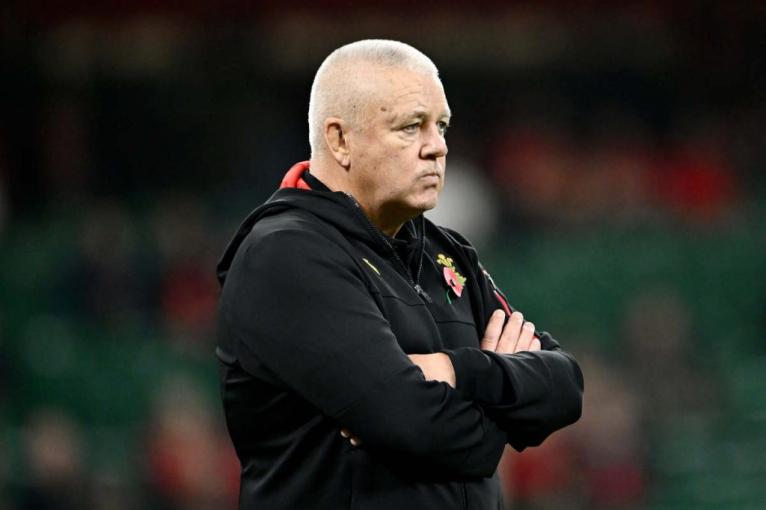
“Absolutely, I would be prepared to fight for my job. I love being involved in the game. I have so many good memories with Wales and am incredibly proud of what we have achieved.
“[But] it’s the most challenging time I’ve ever known as a coach – and what will be, will be. I will chat to a few people [about] what happens from here. I am passionate about Welsh rugby, but there is a lot of negativity around the game right now, and we want to make sure what happens is the best for Welsh rugby. [It is] not about me.
“I will respect the decision.”
It is a measure of how low Welsh fortunes have sunk that one scribe even suggested the appointment of England World Cup-winning coach Sir Clive Woodward as a new director of rugby, even though he has not been offered a professional coaching role since the British and Irish Lions tour disaster in 2005, 19 years ago. Yes, it really has come to that.
Meanwhile Schmidt has taken his adopted nation to six wins from his 11 matches in charge. The Wallabies are back in the black, having posted no fewer than 13 tries and 94 points in their first two tour matches against England and Wales. The defence may still be porous but the Australian sense of attacking identity is back with a vengeance.
The Wallabies’ 52-20 win in Cardiff also neatly reversed the catastrophic loss to the same opponents at the World Cup 14 months ago. Wales’ emphatic 40-6 victory kicked Australia out of the competition at the pool stage for the first time. The turnaround, not only in the result but in the size of the win, amply illustrates the opposed directions Wales and Australia have taken since then. As the Welsh have dropped in the scales, so the Wallabies have risen.
On the field, another essential aspect of the U-turn occurred in the tactics and technicalities of the game. On Wales’ July tour Down Under, it was largely the strength of the Welsh driving maul that kept the tourists in the two-Test series. Over the pair of games, Wales scored three legitimate tries from their lineout drive, and had another one disallowed on review. They scored from anywhere up to 15m out from the Wallaby line, and it made no difference when they were down to seven forwards in the first Test in Sydney.
The sea change in Wallaby selection which enabled the volte-face at the maul was the long-awaited introduction of big Will Skelton in the second row, with an extra ‘tweener [half middle, half back rower] in Seru Uru covering the lineout options off from six. The lineout improved, with Australia winning 11 of their 12 throws for a gratifying 92% return on own ball, while stealing four of the 12 Welsh deliveries. The load was equally divided among Uru, Nick Frost and Bobby Valetini at the tail and the machine positively purred along.
Skelton started by signalling there was going to be no repeat of the July series at the lineout drive.
Once the La Rochelle leviathan gets his shoulders through the seam between the catcher [Christ Tshiunza] and his front lift [Gareth Thomas] it is the end of all driving possibilities. As telly pundit David Flatman commented crisply on TNT Sports, “I’m sorry, but he’s just stronger than everyone else, and that’s what happens”.
Skelton went on to play a key role in three other turnovers of possession with one choke tackle off the ground, and twice shielding the jackal over the ball on the deck. He occupied so many Welshmen it gave the would-be pilferer every chance to operate untroubled, in a cocoon of comfort.
Skelton simply bullies his way past both the two Welsh blockers [number one Gareth Thomas and seven Jac Morgan] to force his way in between the ball-carrier and his cleanout supports en route to the tackle, and that earns Uru a free shot at the ball on the deck. It is the kind of raw power the Wallabies have been sorely missing, but they surely rediscovered their ‘inner brute’ on Sunday afternoon in Cardiff.
One of the more remarkable match stats occurred during the 20 minutes when Australia 12 Samu Kerevi was off the field on a red card. While reduced to 14 men, Australia extended their lead from 19-13 to 40-13, scoring 21 unanswered points before returning to a full complement. The key was the efficiency of their ball-control attack in the red zone, where the Wallabies averaged an outstanding 4.33 points per entry [three points per entry is considered good]. The key to the ball-control attack was their domination of the maul, which generated a succession of penalties and tries; and the key to that domination was Skelton.
The Wallabies had issued a warning shot over Welsh bows in that area midway through the first half.
Starting as the short-side lifter for receiver Uru, by 21:14 on the game-clock Skelton has split the Welsh defence completely in two and has nobody left in front of him to block, so he doubles back and cleans out over hooker Matt Faessler just to make sure of the score instead.
It was portent of things to come in that critical red card period.
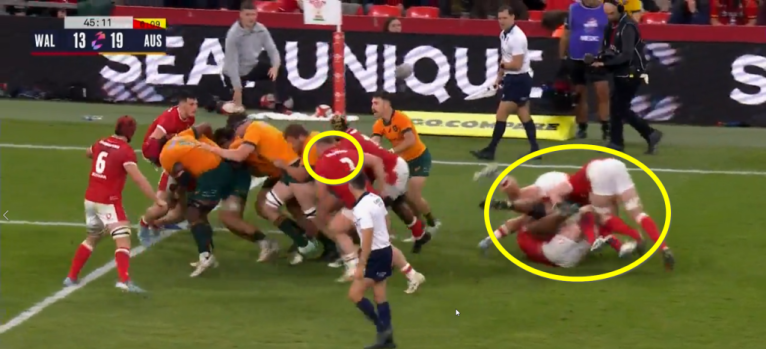
By the time the good ship Skelton is finally sunk, he has taken half of the Welsh forward pack with him – with three on the ground and number two Dewi Lake left behind the play on his feet. It is an unequal contest and the Australian drive jolted forward another 10m before it was brought to a halt deep in the Welsh red zone. The outcome was another Wallaby penalty, another kick to the corner, and – you guessed it – another lineout drive.
On this occasion, Australian lineout coach Geoff Parling came up with a neat tactical twist, starting Skelton at one in the line and using him as the spearhead of a drive straight towards the corner flag. It is not pretty, but it is an extremely efficient way to score tries and keep control of the game. By that stage, such was the Australian comfort blanket at the maul, nobody even noticed Kerevi was off the field.
Skelton’s work rate went up in all departments while the Wallabies were short-handed. There was the turnover assist to Uru in the 43rd minute, and then four carries in the space of a mere 60 seconds which led to another Wallaby penalty in the Welsh 22.
By the time Skelton has become detached from the drive, he has taken the obligatory three Welsh forwards away with him, and that in turn depletes the Welsh defence on the other side of the maul for Faessler to convert his hat-trick.
The presence of Skelton and Uru as starters in the back five forwards has offered the Wallabies a brand new method of scoring tries and managing the game. They are not only a threat to counter-attack from deep with the backs, now they can keep the ball for extended periods in the opposition 22 and grind away through the forwards from short range. That is a new development which will give Schmidt plenty of selection headaches for the final two games against Scotland and Ireland.
Schmidt was busy deflecting talk of an unbeaten tour against the home nations soon after the game had finished.
“It’s too far away to contemplate. We have talked about regenerating well tonight and making sure we don’t miss our flight to Edinburgh; [then] getting the front half of the week right and see what comes in the back half.
“I’ve got massive respect for Scotland. I think they will be very tough. They play a fast game. They put massive pressure on the breakdown. They’ve got a good loose forward trio. But also, I think their tight five have been going really well.
“And then when you get the ball to Finn Russell, he’s a bit of a magician, and out wide Darcy Graham’s been going super for them.
“We certainly haven’t looked as far as Dublin. That’s always going to be really tough for us on a six-day turnaround.”
It did not work. Scarcely had Schmidt finished brushing away talk of Australia’s first Grand Slam since 1984 then attention turned to an even more ambitious objective, a series triumph against the Lions in 2025.
“It’s just around galvanising the [Australian] nation, really. Obviously, I’m pretty good friends with ‘Faz’ [Ireland and Lions head coach Andy Farrell]. We worked together for a while and I know him well, so that will be challenging because he’s a very good coach.
“I think for the players, outside of a World Cup, you just can’t get bigger than the Lions. It is going to be a fantastic tour. We will keep building and I’m hoping it’s a really competitive series.”
With such lofty aims in view, Australia needs to pick every man jack who can help it achieve them. Pick them from Japan, pick them from France. Just don’t shoot yourself in the size 18s.


Comments
Join free and tell us what you really think!
Sign up for free