
After the most hyped build-up to his first test in charge, it was little wonder that All Blacks coach Scott Robertson admitted there was some relief to have escaped from Dunedin with a victory.
As he said, the second half turned into precisely the sort of attritional contest he didn’t want his All Blacks to get sucked into – one where the outcome would swing on micro plays that would have a macro effect.
“When we got into the second half I thought ‘this is exactly what they need’ but we got there,” Robertson said.
“It’s good to be one from one. It obviously could’ve been a little bit different.”
It could have been a lot different, as England, once they stopped kicking so much possession away, were able to regularly go through the All Blacks and give themselves ample opportunity to strike a killer blow.
That they didn’t was partly due to their occasional lapsed in astute decision-making when they had the All Blacks scrambling, and partly because when they really needed to, New Zealand produced big moments.
Ardie Savea snaffled a couple of key turnovers and there were two big scrums that produced All Blacks penalties that enabled them to relieve the pressure and regain territory.
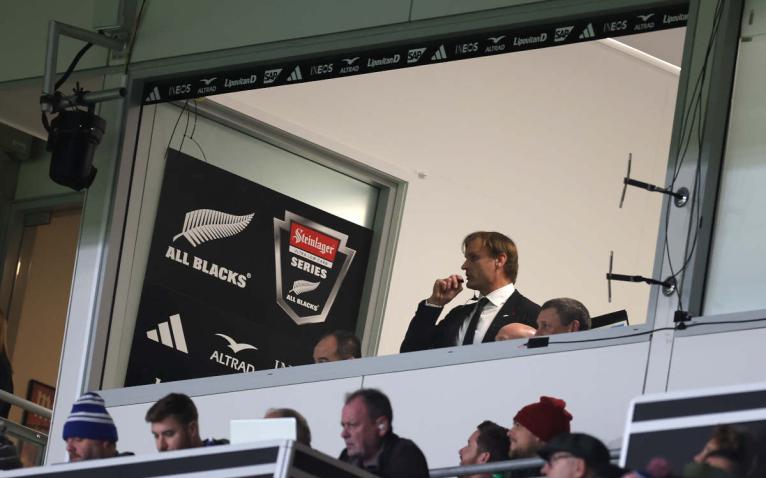
Several times the TV cameras homed in on the All Blacks coaching box, where Robertson was so agitated and on edge that he slapped the wall behind him more than a few times.

His emotional state was the undeniable evidence that the All Blacks coaching group knew they were in trouble, and that if Marcus Smith had been on better goal-kicking form, or England had found just a fraction more composure, they would have secured their first win on New Zealand soil in 21 years.
For England, there is no question it was an opportunity lost. But what they can’t afford to believe is that it was their best or only realistic opportunity to win a test in New Zealand.
England can certainly feel frustrated that they built enough pressure and created ample opportunity to win the game, but they shouldn’t buy into the idea that they won’t be able to do much the same again this week in Auckland.
Which means not buying into the false narrative that their best chance was to catch the All Blacks cold in Dunedin – exploit their lack of game time together and inevitable nerves that were circling due to the additional expectation that was being placed on the Razor regime to begin with a bang.
The All Blacks haven’t lost at Eden Park for 30 years, but that doesn’t change the fact that England’s prospects of winning this week are every bit as high, if not higher than they were last week.
There’s a myth that has built over the years that the All Blacks are most vulnerable in their first test of any given year – that they are a team that rarely finds their cohesion and flow quickly.
But the statistics don’t support that view at all. What they do reveal, however, is that the real point of vulnerability for the All Blacks is their second test of a series.
The All Blacks haven’t lost at Eden Park for 30 years, but that doesn’t change the fact that England’s prospects of winning this week are every bit as high, if not higher than they were last week.
Firstly, England must realise that for the last 12 years, the All Blacks have started each season (with the exception of World Cup and Covid years) at Eden Park.
Secondly, they must realise just how vulnerable the All Blacks have shown themselves to be in the second test of an opening series.
In the last decade, the All Blacks have quite regularly struggled to back-up an opening test victory with a convincing performance.
In 2012, they smacked Ireland hard in the first test in Auckland and then needed a last-minute drop goal by Dan Carter to win the following week in Christchurch.
In 2014, England came within a point of winning the second test after losing the first, and in 2017, the British and Irish Lions were well beaten in the first test but won the second.
Robertson and his coaching group – with the exception of forwards supremo Jason Ryan – are new to the international game and have no experience in having to reset, adapt and rethink to play the same opponent in consecutive weeks.
In 2022, Ireland did the same – lost in Auckland, but bounced back to win in Dunedin (and also Wellington), and the evidence is writ large that the All Blacks tend not to be great at rebuilding between tests one and two, advancing their game or reading how their opponents may look to change up what they are doing based on what happened in the first encounter.
England have been granted an unprecedented opportunity to play New Zealand at their most vulnerable stage on their spiritual home ground, and this test at Eden Park will provide a big clue as to how well the All Blacks are set up to respond not only to the highly-specific threat England pose, but how well they are going to be able to cope with the realities of what 2024 is going to throw at them.
Robertson and his coaching group – with the exception of forwards supremo Jason Ryan – are new to the international game and have no experience in having to reset, adapt and rethink to play the same opponent in consecutive weeks.
The All Blacks pounce on a missed tackle and secure a try to take the lead AGAIN! 😯 pic.twitter.com/NI0My3LTpJ
— Sky Sports Rugby Union (@SkySportsRugby) July 6, 2024
Super Rugby doesn’t pose that challenge, but this year, through a quirk of scheduling, the All Blacks will be playing back-to-back tests against England, Argentina, South Africa and Australia.
The ability to innovate on the hoof is a skill-set that this new All Blacks crew will need to master quickly, and for this particular rematch, the big question is whether the home side will be able to adapt their attack game in the face of England’s supremely well organised and executed rush defence.
England found a weak spot in Dunedin by operating a blitz defence that saw them use their linespeed that made it hard for the All Blacks to get the ball to their outside backs.
It put real heat on the decision-making of No 10 Damian McKenzie and Jordie Barrett, and the All Blacks weren’t able to pick the right ploys to punish England for adopting what was a high-risk, high-reward system.
Almost certainly, it seems, the All Blacks are going to make personnel changes to help them get what they feel they need in Auckland to do a better job of breaking England down.
Stephen Perofeta was picked at full-back for just his fourth cap, and while he was instrumental in creating Ardie Savea’s try, he was taken off after 50 minutes as a sign the coaches felt they needed Barrett’s tactical nous and greater test experience on the field
Specifically, the debate will focus on whether to bring Beauden Barrett into a starting role after he was used off the bench with good impact in Dunedin.
His omission from the starting XV last week was a surprise as while he hadn’t played (other than a one half hit out for his Coastal club in Taranaki) since returning from Japan in early May, the All Blacks looked light on test rugby intellect without him.
McKenzie, for all that he has played nearly 50 tests, has only a handful of caps at No 10 and the expectation was that Barrett would start at fullback to do some of the heavy lifting around game management.
Instead, Stephen Perofeta was picked at fullback for just his fourth cap, and while he was instrumental in creating Ardie Savea’s try, he was taken off after 50 minutes as a sign the coaches felt they needed Barrett’s tactical nous and greater test experience on the field for what they could see was turning into a tense, strategic game of chess.
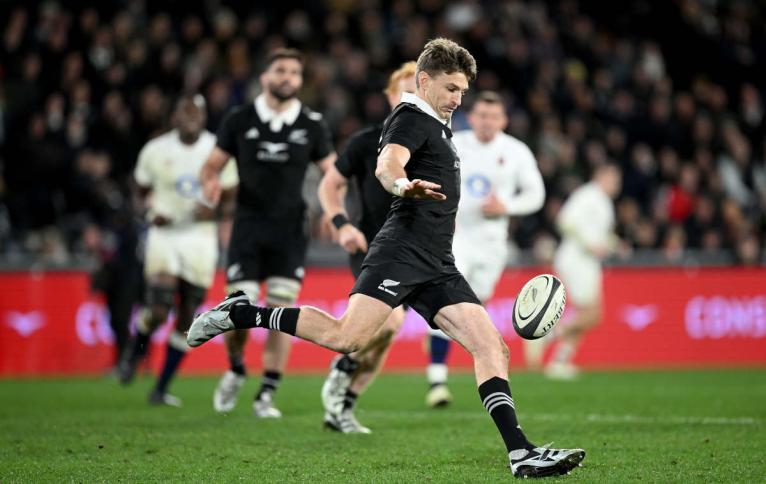
The early arrival of Barrett was also perhaps an admission that the All Blacks accepted that they had overestimated the ability of a young backline to meet the increased and complex demands of international rugby.
“With the group, with the backs, not necessarily just Damian, we’ve looked at little areas where we put ourselves under pressure,” All Blacks assistant coach Jason Holland said a few days after the 16-15 victory.
“We either ran when it wasn’t on to run or kicked when it wasn’t on to kick.
“We’re working hard as a group to make sure we’re making good decisions there.
“Continuity [of selection] is important but that doesn’t mean there’s not a couple of key areas where we need to improve.”
England may have lost the opening test of the series, but they certainly shouldn’t believe they also lost their best chance to score the victory they so desperately crave.


Comments
Join free and tell us what you really think!
Sign up for free