
It was not so very long ago, was it? In the not-so-distant past, it was universally acknowledged Super Rugby was the best preparation for Test match rugby. There was no argument, it was head and shoulders above all the competitions north of the equator. After only one round of the Rugby Championship, it is clear that is no longer the case.
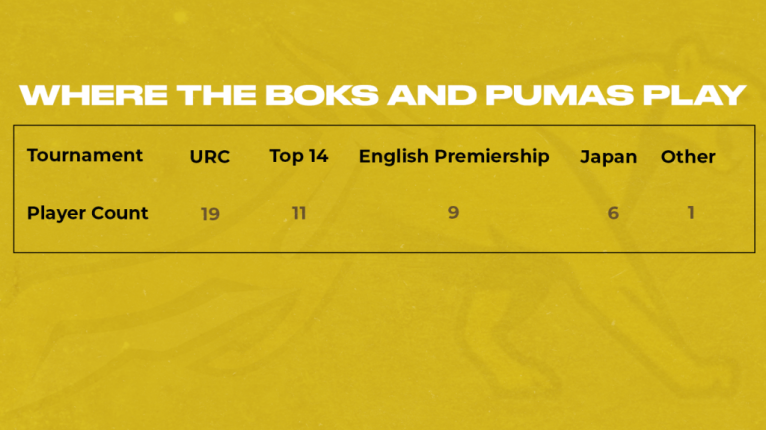
Both the primary nations remaining in Super Rugby Pacific [Australia and New Zealand] lost in their own back yards, conceding 71 points and nine tries in the process. The two 23-man matchday squads from South Africa and Argentina which inflicted the damage contained a mix of players predominantly plying their trade in European competition.
The work Kiwi head coach Joe Schmidt still has to do with his Wallabies was thrown into very painful relief by a loss to the Springboks that threatened to turn into a humiliating shut-out. The world champions were 33-0 ahead with only five minutes left on the clock, before a late Hunter Paisami try added a tiny dab of gloss to the final scoreline.
In Australia, ‘Giteau’s Law’ still presides in spirit if not in letter. There remains a reluctance to embrace overseas influence, whether it comes in the form of overseas players or foreign coaches.
In the build-up to the game at the Suncorp, ex-Waratahs, Ulster and Scotland coach Matt Williams made some incendiary comments on the impact of Kiwi coaches in his homeland in his column for The Irish Times:
“Schmidt was not the people’s choice for the role. Australian rugby has suffered from a string of wrongly-recruited Kiwis, either as coaches or chief executives, who have disastrously driven the game in Australia so far away from its DNA that players of this generation have lost their understanding of Australian rugby’s unique identity.
“So, it is understandable that the Aussie locals are highly sceptical of yet another New Zealander getting the gig as Wallabies boss. When a leading RA official asked me for my opinion of Schmidt coaching the Wallabies, I told him that Schmidt is one of the best coaches I have ever seen, but he lost his way badly [with Ireland] in 2019.
“I believe that in time Joe will be a huge positive for the Wallabies. The vast majority of Wallaby supporters do not have the same opinion and they sit firmly in the‘Doubting Thomas’ category. They need to see a lot of wins before they will believe in Schmidt.”
It is hard enough for any international coach to succeed, without the added pressure from Thomases who doubt the wisdom of overseas experience.
Approaching the first seriously high hurdle of his tenure, Schmidt bent over backwards to keep selection homegrown, and he duly paid the price for it. The New Zealander opted to mine from local sources and excluded Will Skelton, Izack Rodda, Brandon Paenga-Amosa up front, and Marika Koroibete and Samu Kerevi in the backline. Of those, only Koroibete is likely to play a part in the return game in Perth.
All it has done is highlight the shortage of material coming through on the Super Rugby Pacific production line. Every one of the aforementioned players is more physically advanced than the local products who represented the green-and-gold at the Suncorp. ‘The Australian view’ urgently needs to encourage two-way traffic between Australia and the rugby world outside it.
Recently-returned rake Paenga-Amosa rephrased the value of overseas experience on a recent Roar Rugby Podcast:
“Before I went to France, hooker [in Super Rugby] was a very loose position. You would see hookers on the edge like Codie Taylor – Dane Coles is another great example – able to make the run down the sideline and gas wingers and make 20-metre cut-out passes. I was watching them and thinking, ‘Bro, these guys are world-class players. I am going to be like that.’
“Going to France really showed me what I am good at. I am not that guy that is going to burn players on the edge. I am not that guy that will run out wide and step the full-back and chuck a 30-metre pass. That is just not me, man. I am a bigger body. I have got probably five to eight kilos on those boys.
“I understood going to France that my [role] is to play the tight game, try and get over the ball as much as I can, or just be a pest in the ruck, and take [the] tough carries. Even if I do get banged left, right, and centre – that is my job, because I am a bigger body.”
For the game at the Optus Stadium next weekend, Australia badly needs a dose of the medicine BPA has been taking. Bigger bodies who understand their role and can stand up to the Springboks at source: people who can not only absorb South African power, but dish out a goodly portion of it themselves.
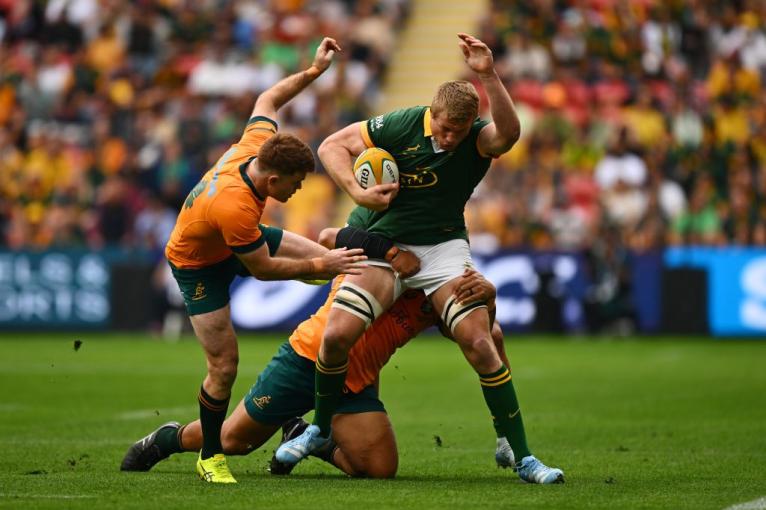
If Schmidt needs an example of the constructive use of overseas influence, he need look no further than the presence of Pieter-Steph du Toit in the South African second row. Du Toit now plies his trade for Toyota Verblitz in Japan. If Rassie Erasmus adopted current Australian eligibility criteria, Du Toit would not have been able to replace the injured RG Snyman and Franco Mostert and lead the Springbok lineout – a potential Achilles heel I observed last week.
As it was, veteran replaced veteran and the set-piece transition was relatively seamless. There was no need to expose a rookie [Ruan Nortje] to the crushing pressure of necessity. As always, Du Toit saves his best for the occasions when it is most needed. He may be best known for his 28 tackles in last year’s World Cup final, but on Saturday he led all Springbok forward ball-carriers with 21 touches on attack, including 14 carries and seven passes.
He ran in all three segments of the field from touchline to touchline: driving the ball off nine, picking up the lead role on the pick-and-go, and inserting himself out wide as the extra back-rower on a scoring move.
In the first clip, the Kloovenburg native creates the space out to the left by narrowing the Wallaby defence up around the ruck perimeter with his power. In the second he finishes the move out wide with speed and a straight running line. Du Toit even had the breath left in his body to match lung-bursting sprints with Australia’s own extra ‘loose’ tight forward, Nick Frost, in the third quarter.
Frost is up and poised to pilfer after a long kick downfield by Bobby Valetini, but the first South African forward to arrive is Du Toit, ready to defuse the emergency at the base and save the turnover.
The ex-Stormer’s single most valuable contribution in the game was his ability to sew the pieces of a new Springbok lineout together. South Africa won 14 of their 16 throws, and Du Toit won one of Australia’s feeds while spoiling two others. He spread the ball around on the Springbok throw, calling his own number once, with four to new cap Ben-Jason Dixon at the back and five to ever-reliable Eben Etzebeth at the front.
The Springbok throw clawed back the flexibility it had under Mostert’s captaincy, and both the confidence and the amount of detail in their short-range variations was impressive. The Bokke started with a sophisticated move to create a score near the Wallaby try line.
Success is built off a myriad of subtle nuances.
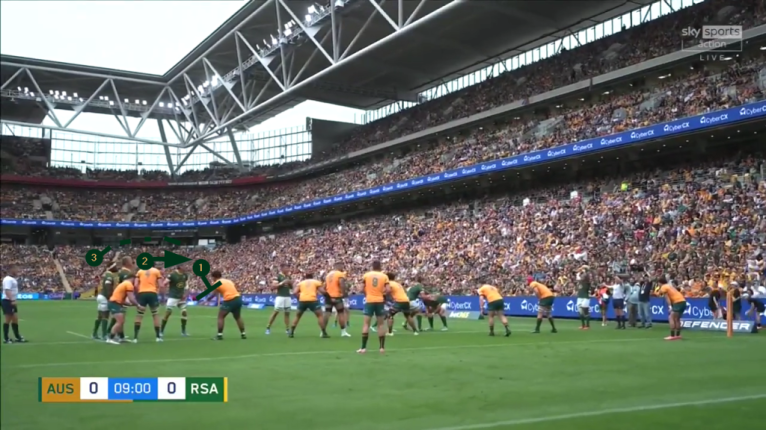
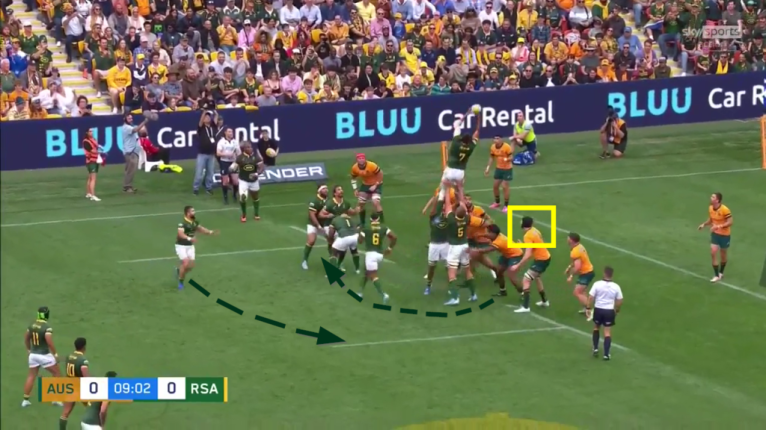
The first requirement is to take Frost out of the frame as an aerial combatant, so Du Toit aligns as a likely receiver looking down the line at his hooker, while the real target [Dixon ahead of him] sets up as a lifter opposite the Wallabies. With Frost ruled out of the play, Siya Kolisi swings around from tail-gunner to become the ball-carrier and try-scorer on a peel around the front pod. There is even a nice little flourish from scrum-half Cobus Reinach, faking a receipt around the end of the line towards the posts.
Du Toit built the Springbok attacking repertoire from that base.
In the first clip, the same move has Kolisi breaking out from the maul earlier, and all but setting up a second try for Malcolm Marx near touch. The second illustrates the essence of quality lineout-calling: the man from the Cape is quite content to do the heavy lifting for others, this time front-boosting an uncontested Dixon and building an attack around end on favourable terms. South Africa scored their fourth try of the match shortly afterwards.
Does Williams’ view represent the outlook of dyed-in-the-wool Wallaby supporters? Does the ‘Australia First’ selection policy need to exclude reinforcements from overseas? If the answer to both those questions is ’yes’ then the sport of rugby in Australia is in deep trouble.
Super Rugby by itself can no longer provide the depth of quality needed, and Schmidt may not be granted enough time to make his plan work before he is given the chop. Without that top crust of Europe and Japan-based talent to provide a physical edge and the experience of winning, the new-build cannot be cemented in place. There will be no learning pyramid because the players at its apex are missing.
If the Wallabies had failed to score a point at their self-proclaimed Brisbane ‘fortress’ it would have been an unmitigated disaster for all involved with rugby in Australia. In the event they came within five minutes of being ‘nilled’. Schmidt could do worse than listen to what Erasmus said when he scrapped the 30-cap overseas rule back in 2019:
“We have been agonising over how to keep players in the country since the game went professional more than 20 years ago, and the bottom line is that the economy of South African rugby is too small to compete. A South African player can earn more from a two-month contract in Japan than he can if he were to win the World Cup with the Springboks this year. That is the reality we have to face up to.”
Amen to that.


Comments
Join free and tell us what you really think!
Sign up for free