
A rummage through the attic can be a truly wonderful thing. You find one past you forgot, or another you never knew existed. On one such exploration, I discovered an article I wrote on The Roar, for so long a buzzing hive of independent sporting thought down under, five years ago, almost to the day.
NEW: Follow Your favourites in the App 📱
You can now follow their favourite teams, tournaments and players in the RugbyPass App!
The Springboks were the reigning world champions, and they had just emerged from a rancorous series against the British & Irish Lions which they eventually won by two Tests to one against the backdrop of an echo-chamber of lifeless, Covid-emptied stadia. Controversy was still thick in the air after South African head coach ‘Rassie’ Erasmus had produced a video questioning the actions of Australian referee Nic Berry in the first Test, which South Africa lost 17-22 in Cape Town.
When the Bokke left for Queensland in rounds three and four of the Rugby Championship which followed, they landed in Australia without their spiritual leader, and promptly lost both games against the Wallabies; the first at Robina Stadium on the Gold Coast 28-26, the second by 30-17 at Wally Lewis’ old stomping ground at Lang Park in Brisbane.
After the Himalayan performance peak demanded by the Lions and without Erasmus, the green-and-gold body was going through the rugby motions with its heart ripped out. As the article recalled: “Oh, how the Springboks are missing their Grand Magus, Rassie Erasmus. Without him, the magic and the charisma are absent. His South African charges may be heartbroken for home shores too, after the prolonged quarantine in Queensland. Whatever his influence behind the scenes, not a word has been heard from Erasmus, nor sight seen of him in public.”
Latterly the Springboks have been camping out in Terrigal, New South Wales, in anticipation of their first overseas fixture of 2026 against the Wallabies at the Optus stadium in Perth this coming Saturday. While Rassie is no longer keeping his head down, some of the other circumstances are strangely similar.
The Bokke are coming off another big performance peak and another long tour of the country, this time by Dave Rennie’s New Zealand. During that RGR series they also conceded an average of over four tries per game. Back in 2021, emergency head coach Jacques Nienaber had felt the need to apologize in the aftermath of the second loss in Brisbane for ‘a very poor defensive performance’, and the concession of four tries for the first time since 2018.
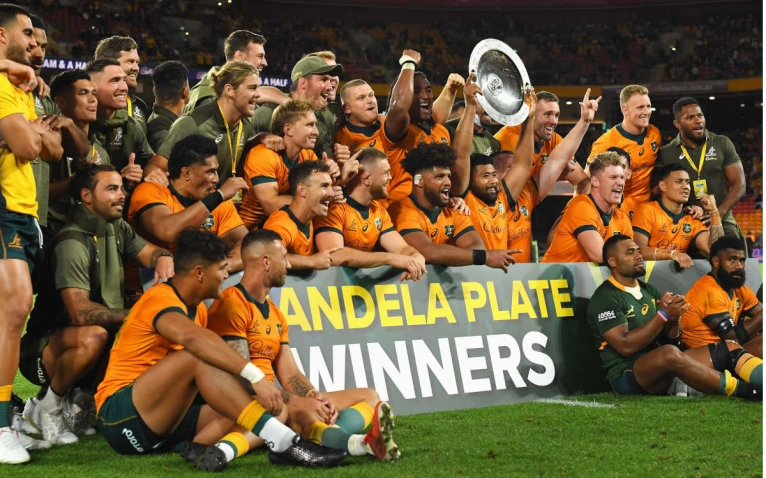
It is as good a historical omen as any for home supporters to cling on to now.
Plus ça change, plus c’est la même chose, as the saying goes, and five years later the Springboks were still winning a big series on their own patch by applying the same formula. South Africa lost the breakdown pilfer stats 6-2 in the first Test in RGR 2026, but reversed the count in the last three Tests, winning the turnover battle by 13 to six. New Zealand’s Nations Championship offensive ruck control was the major casualty.
Even with Rassie very much present and correct, Australia will be praying fervently for a 2021-like reversal of refereeing priorities five years later, with Andrea Piardi at the helm in Perth. The Italian’s last and most memorable action on Aussie shores was green-lighting the cleanout on Carlo Tizzano by Welshman Jac Morgan which handed the British & Irish Lions victory in a Test series one year ago, on the very final play of the game. Australians everywhere would not mind the same preferences shown at ruck-time tomorrow.
A win for the Wallabies is important to the future well-being of the Rugby Championship. The big tour may be back with a bang, and occupying centre stage in the middle of 2026, but the remainders of the Rugby Championship fixture list still matter. With the new Nations Championship swinging around every other year, and the RGR every four, it does raise the question of whether the Rugby Championship could not be more profitably moved towards the same window as the Six Nations in the north.
The Nations Championship is rugby’s new financial flagship. It is backed by big, institutional capital, with a baseline forecast of U.S $659m in its first two editions, and an unprecedented sponsorship by Qatar Airways of U.S. $105m over eight years in the works. The tournament is broadcast on free-to-air telly in England and France with an emphasis on digitally-mounted direct-to-fan engagement, so its reach is wide and deep. The finals at Twickenham later in the year are billed as rugby’s answer to Glastonbury, with a three-day pass costing the average joe U.S $368. This is rugby finally entering the world of big business, and the sheer size and scope of the venture could be all-consuming. As Rassie himself observed, “It’s just my opinion, but I think it would be fantastic if we can all play the Rugby Championship when the Six Nations is on. It would be so much easier to know other teams, to be all aligned. Not having some countries flat in June and others peaking in November, and then we are flat in November.
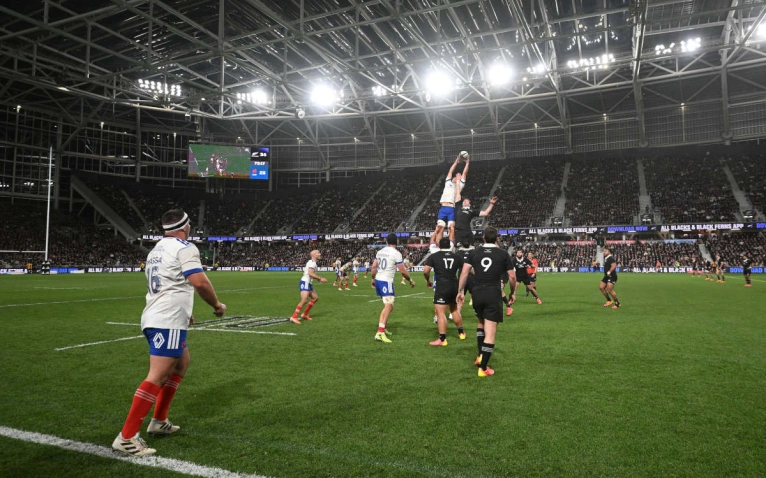
“Law changes or variations would then be so much easier to implement right across the board, because all competitions start at the same time. There might be a big thing I’m missing, but I can’t see any reason why we, New Zealand, Argentina and Australia don’t play that competition at the same time as the Six Nations.”
The Springboks shaded the Pumas in their warm-up and they overcame the All Blacks 3-1 in a titanic RGR series. Can they complete a clean sweep of their TRC rivals? The Wallabies will be retreating into their final redoubt, and defending Rorke’s Drift for their lives.
The good news is that they do have the ability to cause the Boks some headaches in areas where the All Black gave them a free ride – nowhere more so than at numbers 4, 5 and 6 in the forwards, and at lineout time on both sides of the throw. Where Rassie stuck by his tried-and-trusted core crew of Eben Etzebeth, Ruan Nortjé and Pieter-Steph Du Toit throughout the RGR series, New Zealand used four different combinations, and seven different players in those key spinal roles of the back five.
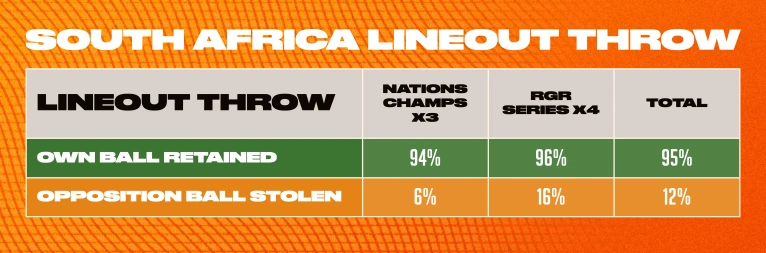
South Africa came out well ahead on both sides of the throw over the four matches, and it confirmed their status as one of the two best lineout teams in the world:
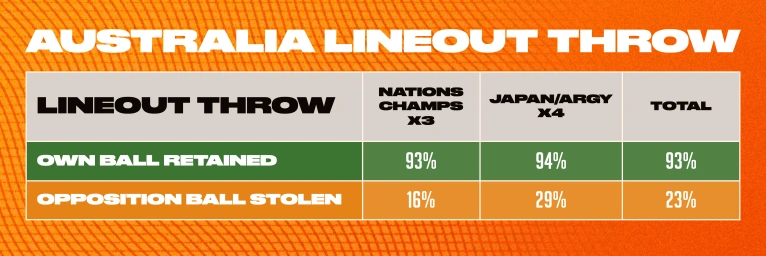
The other nation jostling for prominence at the top of the lineout pecking order is Australia:
Turn your attention to individual comparisons, and you find the same telltale signs at the top end of the lineout ladder: Josh Canham with 16 takes at the summit, closely followed by Ruan Nortjé [15], Eben Etzebeth [13], with the Wallaby duo of Jeremy Williams and Charlie Cale sharing fourth place on 9 takes apiece. The Wallabies are primed to give the Springboks the lineout contest the All Blacks could not, especially on their own throw.
Australia is developing real, meaningful depth in the second row and at blind-side flanker. Even though Will Skelton has been hors de combat at the start of the Les Kiss era, and Nick Frost has been given most of the international season off thus far in 2026, the combination of Canham, Williams and maul-stopping enforcer Lukhan Salakaia-Loto has filled the ranks more than adequately. Behind them, a choice for the ages is unfolding between incumbent skipper Harry Wilson, monstrous Tom Hooper and fleet-footed, spring-loaded Charlie Cale at #6.
Even though Japan featured a pair of two-metres plus locks for the first time in their history – Super Rugby standout Warner Dearns at 2.03m and Australian emigré Harry Hockings at 2.06m – they struggled to cope with the Wallabies fast-twitch into the air: first Cale at the front, then Canham in the middle:
— William Bishop (@RPvids1994) September 18, 2026
— William Bishop (@RPvids1994) September 18, 2026
Both Cale in the first clip and Canham in the second are giving away significant height to their opposite numbers, but their ability to get off the ground more quickly is more important. It became even more important during the two-match mini-series versus Argentina and their veteran lineout caller Guido Petti:
— William Bishop (@RPvids1994) September 18, 2026
— William Bishop (@RPvids1994) September 18, 2026
— William Bishop (@RPvids1994) September 18, 2026
Petti is short for a contemporary lock at only 1.93m, but he has moulded a great living as a receiver and caller out of his incredible speed off the ground. He likes using the receiver to trigger the throw in order to use that spring, rather than employing decoy patterns with complex movement before the ball is delivered. But he meets his match at the front/middle with first Jeremy Williams, then Josh Canham – who has pulled out late with a hamstring strain against the Springboks – and finally Cale getting into the air quicker than their opposite numbers.
Winning one quarter of the ball delivered on the opposition throw was one of the many outstanding features of Rod Macqueen’s World Cup winning side of the late nineties and early noughties, and Les Kiss’ new Wallabies have been good enough to emulate that pilfering percentage thus far in 2026. A little nostalgia goes a long way. It is a good omen for the host nation of next year’s World Cup in an era of tumultuous change for the current international calendar.
 Register your interest to receive priority updates on RWC27 ticket releases. Don't miss out, stay in the loop!


Comments
Join free and tell us what you really think!
Sign up for free