




1
England star makes wild claim about Rugby World Cup chances 'under Steve'
33

The course of this year’s Top 100 players irrevocably changed on 8 March, 28 minutes into France’s Six Nations dust-up with Ireland, when Antoine Dupont – by most neutral’s metrics, the best rugby player in the world – ruptured his cruciate ligament as he was cleared out of a ruck. The prognosis reckoned the pocket dynamo would be lucky if he returned to play before 2026.
A phrase rhyming with clucking bell ran through this writer’s mind, on hearing the news. Dupont had been the front-runner and it would take some player to knock him off his perch. It was time to see if any mere earthling could step into the master’s shoes and showcase a repertoire of skills that could quicken the pulse of fans and freeze the blood of opposition players when reading his name on the team sheet. Fortunately, a cocksure young buck from the Western Cape swaggered onto the Test scene and duly delivered.
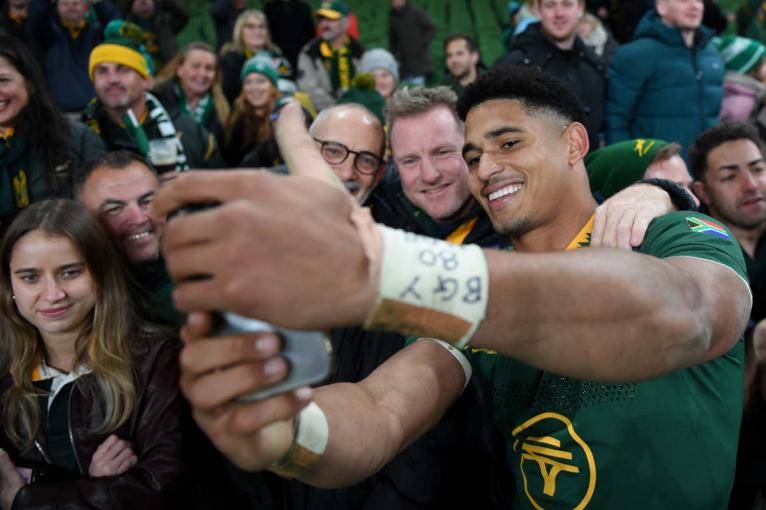
Step forward Sacha Feinberg-Mngomezulu. At 23, he is a proud Gen-Z, unafraid to express himself and eschew tradition, who happens to possess magic in his feet and hands. Like a golfer who has perfected the formula between speed and power, Feinberg-Mngomezulu seems to strike the ball differently. Able to clear his lines with a 50m ‘driver’, or flat-foot a defence with a deft lob-wedge over the top, he has a cultured right boot that can find ravenous wide-men with pinpoint accuracy. In short, he can toy with defenders, unsure which club he’s going to pull out.
With the ball in hand, he is a medley of flicks, feints, reverse passes and out-of-the-back-door sorcery, revelling in putting heavy-duty carriers through the faintest of gaps and he boasts a turn of pace that can leave defenders clasping at his vapour trails. He boasts style, sure, but substance in spades. He crossed the whitewash nine times in his last six Tests over the past three months, surpassing any other Springbok fly-half’s try tally in their 134-history, and ran up a record 37 points against Los Pumas in Cape Town.
What this writer likes about him, is his edge. Many tens are targeted to put them off their game, but Feinberg-Mngomezulu, who is 6ft 1in and 94kgs, has snarl. He doesn’t mind putting ‘shots’ on opposing players, regularly hits double-figures in the tackle stakes and stands his ground. Indeed, he revels in the niggle of a white-hot atmosphere. This temperament, if controlled, should stand him in good stead for the next decade.
Dupont, who has returned in recent weeks, typically showing less ring rust than most, has taken second spot due to his 288-day absence, but to omit him from the list would make little sense. He has still played in 13 games, and if Lionel Messi had an injury lay-off, would he be absent? I don’t think so.
As pointed out in our inaugural 2024 list, the placings aren’t spat out by an automated AI prompt. No, it’s human judgement knitting together a series of factors; match-winning influence, feats of awe-inspiring physical power, raw athletic ability and mental fortitude under duress. They have been assembled by 12 journalists, covering the globe with over 200 years’ worth of experience writing about the game. It is entirely subjective.
There are fallers, of course. The mixed fortunes of Ireland and New Zealand have seen their players slide, but they still have heavy contingents. The sight of a haunted Andrew Porter bested by a rip-snorting Springboks scrum will take some time to erase from the memory. Time is cruel and some older players, like Beauden Barrett and Bundee Aki, are raging against the dying light as their influence wanes. Some individuals, like Len Ikitau, Damian Willemse and Cam Roigard have run into a rich vein of form that has seen them rocket up the list.
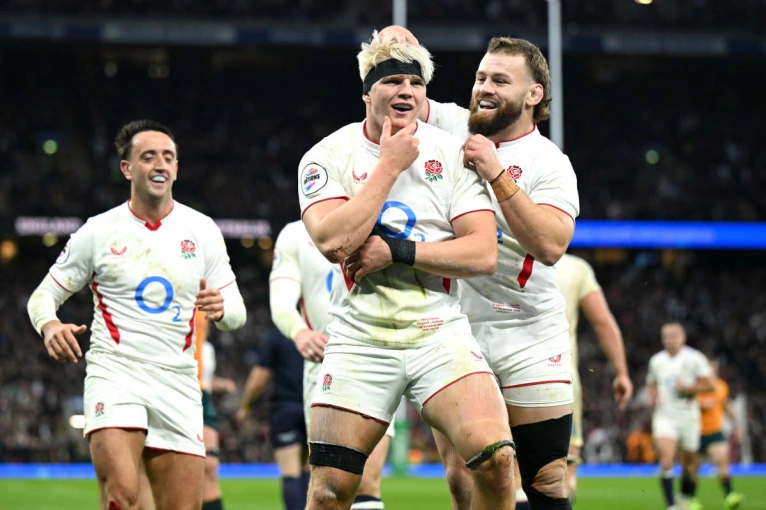
The top 10 has a new entrant in Thomas du Toit, a man the size of a house, who can exert pressure on both sides of the scrum and score a hatful of tries. What’s not to love. England’s baker’s dozen is an improvement on the 10 players they had listed last year and most have moved up the list after their 11-game unbeaten run.
At No 47, Henry Pollock, who was last year still getting teenage kicks at age-grade level, has made his name as an agent provocateur par excellence, who also happens to be a spellbinding rugby player, capable of bums-off-seats brilliance, and importantly transcending our, at times, conservative sport, in a similar fashion to Feinberg-Mngomezulu. Another country to rubber stamp their class is Argentina. Their contingent is up from six to eight players and is testament to a year in which they have run amok with Latin flair and ruffled the feathers of the world’s best.

The RugbyPass Top 100, our definitive ranking of the Top 100 men’s rugby players in the world today, is live! View the full list here now or via the RugbyPass App
The RugbyPass Top 100, our definitive ranking of the Top 100 men’s rugby players in the world today, is live! View the full list here now or via the RugbyPass App
Of course, with any list, there are players who have been inked in before another more compelling addition has been added and left us with regrets. Someone like Tom Willis, who has been, at times, unplayable for England and Saracens, or the mercurial Matthieu Jalibert, who cannot quite prise apart the watertight partnership of Dupont and Ntamack. Then there’s the prolific Georgian Aka Tabutsadze, or the Fijian human Exocet Bill Mata. Few would have quibbled with any of these players’ inclusion, and the same goes for Kwagga Smith, Jack Crowley or Ethan de Groot. All will be under consideration in 12 months time.
What I hope more than anything, is that lovers of our beautiful game learn something, or are able to debate with friends the merits of players and their placings, without descending into rancour or abuse. If you asked a 1000 fans for their Top 100, it would surprise no-one if every list was different. It was a hugely enjoyable process and we thank fans for their mostly engaging discourse to date.
In truth, we considered making this list biennial but with 17 players dropping out, and 17 newcomers replacing them (hello Thomas du Toit, Ollie Lawrence, Tom Curry and Fabian Holland), and others yo-yoing up and down the list, we are glad we’ve made it annual, so thanks once again for the support.
SFM is the best ATM says this AB fan
Here is my list of the top 15 flyhalves from the last 25 years (no specific order):
Carlos Spencer
Stephen Larkham
Beauden Barrett
Handré Pollard
Richie Mo'unga
Romain Ntamack
Dan Carter
Jonny Wilkinson
Finn Russell
Ronan O'Gara
Morne Steyn
Nicolas Sánchez
Dan Biggar
Owen Farrell
Quade Cooper
Each one of them had special talents that set them apart or above others. Quade Cooper’s creative passing, Beauden Barrett & Stephen Larkham’s pace and attacking flair, Jonny Wilkinson’s defense, Ronan O'Gara the tactical general, Dan Carter’s tactical awareness, Handré Pollard the playmaker & game closer, Finn Russell’s flair, Romain Ntamack’s calmness and skillfulness, Nicolas Sánchez’s composure and tactical control and the unconventional King Carlos with his incredible skill set.
I would say it’s SFM’s natural talents & attributes that set him well apart from the top 15 flyhalves we have seen the past 25 years. Out of the list above he has all these attributes and more as well as being bigger & faster than all of them.
Here are some of his talents & attributes SFM has as a no 10:
Bigger, stronger, more powerful, faster, more deceptive and an exponentially better line breaker
Is very square when receiving the ball
Very quick off the mark so opposition have to stay connected and commit to defend him
Great skill level
Kicking accuracy
Deceptive body language
Ability to pass run or kick (long/short/cross/grubber high) without the defense knowing which one of the 3 he is going to do
Does not stand still when making a cross kick
When he gets the ball, he is squaring up so this opens up his vision to see what is in front of him, drawing in defenders onto him because of his speed and line break ability & making space outside at the same time.
Speed around the park, vision to see the wrapping around to make extra man overlaps and the way he attacks soft shoulders and space using his acceleration are all outstanding.
A very, very hard player to contain, even more so playing behind a dominant Springbok pack like we have today.
Best thing about this young man is that he is now inspiring the next generation of flyhalves coming through so the very high bar he is setting is the benchmark for them to aim at.
(Ramble alert!) It’s a good list. I’m surprised not to see Sexton in there but it’a personal list. I’m looking forward to seeing more of SFM. I’ve been watching the game for over 50 years and loads of great newcomers ‘just’ seem like the latest version of some old favourite. Some newcomers really make me sit up and take notice of something I haven’t seen before and a few of those are still as impressive, even if a touch less explosive or whatever, when they retire. Mainly because of 30 years of professionalism the general level of average Tier 1 international players is stratospheric compared to the great farmers, miners, bankers, policemen etc of the good old days. Jonah in the mid-90s was a truly special case, and since then it takes a magnificent player like Dupont, Carter, O’Driscoll, or Hill to stand so far out. Dupont is well on the way but needs to maintain it, and SFM has shown me that he could be one of those amazing players that can capture and retain my attention like Gareth Edwards, Brian Williams or Mark Ella all those years ago.
Join free and tell us what you really think!
Sign up for freeSo many great tries, matches and individual displays in a championship for the ages, but which were the best?
England have lost four games in the Six Nations for the first time but their brilliant display in Paris provides a route forward
The backrow has come in for heavy criticism for his on-field behaviour but is he showing rugby is far less open-minded than it thinks it is?
This has been claimed a few times by Goode, but we’ve never seen any evidence for it.
…not the worst training plan I’ve seen!
Oh wow, was that him actually trying? It’s worse than we thought Jim…
10 bucks says none of the above.
Would love you to subject Irish rucks to the same forensic analysis eric…
An all boys school! Well that explains a lot…
Oh he was looking at her ‘stars’ alright eric…
Not if PSDT has anything to do with it…
Loving your optimism eric old bean, let’s see how it ages…
Don’t give up the day job jb…😉
Not sure that really helps you Eric, you’d be bang to rights in front of HR either way with this…😂


 Clear
Clear 


