
The greatest rivalry in rugby, All Blacks versus Springboks, is the biggest draw the sport has to offer. With the rapid improvement of the All Blacks under new head coach Dave Rennie allied to the crushing weight of history, it could turn out to be the most searching test of Rassie Erasmus’ coaching career to date.
NEW: Follow Your favourites in the App 📱
You can now follow their favourite teams, tournaments and players in the RugbyPass App!
A deep dive into the raw stats produced by the first three rounds of the Nations Championship only whets the appetite for the seven-week tour of the Republic which begins on 7 August, with a game between the Stormers and the visitors in the shadow of Cape Town’s Table Mountain.
The shape of the game and a bold new statement of Kiwi rugby identity in the Rennie/Sir Graham Henry era suggest the All Blacks are capable of not only mounting a serious challenge to Erasmus’ charges, they could even launch a coup d’état and seize the throne. Now wouldn’t that be something?
The shape of the game
A comparison of the past three major international tournaments north and south of the equator – the 2025 Rugby Championship, the 2026 Six Nations and the 2026 Nations Championship – indicates the overall trend is towards ever more attacking content: more points, more tries, more rucks and fewer penalties. The two most recent tournaments, the Six Nations and Nations Championship, lead the way, torch in hand.
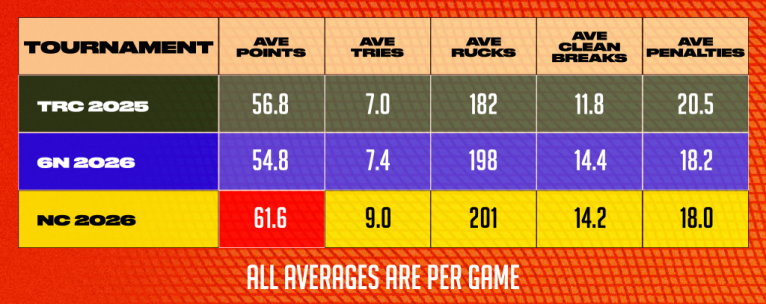
The 12-team Nations Championship includes a wider spread of rugby nations, and more imbalanced match-ups than a regular Six Nations or Rugby Championship. But that only partly explains the increase in scoring profile, and it does not account for the drop in penalty awards or the upsurge in the number of rucks built per game.
There were three and a half minutes more ball-in-play time at the 2026 Six Nations, and one and half more minutes at the Nations Championship compared to the southern hemisphere gold standard, the Rugby Championship. The game is becoming more fluid with every major iteration.
There is also much less of a true contest at the set-piece. Teams at the Rugby Championship were winning 84% of their own lineout ball, at the Six Nations the retention rate rose to 90%, and it increased further to 91% at the Nations Championship. Some 94% of the scrums at the most recent tournament were won by the feeding team, with the balance of penalties and free-kicks also weighing heavily in favour of the side with the put-in.
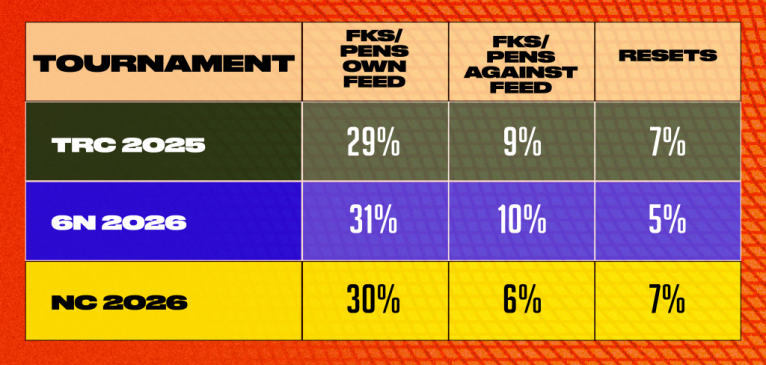
Scrums remain the bugbear of the professional game, often consuming as much as one fifth of overall game time while only producing clean usable ball on just over 50% of occasions.
Why the All Blacks will be tougher to beat in 2026
Since the unexpected ascension of ex-Chiefs and Glasgow coach Rennie to the national throne, and the appointment of Henry as his selector-in-chief, the All Blacks have undergone radical surgery and discovered a new playing identity, and that means it will be South Africa having to make most of the adjustments on the Greatest Rivalry tour. Compare the following two tables.
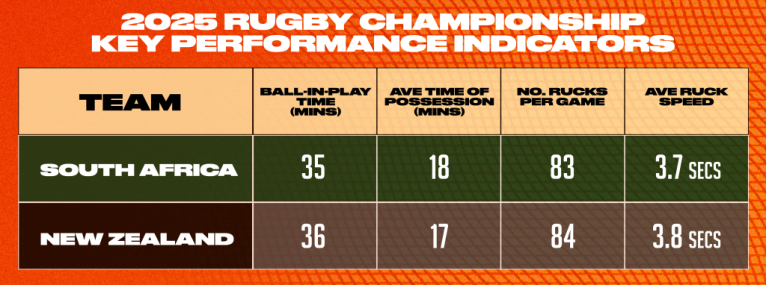
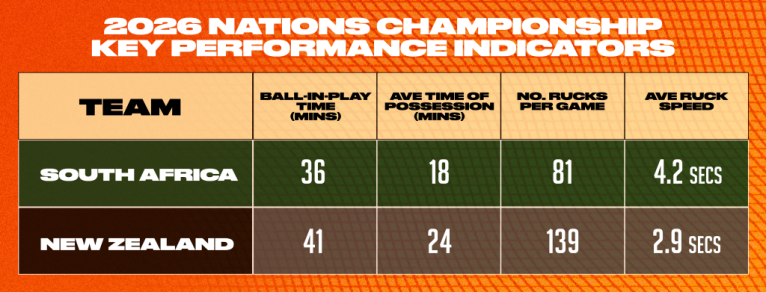
The new sense of New Zealand identity is something to behold. Scott Robertson’s All Blacks were trying to play the Springboks at their own game – very similar ball-in-play time and time of possession, no difference in the number of rucks set or speed of ball delivered from them.
Robertson and forwards coach Jase Ryan favoured the selection of a heavyweight tight five. But with Rennie calling the shots, tight forwards have been asked to drop weight and focus on their skills instead. Asafo Aumua and Ethan De Groot were two of the front rowers who featured in the 40-21 win over Ireland in the third round.
“I know I was eating quite a bit,” Aumua reflected recently. “I was a bit heavy heading into pre-season. But, happy to be back in decent, or good enough, nick to play the game.
“I lied to our nutritionist. I said I was 124kg, but I was actually 126kg. Now I’m 116kg. I was probably just eating too much. I was eating probably double the portions I should have been. But, I’m back to eating properly now.”
De Groot added: “He [Rennie] is allowing us to back skill and have a crack, so yeah, I’m enjoying that side of the game.
“It’s funny because ‘Barnsey’ [assistant coach Neil Barnes] actually gave me s**t for having no skills so I’ve been working hard on trying to prove him wrong with a bit of razzle.”
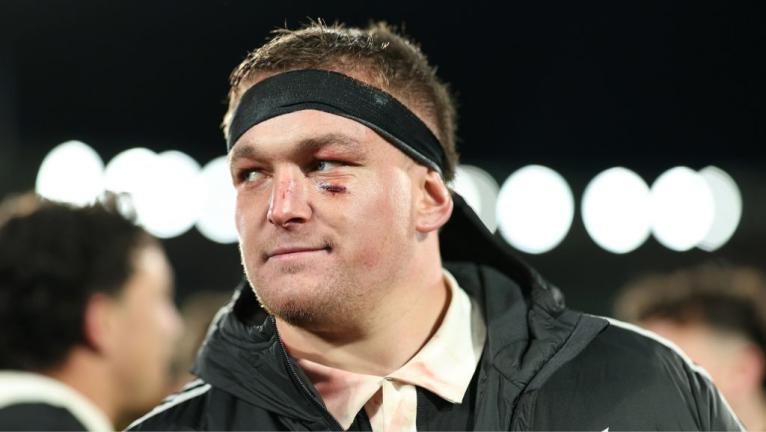
The results are there in the glaring black and white of the stats: games involving Rennie’s All Blacks have featured five minutes more ball-in-play, seven minutes more active time of possession and 55 more rucks built per game than Robertson’s, while the average ruck speed was one full second quicker at the Nations Championship than it was in the Rugby Championship.
Suddenly the All Blacks are recognisably themselves again. When the hooter sounded to mark the end of proceedings against Ireland, Aumua recalled skipper Ardie Savea’s command – to keep looking for another score. There was going to be no let-up in intensity.
“His message was ‘we’re not going to wind down the clock. We’re going to play.’ It’s been a constant throughout the series as well. Just trying to keep the ball moving, keep it alive. Try not to give the opposition a rest.”
The new firm of ‘Rennie and Ted’ has also taken positive steps to fix two gaping holes in the Razor resumé, the desire to score off turnover ball and a drastic drop-off in performance in the fourth quarter of games.
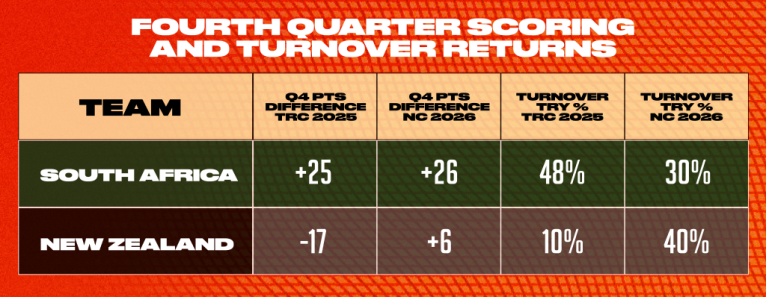
Where the Springboks are ahead of the game
The New Zealand set-piece still needs fixing. The lineout finished dead last at the Nations Championship with an 83% retention rate, compared to a Springbok set-piece running at 94%, even in the absence of 141-cap veteran Eben Etzebeth and experienced caller Lood de Jager.
Fabian Holland cannot return to national colours quickly enough, with the giant Dutchman having completed a tentative 40-minute stint with Otago in the NPC at the weekend. It was his first taste of rugby since dislocating a shoulder in Super Rugby pre-season on 6th February. Holland won 36 lineouts at the Rugby Championship last year, 20 more than the top Springbok [Etzebeth] and a dozen more than the next man, Wallaby Nick Frost. Whether he is partnered by Tupou Vaa’I, Josh Lord or Sam Darry, he will be an essential component of Kiwi success in South Africa. It will be a race against time to get him fully fit.
The scrum will be a bone of philosophical contention. Where the All Blacks envisage a restart and a launchpad for multi-phase attack, the Boks will want to use the scrum as a platform to win penalties, score quickly and terminally damage the morale of the opposition.
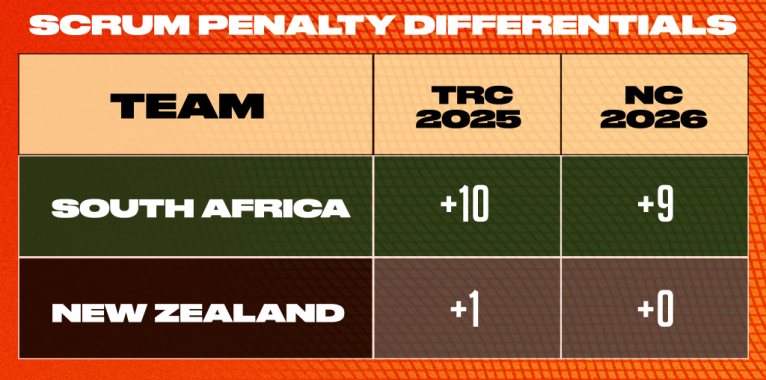
Ultimately, for all their considerable improvement over the Nations Championship, New Zealand will have to match South Africa’s sheer efficiency at scoring points, and this will be the toughest task of all.
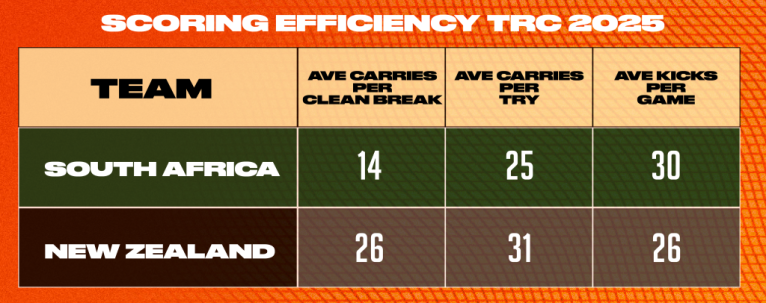
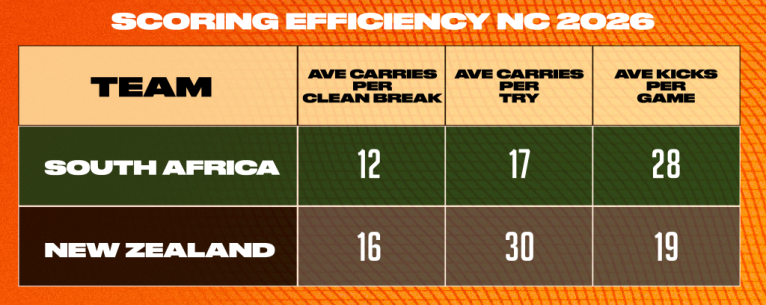
The South African scoring model remains more efficient than New Zealand’s. Although the current All Blacks are creating many more line breaks per carry than Robertson’s side did at TRC 2025, they still need to make as many carries to score a try in 2026 as they did one year previously. The Springbok offence, featuring more kicks and fewer carries, is leaner and more efficient at delivering tries quickly – and it may just have gotten hotter in July.
New Zealand have already established a clear-cut new identity under the auspices of Rennie and Henry. There is no longer any lingering doubt about how the All Blacks want to play the game. As Scotland showed in the second round of the Nations Championship, the new style will be good enough to inconvenience one of the greatest Springbok sides in history. It could even be enough to win a couple of Test matches. Will it be sufficient to carry off the spoils in a series for only the second time in the history of the Greatest Rivalry? The stats tale told at scrum, lineout and in the scoring efficiency table says “probably not”.
But if they can win, these All Blacks will experience the same euphoria as Zinzan Brooke at Loftus Versveld in Pretoria 30 years ago: “I was absolutely knackered on the bloody ground but just thinking, ‘S**t, we’ve done it.’ That was a moment in time where you think, ‘Right, we’ve done it!’ And for me, it just closes a massive door in life.”

Your home for rugby. Download the RugbyPass app on the App Store (iOS) and Google Play (Android) now!
Follow your favourite teams, tournaments and players, and get personalised news and Match Centre notifications direct to your device.
From live rugby streams and upcoming fixtures to breaking news, in-depth analysis and live scores, RugbyPass has everything you need to stay connected to the game.


In order to clarify things Graham which rolling 12-month period was that ? Starting from what date of month in what year and ending when?
And in that year did SA play every team in the Rugby Championship?
Yes it highlights the difference between that SA team and thhat ABs team. SA did it over a multi year window, starting at August 1997 and lost to England in 1998. Had a historic home defeat to the Lions in 1997 as well plus a large dip in performance following the defeat to England. The ABs had a 100% win record in the year for the season and then went on with it to form a world record winning run, plus they played the world's top teams multiple times…and when they finally lost, the continued the winning form afterwards. The historians view the SA lower for these very reasons and seen only as a short period of 12 months of success unlike the ABs who had a near 90% win record in a world cup cycle on top of this 100% season and 18 games win run. Regardless of this, the current Springboks team is not at the level of the that ABs team. Could they do it, sure potentially but only time will tell. If I was a Springboks fan, I would be far more interested in the potential of winning this upcoming RWC and what this means. It would mean that SA is the most dominant rugby nation in the modern era.
Perhaps this excerpt helps explain it better Olly.
The Springboks made rugby history by becoming the first international team to defeat every single opponent from both the Six Nations and The Rugby Championship within a rolling 12-month period, achieving an unofficial "global grand slam
Too long. Dont care. Good luck to you mate. Can’t help stupid.
Draws lines back up this conversation about ABs winning every game in a season…..draws pictures to you saying that SA did this and won the world cup…draws line to SA loosing to ABs that year and to Ireland in the pool games…draws line to the 50/50 record SA had against the Wallabies and ABs last season following your claim they dominated the SH teams….and when you get back to this comment just follow the line back up and repeat. At some point you will realise that SA is a good side and might be he best SA team, but they have not dominated like the ABs delivering a year/season beating everyone involving the top SH teams on multiple occasions and have not had an 18 game winning streak involving all top nations including multiple games against the top SH teams. If you got to this point just follow those line back up. I am over talking to someone who keeps changing what they are saying, making things up then trying the old throw another topic to avoid what they said all over the place arguing.
My goodness. And I’m led to believe our education system is lacking.
Oh lord. If only I could draw a picture for you.
The springboks have beaten every tier one team (indeed teams ranked in the top 20) in their last outing against them. That includes the ABS and Ireland. France. England. Australia. Wales. Scotland.
Do you get it now?
And my missus and I don’t fight. I’m wonderful.
Let me understand, you think SA won every game despite being beaten by the ABs and Ireland?????? Do you just make things up when you and your missus fight or is it just selective facts you work with?
Fifteen years olds are not allowed to marry unless he is an Afghan.
Biggest draw in the sport is Wales v England no matter how good the SH think they might be, the stats will show the biggest crowds and the biggest revenues come from the NH games!!
Only a mad man thinks the ABs are not in with a chance. The SA are a good side, but they are far from unbeatable…. They are not at the ABs-under-Steve-Hansen level….The SA scrum is good, but let’s be honest…the northern hemisphere scrums are not setting the world on fire at the moment, and I do not expect them to have this level of scrum dominance against the ABs.
They’re not “ABs-under-Steve-Hansen level” because the rest of the world is muuuuch better compared to back then. Damn if the SA scrum is only good whilst murdering the rest of the world for a few years now then I’d hate to see a great one.
Sounds a touch like Jason Ryan saying “never again” after the Eden Park match last year when their scrum got murdered and then the following week in Wellington it got massacred again👀
As far as I am concerned the statistics quoted mean nothing as both teams played different teams at different levels of ability. It is only when they get on the field that we will be able to assess how each team is likley to perform.
You could be right that the ABs had the stronger opponents in the NC?
Without wanting to sound simplistic: it’s all about the scrum.
If SA manage to affect a scrum dominance throughout the series then they will win. Its a safety net for them - an ultimate fall back position if the game feels like it might be moving away from them.
Even if they are being outplayed in other areas, as we witnessed when they played Ireland last year, say. they can simply opt to strangle a team into repeated scrums. From this base, they can force penalties and cards and take a hold of the game, accordingly, through sheer attrition. Historically, this was also the case against touring NZ teams too and its a staple of the Springboks’ whole psychology - if the scrum is on top, they think they will win.
The scrum itself boils down to pure physics, really, and SA have generally managed to locate huge physical specimens at hooker, prop and lock, which is then augmented by powerful loose forwards that also know how to maximise their driving weight into the collective.
If NZ can match this, then build some momentum in other areas. as is their own natural game, then they can win. Of course. comparing the physics of opposing packs does require accurate data to input into the calculations. It doesn’t help when online data is often completely misleading….
“I lied to our nutritionist. I said I was 124kg, but I was actually 126kg. Now I’m 116kg. I was probably just eating too much. I was eating probably double the portions I should have been. But, I’m back to eating properly now.”
He’s still listed as 108kg on the official All Blacks site……
The scrum will undoubtedly be a vital factor - see next article!
The ABs matched the Boks in that area in 2024 with a fit Lomax, but didn’t in 2025 without him.
Hi Nick, how are you…? I think that in the 2026 Nations Championship, surprises were always "just around the corner," as we say in Argentina. Beyond some predictable results, the real novelty lay in the evolution of playing styles. Scotland, for example, made a remarkable offensive leap: in their match against Argentina, they needed the fewest attacking possessions to score a try, even surpassing England and Wales (Argentina's other group rivals). The map of offensive evolution leads to a clear conclusion: the gap between Tier 1 teams fluctuates every season, and simply controlling possession or territory is no longer enough, because the advantage belongs to those who convert their opportunities most efficiently. I think that evolving is no longer optional: it's the key ingredient for staying competitive.
Hi Fran hope all is well and good comment as always…
I have a sense evolution in the game is moving pretty fast right now, helped by the reffing!
Came across this clip thought everyone might enjoy it.
https://www.facebook.com/share/r/1Bw75DGrP4/?mibextid=wwXIfr
The Springboks will be delighted Matt Carley has the whistle for the series opener at Ellis Park.
Nika Amashukeli is the ref in Cape Town, Angus Gardner in Soweto and Karl Dickson will do the Baltimore Test.
In theory yes Mitch. But if ABs don’t disntegrate like Ireland did in one key area he could be free to find his wings like Pearce or Dickson!
Absolutely Nick - the ref used to dig his heel into the turf call scrum, the opposing front rows all knew exactly what they had to do and engaged spontaneously and the scrummie put the ball in - and it invariably came out. And the whole process took less than a minute.
And yes, against the head ball is one of the best attacking situations you can get with the mindset of attack suddenly having to hastily convert to defence.
I have never perceive you to promote a perspective that favoured one country or another. It is obvious that you have friends, loyalties and observations which transcend national boundaries, which is why I enjoy engaging with you.
The problem with having 4-5 weeks between the start of the greatest rivalry and the end of the July window is that its a damn long time to wait before the action actually starts!! Lots of people talking about what could and should happen on the field. I just cant wait to actually see it. Fair points though in the article. This series should be the closest to the intensity of a world cup that one can get, it may even be more intense. What does a series like this do for both sides who are now shaping up as polar opposites in style before the world cup? well It allows both teams to heavily scrutinise themselves intensely 1 year out from the showpiece. It will create alot of soul searching and will provide a deep dive into each respective teams playing resources. it presents both sides with an opportunity like no other. In my opinion this tour is a masterpiece and stroke of strategic genius by both unions. It will prepare South Africa and NZ more completely for the world cup than any of the other nation. It is the ultimate test of strength and its for that reason that I think SA and NZ will both take a significant leap in their WC prep for next year which could keep them ahead of the world for some time to come.
More deep dive coming later this week NLR!