
When the ‘Razor’ Robertson era began with a two-Test series against England in July 2024, one of the men sitting on his shoulder in an advisory capacity was Sir Wayne Smith. ‘The Professor’ enjoyed the nominal title of performance coach and he returned to camp ahead of the first game in the double-header against the Springboks at Eden Park a few weeks ago.
As I wrote back then, this seemed a clear sign Robertson would move the men in black back to the future, and reinstate Smithy’s world-conquering counterattack which had dominated planet rugby for the better part of a decade.
How wrong I was. Despite his frequent visits to All Black HQ, the influence Smith’s philosophy has had on this coaching group is to put it politely, negligible. There is little evidence of Smithy’s counterattack policy and the All Blacks no longer run away from opponents in the fourth quarter under its power. New Zealand was minus 17 in the points for/points against ledger in the final 20 minutes at the Rugby Championship – well behind South Africa and Australia.
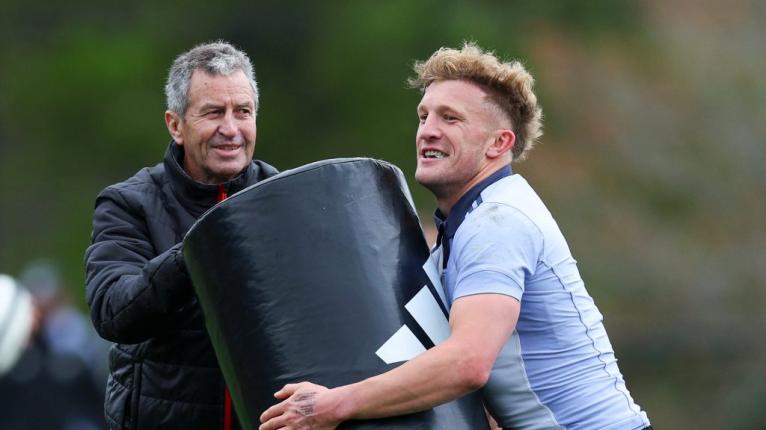
In the salad days of the Henry-Hansen-Smith trifecta, the Professor borrowed heavily from the National Basketball Association; the Los Angeles Lakers ‘fast-break’ offence of the 1980s, recast by Gregg Popovich’s San Antonio Spurs three decades later. The idea of ‘showtime’ was to create a turnover with strong defence, then use transition sprints to spread the court and create two-on-ones and three-on-twos on the counter, with strong drives to the basket to pull in defenders and create space for others. Super-slick passing and the swift identification of mismatches were key to success.
In the great All Blacks teams of the 2010s, Smithy wanted 14 men on their feet in defence, generating lightning-quick turnovers with the ball passed through second receiver automatically, and everyone working at maximum capacity for the first three phases of the transition from defence to attack. As he observed during an excellent Rugby Site mentoring session:
“When I was young and playing the game at youth level, I was taught you always base your attack on what the defence is doing. Your kick counterattack should be based on what the opposition chase is doing.
“I want to try and grow the understanding of how to counterattack off kick receipts, what to look for, and how best to exploit a chasing line. You get stable as soon as you can as an attacking team, and attack them while they are still unstable, or unstructured as a defence.
“It’s the best chance of success. There is a great attacking platform [to be had] off turnover and kick receipts. Counterattacks dominate the scoring in the modern game, and it’s a part of the game that needs to be coached.”
The Professor’s aims were the same as the Lakers’, who won five championships in that golden decade of the 1980s, and the Spurs with their four NBA titles achieved between 2003 and 2014. In Smithy’s heyday the All Blacks would score around half of their tries via counterattack off either kick receipts or turnover ball. Look at the performance of Razor’s All Blacks at the current Rugby Championship, and the stats tell a very different story.
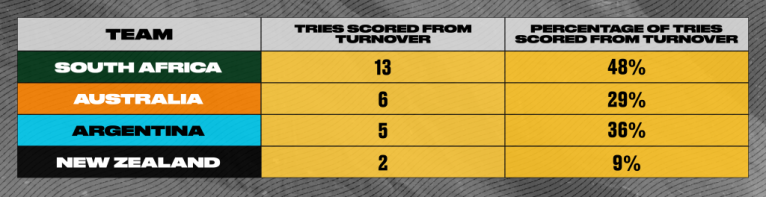
Wind the clock back 10 years, and you would expect this table to be the other way around. Now it is the Springbok who are confidently expecting to exploit unstructured countering situations, and the All Blacks have sunk to the very bottom of the pond, with only two tries deriving from turnover scenarios.
The first Bledisloe Cup game against Joe Schmidt’s Wallabies gave an indication why that is the case. The following general table shows what the All Blacks were doing with their turnover ball at Eden Park.
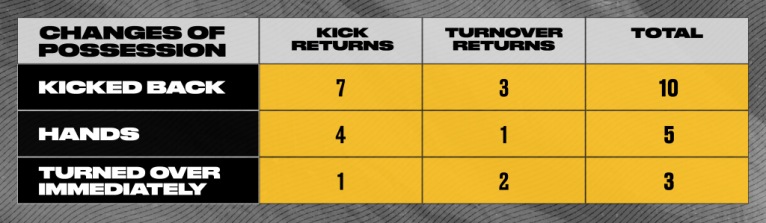
- Of a total of 18 countering opportunities in the game, the All Blacks kicked back 10 [56%], turned over three immediately [17%], and only ran back five [27%]. All five returns direct from kick-off were either kicked back to Australia immediately, or after one short forward phase. There was no attempt made to run back out of their own 22.
- Of the five returned through the hands, two attacks switched back to the short-side within the first three phases, while the other three utilised the full width of the pitch. Of the three which used the full width, all had positive outcomes, with one penalty won, one clean break, and a try.
- New Zealand did not return a kick using the full width of the field until the 53rd minute, and it resulted in a break by Jordie Barrett. They scored their only kick return try of the tournament so far in the 75th minute to clinch the match.
When New Zealand assistant Scott Hansen talked recently about what improvement would look like on the forthcoming end-of-year tour, it did not sound as if explosive counter-offensives from deep were on the menu.
“It’s [about] growing our set piece, the quality possession that we provide… It’s applying pressure in the right area of the field.
“We’ve had a good review of the most recent competition around where we can get some learnings, and fundamentally for us, that is about controlling possession.”
The risk-averse policy off turnover ball was amply illustrated by two sequences occurring in the first half.
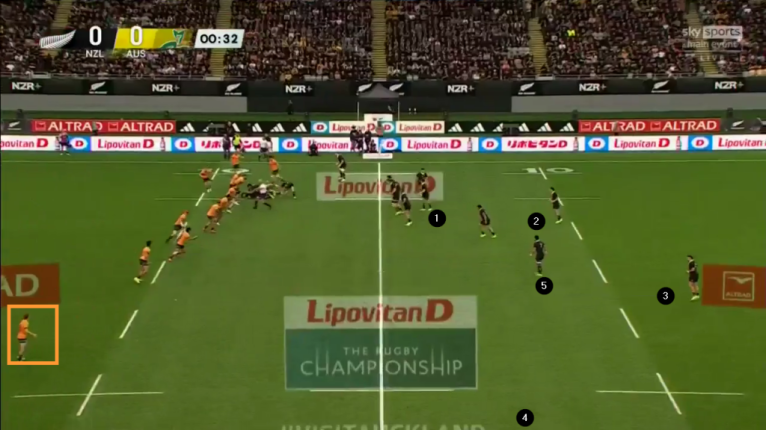
After a magnificent defensive catch by Jordie Barrett, the Walalby defence is offering space out wide, with the last edge defender [14 Harry Potter] standing inside the far 15m line. There are four New Zealand backs available to the wide side of the field and left wing Caleb Clarke is standing beyond Potter on the touch-line. The ace up the Kiwi sleeve is the presence of Ardie Savea [‘5’] as the widest forward, and we know how lethal Ardie can be in space or in one-on-one contests.
The Wallabies are giving New Zealand width but the All Blacks are refusing to accept the free gift.
Clarke is ignored completely, and instead of using Ardie as a runner the All Blacks use him rather tamely, to clean out over another forward run in the middle of the field. There is hardly any sense sense of ‘fast-break’ urgency as he ball is shifted back to the short-side and Wallace Sititi is hustled into touch.
The same pattern was repeated just after the half-hour mark.
Another catch by Jordie, another automatic forward run and switchback to the short-side on second phase. Within two more phases of play, the ‘counterattack’ had decelerated to the point where there was no option but to kick the ball back to Australia via the boot of replacement Damian McKenzie.
A turnover return in the eigth minute had showed the way, but it was not until the 53rd minute the men in black picked up the hint and ran with it.
Here is the Professor’s theory of mismatches in action, with a line of Kiwi backs facing a defensive group featuring two forwards, Harry Wilson and Lukhan Salakaia-Loto, running inside the last defender Max Jorgensen. The real mystery was why it took the All Blacks another 46 minutes of game time to locate the same space. When they finally did, it looked very much as if Jordie Barrett had had enough of the gameplanning straitjacket.
It was almost the first time in the game that there was a definite uplift in the All Blacks’ intensity and speed in a situation with a change of possession, as the ex-Leinsterman glides past Fraser McReight on the mismatch.
Twenty minutes later, the All Blacks worked hard to realign as a countering team for the first time in the game and reaped an immediate reward on the kick return.
Replacement second five-eighth Quinn Tupaea doubles back in double-quick time to make the extra man in midfield, lightning-quick ball links the pod of forwards and the backline instantly, and between them Billy Proctor and Tupaea are able to exploit the defensive uncertainty of Joseph-Aukuso Suaalii at centre. A current Chiefs man sets up a try of which a great ex-Chiefs coach would have been proud, but It was the first time New Zealand had scored a kick return try in over 400 minutes of footy.
If Smith is casting an close eye over the current All Blacks, in his more reflective moments he is probably wondering what has become of the counterattacking strategy he devised. The sense of urgency, of a countering team working at maximum speed and pressure in short, overhwelming spurts of activity is almost entirely absent. A couple of one-out forward rumbles followed by either a switch back to the short-side, or a tit-for-tat kick to the opponent are far more likely. ‘Showtime’ it is emphatically not.
Back in 1982, the LA Lakers finally abandoned a Paul Westhead-coached, half-court offence which Magic Johnson had derided as ‘slow’ and ‘predictable’. Johnson folded his arms and went on the sporting equivalent of a hunger strike, and Lakers owner Jerry Buss backed him to the hilt: “There was a lack of excitement on offense that I missed. I enjoyed Showtime and I wanted to see it again.I’m speaking as much as a fan as anything else.”
New Zealand rugby supporters may be thinking many of the same thoughts 43 years later. Without that full-court dynamism and the sense of pure theatre involved in a counter from deep, who exactly are Razor Robertson’s All Blacks?


100% agree.
They really embarrassed it huh, new pitch’s and everything, playing on turf. Wow! Had kinda wonder what brought it on, one man at the top?
Prop. Either side
It’s not a tough one at all. Turning around and running back into someone is the same as dropping into contact, they only factor you need to be concerned with is whether it was predictable. You have not seen someone veer away from a tackler and then do a 360 to run back into that player again since that incident. Personally I think it was part of their strategy to isolate Frizell, as soon as he saw him lining him up he ran into Cane to take the tackle.
Cane did bend at the hips, he was bent 45%. Obviously not enough/time wise etc, but not much less than say Kolisi in the same game. His problem if you go and review the tackle is that the contact point was at just the same time as his stride was directly under him (so full hieght extension). If a player wants to avoid yellow in those circumstances they need to be aware enough to sort of keep your feet together tripping yourself up. Of course it’s not fullproof as your head is then in danger of making contact instead, but things like passive tackling (if you dont have time to bend the other option is to stay erect and soak it) still gets you carded (and in a case like Ta’avaos v Ireland, red carded sometimes).
Yeah some great bombs. He could be a good back up to Dmac and Richie still, if that is happening.
I can’t see him getting is running game back though, I think Razor blew that chance after making him a start at 10 again, when he had showed he had returned from Japan as a good counter attack weapon at full back. I saw a possibility his running game could flourish again. Not anymore.
Prem a much more open comp than it used to be….
I think it it is just the phase of the rebuild. We will see much more transition attack from NZ in 2026.
That was my thought . . . Because I promise the opposition 10 would take a step away from Leicester, whilst the opposition 12 would be asking his 13 to take a step closer and I just think him at 12 would get both DMac & Jordi and extra foot of space (which is all they need).
I’d then pay money to see LF tackle Wiese or Esterheizen at full flight in that 12 channel - it would be box office level of collisions.
Unfortunately, I raised this and NB simply asked “in that case why has no coach ever played him at 12?” and whilst i hate to admit it NB may have a very good point. I’ve told him to stop using logic in these debates . . . But he still pulls out a few pearls of wisdom. In fairness, he believed it should be JB/LF, so he isn’t far off. 🤣🤣🤣
He did but he’s probably the coach with the most integrity and respect in the game and is probably the only bloke that could keep those 3 working together and not ending up by having 3 of the most intellectual rugby stags going at each other.
The depth of that knowledge base would be incredible and I would love to see the type of rugby they would create. It would be sheer joy on a pitch.
Like most Unions, they bring in a change and the communication of how it all works to the fans is either non-existent or deliberately murky (as they make most of it up along the way 🤣).
What has become clear with ENG is that whoever gets one goes automatically into the squad if they are fit, so 25 of our 36 squad are basically set in advance. Then they have 11 players to fill out the squad, so form is no longer the major factor and the coaches need a longer time with the players to get them used to the ever increasingly complex systems of play.
We were getting better last 6 Nations but having just lost both Currys to injury and Tom Willis being dropped from the squad last night, we have spent a year rebuilding the back row and lost all of them in one go.
We’ve also got some young talent coming through (QUIRKE, ATKINSON. OJOMOH, ARUNDELL) but whilst Atkinson is injured, I very much doubt they will be given much of a chance.
It sounds awful but INJURY has become our best selector and is the main way they finally get their chance.
Lee Blackett is a much more attack orientated coach but he needs quick ball and it will not help losing our power carriers (LCD will be banned, MARTIN, WILLIS) and we look a bit lightweight with those players gone and the next line of replacements being injured HILL, EWELS etc.
The starting side will be not far off last year but the bench is stronger. There’s an argument we are 5 starters short this Autumn, so you can see how that will fuether strengthen the bench when they return.
Having seen the squad, I think NZ will edge us again. Thankfully we don’t play SA this Autumn (they would shred us) so the next big game will be FRA (Away) in the 6 Nations and that will be a true test of where ENG are at.
Mid field scrum 20 meters out with A Savea taking the ball off the back with Mo’unga and B Barrett on either side. Jordan standing behind the scrum to be the third man in the chain. That would make a defense coach cry.
Good question, the £35m for ENGLAND RUGBY covered all the costs except players and the £30m contribution to PREM RUGBY was the salary side, so all up there is an argument to say it costs £65m.
The figures will change slightly this year as ENG rugby have started offering the 25 central contracts with £160k payment to the player and the clubs pay less (in theory), so we have added another £4m of cost but you then don’t get the matchday fee (£15k per game).
I would say RFU is operating on a buget of £65-70m in total, which is why people call them the best funded Union.
It’s mainly because they charge us through the roof for matchday tickets (£150 a ticket to sit with the gods) and because they own Twickenham stadium, so it only costs them £15m a year to run (hence the huge margins).
It’s nuts how profitable International Rugby has become and how difficult the economics are at a club level (mainly due to the player salary levels). Tricky balance.
I’d like to see Fainga'anuku at 12 and J Barrett at 13. Power and distribution combo.
McKenzie could ‘bail out’ to Fainga'anuku who would make the gain line, or to J Barrett to distribute further or for McKenzie to double around from.
What was your position?
B Barrett was looking really good in the first Bledisloe test this year. Playing within himself. Driving the team around. Great contestables.
Maybe he is learning a new way to play, now that his physical gifts aren’t what they used to be?
Smith failed as main coach in 2000-2002. Some said his brain was too big to focus and see the wood for the trees. I’d still have him in the mix.
I’d have Jamie Joseph as main coach. He was ‘hard nose’/‘no prisoners’ player. That’s the attitude you need as a main coach. The assistants can nurse the bruised egos.
Also, John ‘The Journey’ Michell doing double duty as press manager🤣
I watched the ‘Try from the end of the world’ live on tv. Still can’t believe it. I thought the All Blacks had the series drawn and squared away. It’s never over until the fat lady sings.
Jona Nareki could do it.
Robertson could’ve played Love at 14 and given him time, late in the game, at 10.
They way he ran at the line, big players, 5-6 years ago was just nuts. Man, as a sub, could you imagine every ruck for the last 20 mins of the game starts with him taking a snipe at some space around the edges? You thought this Razor team was tiring themselves out, a young Dmac at 9 would have left everyone with rubber legs.
Yeah for sure, it’s just a bugger it didn’t work out. I too think that if BB needs a challenge Razor should be creating that environment for it rather than gifting him the jersey. He could also be doing it out of spite in Dmacs Bledisloe 1 performance, another poor thing to do. It would be so much better if say Barrett was given succinct roles he could be successful at, and which made him want to do more, no I feel like if he gets dropped he’s probably not going to see the point in continuing.
I was pretty happy with Rieko’s effort and commitment to his move to 13, I have ‘what ifs’ for both his progress as a 13 and what he might have remained as an 11, but he was a solid defensive lynchpin in the end.
I’m really all for involvement of everyone aye, these athletes and their ideas especially, but I think it requires a really special person to facilitate. I have more confidence in Razor than Foster in that regard still. I worried his assistants especially start loosing the players though.
Still think McKenzie would’ve been an all time great: 9, 10, 14, 15. Bring him on at 9 with 20minutes to, with Mo’unga at 10 and B Barrett at 15.
Mo’unga would be too small, at 85kg, for a 12 these days. Imagine him marking a Bundee Aki or Nonu style 12?
Yrs agree. I don’t just think its them either. I think many Kiwi fans feel it too.
I’ve noticed an ongoing tendency for any of your New Zealand focused articles (and some that aren’t focused on New Zealand) to degenerate to a ‘vigorous’ discussion about the merit’s of Mo’unga as a test 10.
As you are one of the few authors that really engages in the comments (which is awesome, thanks for taking the time and effort to do so), I can see how it gets tedious; like kids arguing. Especially as both sides of the argument seem to want you to say the other side is wrong.
The big issue seems to be the entire coaching panel.
Yep they were on the ball, did a great job. I was really proud.
Nick wrote articles about how it wasn’t scalable, Joes teams and structures had limits, but from where we were, couldn’t have asked for anything more.
I think both Schmidt and Cron are a bit angry at how Foster was treated. Doubt they’ll assist Foster’s replacement. Would be nice to see both of them back in black suits.
Yes probably as far as you’d want to go of course, hard to see one union juggling more than 5 teams, let alone a full dozen or whatever you’re likely to get back to.
So say NZR has 270mil revenue %40 of that is for players, 108mil is “professional” bill equivalent of 45mil pound. That obviously doesn’t count the logistic parts of “NZ Rugby” teams, so i wonder how much of the 35mil RU pays for its teams is logistics as apposed to playing bonuses. Could be similar numbers in the end I suppose. NZR doesn’t break its financial reports in the same way you described englands. NZR has disclosed the costs of it’s teams before actually.
I don’t think they’d want to move any further towards more control. I’m pretty sure all players came under NZRPA negotiated share, NZR basically have to spend that amount of money each year on players. Not sure if it gets broken down any further than that. Would be interesting to know SRs take, pretty sure most its players would be on the 150k minimum. That’s 200 players so maybe a third of our total pool is Super Rugby. So now that England plays are on retainer is RU still giving 30mil to PR? That would be a lot on top of Test players, but I guess theyre doing more of the grunt work there too, where as a separate portion would go to our other domestic league, SR only being involved in a port of the HPPs
LG/JB/TQ+ at 12/13?
🏳️🌈
I just wanted to say how much I enjoyed this discussion and o thank the various posters for their contributiond throughout. I thought this was one of the best NB discussions we have had on here. Thanks Nick, great debate.
Some one bought his name up and the conversation went in that direction.