
In the Shona language native to Zimbabwe there is a well-known phrase: ‘tsimba itsoka’. It means ‘no foot, no footprint’ and it refers firstly to the footprint an animal may leave on the veld; on the larger scale of human activity, it highlights to the deep mark a man or a woman may leave on the ground of life.
NEW: Follow Your favourites in the App 📱
Users can now follow their favourite teams, tournaments and players in the RugbyPass App!
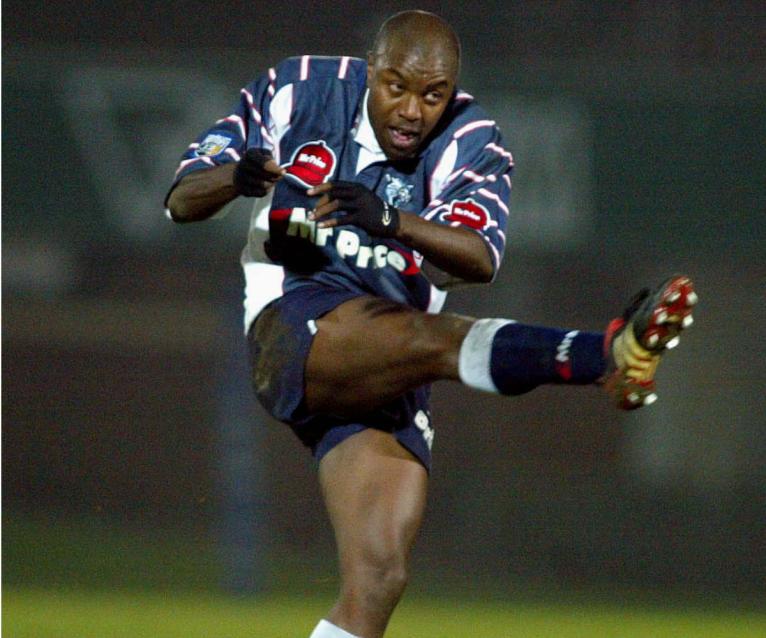
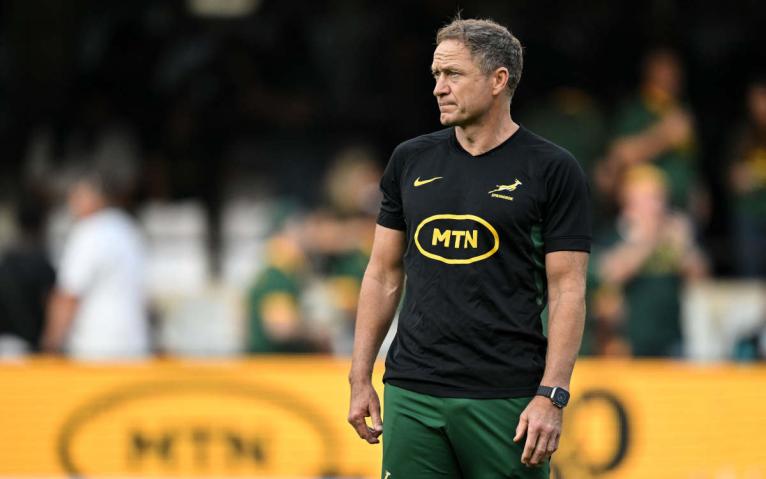
A few weeks ago, I met Kennedy Tsimba, the current Skills coach of the Pretoria-based Bulls. As a player, Kennedy was a star in Sevens and he was anointed the ‘King of Bloemfontein’ for his record-breaking try-scoring feats with the Cheetahs. Tsimba became the fastest player to score over 1000 points in the Currie Cup, the Vodacom Cup and Super Rugby during his six-year stint in the Vrystaat and he is remembered. The footprint is strong.
In his second lifetime as a skills coach, Tsimba is looking to transform the understanding of what rugby can be in the professional era. He reminds me of Sir Wayne Smith, helping create a new climate for attacking rugby in the Republic. He is digging the same irrigation ditches, and siting the same sprinklers in South Africa as ‘the Professor’ did in New Zealand.
During his time as peak coaching influencer in the Henry-Hansen epoch with the All Blacks, Smithy borrowed from the Los Angeles Lakers’ legendary ‘fast-break offence’ in the 1980s and traded basketball coin for rugby gold. The Lakers created turnovers with strong defence and used high-intensity transition sprints to spread the court and create two-on-ones on the counter. Super-slick passing and the swift identification of mismatches were the key to success.
In the great All Blacks teams of the 2010s, Smithy wanted 14 men on their feet in defence, generating lightning-quick turnovers with the ball passed through second receiver automatically, and everyone working at maximum capacity for the first three phases of the transition from defence to attack. As he observed during an excellent Rugby Site mentoring session:
“When I was young and playing the game at youth level, I was taught you always base your attack on what the defence is doing. Your kick counterattack should be based on what the opposition chase is doing.
“I want to try and grow the understanding of how to counter-attack off kick-receipts, what to look for, and how best to exploit a chasing line. You get stable as soon as you can as an attacking team, and attack them while they are still unstable, or unstructured as a defence.
“It’s the best chance of success. There is a great attacking platform [to be had] off turnover and kick receipts. Counterattacks dominate the scoring in the modern game, and it’s a part of the game that needs to be coached.”
Now ex-Otago first five-eighth Tony Brown and Kennedy Tsimba are spreading the same gospel in South Africa, in a culture which has traditionally emphasized the power of defence, kicking and set-piece. Both the Springboks, and the teams below them in the URC, are becoming more and more ‘comfortable in chaos’. Kennedy sent me the following transcript, summarizing the impacts of what he terms ‘Shift Theory’:
Why Transition Matters. The Coaching Conversation Rugby Needs to Have
Every coach knows the feeling.
You spend a week preparing for the perfect lineout launch. The attack shape is clear. The defensive system has been rehearsed. Every player understands their role.
Then, three minutes into the match, the ball ricochets off a contest, two players slip, someone instinctively chips ahead, and suddenly everything you rehearsed has disappeared.
The game has asked a different question.
For years, rugby coaching has become exceptionally good at preparing players for certainty. We have built sophisticated attacking systems, defensive frameworks and set-piece detail that continue to raise the standard of the game.
Yet rugby has never been played entirely on the coach’s white-board. It has always belonged to the moments when the picture changes.
Imagine teaching someone to sail.
You can spend hours explaining how to steer, trim the sails and navigate calm water. But no sailor is ultimately judged by how they perform in perfect conditions. They are judged by what they do when the wind suddenly changes direction.
Modern rugby feels remarkably similar.
The teams that consistently succeed are not simply those with the best systems. They are often the teams that recognise change first and adapt before anyone else.
That observation has shaped much of my coaching journey.
Rather than asking, “How do we become better organised?” I found myself asking a different question:
What happens when organisation disappears? That single question led me into years of studying elite rugby through the lens of adaptability. It led me to examine the Springboks’ ability to thrive under pressure, to explore why certain international teams appear so comfortable in broken play, and even to look beyond rugby into football, where transitions have long been recognised as moments that define matches.
The more I observed, the more one idea kept returning. Perhaps we have misunderstood where modern rugby is really played. Not inside structure. But in the moments between structures.
Those moments are rarely neat. They cannot be fully scripted. They arrive disguised as turnovers, kick returns, loose balls, unexpected offloads and defensive collisions. They last only seconds, yet they often determine momentum, field position and, ultimately, the outcome of games.
The challenge for coaches is no longer simply to build better systems. It is to prepare players for the instant those systems dissolve.
This is not an argument against structure. Far from it. Structure remains the platform from which teams launch their ambitions. But perhaps our coaching conversations have become unbalanced.
We devote extraordinary energy to teaching players what to do when the picture remains stable. Should we now spend equal energy preparing them for when it changes?
As rugby accelerates towards Rugby World Cup 2027, the margins between the world’s leading teams continue to narrow. Physical preparation is exceptional. Tactical detail is extraordinary. Skill levels continue to rise.
The next competitive advantage may not come from another attacking pattern or defensive system. It may come from helping players become more adaptable than their opponents.
Over the coming months, this series is not intended to present all the answers. Instead, it aims to start a conversation. Through data, coaching experiences and discussions with some of the game’s leading thinkers, we will explore a question that I believe deserves greater attention:
Are the moments between structure becoming the most important moments in modern rugby?
Because sometimes the future of a game does not begin with a new tactic. Sometimes, it begins with a different question.
South African players have always been powerful and physical, but the dividend from the shift theory taught by the likes of Tony Brown and Kennedy Tsimba is helping players become more adaptable than their opponents, and that is a new addition.
The proof of the pudding lies in the development at national level since the 2023 Rugby World Cup. At the 2025 Rugby Championship, South Africa topped the charts for tries scored off turnover ball with 13, seven more than the second-placed team Australia. It accounted for a massive 48% of their total try-scoring output.
In the URC 2025-26 season, the Bulls scored 24 tries off turnover, joint first in the competition with eventual league champions Leinster. The Professor would be silently nodding his approval at the improvements South African rugby has made.
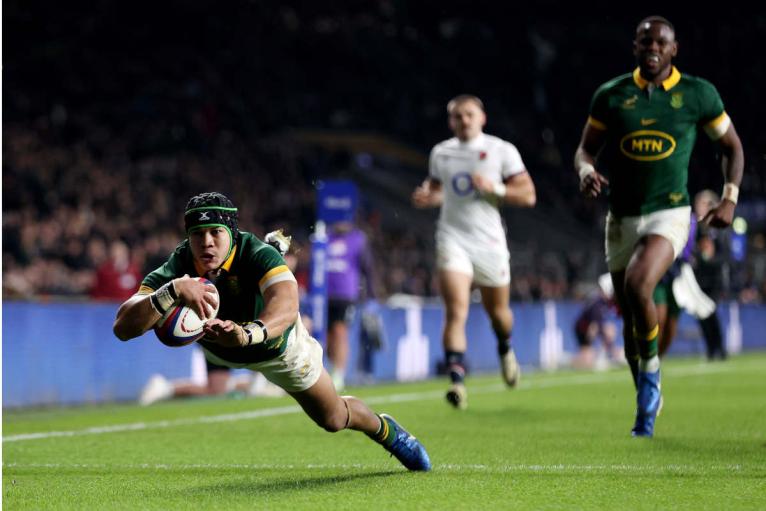
Transitions or ‘shifts’ begin with the opening action of the game, from kick-offs. The first kick of the match usually signifies a change of possession from the kicking team to the receiving side, and the restarts thereafter occur at ‘chaotic’ or transformative psychological moments when one side has just scored points, and their momentum can either be reversed or reinforced on the next sequence of play.
The opening game of the ‘Greatest Rivalry’ tour illustrated how these moments can be exploited by a team attuned to the counter-attacking wavelength Wayne Smith and Kennedy Tsimba describe. The All Blacks ran the ball back at both of the first two kick-offs at the DHL stadium in Cape Town and the dynamics of the process are worth examination:
— William Bishop (@RPvids1994) August 10, 2026
The home side start with a typical kick-off chase formation, with a 12-man chase, two defenders dropping to the backfield [#10 and #15] and the #9 hedging his bets in between the two lines of defence. The kick goes to the left – the forwards’ side – so that the remaining backs can protect the wide side of the field if the receiving team elects to run the ball back.
There are already some important ‘moments between structure’ of the sort Kennedy mentioned in his introduction. The Stormers scrum-half has not decided whether to join the front line or drop back, and there is a temporary imbalance with the chasing forwards and backs split to opposite sides of the field.
During his time as head coach of the Glasgow Warriors, Dave Rennie got more ‘pay’ from kick-off returns than any other coach in the URC, and exploited the opportunities presented by such moments outstandingly well. The All Blacks begin with a wide play dragging both of the Stormers’ centres towards open-side touch at 0:14, then pin them there with another short-side phase at 0:27, where all of numbers 12, 13 and 14 are trapped in or around a ruck only seven metres from the right [defensive] side-line.
This gives them a free shot at a midfield mismatch on the next play, with dynamic back-rower ball-carrier Peter Lakai lined up opposite two Capetonian props, #3 Neethling Fouché and #1 Vernon Matongo, and Lakai runs straight past Matongo on a long gallop upfield.
The second clean break from another kick-off return occurred only six minutes later:
— William Bishop (@RPvids1994) August 10, 2026
The set-up is the same, with a longer kick to the left or forwards side, the Stormers’ three-quarters aligned to the right, 10 in the backfield and 9 hedging his bets on the left of the chase. One midfield phase is enough to split both of the home side’s centres to the right of the ruck, and between them #2 Samisoni Taukei’aho and #9 Cortez Ratima are able to evade a couple of weak tackles by front-rowers Matongo and André-Hugo Venter to create the mismatch break.
The same chase pattern from kick-off was pulled apart by the Pumas in the Argentina-South Africa encounter on the following evening:
— William Bishop (@RPvids1994) August 10, 2026
The key ‘moment between structures’ in this instance occurs when Springbok #9 Cobus Reinach decides to fill in on the line at 10:30 and leave the gap between the two lines of defence untenanted. With the Bok three-quarters looking to rush upfield on the right, the two factors combined open the space for a successful chip-and-regather into the space by Pumas #9 Simón Benítez-Cruz.
Those moments when the coaching picture changes are among the most interesting in the modern game, and Kennedy Tsimba is one of the men gleaning the lessons from them. What happens when structure breaks down? What happens when the challenge for coaches is no longer simply to build better systems, but to prepare players for the instant those systems dissolve? These are the questions we will explore in a series of articles in the coming weeks, as the Greatest Rivalry tour builds to a climax, and beyond.

Watch Rugby's Greatest Rivalry LIVE
Two rugby giants collide. Stream live, replays and highlights free on RugbyPass TV.


The thing about the All Blacks that I have found pleasing is that they built plenty of rucks and barely box kicked playing more off counter and transition in the first games this year and relied on lightning quick ball. Then against Ireland they didnt rely on width or counter but ground the Irish down with brutality and long sequences consisting of massive phase counts which ultimately broke the dam wall. Then they played a bunch of rubbish against the stormers in cape town and got schooled at the high ball and conceded plenty of technical penalties. Against the Sharks though they played more off 9, kicked long for the corners and won multiple 50-22’s. Love put in a shift in that game in total contrast to other performances. They also kicked more through Barrett and put several box kicks up off 9 when clearing. Then when they saw the Sharks tiring they ramped it up, played wide and scored plenty. The All Blacks are showing more and more adaptability, they are playing whats in front of them and building their game and its clear that they are moving away from the rigid structures implemented under Razor. The Springboks already have that in them, their performances in Wellington and Ireland were polar opposites, their performance against France and Italy showed how they can adapt to adversity. Thats what makes this series so interesting, one team is becoming better at adapting to change while the other is already so good at it. Will the All Blacks have done enough to challenge the Boks? Cant wait for next week
I was enjoying reading about Kennedy right up to the point the Wayne Smith parallel ruined it for me.
We really don't need this ABs angle jammed into every piece about South African coaching innovation, especially when the comparison is like oil and water.
Smith’s copy-and-paste Lakers blueprint relied on rigid rules, pre-drilled running lines, and rehearsed triggers (if X happens, do Y).
That is nothing like Kennedy’s Shift Theory, which is the exact opposite and NOT about running pre-programmed scripts.
It’s about preparing South African players to operate instinctively when all structure dissolves.
Pre-programmed (LA Lakers) vs. Instinctive (SA).
Why don't we just let King Kennedy’s vision shine on its own terms?
Enough of that, now back to the pap and wors of the article...
Traditionally, Bok DNA was all about imposing order through set-piece and defensive pressure.
What Kennedy is doing, and what we're seeing across the URC and Bok setups, is treating structure as merely the launching pad, with the game itself being won in unstructured transition phases.
The kick-chase platform is a prime example of South African Shift Theory™.
The Boks have been marrying SA’s physical foundation with elite transition attack for a while now, so Kennedy's work feels like the natural next evolution in the process, overlaying high-speed transition intelligence right on top of our power.
Im Just thinking out aloud here, with Tony Brown doing similar work with the Boks and guys like Kennedy driving South African Shift Theory™ at union level, SA rugby is evolving from a purely physical juggernaut into a side that actively thrives in chaos.
With Cheslin Kolbe setting the standard and youngsters coming through like Siyaya, Yaqeen Ahmed, and Jaco Williams, it’s an exciting time to open the gates and let our new breed of Bok chaos merchants show us what they can do!
What a load of nonsense. First of all when you train players to respond to whats in front of them you are training them. That means you are creating pitcures to which they will respond. Training rehearses scenarios so therefore what you are talking about is a preplanned response to a scenario. You are training players to be prepared for specific pictures and to create structure in what was previously unstructured situation. What is structure? well structure is when everyone sees the picture and responds in the same way. So if you see a tight forward in the chasing line and a fast back has that ball then attack that point and every other player knows that back will attack that point and starts to run support perhaps preparing for the offload or a breakdown. What Tsimba and Brown are doing are training players to create responses based on whats in front of them and not to play at default settings and thats exactly what Smith did so theres plenty of parrallels between the two whether you want to admit that or not
Thriving in chaos doesn’t just happen by itself though Wayneo, it starts with analysing the default muscle memory of what players default to when the pressure and adrenaline kicks in, understanding what choices they might want to add to the repertoire and how all of this connects across the collective profiles of the team. In short, delivering success from chaos requires a pretty structured framework to train better and practise improvements.