
The All Blacks’ tour of South Africa has produced a series worthy of ‘Rugby’s Greatest Rivalry’. It has been full to the brim with drama and controversy on and off the pitch. Neither side can bear to mention the name of the other without a swear word muttered under the breath. And that is as it should be in the joust between the two greatest rugby nations on God’s green one.
NEW: Follow Your favourites in the App 📱
You can now follow their favourite teams, tournaments and players in the RugbyPass App!
What are the portents for South Africa and New Zealand on the final march towards a World Cup in Australia in just over 12 months? Has the tour influenced the future of the game for better or worse?
*
Who chose the battleground for the RGR series?
Popular legend has it the ‘Iron Duke’ had surveyed the field of Waterloo a whole year before the climactic battle in June 1815. He had made his plans well before Napoleon even thought of escaping from exile on the isle of Elba.
“He who occupies the high ground and the sunny side will fight to advantage,” said the Chinese philosopher/warrior Sin Tzu, and Springbok head coach Rassie Erasmus unquestionably won the battle to fight the series on his own terms. Before the series ever started, RugbyPass created the following table as a rough guide to the differences in how both teams wanted to play the game.
South Africa are most comfortable with low ball-in-play, a staccato play-in-explosive-bursts scenario. At the Nations Championship, Dave Rennie’s All Blacks had established they wanted far higher ball-in-play time, to run their opponents off their feet with the sheer volume of attacking rucks and lightning-quick ball derived from them.
What happened when the two worlds clashed in the RGR series?
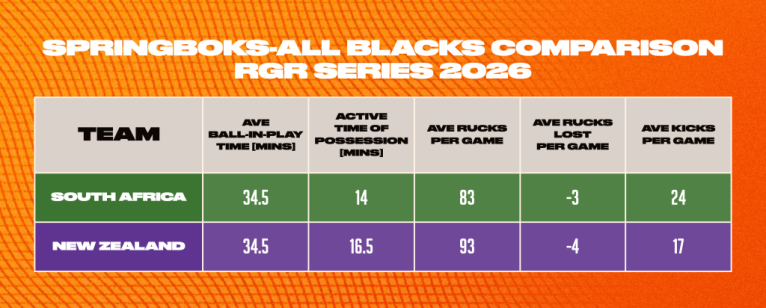
There was only one team sitting on the high ground and enjoying the sunshine, and that was South Africa. The series was played out on a battleground of the Springbok supremo’s choosing, with the average ball-in-play time dropping well below the Nations Championship average of just over 37 minutes per game, and a massive six and a half minutes underneath the standard New Zealand had set in the same competition.
The Springboks don’t mind playing without the ball in low ball-in-play games, but seven and half minutes less active time-of-possession, and 46 fewer rucks really matter when you want to play a high-tempo possession game.
As the stats suggest, the contest at the breakdown increased markedly from World Rugby’s new showcase event in July, and that suited the Boks more than the All Blacks too. Where the Kiwis were turning over one ball in every 70 rucks at the Nations Championship, they were leaking one in every 23 during the RGR series.
*
Who improved more over the second half of the series?
Halfway through the series, this article examined the big plusses and minuses for both teams with two Tests to play and the series balanced at one win apiece. South Africa had clear areas of superiority, as demonstrated in the below table.

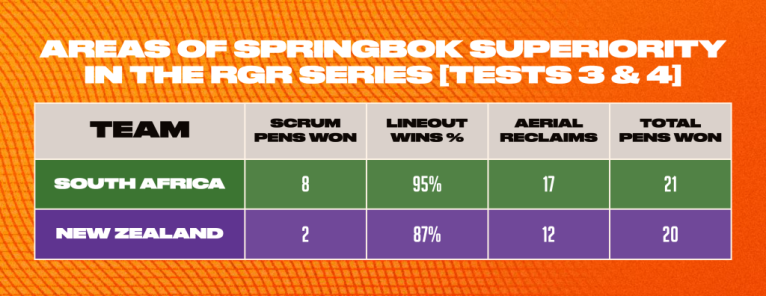
Although the gap narrowed at the lineout and in the overall penalty count, the Springboks preserved a healthy advantage at scrum time, and in the aerial game, and New Zealand did not do enough to reduce the shortfall at either. The Springboks scored from a long-range lineout drive to win the third Test, while refereeing perceptions at scrum-time in Soweto and Baltimore remained the same as they were at Ellis Park and in Cape Town.
By way of contrast, South Africa made some major strides over the course of the last two matches, having lagged behind their foes in several key metrics as the first table below indicates.

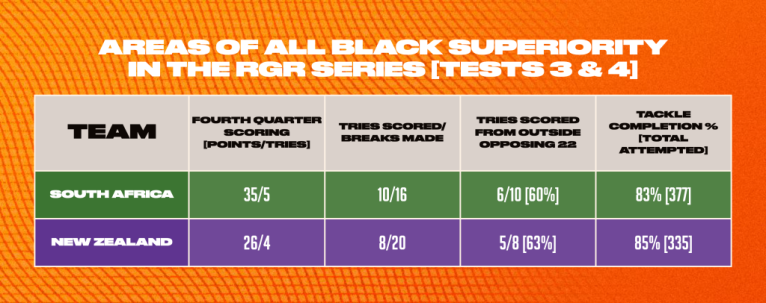
The Springboks made huge inroads, clearing the minefields of All Black domination over the first two Tests. They reversed the scoring pattern in the last half-hour of games, and all but doubled their ratio of line-break conversions. They even started scoring tries from outside the red zone for the first time in the series!
If there was one reason above all South Africa beat New Zealand by three Tests to one, that was it. Their coaches and players understood the areas that needed to be fixed halfway through the series, and others where they had to stay ahead of their rivals, with more clarity than the opposition.
It will leave the All Blacks coaching panel disheartened rather than crushed. The tourists still scored more tries than the Springboks, at an average of over four tries per game while creating more line-breaks against the vaunted blitz defence, and they remain more capable than the world champions of scoring from positions outside the opposition 22 consistently.
Ultimately, they wounded the Bok but were unable to make the kill. As assistant coach Neil Barnes told Jason Pine on Newstalk ZB: “For anybody that understands the game, [the gap between the teams is] not very far at all.
“To be fair, I’ve got a Bud Light sitting in my hand at the moment that I’m chewing through, so obviously disappointed. But the more I reflect, the more I know we’re seriously close to them [the Springboks].
“Probably just not getting the rub of the green, or getting a lot of luck in close moments at the moment. They’re probably, you’re fair to say the better team tonight [in Baltimore].
“But holy hecka, like there’s a couple of moments of swinging with about 20 minutes to go, where two or three times in a row we come out on the wrong side of a close call.”
Amen to that.
*
The series raised some interesting questions around the future of the game. Barnes again: “Sometimes you know you get a bounce or something like that, but yeah, there’s definitely a couple of decisions in there that could have gone either way.
“I thought we made a big shift in our set-piece tonight compared to what happened last week, so that was good.
“But at the end of the day, they actually played with some freedom tonight because they were one up in the series, so they couldn’t lose it. And good on them, I thought it was a good game of rugby.
“We’ve got to be in a position where we can actually control the game for longer with the speed of it, fatigue them more. But every time they keep getting penalties for b****r-all and get to slow the game down, it brings them back into it.”
To get an idea of what Barnes means, take a look at the following refereeing analysis for the RGR series.
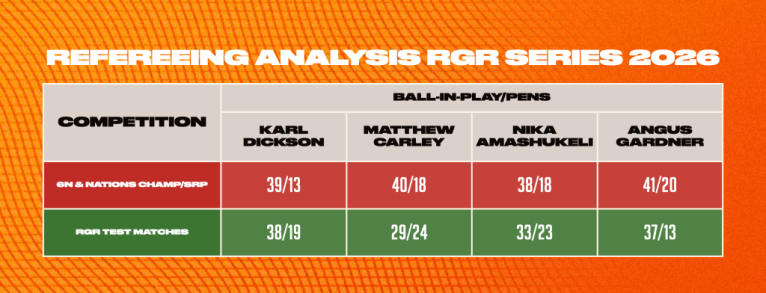
All three of the Europe-based officials [Matthew Carley in the first Test, Nika Amashukeli in the third and Karl Dickson in fourth] refereed against type, at least in comparison to the approach they take in their domestic leagues. Between them, the trio shaved an average of five minutes off their typical ball-in-play time while blowing the whistle for penalties on six extra occasions per game.
The only Super Rugby Pacific representative on the panel, Australian Angus Gardner, produced a similar ball-in-play time to his Nations Championship performance, while blowing seven fewer penalties.
Gardner paid close attention to the brake foot of both hookers and the head position of all four props at the scrum. He showed the patience of a saint, calling for four successive resets in the 44th minute of the second Test before free-kicking the Boks on the fifth.
— William Bishop (@RPvids1994) September 14, 2026
— William Bishop (@RPvids1994) September 14, 2026
These are the actions of a man who does not want to sanction the scrum if he can possibly help it. By the beginning of the fourth Test, there had been a big change in officiating atmosphere.
— William Bishop (@RPvids1994) September 14, 2026
— William Bishop (@RPvids1994) September 14, 2026
Englishman Karl Dickson is happy to first free-kick, then penalise New Zealand hooker Codie Taylor immediately, even though he doesn’t appear to withdraw his brake foot before Malcolm Marx on the opposite side of the tunnel. As TV commentator and ex-Bok hooker Hanyani Shimange observed after the third reset in Cape Town, “if this one doesn’t complete, he [Gardner] is going to have to make a decision”.
There remain issues at the scrum which the referee cannot be expected to judge in real time, but the RGR series has promoted the possibility of longer tours and rugby could be all the better for it.

Your home for rugby. Download the RugbyPass app on the App Store (iOS) and Google Play (Android) now!
Follow your favourite teams, tournaments and players, and get personalised news and Match Centre notifications direct to your device.
From live rugby streams and upcoming fixtures to breaking news, in-depth analysis and live scores, RugbyPass has everything you need to stay connected to the game.


I have long held the belief that standard rugby stats were built for teams that play linear, high-possession rugby.
Applying the metrics to the Springboks tends towards a misunderstand of their game model.
For instance, conventional wisdom says more ball = more control, but the Boks treat possession as energy expenditure.
They also tend not to want 60% possession, preferring lethal efficiency per event.
I have also noted that in high possession games generally correlate with poor performances and sometimes they were forced to grind out the win.
Then there is the tackle stats where the Boks operate at a 10–15% dominant tackle rate, nearly 5x the international average of 3%.
That single stat massively impacts the opponent's phase play, turning high team possession for the opponent into negative meters and slow ball.
Kicking for the Boks isn't giving up control either, it's manipulation to them.
When the Boks kick, it tends to be viewed as lost possession but in reality, it’s a controlled transfer of cognitive load.
They force the opponent's backfield to process aerial chaos, stressing them and draining their mental capacity.
The Boks also deliberately skew the game’s physical toll early on (similar to the ABs) so that when the game opens up late in the match, the opponent's defensive speed has collapsed.
This all underscores how I see this Boks side, they don’t play with traditional metrics, its like they play to deliberately break the system.
For the Arendse try Dickson states that he did not think it was an early tackle by Hanekom. The tackle was extensively reviewed and there is no evidence to suggest otherwise.
After the tackle by Van den Berg on Roigard Dickson asks the TMO to check the ruck. Not only was Roigard clearly offside, but one of the NZ back rowers tackles PSDT while he is on the deck.
Nothing close to not getting the rub of the green, or not getting a lot of luck in close moments.
On stats:
The NZ line out improvements fail to take into account that several times they threw to the prop (and once to the scrum half who was in the 5m), which is not an ideal platform to attack of.
SA failed to capitalise on 22 entries in game 1 as they were undercooked.
Once they got ahead in game 2 and 3 the low risk game was played in the final 20 minutes, with emphasis on winning, not on scoring.
NZ can definitely beat SA in a QF, so on that sense the gap is not big. Losing 8 out of the last 10 says the gap is pretty big. A lot will depend on the ref, though according to DR there is a dispute between NZ and World rugby about the scrums, and it is unlikely that the former will win that dispute. However, an Australian ref may sway it for NZ.
It was 50/50 and there was a strong case to say that Hanekom is dragging Moorby’s right arm down slightly before he ever receives the ball. Could have gone either way.
WR will be well able to see the stats I’ve presented on the refs for themselves. They will be right to question why the reffing emphasis changes from the 6N and Nations Champs to the RGR series with the same officials involved.
And why Gardner can award four or five scrum pens less, and 10 pens less overall than the other three. These are questions well worth asking for the future of the game.
I expect other nations to join in the great scrum dispute in due course. Another debate well worth having.😉
Nice analytic piece Nick. It think the statement that the Springboks had the high ground and the sun sums it up nicely. You can only play as well as your opponents let you play.
I also agree that the gap is not as big as the fourth test suggests - there were long periods of of play when the AB’s dipped in intensity but even then the Springboks didn’t run riot as they could have so that says something for the sheer tenacity of the AB’s, and their comeback scores showed lots of ability to hang in when the opposition is threatening to run away with the game especially during the period of play when the Springboks were all over the AB”s and looked certain to score only for the AB’s to make a a crucial steal five meters from their line. Unfortunately they missed the touch clearance on their penalty and their put in to the lineout only to have the Boks run it back at them, I would have had a few choice words for the kicker if I had made that steal.
And I still think the Boks were the fitter side.
A stat I would like to see is meters made per pass. I could be wrong but my overall impression of the game was that the Boks were running more per carry than the AB’s which could also speak to fitness and energy.
One final thought. The narrowing of the gap in the lineouts include at least four throws to the hooker so perhaps not as much improvement as one would want.
It’s partly that and it’s also partly getting the refs to agree with your agenda, and Rassie did that better than Rennie too. It’s why international teams keep huge dossiers on the refs they are likely to encounter.
The stats make it clear that NZ did not improve as much as SA over the course of the series.
As far as fitness goes, that too is related to ball-in-play time. What you can say from RGR is that the Boks are fitter within the own parameters of the game they wanted to play.
If the ABs had been able to extend their time of possession, and their multi-phase play for longer the fitness values would have likely reversed. But they never looked likely to do it consistently.
And that’s the way the cookie crumbles.
Yes. I agree. Northern Hemisphere referees are better.
Also, I’d love a stat that shows how much time the ABs wasted vs the SBs.
Perhaps the SBs got penalties for “b*gger-all” but the ABs enjoyed laying about the field with injuries. Aplenty.
Anyway. Glad we put the ABS away.
The gap is real. 3 to 1.
Yes the Boks deserved their win, no doubt about it.
But it’s not clear which version of NH refs you prefer - the ones who reffed the 6N and NC, or those who turned up in SA?
The faces looked the same, but the outcomes were very different.